Rome, Italy, Nov 18, 2017 / 06:01 am (CNA/EWTN News).- Reports about the Legion of Christ’s offshore accounts date to the time of its disgraced founder and do not apply to the religious institute today, a spokesman has said.
“Today the Legion of Christ does not own offshore companies nor does it own resources in offshore companies,” Legionaries of Christ spokesman Father Aaron Smith told Vatican Insider.
“The companies, in Bermuda, Panama, Jersey and Virgin Islands, to which the articles refer, were created at the time when Father Marcial Maciel was general manager and then were closed,” he said.
According to Smith, the offshore companies were managed “in compliance with the law and were not shell companies used for illegal activities.”
Vatican analyst Andrea Tornielli, writing at Vatican Insider, summarized several reports on the topic
These reports drew on the Paradise Papers, a collection of 13.4 million documents on various entities’ offshore finances that were reputedly obtained in a computer hack of the offshore law firm Appleby. The collection covers six decades, through the year 2014.
The documents were leaked to a German newspaper and shared with a network of journalists, including the International Consortium of Investigative Journalists. The documents began to be released Nov. 5.
Based on these documents, the Italian television program Report and the weekly magazine L’Espresso had reported that the International Volunteer Services company had been set up in Bermuda to protect the millions in revenues from the Legion’s education institutes. The alleged $300 million in revenues were said to come from the fees of more than 160,000 students around the world.
The first offshore company created, The Society for Better Education, was reportedly founded in July 1992. L’Espresso claimed the money was “secretly moved abroad and managed by Father Maciel personally, who rigidly controlled his collaborators.” The offshore network’s Rome address was the headquarters of the Legion in Italy.
L’Espresso had said that the Caserta Children’s Village would have suffered a $33 million loss through money going abroad.
Smith, however, said it was false to claim that over $300 million had been channeled annually through the International Volunteer Services company.
His comments contradicted L’Espresso’s claim that the Legion’s offshore network had not been fully closed. It had claimed that some companies that opened in the 1980s in Panama are still registered, as are some in the British crown dependency of Jersey off the coast of France.
Smith cited a 2014 statement from the Commission for the Study and Review of the Economic Situation of the Congregation of the Legionaries of Christ which said there was “no misappropriation of money or other irregularities in the annual audit.”
Legionaries-backed activities today “have societies that allow them to operate in compliance with the laws in force in those countries where they carry out their pastoral mission,” Smith said.
The educational institutions “have no relations” with offshore companies and work “transparently,” are audited, and “comply with the legal and tax provisions of the respective countries,” Smith said.
He denied any links between the Caserta Children’s Village and offshore companies.
The Legion of Christ was long the subject of critical reports and rumors before it was rocked by Vatican acknowledgment that its charismatic founder, Fr. Maciel, lived a double life, sexually abused seminarians, and fathered children.
In 2006 the Congregation of the Doctrine of the Faith, with the approval of Benedict XVI, removed Maciel from public ministry and ordered him to spend the rest of his life in prayer and penance. The Vatican congregation decided not to subject him to a canonical process because of his advanced age.
From that point, Pope Benedict carried on a process of reform for the Legion of Christ, a process continued under Pope Francis.
As of 2016, the institute had 963 priests, 1,650 male religious, and 121 parishes. Its associated lay movement is Regnum Christi.
 […]
[…]


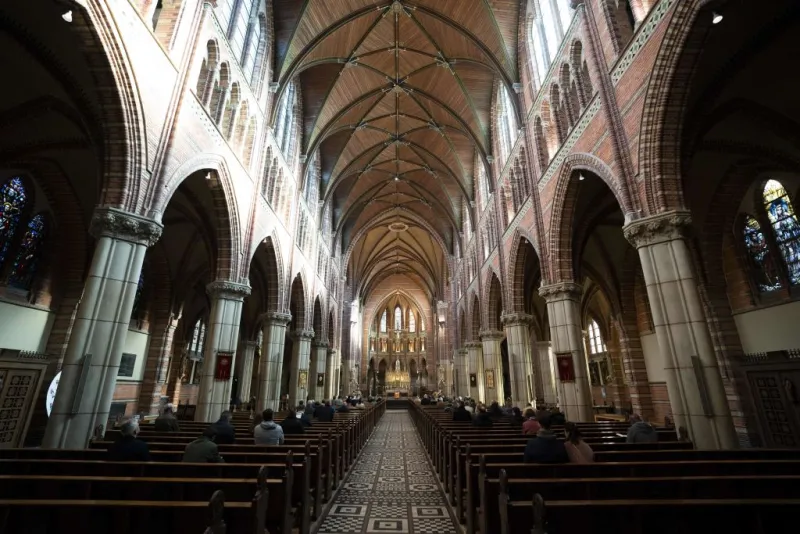


Shape of things to come.
Have they tried the TLM? Rumour has it that may bring in the younger set.
Gilberta: This is a common illogical and misleading falsehood that you should get rid of and deceptively advanced by promoters of the old pre-Vatican II Mass, that the Vatican II Mass attendance declines whereas with the Tridentine Mass attendance increases. There is totally no connection. Decrease in mass attendance is a result of a complex of social factors and can never be singularly attributed to the Vatican II Mass. Just take a look at the surging numbers and faith of emerging Catholic communities in Africa and Asia, they are nourished and sustained by the Vatican II Mass.
You shouldn’t comment on the subject if you are so devoid of knowledge as to believe there are such things as a “pre-Vatican II Mass” and a “Vatican II Mass.” They don’t exist. As far as your condescension goes, the prior suggestion was valid. Many Catholics do perfer to worship God instead of themselves.
DD;
You have no idea what you’re talking about. Have you ever even been to a Latin Mass? I have. There are people there who come 100 miles each way for the Mass, NOT wanting to go to the NO Mass a few miles away.
Deacon Dom,
I think the point is more about demographics. Traditional/Conservative Catholics are the only Catholic population in the West increasing demographically. Have you attended a TLM recently? They are full to overflowing with young families & numerous children in a similar way that Amish & Mennonite churches are. Hasidic communities also.
Western cultural Catholics are contracepting themselves into a virtual oblivion just like the popular culture that surrounds them.
Africa & Asia are different from the West & what works in those regions may look different also. But their surging numbers are fueled by people actually choosing to reproduce themselves. That’s what’s lacking in Holland & the West.
Good point Gilberta.
🙂
I offered the TLM for the first time on my ordination date in 2020. Such a relief to have full focus on whom I’m offering and not to play with the congregation with the banality of music that is so soul destroying! Great thing about the TLM is this focus on Christ and not the lame inaudible response to the prayers!
Interesting to see the response to my comment.
Today’s article (Sept. 7) in The Catholic Thing would seem to bolster the theory that the ditching of the TLM, in which Holland apparently played a role, wasn’t exactly a brilliant (or VII-mandated) move.