


Denver Newsroom, Jul 12, 2022 / 13:00 pm (CNA).
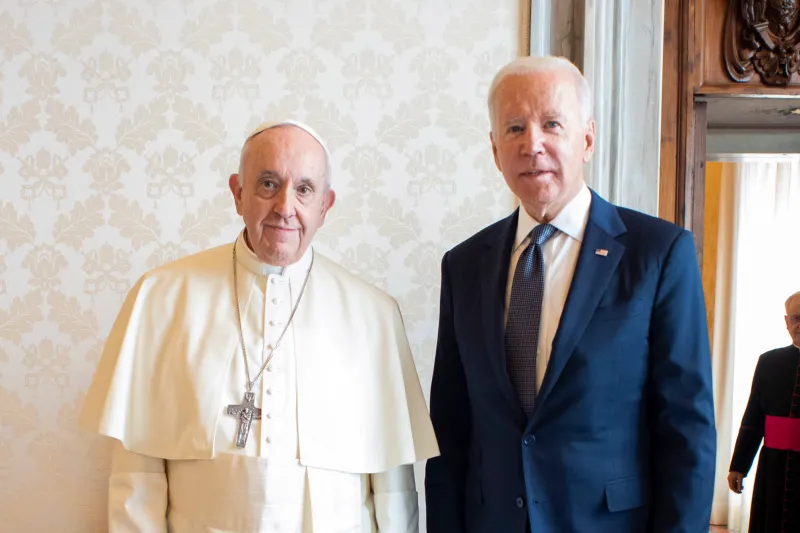
Pope Francis has described it as an “incoherence” that President Joe Biden, a Catholic, is in favor of legal abortion.
During an interview with Univisión and Televisa broadcast July 12, Pope Francis spoke about abortion and Biden’s position, after being asked about whether to admit politicians who promote legal abortion to Holy Communion.
The Holy Father affirmed that there is scientific data that show that “a month after conception, the DNA of the fetus is already there and the organs are aligned. There is human life.”
“Is it just to eliminate a human life?” he then asked.
As for the defense of abortion by the U.S. president, Pope Francis stated that he leaves it to Biden’s “conscience.”
“Let (Biden) talk to his pastor about that incoherence,” the pope said.
Though a Catholic, Biden has repeatedly supported abortion rights despite the Church’s teaching that human life must be respected and protected from the moment of conception.
Last week Biden signed an executive order aimed at protecting abortion access in response to the Supreme Court’s decision to overturn Roe v. Wade, which legalized abortion throughout the U.S.
The president called it “a moment to restore the rights that have been taken away from us, and the moment to protect our nation from an extremist agenda that is antithetical to everything we believe as Americans.”
In September 2021, Biden said he did not “agree” that life begins at conception.
“I have been and continue to be a strong supporter of Roe v. Wade,” he said at the White House, answering a reporter’s question on abortion. “I respect them — those who believe life begins at the moment of conception and all — I respect that. Don’t agree, but I respect that,” he said.
Cardinal Wilton Gregory of Washington commented shortly afterward that “The Catholic Church teaches, and has taught, that life — human life — begins at conception. So, the president is not demonstrating Catholic teaching.”
Gregory told a journalist in November 2020 that he would not deny Communion to a politician who supported the codification of legal abortion in federal law and the taxpayer funding of abortion. Biden supports both policies.
In June 2021, the parish council of the president’s Washington, D.C. parish, Holy Trinity, stated its agreement with Gregory “concerning the issues surrounding offering the Eucharist to American politicians.”
“Holy Trinity Catholic Church will not deny the Eucharist to persons presenting themselves to receive it,” the statement said.
“As a parish which has a long history of welcoming all, we concur with and support the pastoral approach of our Archbishop.”
This story was first published by ACI Prensa, CNA’s Spanish-language news partner. It has been translated and adapted by CNA.
If you value the news and views Catholic World Report provides, please consider donating to support our efforts. Your contribution will help us continue to make CWR available to all readers worldwide for free, without a subscription. Thank you for your generosity!
Click here for more information on donating to CWR. Click here to sign up for our newsletter.


Come on, ‘Mal’.
Show once again how to uncritically and blindly cheerlead this Pope who will not condemn the world’s most powerful leader in his maniacal push on abortion.
Francis’s ‘hitman’ analogy means nothing when the President of the United States ably plays that role.
Ramjet, do you recall these words: “I have not come to condemn but to save.”
Pope Francis, who is more pro-life than most Catholics, gave this very Jesus-like response: “Let (Biden) talk to his pastor about that incoherence.” That is how it should be.
Ah. Well, we know that Cardinal Gregory and Joe Biden are both eager to talk this out. I feel better already.
You will feel even better, Carl, if you pray for them instead of just dismissing this appropriate advice.
Woe to those who call evil good and good evil, ss the scriptures teach. And woe to those who repeatedly defend the indefensible under the pretense of being loving. A shipwreck is a shipwreck Mal, whether you recognize it or not.
Do you recognize this, Athanasius? “Blessed are ye, when men shall revile you, and persecute you, and shall say all manner of evil against you falsely, for my sake.”
The key words are “evil,” and “falsely,” and “for my sake.” The issue is why evil rather than truth, and falsely rather than not falsely, and especially for my sake rather than for the sake of worldly ideology?
In the same way, we are admonished to not only love one another, but to love one another “as I have loved you” (Luke). This raises the stakes and elevates the call above humanism (its lookalike). Or, again, when Matthew speaks not simplistically of the poor, but of the “poor in spirit” which is not so limited to an economic demographic or subject to ideological manipulation.
Maybe Athanasius and others are not so uninformed and ripe for being reviled as some suppose, Mal.
Didn’t the Pope just two weeks ago invite wild-eyed abortion apologist and advocate Nancy Pelosi into the Vatican to partake of the Eucharist? Joe Biden is absolutely incoherent on every issue, not just abortion. But Pope Francis based on his kid-glove treatment of Nancy Pelosi and now his criticism of Joe Biden has established his own incoherence for all to see. Does he not remember his words from one day to the next or have any sense of their impact on his flock and the world?
Where did you read that? If you did, it would have to be one of those anti-Pope Francis sites that have yet to publish even one pro-Francis article.
Pelosi was treated as an American government official. She was not invited to receive communion.
And regarding “incoherence,” then what about the Church’s related internal detail of “Eucharistic coherence”?
And “Conscience”? And pastoral chats: ““Let (Biden) talk to his pastor about that incoherence?”
“A separation, or even an opposition, is thus established in some cases between the teaching of the precept, which is valid and general, and the norm of the individual conscience, which would in fact make the final decision [no longer a moral judgment] about what is good and what is evil. On this basis, an attempt is made to legitimize so-called ‘pastoral’ solutions contrary to the teaching of the Magisterium, and to justify a ‘creative’ hermeneutic according to which the moral conscience is in no way obliged, in every case, by a particular negative precept [thou shalt not]” (Veritatis Splendor, n. 56).
And, again:
“The relationship between faith and morality shines forth with all its brilliance in the unconditional respect due to the insistent demands of the personal dignity of every man, demands protected by those moral norms which prohibit without exception [!] actions which are intrinsically evil” (n. 90).
“The Church is no way the author or the arbiter [!] of this [‘moral’] norm” (n. 95).
Thank God we have the Washington DC “parish council” to sort all this stuff out! Such is our synodal Magisterium and the flattened governance of the Church. Another fig leaf for another invertebrate and “incoherent” cardinal.
“As for the defense of abortion by the U.S. president, Pope Francis stated that he leaves it to Biden’s conscience”. If there’s incoherence in Pres Biden’s abortion policy and his Catholicism, Biden finds that faux justification in Amoris Laetitia and the incoherence of Francis’ presumption of conscience as the rule of morality rather than the natural law within [written in man’s heart by God], and Christ’s revelation, which are the rule, whereas conscience, to act with knowledge, assumes knowledge by which it is the measure of moral good or evil not the rule.
It is “incoheence” that Pope Francis, a Catholic, in in favor of abortion promoting policies of the United Nations and quite willingly invites the most notorious abortion advocates on the face of the earth to lecture the Church on what they regard as sensible population planning.
From womb to tomb, life is sacred and a precious gift. Long live life.
Didn’t the Pope just two weeks ago invite wild-eyed abortion apologist and advocate Nancy Pelosi into the Vatican to partake of the Eucharist? Joe Biden is absolutely incoherent on every issue, not just abortion. But Pope Francis based on his kid-glove treatment of Nancy Pelosi and now his criticism of Joe Biden has established his own incoherence for all to see. Does he not remember his words from one day to the next or any sense of their impact on his flock and the world?
So we’ve done away with sin and replaced it with “incoherence.”
And, we no longer need to see our confessor regarding our giving material support to the killing of babies. Instead, we should have a “dialogue” with the bishop and have him accompany us (?to hell, perhaps?) Sounds like a lot of New Age, Progressive clap trap to me. Straight out of the 1960’s playbook. Kumbaya, y’all.