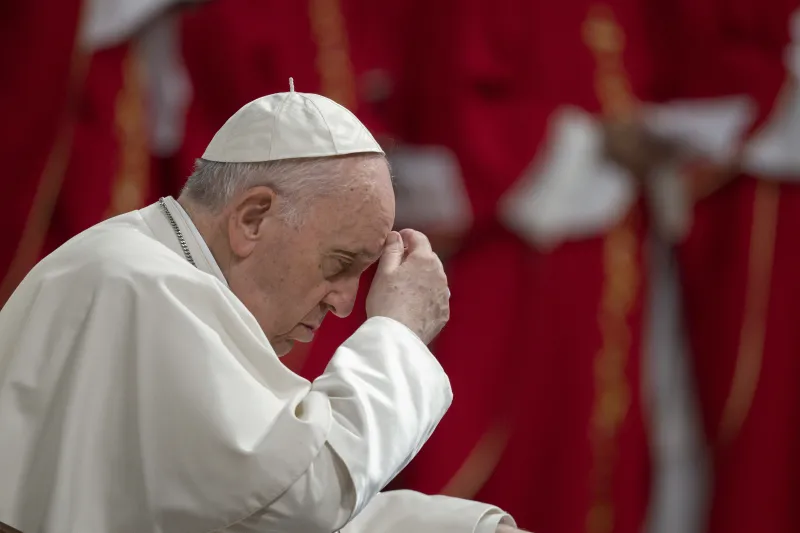
Pope Francis sat at the front of the congregation in St. Peter’s Basilica on the Solemnity of Pentecost on June 5, 2022. / Vatican Media
Vatican City, Jun 14, 2022 / 04:12 am (CNA).
There are many “restorers” in the United States who do not accept the Second Vatican Council, Pope Francis said in an interview published on Tuesday.
Speaking to the editors of Jesuit journals, he criticized what he called “restorationism” in the Church, which he defined as the failure to accept Vatican II, the ecumenical council held from 1962 to 1965.
He said: “Restorationism has come to gag the Council. The number of groups of ‘restorers’ — for example, in the United States there are many — is significant.”
“An Argentine bishop told me that he had been asked to administer a diocese that had fallen into the hands of these ‘restorers.’ They had never accepted the Council. There are ideas, behaviors that arise from a restorationism that basically did not accept the Council.”
“The problem is precisely this: in some contexts, the Council has not yet been accepted. It is also true that it takes a century for a Council to take root. We still have 40 years to make it take root, then!”
Pope Francis cited opposition to Vatican II when he issued the motu proprio Traditionis custodes, limited celebrations of the Traditional Latin Mass.
In a letter to the world’s bishops, he said he was saddened that the celebration of the Traditional Latin Mass was “often characterized by a rejection not only of the liturgical reform, but of the Vatican Council II itself.”
To doubt the Council, he said, is “to doubt the Holy Spirit himself who guides the Church.”
The pope’s conversation with editors, which also touched on the war in Ukraine and the German “Synodal Way,” was published in La Civiltà Cattolica on June 14, but was conducted on May 19.
If you value the news and views Catholic World Report provides, please consider donating to support our efforts. Your contribution will help us continue to make CWR available to all readers worldwide for free, without a subscription. Thank you for your generosity!
Click here for more information on donating to CWR. Click here to sign up for our newsletter.
This photo of Father Allan Travers was featured in the local newspaper after his pitching “performance” for the Detroit Tigers against the Philadelphia A’s on May 18, 1912. The photo featured the caption “strikebreaker,” which worried Travers’ mother, since there was a street trolley strike in Philadelphia earlier in the month, and she didn’t want her son caught in the confusion. / Photo credit: Public domain
Detroit, Mich., Jul 23, 2023 / 08:00 am (CNA).
The worst pitcher ever to take the mound for the Detroit Tigers became a Catholic priest.
Granted, Allan Travers was already on the path to the priesthood before suiting up for Detroit on May 18, 1912. But his story — and place in baseball history — is the prime example of being in the right place at the right time (or the wrong place at the wrong time).
Travers played in only one game, but one was enough to show that God had plans for him that didn’t involve the big leagues.
The story begins, as most stories of Tigers lore do, with Ty Cobb.
The Tigers were in New York on May 15 to play the Highlanders (the precursor to the Yankees). Cobb was playing in the outfield when he was verbally abused by a New York fan who was using profanity and racial slurs to describe Cobb’s play.
Cobb — never known for keeping his cool — stormed into the stands and unleashed a volley of punches on the fan. Tigers players rushed to the scene of the chaos, yelling at Cobb to lay off the man, who was missing one hand and three fingers on his other hand after suffering an industrial accident.
Cobb didn’t care and continued the barrage.
Ban Johnson, president of the American League, happened to be at the game, checking on the family-friendly excitement of what was turning into America’s pastime.
Having one of the league’s star players beat up a disabled spectator didn’t jibe well with Johnson’s vision for baseball, so Cobb was suspended indefinitely.
The Tigers felt Cobb’s punishment was unfair, so the players voted to strike until Cobb was reinstated for the club’s next game in three days against the two-time defending World Series champion Philadelphia Athletics.
Detroit Tigers legend Ty Cobb is pictured in 1911. Not one to keep his cool, Cobb launched himself into the stands to attack a fan who insulted him in 1912, resulting in a league suspension and sparking his teammates to strike in protest. Credit: Public domain
Johnson called the Tigers’ bluff, informing then Tigers owner Frank Navin the team would face a $5,000 fine for every game Detroit forfeited.
Navin needed to field a team, and quick, so he and Tigers manager Hughie Jennings collaborated with Athletics owner/manager Connie Mack to field a team of players to take the field.
This was well before the age of expansive minor league rosters — or commercial airlines, for that matter — so it wasn’t as though the Tigers could call up the farm team in Toledo and get them to Philadelphia in time to play the A’s. Instead, scouting was done the old-fashioned way, spreading word throughout town, asking who wanted to play baseball.
And this is where Aloysius Joseph “Allan” Travers, the student manager on the St. Joseph’s College baseball team, comes into the story.
Jennings worked with a friend of his, Joe Nolan, a sportswriter for The Philadelphia Bulletin,to field a team. Nolan knew Travers, a junior at St. Joseph’s who lived in Philadelphia, from the time the A’s fielded a second-stringer team to play St. Joseph’s College.
Nolan asked Travers to find 10-12 amateur players in the area who could suit up for the Tigers in case the Tiger players followed through on their strike threats. The idea was that the amateurs would never actually take the field; rather, it was just a tactic to get Jennings’ “real” players on the field.
Father Allan Travers, SJ, was a priest who taught at St. Joseph’s College (now St. Joseph’s University) in Philadelphia. But in 1913, while a student at St. Joseph, he was the improbable pitcher for the Detroit Tigers, where he secured a bizarre spot in baseball history. Credit: Public domain
Travers rounded up eight players who were free that day and enticed by the $25 Navin offered to each player.
Jennings had his team of strike-breakers, as requested by Navin.
When the umpire called “play ball,” the Tiger regulars took the field, but when the umpire spotted Cobb and told him to take a seat, the rest of the team walked out and took off their uniforms.
The strike-breakers would have to play after all. They were ushered into the locker room and donned the Tigers’ gray uniforms (this was in the days before names were on the back of uniforms). Two bench coaches joined the group to offer the squad some big league experience.
The question was, who would pitch?
There were no takers at first, so Navin offered an extra $25. Travers volunteered; $50 was good money for a college kid in 1912. There was one small problem — Travers had never played organized ball.
He was the assistant manager on the college baseball team, tasked with keeping stats and writing game summaries.
But there he was, the college student with plans to join the seminary after graduation, pitching before 20,000 fans at Shibe Park against the two-time defending World Series champions. A modern David versus Goliath, a plucky underdog story.
This time Goliath won.
Travers did as well as one would expect the assistant manager of a college baseball team to do against professionals. He pitched a complete game, surrendering 24 runs on 26 hits (both American League records), walking seven and striking out one. He got an MLB strikeout — they can’t take that away from him.
But the 15.75 ERA leaves a mark. He also batted 0-for-3 at the plate.
Travers’ time in the major leagues was abrupt. After the 24-2 shellacking the A’s put on the strikebreaking Tigers, Cobb persuaded his teammates to end the strike before the team’s upcoming series against the Washington Senators.
Travers’ calling was the priesthood, not pitching.
After graduating from St. Joseph’s College in 1913, he joined the Society of Jesus, studying at St. Andrew on the Hudson in New York and Woodstock College in Maryland. He was ordained a priest in 1926, making him the only priest ever to play in a Major League game.
His ministry took him to teaching positions at St. Francis Xavier High School in Manhattan and St. Joseph’s Prep and St. Joseph’s College in Philadelphia.
Father Travers didn’t speak about his baseball exploits, but he did give an interview about his bizarre start for the Tigers.
“About noon when Nolan told me about the strike of Detroit, he told me the club would be fined and might lose its franchise if 12 players didn’t show up,” Travers told sportswriter Red Smith. “He told me to round up as many fellows as I could. We never thought we’d play a game.”
The replacement Detroit Tigers are pictured in the dugout against the Philadelphia A’s on May 18, 1912. Photo credit: Public domain
The priest said Jennings told him to avoid throwing fastballs to “avoid getting killed out there,” but the A’s didn’t hold back, even resorting to bunting when they found out the third baseman had never played baseball before.
“I fed ‘em nothing but slow stuff after Frank Baker almost hit one out of the park on me, which fortunately went foul,” Travers said. “I was doing fine until they started bunting. The guy playing third base had never played baseball before. I just didn’t get any support. I threw a beautiful slow ball and the A’s were just hitting easy flies. Trouble was, no one could catch them.”
Curious enough, the only “fame” Travers got from his start was his picture in the newspaper with the word “Strikebreaker” printed above. There was a trolley strike in Philadelphia that month, and Travers’ mother was worried for her son’s safety because people might suspect he was a scab.
Travers didn’t like talking about his baseball “career” with his students, and his story is not well known, save for a few baseball history blogs.
He did sign a ball from that fateful day that wound up in the collection of Ada, Michigan, resident Steve Nagengast, who claims to have the largest collection of Tigers autographs. Nagengast was featured in the Detroit News, and the anecdote about Travers piqued Detroit Catholic’s interest.
Travers didn’t have the greatest impact on Tigers history. But the $5,000-per-game fine the Tigers faced for each game the club forfeited would have been devastating, especially in an era when professional teams folded and changed towns all the time.
So who knows.
Father Travers’ one-game career might have just saved the Tigers.
North Korean flags in Pyongyang. / John Pavelka via Flickr (CC BY 2.0).
Rome Newsroom, Jul 7, 2021 / 12:00 pm (CNA).
Pope Francis could visit Pyongyang, according to the director of South Korea’s National Intelligence Service, who said that he w… […]
CNA Staff, Aug 23, 2024 / 17:50 pm (CNA).
The news broke early this week that Planned Parenthood was offering free abortions and vasectomies outside the 2024 Democratic National Convention in do… […]
21 Comments
Gag us with a spoon, gag us with BS, or gag us with words of misbesotted men who speak the truth of their own devise. Lord, have mercy.
“…the Council has not yet been accepted.” Obviously. So it is that traditionalists take no pleasure in agreeing that certain post-conciliar opes have opted not to accept the literal intentional meaning of the Fathers as they have written in certain Council documents. That explains why the traditional movement will never die.
Yes. Some men do refuse to accept the teaching of VCII, and it seems they cannot get enough of projecting hate, blame, ridicule, and other favored delectable derogation upon some devout faithful. Such a mistake is of epic spiritual proportion. The traditional movement, knowing and loving truth, will live forever in papal infamy. Truth is Christ, and Christ never dies.
Curious that some hierarchs entertain no qualm in judging some truths but elide and deny affronts to others.
Labeling is not getting at problems deriving from misunderstandings of VATICAN II. But a fully pastoral dynamic would give the true lead from VATICAN II and faithfully tend to those who can and do follow it faithfully.
Many groups are persistently at odds with VATICAN II:
– Chinese State Church
– German apostate movement
– Politicians declared for legal abortion, homosexuality, etc.
– Secret society groups like Freemasons
– Sankt Gallen Group
– Clerical globalists
– Vaccine clericalists
– WEF-GAVI Catholics
– Vaccine Elites
– Etc.
Some are destroyers. Some are underminers. Some consider themselves “restorers”. They all want to believe that they are reformists and some will profess to be reforming along with Pope Francis. They will say they are behind the Pope in everything the Pope wants in reform of the Curia and the Vatican bureaucracy; and in the exemplifying of the commandments of openness and fraternity. They think and behave in that manner and the Holy Father seems to be paternalizing it.
If you pay close attention to Archbishop Shevchuk you will discover a host of ways that he is at odds with ….. openness and fraternity ….. that some say IS the meaning of VATICAN II. Plus, in his own style Shevchuk has highlighted how the 4 principles in Evangelii Gaudium can have a “different” connotation and result that at the same time are very highly personalized to him and President Zelensky.
So, on top of being at odds with VATICAN II, these groupings are always doing their own thing and their own extra things.
I am not labeling anyone, only giving the Holy Father’s use of a label of “restorer” its true context. As I understand it the Sankt Gallen group labeled itself; but some people add “Mafia” to the label.
Elias, you may know it was Cardinal Carlo Martini SJ when Archbishop Milan who established approx 1995 the Sankt Gallen Group, Martini nicknamed the radical pope. Cardinal Czerny SJ the prefect of the Dicastery for Promoting Integral Human Development recently called Cardinal Mario Martini a prophet. We find in this Jesuit league of heterodox gentlemen a distinct pattern of proportional ethics centered on mitigation and favorable outcome.
Although Cardinal Carlo Martini specifically espoused prohibition of abortion Sandro Magister nonetheless notes Martini’s attentiveness to gray areas in moral doctrine. “The cardinal seems too tempted by a mitigated interpretation of things – a perfect example of this is the euphemistic formulas on abortion – in keeping with an incorrigible propensity on the part of the ‘pro-dialogue’ Catholic circles, of which he has always been a point of reference” (Pietro De Marco on Cardinal Martini and abortion in Sandro Magister’s Carlo Maria Martini’s Day After April 2006). Cardinal Martini in his 2012 paperback Credere e conoscere Faith and Understanding, while agreeing with the concept of traditional marriage says it is “not right to express any discrimination on other types of unions.”
There is marked similarity between Martini and Bergoglio [allegedly Martini’s protege] in the espousal of prohibitive ethics in tandem with “a mitigated interpretation of things”, to wit, on abortion and homosexuality. With heterodox Jesuit Jean Claude Hollerich appointed by Jesuit Pope Francis as Synod relator the Jesuit League of Destructeurs is well placed to marginalize the restorers. Perhaps. Whatever transpires in the end Christus Vincit.
“The problem is precisely this: in some contexts, the Council has not yet been accepted. It is also true that it takes a century for a Council to take root. We still have 40 years to make it take root, then!”
On the other hand, in addition to the “restorers,” there are at least as many “deconstructionist” peddlers of the “virtual” Council who also do not yet accept the real Council. The question of the moment might be how a now-demoted curia can still deal with this two-sided problem with restored (!) coherence.
Part of the solution for all parties might be exercising the institutional memory to actually read the documents of the Council (a most remarkable “suggestion” made at the 20th anniversary (!) of the Council, in 1985, by the Extraordinary Synod of Bishops convened precisely to clarify “divergent opinions”); and accountability to the Catechism of the Catholic Church (a “fruit of the Council,” initiated by the same Synod and released in 1992/1994); and maybe much more of what we do see now in the recent papal rebuke of Bishop Batzing—that we don’t need a second evangelical (Lutheran) church in Germany: https://www.catholicworldreport.com/2022/06/14/pope-francis-told-bishop-batzing-we-dont-need-two-evangelical-churches-in-germany/ That summarizes a lot! Also, a response to the dubia, too, consistent with the post-Vatican II (!) Veritatis Splendor; plus, papal support for Eucharistic coherence (a very low bar, indeed) would also signal the more unified and 100-hundred-years-out future direction of the perennial and Eucharistic Church.
Very respectfully, one can notice such details without being a “restorer” in rejection of Vatican II. Quite the opposite.
On the other hand, some of us would like to see further reforms to continue the work of the Council, especially in the areas of evangelization and mission, and more work on the vocation of baptism. It’s a simple fact that the work of the council is unfinished because the Church as a human institution is an unfinished work.
Yea, verily, another half-truth or less to insinuate that “the Church as [is] a human institution…” Instead, given the reality of Pentecost as the origin of the Church, the Church also teaches that “the bishops have by divine institution [!] taken the place of the apostles as pastors of the Church, in such wise that whoever listens to them is listening to Christ and whoever despises them despises Christ and him who sent Christ” (Lumen Gentium, 20:2).
So, the Church evolves as an essentially “unfinished work” and essentially a “human institution,” only if the First Ecumenical Council, at Nicaea (325 A.D.), was wrong to shed Arianism.
So, a divine institution, but, yes, partly in human hands. Yet…
As the Body of Christ, we believe: “The Christian dispensation, therefore, as the new and definitive covenant, will never pass away, and we now await no further new public revelation before the glorious manifestation of the Lord Jesus Christ (cf 1 Tim 6:14, Tit. 2:13)” (Dei Verbum, n. 4). “Jesus Christ, the same yesterday, today, and forever” (Heb. 13:8).
Peter, the word I used is “as.” Your interpretation “as (is)” is your own wording, and a fake news reply to mine. The Church easily has human elements, readily identifiable. These are open to virtue or flaws and even sin.
Where the ideals and particulars of the Council have failed to take root: this is a manifestation of our human weakness. Never fear, though: God is content to work in human weakness. That, my friend, is an apostolic truth. But it doesn’t mean we can be content to linger in our flaws and failures.
Not entirely as(!) “fake news,” but my intent was to clarify an idea not precluded by your wording (“as”), rather than to contest your likely more precise meaning (not “is”). Thank you, here, for clarifying my clarification. We are on the same page. Are we having fun, yet?
Jesus gave us the Holy Spirit to forever guide and teach us. So, yes the mission of this Church continues. Our Church is indeed human because it was established for the descendants of Adam and Eve. However, because it is a family of human souls that is intimately one with Jesus, it has also a divine dimension. So, though Catholics continue to breathe, eat, reproduce etc. like earthly beings, we do have the Holy Spirit and the sanctifying graces that enable us to maintain our oneness with the Son of God.
Has Pope Francis ever spent any time on American soil?
Has he mingled among American Catholic sheep enough to become familiar with their “scent?” But, I answer my own question – Chicago, Washington DC, New Jersey and, now, San Diego. I believe that we understand all too well the “scent” of the particular sheep with which Pope Francis is intimately familiar.
Other than from communing with that close circle of associates, I suspect that PF assimilates his worldview of America by perusing various British tabloids, if he exerts that much effort.
Why cannot a person have a wide Catholic view that encompasses many philosophies? There seems to be a tendency to pigeonhole our Pope by giving him a label or category and then judging him accordingly. In a letter to the Corinthians, Paul warns us not to judge but the leave it to God who will “expose the motives of men’s hearts”. And that applies to all of us. Paul, who grew up in a community that was conditioned by Laws or doctrines, became aware of the role that conscience played. As he told the Romans that those who do not know the Law, their conscience will bear witness. We do, of course, have a memorable example when an adulteress was brought before Jesus. Our Lord knew that she had sinned (did he not tell her to sin no more) but he did not condemn her. This is very significant. Is there something that he saw deep in her soul that all those religious people did not? Our merciful and just Lord sees much more than we can see superficially and so judges differently.
Committing a wrongdoing – no matter how serious – does not necessarily make the wrongdoer a sinner. Our Catechism teaches us that for a wrongdoing – thought, word or deed – to be a sin the person must know that it is wrong and have full consent of the will. When a person who does something wrong because voices told him to do it, is he committing a sin? Does a non-Catholic Christian who divorces and remarries commit a sin? No, because he/she has been conditioned by the religious belief that it is not sinful. Did Jesus sin when he broke the Law pertaining to the Sabbath?
Pope Francis, like Pope JP2 and Benedict16, believes that we should refrain from sinning. There is no rupture in their teachings. It could be that he has a deeper appreciation of the merciful nature of our infinitely loving God.
Ships passing in the night. Yes, “there is no rupture in their teachings,” but there is a rupture between the teachings and what is enabled in practice by informal signaling and other actions, inactions, and silences…
Try to grasp this elementary point…specifically addressed for our edification by Pope St. John Paul II, in anticipation of current subtleties and deceptions. Take, for example, this, from Veritatis Splendor (VS), now part of the Church’s Magisterium, and which, therefore (!), has been rendered invisible since 2013:
“A separation, or even an opposition, is thus established in some cases between the teaching of the precept, which is valid and general, and the norm of the individual conscience, which would in fact make the final decision [no longer a moral judgment] about what is good and what is evil. On this basis, an attempt is made to legitimize so-called ‘pastoral’ solutions contrary to the teaching of the Magisterium, and to justify a ‘creative’ hermeneutic according to which the moral conscience is in no way obliged, in every case, by a particular negative precept [thou shalt not]” (VS, n. 56).
Really part of the the Church’s formal and teaching Magisterium? Try this:
“This is the first time, in fact, that the Magisterium of the Church [!] has set forth in detail the fundamental elements of this teaching [‘Christian moral teaching’], and presented the principles for the pastoral discernment necessary in practical and cultural situations which are complex and even crucial” (VS, n. 115).
So, what does it mean when sympathizers of the homosexual lifestyle (the lifestyle agenda, not judging the individual persons!) are advanced to high positions, when the poster-child James Martin is given papal photo ops and elevated as a curial consultor, and when the synodal frontrunners Marx/Batzing/Hollerich & Co. each announce (simultaneously!) the needed demolition of both natural law (of which, “the Church is no way the author or the arbiter of this norm” (VS, n. 95), and the Catechism, all robed with the same media techniques as earlier smothered the “real” Second Vatican Council (the clarity of the voted Documents) under the “virtual-media” council of the fluid and so-called spirit of Vatican II?
Disagree if you still must, but at least address and exhibit a rudimentary grasp of the self-evident issue of contention/misunderstanding/likely schism—-
the rupture (documented above) between Francis and his predecessors, and between (your focus on) “teachings” and disconnected categories of action (also above) enabled by Chapter 8 and fn. 351 of Amoris Laetitia (2013) and now being exploited, synodally, by imposter successors of the Apostles.
So, yes, mercy, but within the truth. A work in progress…but scandalously flawed.
To be honest, Peter, I too was at sometime perturbed by these proclamations. I was, like the Pharisees of our Lord’s time, very comfortable with the teachings of the Church. I was aware of right, wrong, good and bad. So, I submitted many posts in which I criticized the Pope. However, I did continue to pray for the Church and our Pope keeping in mind what our Founder emphatically said: on THIS rock I Will build my Church. It soon dawned on me that there was no problem with the Church or the Rock, but that it was in my attitude and failure to truly take into account the teachings of the Church which, in my younger days, good nuns and priests had passed on to me.
Our Catechism unambiguously states that for an act to be deemed a sin, the act must be a wrongdoing. But it goes on to say that the wrongdoer must be be fully aware of it being a wrongdoing, and that it must be committed intentionally, willfully. So, obviously it is not just the act that needs to be considered but also the awareness and the intention.
This is Church teaching as it has always been. Pope Francis, who is affectionately called the Slum Pope by those who know him personally, would have come across many instances among the impoverished, the betrayed spouses and the helpless ones who had to live in accordance with their sad situations. Church teachings apply not only to the educated, well-off Catholics in the West but also to those neglected by the world. This is what makes it Catholic – and Christian (Christ-like).
I now understand Pope Francis, and agree with him on this statement.
Peter and Mal,
According to JPII’s Encyclical “Dives in Misericordia, mercy is experienced when one is merciful. Question: Does man owe mercy to God? Does one give mercy to God when one sins against Him? Are Church bishops acting mercifully toward God, Church members and mankind in general when they overlook or excuse sin? When they fail to teach, explain, or define that in which sin consists? When they redefine sin and ‘pastorally’ enable or encourage its continuance?
“Conversion is the most concrete expression of the… presence of mercy in the human world. The true and proper meaning of mercy…is manifested in its true and proper aspect when it restores to value, promotes and draws good from all the forms of evil existing in the world and in man. Understood in this way, mercy constitutes the fundamental content of the messianic message of Christ and the constitutive power of His mission.” (Paragraph 6, Dives in Misericordia)
He refuses to condemn Putin by name. He refuses to condemn the Chinese authorities for their persecution of Catholics, including the arrest of Cardinal Zen. But Francis has no problem lashing out at traditional Catholics who just want to preserve the traditions and beliefs of the Church which he himself is hellbent on destroying. I bet he can’t even cite which documents and declaration of the Council the “Restorers” supposedly reject.
The sooner his corrupt Pontificate comes to an end, the better. We need a Shepherd, not ab abusive bully.
Mal, Pope Francis used the label “restorer” and it swipes indiscriminately at the faithful.
You can’t accept a label without knowing what the content is and if you did accept it without knowing the content, you would be dishonest. I am not the first to recognize this nor the first to say it; but I am not going to reveal how many have mentioned it, it’s too basic!
On the other hand, there are some professed Catholics who are labeling themselves and professing content inconsistent with the fullness of faith, or, just deficient or questionable; yet,
1. they are insisting they are to be credited as leaders because of “what is in their hearts” and
2. what is going to come out of it is “development” obliging on the way us to wait and see.
I know some Scripture about that and I shall not share it with you.
The Holy Father has propounded 4 “principles” in Evangelii Gaudium. They very nearly match things intuited by Lenin and as such they have nothing to do with St. Vincent of Lerins or the Deposit of Faith or the Catholic Church. Whatever and whatever -but ….. but ….. but the Holy Father himself is not consistent with the offering in those 4 dicta.
Meanwhile the course he seems to be charting might turn out to be be pluralist but right now it’s neither magisterial nor pluralist in the sense of VATICAN II -full circle, nobody can really know what the content is and they must suspend discretion and discernment lest they run to judgment/judgmentalism.
What I do notice is that ever so often, you, Mal, restate stuff about the faith and play a hunch, “It is Pope Francis! Because the Holy Spirit guaranteed it!” Kind of spavined like you’re always hitting some kind of a paydirt. So, okay, you feel snakeblooded with it but the very doctrine already enunciated is, wait and see! The synod still has to decide.
YiHa! I have a notion you are hogtied. YippieYaYo! Time for the Bourbon!
In the link to the CWR article, George Weigel’s latest on conclaves, you will see in the comments where Fr. Morello describes how the original Sankt Gallen Owlhoots is mostly demised but that it is persisting in its heirs who are some tough old coots and va`rmints going exactly plumb nowhere for now.
Needless-to-say the 4 “principles” in Evangelii can not remedy the other malformations highlighted in the document. If anything it accommodates them.
Gag us with a spoon, gag us with BS, or gag us with words of misbesotted men who speak the truth of their own devise. Lord, have mercy.
“…the Council has not yet been accepted.” Obviously. So it is that traditionalists take no pleasure in agreeing that certain post-conciliar opes have opted not to accept the literal intentional meaning of the Fathers as they have written in certain Council documents. That explains why the traditional movement will never die.
Yes. Some men do refuse to accept the teaching of VCII, and it seems they cannot get enough of projecting hate, blame, ridicule, and other favored delectable derogation upon some devout faithful. Such a mistake is of epic spiritual proportion. The traditional movement, knowing and loving truth, will live forever in papal infamy. Truth is Christ, and Christ never dies.
Curious that some hierarchs entertain no qualm in judging some truths but elide and deny affronts to others.
Labeling is not getting at problems deriving from misunderstandings of VATICAN II. But a fully pastoral dynamic would give the true lead from VATICAN II and faithfully tend to those who can and do follow it faithfully.
Many groups are persistently at odds with VATICAN II:
– Chinese State Church
– German apostate movement
– Politicians declared for legal abortion, homosexuality, etc.
– Secret society groups like Freemasons
– Sankt Gallen Group
– Clerical globalists
– Vaccine clericalists
– WEF-GAVI Catholics
– Vaccine Elites
– Etc.
Some are destroyers. Some are underminers. Some consider themselves “restorers”. They all want to believe that they are reformists and some will profess to be reforming along with Pope Francis. They will say they are behind the Pope in everything the Pope wants in reform of the Curia and the Vatican bureaucracy; and in the exemplifying of the commandments of openness and fraternity. They think and behave in that manner and the Holy Father seems to be paternalizing it.
If you pay close attention to Archbishop Shevchuk you will discover a host of ways that he is at odds with ….. openness and fraternity ….. that some say IS the meaning of VATICAN II. Plus, in his own style Shevchuk has highlighted how the 4 principles in Evangelii Gaudium can have a “different” connotation and result that at the same time are very highly personalized to him and President Zelensky.
So, on top of being at odds with VATICAN II, these groupings are always doing their own thing and their own extra things.
I am not labeling anyone, only giving the Holy Father’s use of a label of “restorer” its true context. As I understand it the Sankt Gallen group labeled itself; but some people add “Mafia” to the label.
Elias, you may know it was Cardinal Carlo Martini SJ when Archbishop Milan who established approx 1995 the Sankt Gallen Group, Martini nicknamed the radical pope. Cardinal Czerny SJ the prefect of the Dicastery for Promoting Integral Human Development recently called Cardinal Mario Martini a prophet. We find in this Jesuit league of heterodox gentlemen a distinct pattern of proportional ethics centered on mitigation and favorable outcome.
Although Cardinal Carlo Martini specifically espoused prohibition of abortion Sandro Magister nonetheless notes Martini’s attentiveness to gray areas in moral doctrine. “The cardinal seems too tempted by a mitigated interpretation of things – a perfect example of this is the euphemistic formulas on abortion – in keeping with an incorrigible propensity on the part of the ‘pro-dialogue’ Catholic circles, of which he has always been a point of reference” (Pietro De Marco on Cardinal Martini and abortion in Sandro Magister’s Carlo Maria Martini’s Day After April 2006). Cardinal Martini in his 2012 paperback Credere e conoscere Faith and Understanding, while agreeing with the concept of traditional marriage says it is “not right to express any discrimination on other types of unions.”
There is marked similarity between Martini and Bergoglio [allegedly Martini’s protege] in the espousal of prohibitive ethics in tandem with “a mitigated interpretation of things”, to wit, on abortion and homosexuality. With heterodox Jesuit Jean Claude Hollerich appointed by Jesuit Pope Francis as Synod relator the Jesuit League of Destructeurs is well placed to marginalize the restorers. Perhaps. Whatever transpires in the end Christus Vincit.
“The problem is precisely this: in some contexts, the Council has not yet been accepted. It is also true that it takes a century for a Council to take root. We still have 40 years to make it take root, then!”
On the other hand, in addition to the “restorers,” there are at least as many “deconstructionist” peddlers of the “virtual” Council who also do not yet accept the real Council. The question of the moment might be how a now-demoted curia can still deal with this two-sided problem with restored (!) coherence.
Part of the solution for all parties might be exercising the institutional memory to actually read the documents of the Council (a most remarkable “suggestion” made at the 20th anniversary (!) of the Council, in 1985, by the Extraordinary Synod of Bishops convened precisely to clarify “divergent opinions”); and accountability to the Catechism of the Catholic Church (a “fruit of the Council,” initiated by the same Synod and released in 1992/1994); and maybe much more of what we do see now in the recent papal rebuke of Bishop Batzing—that we don’t need a second evangelical (Lutheran) church in Germany: https://www.catholicworldreport.com/2022/06/14/pope-francis-told-bishop-batzing-we-dont-need-two-evangelical-churches-in-germany/ That summarizes a lot! Also, a response to the dubia, too, consistent with the post-Vatican II (!) Veritatis Splendor; plus, papal support for Eucharistic coherence (a very low bar, indeed) would also signal the more unified and 100-hundred-years-out future direction of the perennial and Eucharistic Church.
Very respectfully, one can notice such details without being a “restorer” in rejection of Vatican II. Quite the opposite.
How would he know?
On the other hand, some of us would like to see further reforms to continue the work of the Council, especially in the areas of evangelization and mission, and more work on the vocation of baptism. It’s a simple fact that the work of the council is unfinished because the Church as a human institution is an unfinished work.
Yea, verily, another half-truth or less to insinuate that “the Church as [is] a human institution…” Instead, given the reality of Pentecost as the origin of the Church, the Church also teaches that “the bishops have by divine institution [!] taken the place of the apostles as pastors of the Church, in such wise that whoever listens to them is listening to Christ and whoever despises them despises Christ and him who sent Christ” (Lumen Gentium, 20:2).
So, the Church evolves as an essentially “unfinished work” and essentially a “human institution,” only if the First Ecumenical Council, at Nicaea (325 A.D.), was wrong to shed Arianism.
So, a divine institution, but, yes, partly in human hands. Yet…
As the Body of Christ, we believe: “The Christian dispensation, therefore, as the new and definitive covenant, will never pass away, and we now await no further new public revelation before the glorious manifestation of the Lord Jesus Christ (cf 1 Tim 6:14, Tit. 2:13)” (Dei Verbum, n. 4). “Jesus Christ, the same yesterday, today, and forever” (Heb. 13:8).
Peter, the word I used is “as.” Your interpretation “as (is)” is your own wording, and a fake news reply to mine. The Church easily has human elements, readily identifiable. These are open to virtue or flaws and even sin.
Where the ideals and particulars of the Council have failed to take root: this is a manifestation of our human weakness. Never fear, though: God is content to work in human weakness. That, my friend, is an apostolic truth. But it doesn’t mean we can be content to linger in our flaws and failures.
Not entirely as(!) “fake news,” but my intent was to clarify an idea not precluded by your wording (“as”), rather than to contest your likely more precise meaning (not “is”). Thank you, here, for clarifying my clarification. We are on the same page. Are we having fun, yet?
Jesus gave us the Holy Spirit to forever guide and teach us. So, yes the mission of this Church continues. Our Church is indeed human because it was established for the descendants of Adam and Eve. However, because it is a family of human souls that is intimately one with Jesus, it has also a divine dimension. So, though Catholics continue to breathe, eat, reproduce etc. like earthly beings, we do have the Holy Spirit and the sanctifying graces that enable us to maintain our oneness with the Son of God.
Has Pope Francis ever spent any time on American soil?
Has he mingled among American Catholic sheep enough to become familiar with their “scent?” But, I answer my own question – Chicago, Washington DC, New Jersey and, now, San Diego. I believe that we understand all too well the “scent” of the particular sheep with which Pope Francis is intimately familiar.
Other than from communing with that close circle of associates, I suspect that PF assimilates his worldview of America by perusing various British tabloids, if he exerts that much effort.
Why cannot a person have a wide Catholic view that encompasses many philosophies? There seems to be a tendency to pigeonhole our Pope by giving him a label or category and then judging him accordingly. In a letter to the Corinthians, Paul warns us not to judge but the leave it to God who will “expose the motives of men’s hearts”. And that applies to all of us. Paul, who grew up in a community that was conditioned by Laws or doctrines, became aware of the role that conscience played. As he told the Romans that those who do not know the Law, their conscience will bear witness. We do, of course, have a memorable example when an adulteress was brought before Jesus. Our Lord knew that she had sinned (did he not tell her to sin no more) but he did not condemn her. This is very significant. Is there something that he saw deep in her soul that all those religious people did not? Our merciful and just Lord sees much more than we can see superficially and so judges differently.
Committing a wrongdoing – no matter how serious – does not necessarily make the wrongdoer a sinner. Our Catechism teaches us that for a wrongdoing – thought, word or deed – to be a sin the person must know that it is wrong and have full consent of the will. When a person who does something wrong because voices told him to do it, is he committing a sin? Does a non-Catholic Christian who divorces and remarries commit a sin? No, because he/she has been conditioned by the religious belief that it is not sinful. Did Jesus sin when he broke the Law pertaining to the Sabbath?
Pope Francis, like Pope JP2 and Benedict16, believes that we should refrain from sinning. There is no rupture in their teachings. It could be that he has a deeper appreciation of the merciful nature of our infinitely loving God.
Ships passing in the night. Yes, “there is no rupture in their teachings,” but there is a rupture between the teachings and what is enabled in practice by informal signaling and other actions, inactions, and silences…
Try to grasp this elementary point…specifically addressed for our edification by Pope St. John Paul II, in anticipation of current subtleties and deceptions. Take, for example, this, from Veritatis Splendor (VS), now part of the Church’s Magisterium, and which, therefore (!), has been rendered invisible since 2013:
“A separation, or even an opposition, is thus established in some cases between the teaching of the precept, which is valid and general, and the norm of the individual conscience, which would in fact make the final decision [no longer a moral judgment] about what is good and what is evil. On this basis, an attempt is made to legitimize so-called ‘pastoral’ solutions contrary to the teaching of the Magisterium, and to justify a ‘creative’ hermeneutic according to which the moral conscience is in no way obliged, in every case, by a particular negative precept [thou shalt not]” (VS, n. 56).
Really part of the the Church’s formal and teaching Magisterium? Try this:
“This is the first time, in fact, that the Magisterium of the Church [!] has set forth in detail the fundamental elements of this teaching [‘Christian moral teaching’], and presented the principles for the pastoral discernment necessary in practical and cultural situations which are complex and even crucial” (VS, n. 115).
So, what does it mean when sympathizers of the homosexual lifestyle (the lifestyle agenda, not judging the individual persons!) are advanced to high positions, when the poster-child James Martin is given papal photo ops and elevated as a curial consultor, and when the synodal frontrunners Marx/Batzing/Hollerich & Co. each announce (simultaneously!) the needed demolition of both natural law (of which, “the Church is no way the author or the arbiter of this norm” (VS, n. 95), and the Catechism, all robed with the same media techniques as earlier smothered the “real” Second Vatican Council (the clarity of the voted Documents) under the “virtual-media” council of the fluid and so-called spirit of Vatican II?
Disagree if you still must, but at least address and exhibit a rudimentary grasp of the self-evident issue of contention/misunderstanding/likely schism—-
the rupture (documented above) between Francis and his predecessors, and between (your focus on) “teachings” and disconnected categories of action (also above) enabled by Chapter 8 and fn. 351 of Amoris Laetitia (2013) and now being exploited, synodally, by imposter successors of the Apostles.
So, yes, mercy, but within the truth. A work in progress…but scandalously flawed.
To be honest, Peter, I too was at sometime perturbed by these proclamations. I was, like the Pharisees of our Lord’s time, very comfortable with the teachings of the Church. I was aware of right, wrong, good and bad. So, I submitted many posts in which I criticized the Pope. However, I did continue to pray for the Church and our Pope keeping in mind what our Founder emphatically said: on THIS rock I Will build my Church. It soon dawned on me that there was no problem with the Church or the Rock, but that it was in my attitude and failure to truly take into account the teachings of the Church which, in my younger days, good nuns and priests had passed on to me.
Our Catechism unambiguously states that for an act to be deemed a sin, the act must be a wrongdoing. But it goes on to say that the wrongdoer must be be fully aware of it being a wrongdoing, and that it must be committed intentionally, willfully. So, obviously it is not just the act that needs to be considered but also the awareness and the intention.
This is Church teaching as it has always been. Pope Francis, who is affectionately called the Slum Pope by those who know him personally, would have come across many instances among the impoverished, the betrayed spouses and the helpless ones who had to live in accordance with their sad situations. Church teachings apply not only to the educated, well-off Catholics in the West but also to those neglected by the world. This is what makes it Catholic – and Christian (Christ-like).
I now understand Pope Francis, and agree with him on this statement.
Peter and Mal,
According to JPII’s Encyclical “Dives in Misericordia, mercy is experienced when one is merciful. Question: Does man owe mercy to God? Does one give mercy to God when one sins against Him? Are Church bishops acting mercifully toward God, Church members and mankind in general when they overlook or excuse sin? When they fail to teach, explain, or define that in which sin consists? When they redefine sin and ‘pastorally’ enable or encourage its continuance?
“Conversion is the most concrete expression of the… presence of mercy in the human world. The true and proper meaning of mercy…is manifested in its true and proper aspect when it restores to value, promotes and draws good from all the forms of evil existing in the world and in man. Understood in this way, mercy constitutes the fundamental content of the messianic message of Christ and the constitutive power of His mission.” (Paragraph 6, Dives in Misericordia)
He refuses to condemn Putin by name. He refuses to condemn the Chinese authorities for their persecution of Catholics, including the arrest of Cardinal Zen. But Francis has no problem lashing out at traditional Catholics who just want to preserve the traditions and beliefs of the Church which he himself is hellbent on destroying. I bet he can’t even cite which documents and declaration of the Council the “Restorers” supposedly reject.
The sooner his corrupt Pontificate comes to an end, the better. We need a Shepherd, not ab abusive bully.
This is our Lord’s Church and he gives us what we need – not what you or I want.
Mal, Pope Francis used the label “restorer” and it swipes indiscriminately at the faithful.
You can’t accept a label without knowing what the content is and if you did accept it without knowing the content, you would be dishonest. I am not the first to recognize this nor the first to say it; but I am not going to reveal how many have mentioned it, it’s too basic!
On the other hand, there are some professed Catholics who are labeling themselves and professing content inconsistent with the fullness of faith, or, just deficient or questionable; yet,
1. they are insisting they are to be credited as leaders because of “what is in their hearts” and
2. what is going to come out of it is “development” obliging on the way us to wait and see.
I know some Scripture about that and I shall not share it with you.
The Holy Father has propounded 4 “principles” in Evangelii Gaudium. They very nearly match things intuited by Lenin and as such they have nothing to do with St. Vincent of Lerins or the Deposit of Faith or the Catholic Church. Whatever and whatever -but ….. but ….. but the Holy Father himself is not consistent with the offering in those 4 dicta.
Meanwhile the course he seems to be charting might turn out to be be pluralist but right now it’s neither magisterial nor pluralist in the sense of VATICAN II -full circle, nobody can really know what the content is and they must suspend discretion and discernment lest they run to judgment/judgmentalism.
What I do notice is that ever so often, you, Mal, restate stuff about the faith and play a hunch, “It is Pope Francis! Because the Holy Spirit guaranteed it!” Kind of spavined like you’re always hitting some kind of a paydirt. So, okay, you feel snakeblooded with it but the very doctrine already enunciated is, wait and see! The synod still has to decide.
YiHa! I have a notion you are hogtied. YippieYaYo! Time for the Bourbon!
In the link to the CWR article, George Weigel’s latest on conclaves, you will see in the comments where Fr. Morello describes how the original Sankt Gallen Owlhoots is mostly demised but that it is persisting in its heirs who are some tough old coots and va`rmints going exactly plumb nowhere for now.
Needless-to-say the 4 “principles” in Evangelii can not remedy the other malformations highlighted in the document. If anything it accommodates them.
https://www.catholicworldreport.com/2022/06/15/demythologizing-conclaves/
“but the very doctrine already enunciated is, wait and see! The synod still has to decide”
Well, not so. This synodal process is not about doctrine. It never has been. Pope Francis emphasized this point on quite a few occasions.
Well then you have said it Mal very much the drygulcher.