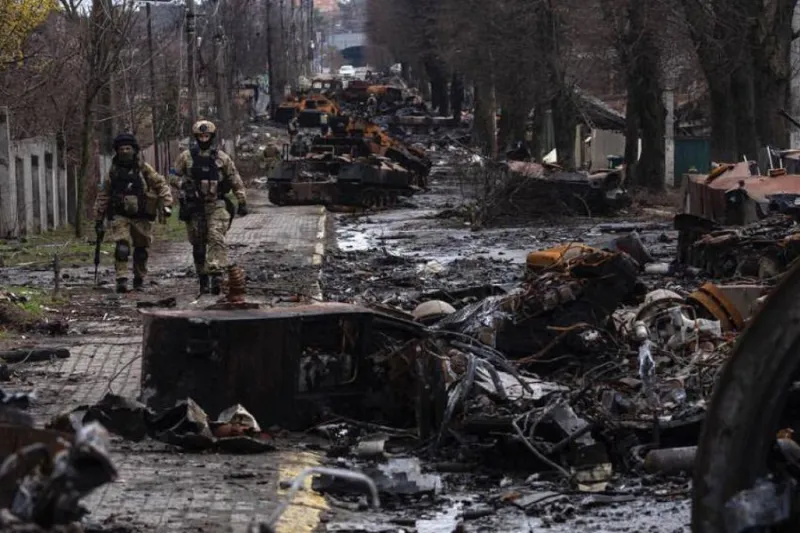
The aftermath of the Russian occupation of Bucha, Ukraine. / Ministry of Digital Development Mikhail Fedorov via Wikimedia (Public Domain).
Washington, D.C. Newsroom, Apr 24, 2022 / 07:56 am (CNA).
Pope Francis on Sunday renewed his call for a truce in Ukraine, saying “the attack must be stopped.”
“Today various Eastern Churches, Catholic and Orthodox, and several Latin communities, celebrate Easter according to the Julian calendar. We celebrated it last Sunday, following the Gregorian calendar. I offer them my warmest wishes: Christ is risen, he is truly risen! May he fill with hope the good expectations of hearts. May he grant peace, outraged by the barbarity of war,” the pope said on April 24.
Pope Francis delivered his remarks about the war from his balcony above St. Peter’s Square at the conclusion of his Regina Caeli reflection for Divine Mercy Sunday.
“Today marks two months since the beginning of this war: Instead of stopping, the war has worsened. It is sad that in these days, which are the holiest and most solemn for all Christians, the deadly roar of weapons is heard rather than the sound of bells announcing the Resurrection; and it is sad that weapons are increasingly taking the place of words,” he continued.
“I renew my appeal for an Easter truce, a minimal and tangible sign of a desire for peace. The attack must be stopped, to respond to the suffering of the exhausted population; it must stop, in obedience to the words of the Risen Lord, who on Easter Day repeats to his disciples: ‘Peace be with you! (Lk 24:36; Jn 20:19.21),” the pope said.
“I ask everyone to increase prayer for peace and to have the courage to say, to show that peace is possible,” he concluded. “Political leaders, please, listen to the voice of the people, who want peace, not an escalation of the conflict.”
In an interview with an Argentine newspaper published last week, Pope Francis said a meeting with Russian Orthodox Patriarch Kirill in Jerusalem will no longer take place as planned. He also indicated in the same interview that he did not anticipate visit Kyiv, Ukraine’s capital, because of the continued fighting.
If you value the news and views Catholic World Report provides, please consider donating to support our efforts. Your contribution will help us continue to make CWR available to all readers worldwide for free, without a subscription. Thank you for your generosity!
Click here for more information on donating to CWR. Click here to sign up for our newsletter.
Pope Francis delivers the Sunday Angelus from the window of his study overlooking St. Peter’s Square, Jan. 28, 2024. / Credit: Vatican Media
Vatican City, Jan 28, 2024 / 12:18 pm (CNA).
Pope Francis warned on Sunday that the devil wants to “chain our souls” and enslave us with many temptations, while “Jesus came to free us from all of these chains.”
In his Angelus address on Jan. 28, the pope said that “the devil always takes away your freedom” and named some of the temptations that the evil one uses to ensnare us.
Pope Francis encouraged people to learn how to “say ‘no’ to the temptations of evil before they creep into the soul” by invoking the name of Jesus.
When facing a temptation, do not attempt to “negotiate with the devil,” Pope Francis said.
“We must call on Jesus,” he underlined. “Call on him where we feel the chains of evil and fear tighten most strongly.”
“There are many chains in our life,” the pope explained.
“I am thinking of addictions, which enslave [so we are] always dissatisfied, and devour energy, goods, and affections; I am thinking of dominant fashions, which push us toward impossible perfectionism, consumerism, and hedonism, which commodify people and spoil their relationships.”
“And other chains: There are the temptations and conditioning that undermine self-esteem, serenity, and the ability to choose and love life,” he said.
Pope Francis added that another chain is “fear, which makes one look at the future with pessimism and impatience, which always casts blame on others.”
He said that “the idolatry of power” is a “very ugly chain” that creates conflicts and can lead to weapons that kill, the manipulation of thought, or economic injustices.
“And Jesus came to free us from all these chains,” Pope Francis said.
“Jesus has the power to cast out the devil. Jesus frees us from the power of evil.”
In his reflection on Sunday’s Gospel, Pope Francis described how Jesus freed a person possessed by an “evil spirit” in Mark’s Gospel, noting that the possession tormented her and caused her to scream.
“This is what the devil does: He wants to possess us in order to ‘chain our souls,’” he said.
Pope Francis noted that in the Gospel, Jesus casts out the devil, “but does not dialogue with him,” noting that during the temptation in the desert, Jesus only answered with words from Scripture.
“The Lord, with the strength of his Spirit, wishes to repeat to the evil one today too: ‘Go away! Leave that heart alone. Do not divide the world, families, communities; let them live peacefully, so that the fruits of my Spirit may flourish, not yours,’ so says Jesus, ‘so that love, joy, meekness may reign among them, and instead of violence and cries of hatred there may be freedom and peace.’”
“So let’s ask ourselves: Do I really want freedom from those chains that tighten my heart? … Do I invoke Jesus, do I allow him to act in me, to heal me inside? May the Holy Virgin protect us from evil,” he said.
Speaking from a window in the Vatican’s Apostolic Palace to the crowd gathered below in St. Peter’s Square, Pope Francis prayed for peace in Ukraine, Palestine, and Israel.
Pope Francis made an impassioned plea for reconciliation in Myanmar, marking three years since the country’s military coup.
“For three years now, the crying of pain and the noise of weapons have taken the place of the smile that characterizes the population of Myanmar. I therefore join the voice of some Burmese bishops, ‘so that the weapons of destruction are transformed into tools for growth in humanity and justice,’” he said.
“Peace is a path and I invite all parties involved to take steps of dialogue and to clothe themselves with understanding, so that the land of Myanmar reaches the goal of fraternal reconciliation. The transit of humanitarian aid is allowed to guarantee the necessities of every person.”
The pope added that he was relieved to hear of the release of six religious sisters who were kidnapped in Haiti last week and called for an end to all acts of violence in the country, urging the international community to support Haiti’s peaceful development.
Pope Francis addresses international diplomats to the Holy See on Jan. 9, 2023, in the Vatican’s Blessing Hall. / Vatican Media
Rome Newsroom, Jan 9, 2023 / 06:28 am (CNA).
The global community is engaged in a “third world war” marked by heightened fear, conflict, and risk of nuclear violence, but a recommitment to “truth, justice, solidarity and freedom” can provide a pathway to peace, Pope Francis told international diplomats Monday.
Citing the ongoing war in Ukraine, but also drawing on conflicts in places such as Syria, West Africa, Ethiopia, Israel, Myanmar, and the Korean Peninsula, the Holy Father said this global struggle is being “fought piecemeal,” but is nonetheless interconnected.
“Today the third world war is taking place in a globalized world where conflicts involve only certain areas of the planet direct, but in fact involve them all,” said Pope Francis, speaking in the Vatican’s apostolic palace.
The pope made these remarks as part of his annual address to the diplomatic corps accredited to the Holy See. Pope Francis characterized this speech as “a call for peace in a world that is witnessing heightened divisions and war.”
Pope Francis addresses diplomats to the Holy See in the Blessing Hall at the Vatican on Jan. 9, 2023. Vatican Media
As part of this heightening of tensions, the Pope warned about the increased threat of nuclear warfare, drawing particular concern to the stall in negotiations for the Iran nuclear deal. He told the gathered diplomats that the possession of nuclear weapons is “immoral” and called for an end to a mentality that pursues conflict deterrence through the development of ever-more lethal means of warfare.
“There is a need to change this way of thinking and move toward an integral disarmament, since no peace is possible when instruments of death are proliferating,” the pope said.
In proposing a path towards global peace, the Holy Father drew heavily from Pacem in Terris (“Peace on Earth”), the papal encyclical promulgated by St. John XXIII in 1962. Pope Francis said the conditions which prompted the “good Pope” to issue Pacem in Terris 60 years ago bear a striking similarity to the state of the world today.
In particular, the Holy Father drew from what John XXIII described as the “four fundamental goods” necessary for peace: truth, justice, solidarity, and freedom, values that “serve as the pillars that regulate relationships between individuals and political communities alike.”
Regarding “peace in truth,” the Holy Father underscored the “primary duty” of governments to protect the right to life at every stage of human life.
“Peace requires before all else the defense of life, a good that today is jeopardized not only by conflicts, hunger, and diseases, but all too often in the mother’s womb, through promotion of an alleged ‘right to abortion,’” said Pope Francis, also calling for an end to the death penalty and violence against women.
Speaking of the necessity of religious freedom for peace, the Holy Father noted widespread religious persecution against Christian minorities, but also discrimination in countries where Christianity is a majority religion.
“Religious freedom is also endangered wherever believers see their ability to express their convictions in the life of society restricted in the name of a misguided understanding of inclusiveness,” he said.
Regarding justice, the Holy Father called for a “profound rethinking” of multilateral systems such as the United Nations to make them more effective at responding to conflicts like the war in Ukraine. But he also criticized international bodies for “imposing forms of ideological colonization, especially on poorer countries” and warned of the growing risk of “ideological totalitarianism” that promotes intolerance towards those who dissent from certain positions claimed to represent ‘progress.’”
Pope Francis visits with international diplomats accredited to the Holy See on Jan. 9, 2023, at the Vatican. Vatican Media
The Holy Father also spoke of the need to deepen a sense of global solidarity, citing four areas of interconnectedness: immigration, the economy and work, and care for creation,
“The paths of peace are paths of solidarity, for no one can be saved alone. We live in a world interconnected that, in the end, the actions of each have consequences for all.”
Finally, regarding “peace in freedom,” Pope Francis warned of the “weakening of democracy” in many parts of the world, and an increase in political polarization. He said peace is only possible if “in every single community, there does not prevail that culture of oppression and aggression in which our neighbor is regarded as an enemy to attack, rather than a brother or sister to welcome and embrace.”
The Holy Father’s address to the diplomatic corps, which includes representatives of the 91 countries and entities with an embassy chancellery accredited to the Holy See, also served as an opportunity to review diplomatic highlights of the past year and expectations for the year to come.
Milestones included the signing of new bilateral accords with both the Democratic Republic of São Tomé and Príncipe and with the Republic of Kazakhstan. The Holy Father also briefly mentioned the provisional agreement between the Holy See and the People’s Republic of China, first agreed to in 2018 and renewed in 2022 for an additional two years.
“It is my hope that this collaborative relationship can increase, for the benefit of the life of the Catholic Church and that of the Chinese people.”
The next significant marker on the pope’s diplomatic docket: His trip to the Democratic Republic of Congo at the end of the month as a “pilgrim of peace,” followed by a joint visit to South Sudan with the Archbishop of Canterbury and the head of the Presbyterian Church of Scotland.
CNA Staff, Jul 21, 2020 / 03:30 am (CNA).- Pope Francis made a surprise visit Monday to a sports camp for the children of Vatican employees.
The Holy See press office said July 20 that the pope met with the young people shortly after 9 a.m., while the… […]
2 Comments
Where was? Is? Pope Francis when it comes to tradegy, death and suffering of Christians, specifically Catholics, in the Middle East or China, Vietnam, or Australia?. Why Ukraine suddenly in a war which has been going on for years, seemingly without the interest of Pope Francis? How many Millions, yes Millions have left the Church since his selection as Pope?
It would appear the Pontiff holds the value of any Ukranian’s life to be many times that of a Syrian Catholic or a Maronite or Melkite.
An attempt at humor mixed with concern of greater tragic outcome in response to the article, “Pope Francis to Patriarch Kirill: Let’s be ‘true peacemakers’ for war-torn Ukraine” seems futile and ill-considered. Silence, a prevailing apathy virtually oblivious to the danger of two nuclear superpowers closing in on direct combat is distressing. Especially with the loud outcry for increased armaments, greater commitment [if Vladimir Putin is as mad as some contend then what does the mad do when pushed back and cornered?].
It really isn’t a matter of humor. Pope Francis I joked cannot always be wrong. Well, in this instance he’s in this writer’s estimate absolutely correct. Obviously, I fear for the many of us who are not prepared to meet judgment.
Where was? Is? Pope Francis when it comes to tradegy, death and suffering of Christians, specifically Catholics, in the Middle East or China, Vietnam, or Australia?. Why Ukraine suddenly in a war which has been going on for years, seemingly without the interest of Pope Francis? How many Millions, yes Millions have left the Church since his selection as Pope?
It would appear the Pontiff holds the value of any Ukranian’s life to be many times that of a Syrian Catholic or a Maronite or Melkite.
An attempt at humor mixed with concern of greater tragic outcome in response to the article, “Pope Francis to Patriarch Kirill: Let’s be ‘true peacemakers’ for war-torn Ukraine” seems futile and ill-considered. Silence, a prevailing apathy virtually oblivious to the danger of two nuclear superpowers closing in on direct combat is distressing. Especially with the loud outcry for increased armaments, greater commitment [if Vladimir Putin is as mad as some contend then what does the mad do when pushed back and cornered?].
It really isn’t a matter of humor. Pope Francis I joked cannot always be wrong. Well, in this instance he’s in this writer’s estimate absolutely correct. Obviously, I fear for the many of us who are not prepared to meet judgment.
