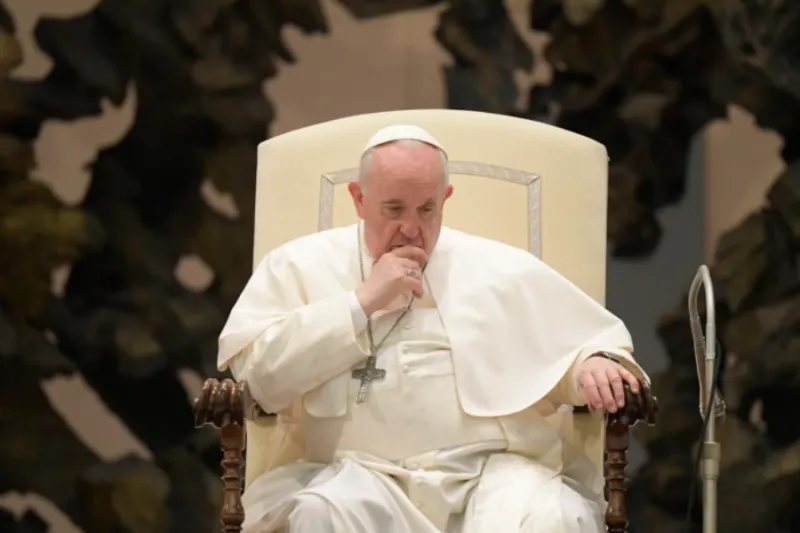
Pope Francis’ general audience in the Paul VI Hall at the Vatican, Feb. 9, 2022. / Vatican Media.
Vatican City, Feb 15, 2022 / 07:20 am (CNA).
Pope Francis unveiled new changes to Church law in an apostolic letter published Tuesday, saying that he was seeking to promote “a healthy decentralization” in the Church.
In the letter issued motu proprio (“on his own impulse”) on Feb. 15, the pope said that his intention with the changes was to “foster a sense of collegiality and pastoral responsibility” on the part of bishops, local bishops’ conferences, and major superiors religious communities, as well as to “support the principles of rationality, effectiveness, and efficiency.”
Among the changes in the motu proprio, entitled Assegnare alcune competenze (“Assigning some competencies”), were articles regarding the establishment of interdiocesan seminaries, the incardination of clerics, the publication of catechisms by bishops’ conferences, and laws concerning temporary professed vows.
Pope Francis explained that with the changes he wanted to encourage “a more rapid effectiveness of the pastoral action of government on the part of the local authority.”
“I have considered it opportune to make changes to the norms hitherto in force concerning some specific matters, attributing the respective competencies,” Pope Francis wrote.
“These normative changes reflect even more the shared and plural universality of the Church, which includes differences without homogenizing them, with the guarantee, as far as unity is concerned, of the ministry of the Bishop of Rome,” he said.
Some of the 10 articles in the decree consist of only small changes in wording.
For example, Article 8 changes canon law so that the Vatican will only need to “confirm,” rather than “approve,” the publication of catechisms by a Catholic bishops’ conference.
Canon 775 §2 previously said: “If it seems useful, it is for the conference of bishops to take care that catechisms are issued for its territory, with the previous approval of the Apostolic See.”
The law now states: “If it seems useful, it is for the conference of bishops to take care that catechisms are issued for its territory, subject to confirmation by the Apostolic See.”
The change from the requirement for Vatican “confirmation,” rather than approval, also applies to Article 1, on the creation of interdiocesan seminaries, and Article 2, on the Ratio (guidelines) of priestly formation.
Pope Francis signed the motu proprio on Feb. 11, the feast of Our Lady of Lourdes.
This is the second motu proprio that Pope Francis has issued this week. On Monday, the pope also decreed the reorganization of the Congregation for the Doctrine of the Faith into a doctrinal section and a disciplinary section.
Pope Francis has published 49 motu proprios since his election in 2013.
Bishop Marco Mellino, the secretary of the Council of Cardinals and a member of the Pontifical Council for Legislative Texts, told Vatican News that he saw Tuesday’s motu proprio as part of “the work of reform that Pope Francis has initiated since the beginning of his pontificate.”
“It responds to the spirit of ‘healthy decentralization’ indicated in the apostolic exhortationEvangelii gaudium, n. 32, aimed at favoring and enhancing the dynamics of proximity in the Church, without compromising hierarchical communion with this,” he said.
He added: “It is evident, in fact, that when the authority has a direct and closer knowledge of the persons and cases in point that require a pastoral action of government, this action, by virtue of its proximity, can be of more rapid efficacy.”
If you value the news and views Catholic World Report provides, please consider donating to support our efforts. Your contribution will help us continue to make CWR available to all readers worldwide for free, without a subscription. Thank you for your generosity!
Click here for more information on donating to CWR. Click here to sign up for our newsletter.
The 2021 March for Life in Berlin, Germany. / Rudolf Gehrig/CNA Deutsch.
CNA Newsroom, Aug 11, 2022 / 06:58 am (CNA).
According to a new representative poll, 58% of German Catholics do not like “the fact that the Pope and the Church speak out a… […]
The Eucharistic procession ended in the Vatican’s Lourdes Grotto. / Daniel Ibáñez/CNA
Boston, Mass., Jun 13, 2023 / 09:10 am (CNA).
Celebrating the solemnity of Corpus Christi, a more than 700-year-old feast day that commemorates the real prese… […]
The Catholic faithful gathered in the Cenacle in Jerusalem for the Mass of the Lord’s Supper that the Franciscan friars celebrated on Holy Thursday, March 28, 2024. The Cenacle is at the center of strong tensions and disputes regarding ownership and rights of access and celebration. An ancient tradition places King David’s tomb here and over the centuries Jews and Muslims have leveraged this to first expel the Franciscans and then to prevent Christian worship, which they deemed sacrilegious. / Credit: Marinella Bandini
Jerusalem, Mar 28, 2024 / 17:15 pm (CNA).
On Holy Thursday, the doors of the Cenacle in Jerusalem were opened to welcome the Franciscans of the Custody of the Holy Land. In this “Upper Room,” called the Cenacle in the Holy Land, Jesus had his Last Supper, washed his apostles’ feet, and instituted the Eucharist.
It was here that the Franciscans celebrated the Mass of the Lord’s Supper, reenacting those same gestures. (At the Basilica of the Holy Sepulcher, however, the celebration is held on Thursday morning due to the Status Quo. Here is Cardinal Pierbattista Pizzaballa’s homily from that Mass.)
Cardinal Pierbattista Pizzaballa, the Latin Patriarch of Jerusalem, kisses the feet of a Franciscan friar during the “Washing of the Feet” ritual at the Mass of the Lord’s Supper celebrated at the Holy Sepulchre on Holy Thursday. The celebration is held on Thursday morning due to the Status Quo. March 28, 2024. Courtesy of the Custody of the Holy Land
The custos of the Holy Land, Father Francesco Patton, presided over the Eucharistic celebration at the Cenacle. In his homily, before washing the feet of six teachers and six students from the Terra Sancta School in Jerusalem, he emphasized the value of the “new commandment” that Jesus gave to his apostles here: “As I have loved you, so you also should love one another” (Jn 13:34).
“To love means to give oneself and to serve,” he said. “In this celebration, we want to nourish ourselves with Jesus because if he is alive within us, then we too will become capable of loving one another as he loved us. And we also want to learn from Jesus not to be served but to serve.”
Some students from the Terra Sancta School in Jerusalem who took part in the “Washing of the Feet” ritual during the Mass of the Lord’s Supper celebrated at the Cenacle in Jerusalem on Holy Thursday, March 28, 2024. Addressing them specifically in his homily, the Custos of the Holy Land emphasized the value of the “new commandment” that Jesus gave to his apostles here: “As I have loved you, so you also should love one another” (John 13:34). Credit: Marinella Bandini
Holy Thursday is the only day, along with Pentecost Sunday, when the Franciscans have the right to gather in the Upper Room to pray. Usually, it is a liturgy of the word, but since 2021 they have celebrated Mass. Outside, Israeli Army personnel ensure security.
The Cenacle is at the center of strong tensions and disputes regarding ownership and rights of access and celebration. An ancient tradition places King David’s tomb here, and over the centuries, Jews and Muslims have leveraged this place to first expel the Franciscans and then to prevent Christian worship, which they deem sacrilegious.
Father Narciso Klimas, historian and archivist of the Custody of the Holy Land, explained to CNA: “The Custody has all the documents confirming our ownership of Mount Zion.” Even today, traces of Christian presence are visible, both in the architecture of the place and in some symbols.
“The presence of the Franciscans at the Cenacle,” Klimas explained, “dates back to 1342, but as early as 1333, the rulers of Naples, Robert of Anjou and Sancha of Majorca, acquired the land and donated it to the friars. This was the first headquarters of the Custody of the Holy Land.” To this day, the official title of the Custos of the Holy Land is “Guardian of Mount Zion and the Holy Sepulchre.”
Father Francesco Patton, custos of the Holy Land, incenses the altar at the beginning of the Mass of the Lord’s Supper that the Franciscan friars celebrated inside the Cenacle in Jerusalem on Holy Thursday, March 28, 2024. This is the only day, along with Pentecost Sunday, that the Franciscans have the right to gather here to pray. Usually, it is a liturgy of the word, but since 2021 they have celebrated Mass. Credit: Marinella Bandini
In 1421, a rabbi submitted a petition to the local emirs, claiming the right for Muslims and Jews to this place due to the presence of King David’s tomb. One hundred years later, Klimas continued, “the Ottomans used this argument to gradually expel the Franciscans, until in 1551 the sultan decreed the total expulsion of the Franciscans from Mount Zion.” The Cenacle first became a mosque and later, in the lower part, also a synagogue.
“Since then,” Klimas recounted, “the Franciscans have never stopped attempting to regain possession of the Cenacle. The friars have always tried to ensure a presence, at least on Holy Thursday and Pentecost, sometimes even with methods that are not exactly orthodox (such as bribing the local guardian).”
Something began to change in the 19th century, during the time of the Ottoman Sultan Abdülmecid. Since then, the Franciscans have had the right to pray at the Cenacle on Holy Thursday and Pentecost. After a failed attempt in the 1930s to regain control of it, the friars managed to purchase adjacent land where they built the convent of San Francesco “ad Coenaculum” (next to the Cenacle).
In 1948, with the founding of the State of Israel, the entire Mount Zion came under Israeli control, and until today, the Israeli state owns the entire complex of the Cenacle. The neighborhood has a strong Jewish religious character and is characterized by the presence of synagogues and rabbinical schools.
The Franciscan friars and the faithful in the Armenian Cathedral of St. James in Jerusalem after the Mass of the Lord’s Supper celebrated at the Cenacle. Here, the friars commemorate the hospitality they received here in the 16th century. After being expelled from the Cenacle, the Franciscans were welcomed by the Armenians for seven years while the convent of St. Saviour was purchased, to this day the headquarters of the Custody of the Holy Land. March 28, 2024. Credit: Marinella Bandini
“Even if the Cenacle cannot return to our hands,” Klimas explained, “we ask at least to celebrate regularly, even with pilgrims, without the need for special permits.”
Negotiations on these matters (taxation and property) have been ongoing for over 25 years between the Holy See and the State of Israel, following the signing of the Fundamental Agreement in 1993 and the agreement recognizing the legal personality of the Catholic Church in Israel in 1997.
Despite the slow pace of diplomatic negotiations, some practical progress can be observed informally. The ability to celebrate Mass on Holy Thursday at the Cenacle is among these developments. Permissions to access the site on other special occasions are usually granted without significant issues as well.
After the Mass at the Cenacle, as tradition dictates, the Franciscans proceeded in a procession to three churches in two other symbolic places: the Armenian churches of St. James and of the Holy Archangels (of the Armenian Apostolic Church), and the Syro-Orthodox Church of St. Mark.
The Franciscan friars and the faithful in the Armenian Church of the Holy Archangels in Jerusalem after the Mass of the Lord’s Supper celebrated at the Cenacle on March 28, 2024. Friars and faithful pray together and receive the blessing from the representative of the Armenian Apostolic Church. Credit: Marinella Bandini
This yearly visit commemorates the hospitality the friars received in the 16th century. After being expelled from the Cenacle, the Franciscans were welcomed by the Armenians for seven years while the convent of St. Saviour was purchased, to this day the headquarters of the Custody of the Holy Land. Friars and faithful prayed together and received the blessing from the representative of the Armenian Apostolic Church.
The Syriac Orthodox Church of St. Mark is said to be built on the house of Mary, the mother of the evangelist Mark. According to Syriac tradition, this is the place where Jesus had the Last Supper. Here as well, those present prayed together and were able to listen to the Lord’s Prayer sung in Aramaic by one of the monks, who then gave a blessing.
The Franciscan friars and the faithful in the Syro-Orthodox church of St. Mark in Jerusalem after the Mass of the Lord’s Supper celebrated at the Cenacle on March 28, 2024. According to Syriac tradition, this is the upper room where Jesus had the Last Supper. Here as well, those present pray together and listen to the Lord’s Prayer sung in Aramaic by one of the monks, who then gives the blessing. Credit: Marinella Bandini
Sort of a Francis whim? Or a long contemplated part of an unfolding agenda? Decentralization, territories issuing catechisms with their cultural nuances, or with catechisms that differ canonically on faith and morals? There’s little that’s not already contained in the Catholic Catechism that doesn’t cover regional particularities. As with the universal parish Synod on synodality group talk how many pastors are up front on abortion, homosexuality, judgement, heaven and hell? Few. Expect then a consensus on wide latitude of personal expression of the faith.
Subsidiarity on faith and morals doesn’t lead to One Body, One Faith. Rather disintegration of what once was a unity of faith and practice. As we continue to become more decentralized we will assuredly find ourselves within a cleverly engineered Protestant Church. Except for the faithful diehards, the storied Remnant.
Sure. So the Germans can go their merry way, making up the church as they see fit, no matter what oddities they come up with. Its a local concern, after all. But certainly what they envision will not be a true Catholic church. No standardization of belief and ritual, just “do your own thing”. That path takes us down the way of Protestantism, where self appointed “ministers “, well-intended folks all, can and do make it up as they go along.You know,those people who act as beer distributors full time and as a minister on the side. Being open and flexible to local concerns is a line of action which a church must approach with conservatism and caution. To do less than that is to risk the loss of the essential truth of the faith, which is to be taught and handed down, in exchange for a sort of bland secular “niceness”. Many actions which pass for ordinary secular behavior today are in fact sins. That nobody wants to hear it, does not make it any less true. The church has been remiss for decades for failing to say so often and clearly. When you stand for everything being ok ( because we dont want to be accused of judging anyone), essentially you stand for NOTHING. With apologies to Trump haters, “niceness” is NOT the most important quality in a leader. The Pope, if he continues down this road, will soon learn he has unleashed a more dangerous Pandora’s box than had been loosed with Vatican II. The church may not be able to withstand this final blow.
Sort of a Francis whim? Or a long contemplated part of an unfolding agenda? Decentralization, territories issuing catechisms with their cultural nuances, or with catechisms that differ canonically on faith and morals? There’s little that’s not already contained in the Catholic Catechism that doesn’t cover regional particularities. As with the universal parish Synod on synodality group talk how many pastors are up front on abortion, homosexuality, judgement, heaven and hell? Few. Expect then a consensus on wide latitude of personal expression of the faith.
Subsidiarity on faith and morals doesn’t lead to One Body, One Faith. Rather disintegration of what once was a unity of faith and practice. As we continue to become more decentralized we will assuredly find ourselves within a cleverly engineered Protestant Church. Except for the faithful diehards, the storied Remnant.
Thanks Courtney fro presenting this article without polluting it with personal opinion. This is what good reporting is all about.
Sure. So the Germans can go their merry way, making up the church as they see fit, no matter what oddities they come up with. Its a local concern, after all. But certainly what they envision will not be a true Catholic church. No standardization of belief and ritual, just “do your own thing”. That path takes us down the way of Protestantism, where self appointed “ministers “, well-intended folks all, can and do make it up as they go along.You know,those people who act as beer distributors full time and as a minister on the side. Being open and flexible to local concerns is a line of action which a church must approach with conservatism and caution. To do less than that is to risk the loss of the essential truth of the faith, which is to be taught and handed down, in exchange for a sort of bland secular “niceness”. Many actions which pass for ordinary secular behavior today are in fact sins. That nobody wants to hear it, does not make it any less true. The church has been remiss for decades for failing to say so often and clearly. When you stand for everything being ok ( because we dont want to be accused of judging anyone), essentially you stand for NOTHING. With apologies to Trump haters, “niceness” is NOT the most important quality in a leader. The Pope, if he continues down this road, will soon learn he has unleashed a more dangerous Pandora’s box than had been loosed with Vatican II. The church may not be able to withstand this final blow.
