The funeral of Fra’ Matthew Festing, the Order of Malta’s 79th Grand Master, takes place at St. John’s Co-Cathedral in Valletta, Malta, Dec. 3, 2021. / Martin Micallef/Maltese Association Order of Malta via Flickr. See CNA article for full slideshow.
Valletta, Malta, Dec 4, 2021 / 04:00 am (CNA).
Fra’ Matthew Festing, the 79th Grand Master of the Order of Malta, was laid to rest in the crypt of a cathedral in Malta’s capital city following his state funeral on Friday.
When his coffin arrived at St. John’s Co-Cathedral in Valletta on Dec. 3, a loud clap of thunder sounded, the order’s British association reported.
Cardinal Silvano Maria Tomasi, the pope’s special delegate to the Order of Malta, celebrated the live-streamed Requiem Mass. Archbishop Charles Scicluna of Malta and Msgr. Jean Laffitte, the Prelate of the order, concelebrated.
Those present included Malta’s President George Vella and Prime Minister Robert Abela, as well as Fra’ Marco Luzzago, Lieutenant of the Grand Master.
In his homily, Tomasi said: “Through the choice of becoming a Knight of Justice, Fra’ Matthew dedicated his life to the mission of the order, a mission that has remained constant through the centuries: tuìtio fidei et obsequium pauperum, the defense of the Faith and service to the poor.”
“After nine centuries, the mission of the order continues to inspire and it advances on the main road of the Church, faithful to its teaching and to all those who like Fra’ Matthew — and may he rest in peace — tried without fear of their limits to implement the Gospels’ message.”
Festing served as the Grand Master of the lay religious Catholic order, founded in Jerusalem in the 11th century, from 2008 to his resignation in 2017. He died in Malta on Nov. 12 at the age of 71.
Following the Requiem Mass, he was interred in the Crypt of the Grand Masters in St. John’s Co-Cathedral, becoming the order’s 12th Grand Master to be buried in the crypt and the first for hundreds of years.
If you value the news and views Catholic World Report provides, please consider donating to support our efforts. Your contribution will help us continue to make CWR available to all readers worldwide for free, without a subscription. Thank you for your generosity!
Click here for more information on donating to CWR. Click here to sign up for our newsletter.
Paris, France, Jun 17, 2019 / 03:10 pm (CNA).- During Saturday’s Mass in a side chapel of Notre-Dame de Paris, the cathedral’s first since its April fire, Archbishop Michel Aupetit emphasized that the church is no mere cultural heritage of France, but is meant for the worship of God.
The June 15 Mass anticipated the June 16 feast of the dedication of Notre-Dame.
“Dedication comes from dedicatio which means consecration. The dedication is the consecration of a church to divine worship. What we celebrate by the dedication each year, is the profound reason why Notre-Dame cathedral was built: to manifest man’s inner impulse toward God,” Archbishop Aupetit said during his homily June 15.
About 30 people assisted in the Mass, including canons of the cathedral and other priests, wearing hard hats for safety. The Mass was said Notre-Dame des Sept Douleurs, a side chapel that housed the crown of thorns.
“The cathedral was born of the faith of our ancestors,” the archbishop said. “It shows trust in the goodness of Christ, his love greater than hate, his life stronger than death as well as the tenderness of our forebears for the Virgin Mary, his mother, whom he entrusted to us as his most precious good just before dying on the cross.”
“This cathedral was born of the Christian hope which perceives well beyond a small, self-centered personal life to enter into a magnificent project at the service of all, in projecting itself well beyond a single generation.”
“It was also born of charity, since open to all, it is the refuge of the poor and excluded who find their protection there,” he added.
Alluding to reactions to the cathedral’s fire, Aupetit asked: “Are we ashamed of the faith of our ancestors? Are we ashamed of Christ?”
He affirmed that Notre-Dame “is a place of worship, this is its sole and proper end. There are no tourists at Notre Dame, because this term is often pejorative and doesn’t do right to the mystery which impels humanity to come to search for something beyond itself. This cultural good, this spiritual wealth, cannot be reduced to a patrimonial good. This cathedral, a communal work in the service of all, is but a reflection of the living stones that are all those who enter it.”
“Can one truly by ignorance or by ideology separate culture and cult? The etymology itself shows the strong link that exists between the two. I strongly emphasize: a culture without cult becomes a non-culture,” he stated.
“You only have to look at the abysmal religious ignorance of our contemporaries because of the exclusion of the divine notion of the very Name of God in the public sphere by invoking a laïcité which excludes any visible spiritual dimension.”
Notre-Dame’s cornerstone is Christ, he emphasized. “If we were to remove this stone, this cathedral would collapse. It would be an empty shell, a case without jewels, a skeleton without life, a body without a soul.”
While the cathedral, as “the fruit of human genius,” is “man’s masterpiece,” he said that “the human person is the fruit of the divine genius. It is God’s masterpiece.”
“When the two are joined together in the person of Jesus Christ, true God and true Man, the Covenant between the transcendent and the immanent (Heaven and earth) is truly accomplished. It is here and now in this cathedral at each one of the Eucharists that we celebrate, that this Covenant is realized, when the body of Christ shared by all, opens us to eternal life.”
Aupetit concluded: “We can’t say enough that we are happy to celebrate this Mass to render to God what is God’s and to Man his sublime vocation.”
A fire broke out in Notre-Dame April 15. The roof and the spire, which dated to the 19th century, were destroyed. The major religious and artistic treasures of the cathedral were removed as the fire began, including a relic of the crown of thorns.
Originally built between the twelfth through fourteenth centuries, the landmark cathedral in the French capital is one of the most recognizable churches in the world.
The cathedral was undergoing some restorative work at the time the fire broke out, though it is unknown if the fire originated in the area of the work.
Last month the French Senate passed a bill mandating that Notre-Dame be rebuilt as it was before the fire. President Emmanuel Macron had called for “an inventive reconstruction” of the cathedral.
Since the adoption of the 1905 law on separation of church and state, which formalized laïcité (a strict form of public secularism), religious buildings in France have been property of the state.
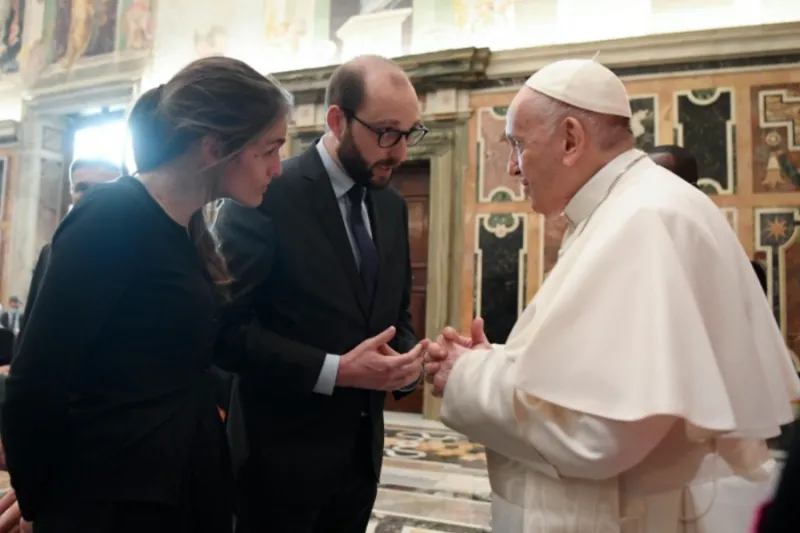
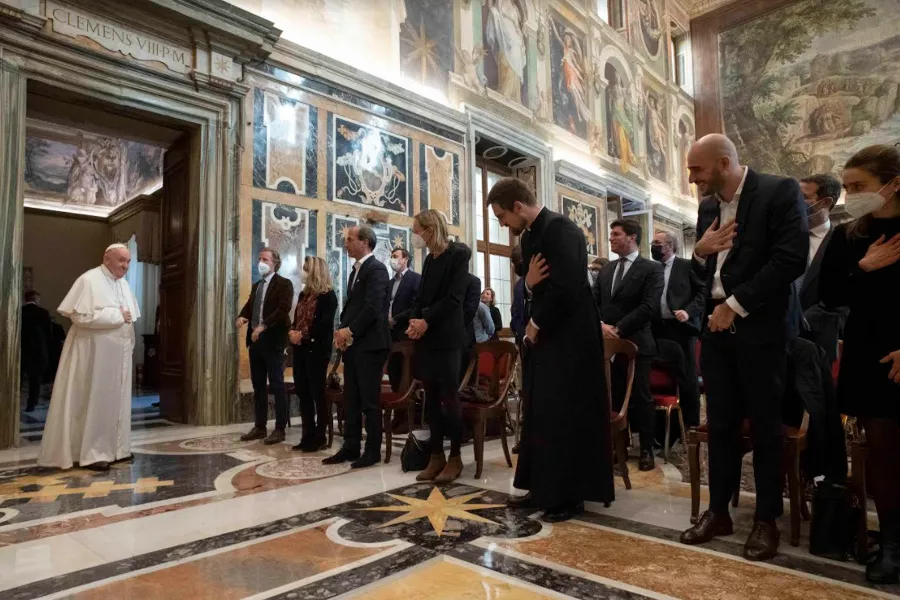
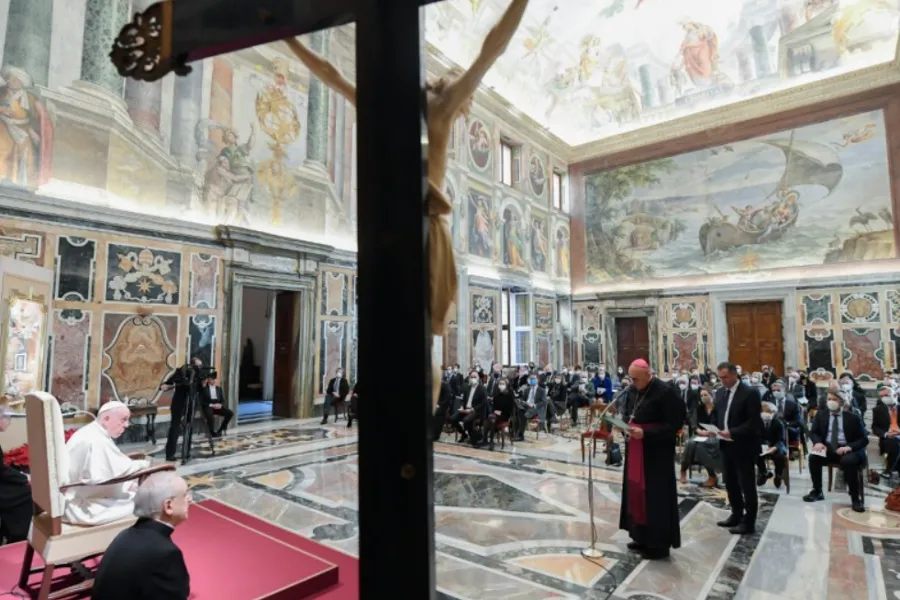
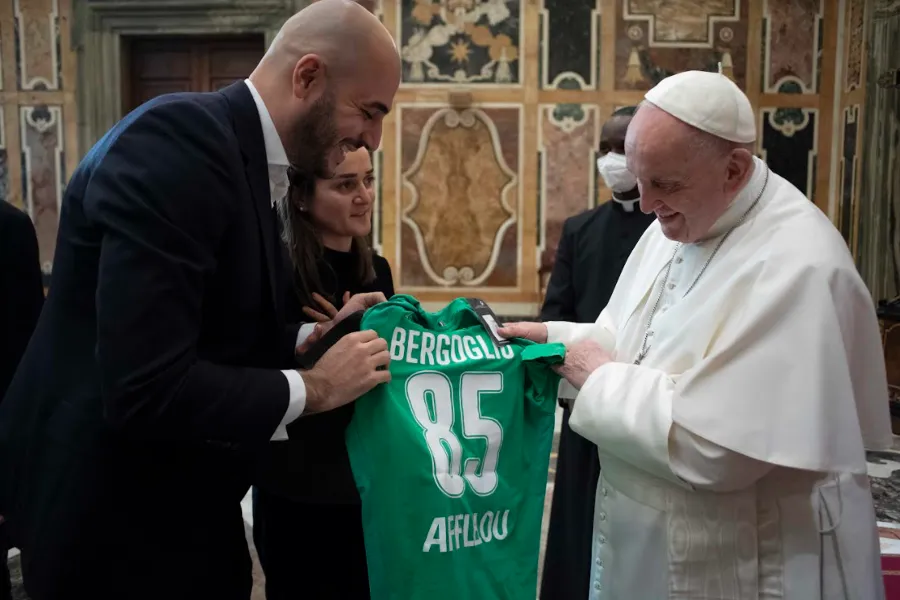
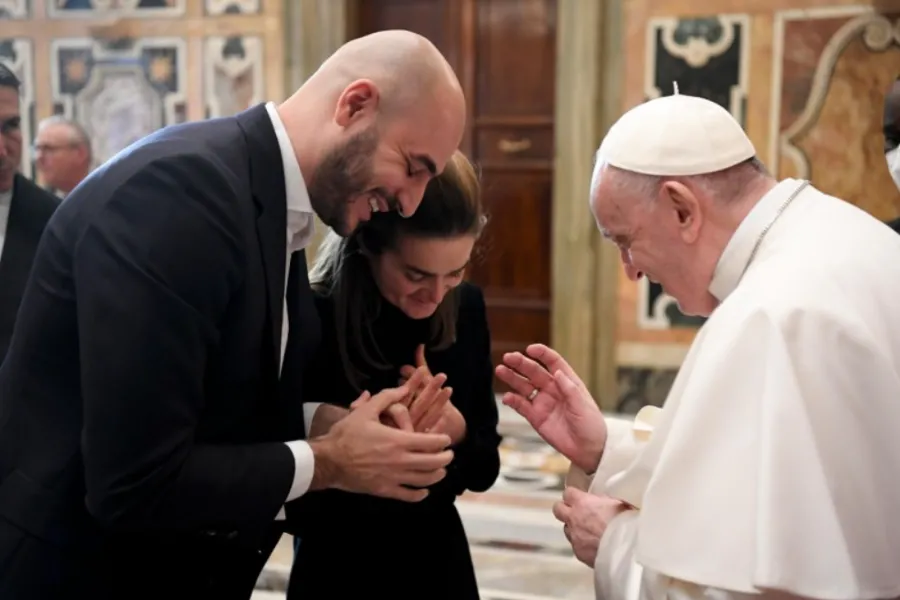
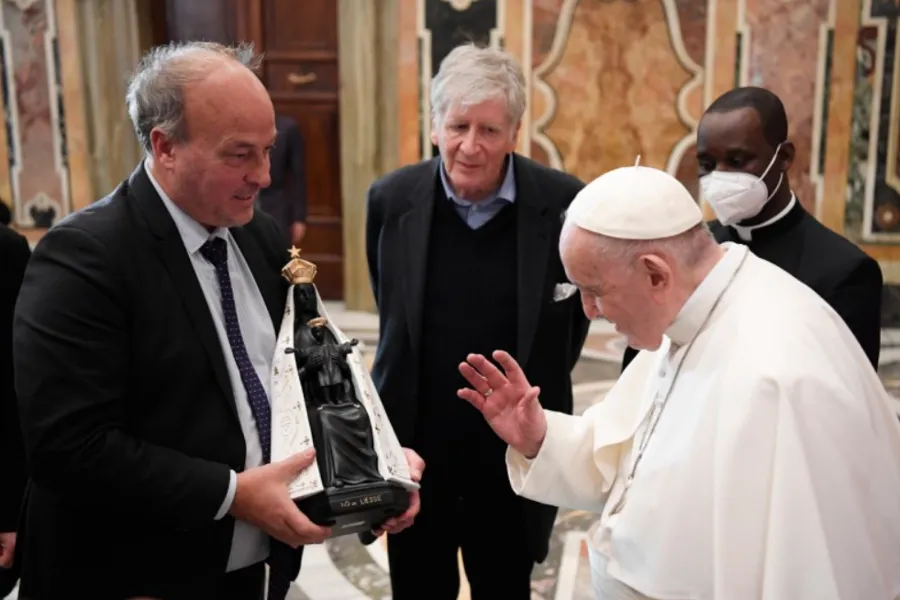
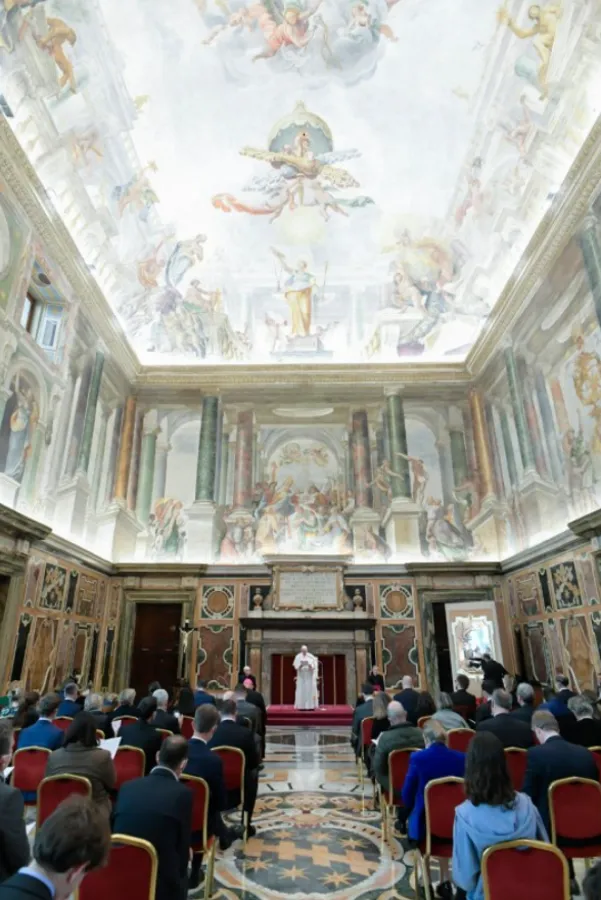
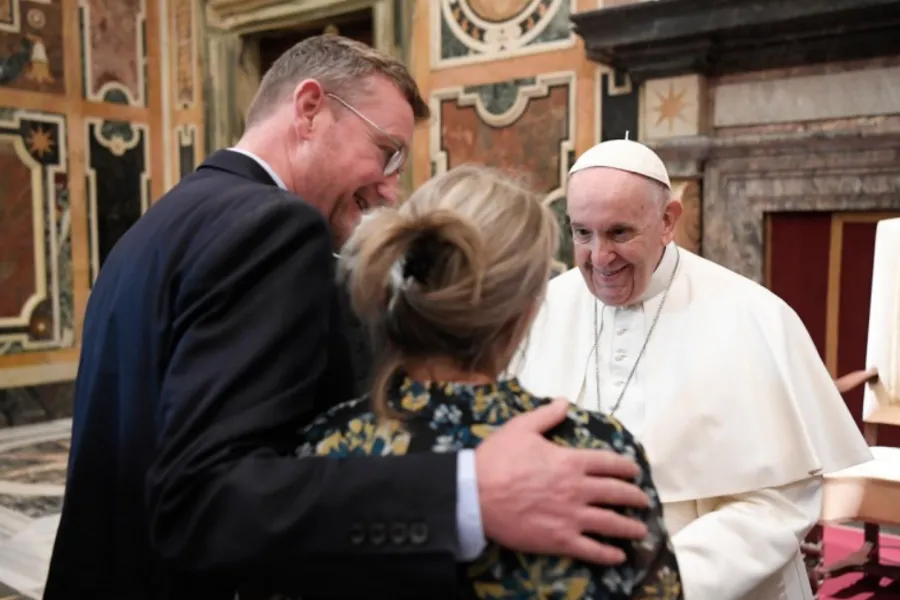
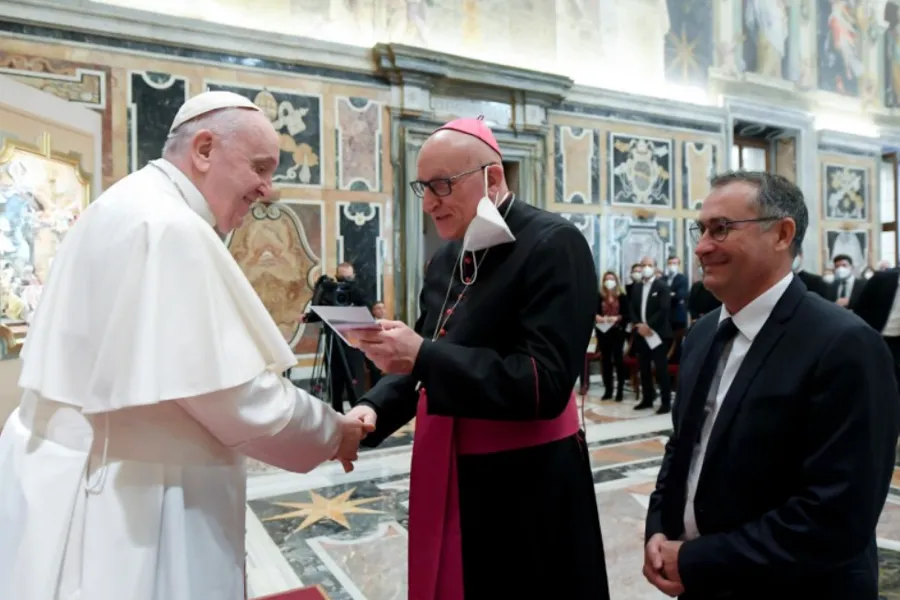
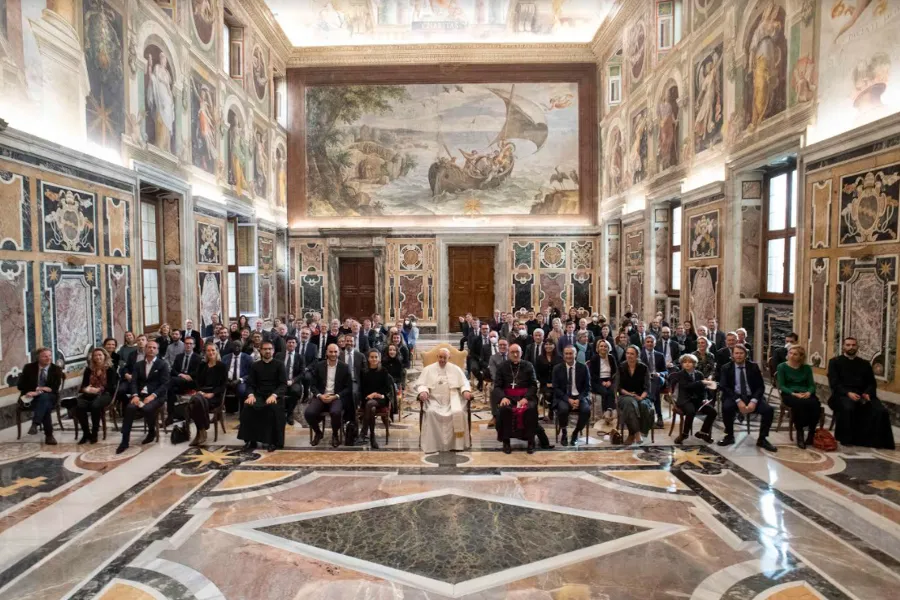
Pope Francis meets with French Catholic entrepreneurs at the Vatican’s Clementine Hall, Jan. 7, 2022. / Vatican Media.
Vatican City, Jan 7, 2022 / 07:30 am (CNA).
Pope Francis on Friday offered advice to business leaders who want to live out the Gospel in the workplace, where he said “the Church needs your witness.”
In a meeting at the Vatican with French Catholic entrepreneurs on Jan. 7, the pope said that he wanted to share some teachings to help “carry out your role as leaders according to the heart of God.”
Vatican Media.
“I realize how demanding and difficult it can be to implement the Gospel in a competitive professional world,” Pope Francis said.
“Nonetheless, I invite you to keep your gaze fixed on Jesus Christ through your prayer life and the offering of your daily work. He had the experience on the cross of loving to the end, of fulfilling his mission to the point of giving his life.”
Vatican Media.
The pope said that Christian business leaders had their own crosses to bear, but encouraged them to endure them with the grace and confidence of knowing that Jesus has “promised to accompany us ‘to the end of the world’ (Matthew 28:20).”
“Do not hesitate to invoke the Holy Spirit to guide your choices,” Francis added.
Vatican Media.
The pope met with entrepreneurs participating in a conference entitled, “The Journey of the Common Good,” which brought 200 people together in Rome for discussions on “how to transform your company to put it at the service of the Common Good.”
Vatican Secretary of State Cardinal Pietro Parolin, papal preacher Cardinal Raniero Cantalamessa, and French bishops’ conference president Archbishop Éric de Moulins-Beaufort attended the conference, along with a number of other French bishops, including Bishop Dominique Rey of Fréjus-Toulon.
Vatican Media.
Pope Francis outlined pairs of concepts that he said appeared to be in tension but can help bring unity to the life of a Christian. One example he gave was “authority and service.”
“Exercising authority as a service requires sharing it. Here too, Jesus is our teacher, when he sends his disciples on mission endowing them with his own authority,” he said.
Vatican Media.
“You are invited to put into practice the subsidiarity which enhances the autonomy and the capacity for initiative of all, especially of the least. … Thus, the Christian executive is called to carefully consider the place allotted to all people in his company, including those whose duties may appear to be of minor importance, because each is important in God’s eyes.”
The pope also encouraged Christian executives to be close to their employees, “to take an interest in their lives, to become aware of their difficulties, sufferings, anxieties, but also their joys, projects, hopes.”
“The mission of the Christian leader resembles, in many respects, that of the shepherd, of whom Jesus is the model, and who knows how to go before the flock to show the way, knows how to stand in the middle to see what is happening there, and also knows how to stay behind, to make sure no one loses contact,” he said.
Vatican Media.
“I have often urged priests and bishops to have ‘the smell of sheep,’ to immerse themselves in the reality of those entrusted to them, to get to know them, to be close to them. I believe this advice also applies to you.”
Vatican Media.
Last April, Pope Francis recognized the heroic virtue of Venerable Enrique Shaw, an Argentine businessman with a cause for sainthood.
Shaw was born in Paris, France, in 1921, and emigrated to Argentina, where he established himself as a businessman of outstanding integrity. He founded the Christian Association of Business Executives in 1952 and sought to apply Catholic social teaching in the workplace.
The businessman had nine children, including one who became a priest. He wrote numerous books and articles, and established a pension fund and a healthcare plan to provide 3,400 workers with financial support in the case of illness, and loans for important life events such as marriage, birth, and death.
Vatican Media.
Pope Francis oversaw the diocesan phase of Shaw’s cause while he was serving as archbishop of the Argentine capital.
Vatican Media.
“I find it very beautiful and courageous that, in today’s world often marked by individualism, indifference and even the marginalization of the most vulnerable people, some entrepreneurs and business leaders have at heart the service of everyone and not just private interests or inner circles,” Pope Francis told the entrepreneurs.
CNA Staff, Nov 14, 2023 / 13:00 pm (CNA).
The Satanic Temple said this month that it is launching an “After School Satan Club” (ASSC) at a Connecticut elementary school, months after a federal judge … […]





Leave a Reply