Memorial in Ottawa, Canada, in tribute to 215 Indigenous children whose remains were found in unmarked graves at the site of a former residential School in Kamloops, June 1, 2021. / meandering images/Shutterstock
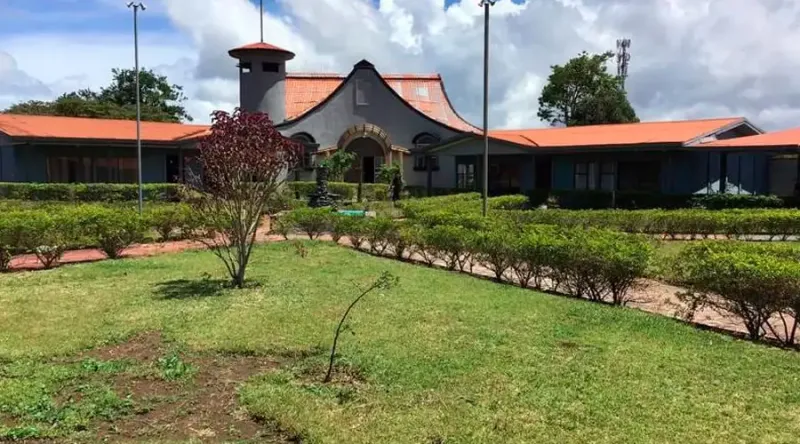
The Benedictine Monastery of San Jose in Costa Rica’s Diocese of Cartago, which was canonically closed Nov. 7, 2021. / Diocese of Cartago.
Cartago, Costa Rica, Nov 10, 2021 / 10:24 am (CNA).
The Diocese of Cartago has ordered the canonical closure of the San José Benedictine Monastery, a diocesan foundation that had functioned ad experimentum for some years.
“This decision of ecclesiastical closure is carried out as a result of an internal administrative process of the Church, which originated in a pastoral visit to the Monastery; this being done in accordance with the powers conferred by the Code of Canon Law, whose result and conclusions were endorsed by the Congregation for the Institutes of Religious Life and Societies of Apostolic Life in Rome,” the diocese stated Nov. 7.
Father Jorge David Arley Campos, press officer for the Diocese of Cartago, told ACI Prensa, CNA’s Spanish language sister news agency Nov. 9. that “as the assessment and investigation of the fruits of the experience is an internal process, the specific reasons” for the closure are not published, since “it was the decision of the commission in charge and the judicial vicar of the diocese.”
“The final decision was made known but not the reasons, since there are elements of secrecy in the matter and they cannot be exposed to public opinion due to the nature of the entrusted secret, in order not to damage the conscience of the faithful and to avoid incorrect interpretations by the faithful,” the priest said.
On its Facebook page, the monastery calls itself a “monastic community governed by the Rule of Saint Benedict, cloistered under our constitutions, and our main work is: prayer and manual labor.”
“We are a cloistered community, we do not do pastoral work outside the monastery. We do not belong to the Diocese of Cartago,” the Facebook page states.
The Nov. 7 diocesan communiqué says that “the members of this diocesan experience have been allowed and offered all our collaboration in their transfer to other experiences of community, if they see fit, awaiting word from them.”
The diocese said that while it has closed the monastery and thus ended its ecclesial mission, it is aware that the monastery was also established as a civil association enrolled in the Civil Registry and so “it belongs to them to determine its future as a civil association.”
From Nov. 7 “the Diocesan Experience of the San José Benedictine Monastery will not be part of the Diocese of Cartago, likewise there will be no authorization for the celebration of the sacraments and sacramentals in the place of that experience.”
Fr. Arley Campos explained to ACI Prensa that as a civil association the monastery is “a legal entity under which they were legally protected as a group.”
“As an association it’s up to them to determine their future, but they are no longer canonically a movement of the Catholic Church,” the priest said.
An article published Nov.1 La Nación, a San José daily, says that “the Benedictine monks of the San José Monastery, in Paraíso de Cartago, charged that the current bishop of Cartago, Mario Enrique Quirós Quirós, has persecuted them for years to ‘eliminate’ their ‘presence ‘in the diocese and take from them their monastery grounds.”
The monastery was founded about eight years ago under Bishop José Francisco Ulloa Rojas. Bishop Quirós succeeded him in 2017.
In its Nov. 7 statement, the Diocese of Cartago doesn’t mention the article in La Nación, but noted that “the land and facilities where the campus of said experience have been located is the property of the indicated Association and has never been the subject of discussion.”
A response sent by the Diocese of Cartago to La Nación says that “the members of the San José Monastery, which was founded by the diocese, were informed of the conclusion of said experience, as a result of not obtaining the expected fruits during this time.”
The diocese further noted that members of the monastery “have been given the opportunity to exercise, pursuant to CIC c. 50, their right of reply.”
Canon 50 of the Code of Canon Law establishes that “before issuing a singular decree, an authority is to seek out the necessary information and proofs and, insofar as possible, to hear those whose rights can be injured.”
The press officer of the Diocese of Cartago explained to ACI Prensa that what happened in this case was the “closure of a diocesan foundation that was subject to evaluation and that could have become an autonomous monastery,” as they exist in other parts of the world.
Fr. Arley Campos said that the members of the group can stay on their property, “since the material goods they enjoy are theirs and their internal regulations, like those of any civil group, are those that govern their action.”
However, the priest clarified, “its mode of operation and what that entails is no longer covered by the Diocesan Church of Cartago.”
Minsk, Belarus, Nov 10, 2021 / 06:22 am (CNA).
The Catholic Church in Belarus called Wednesday for prayers for migrants and refugees amid a growing humanitarian crisis at the country’s border with Po… […]
Pope Francis’ general audience in the Paul VI Hall at the Vatican, Nov. 10, 2021. / Vatican Media.
Vatican City, Nov 10, 2021 / 05:17 am (CNA).
Pope Francis encouraged Christians to call on the Holy Spirit more often when facing difficulties, ex… […]
As the United States Conference of Catholic Bishops prepares to meet in Baltimore, misconceptions about a proposed conference statement on the Eucharistic vitality and integrity of the Church in America abound. The confusions originating from […]
Bishop Ronald Gainer, 74, has served as Bishop of Harrisburg, Pennsylvania since 2014. He was born in Pottsville, 60 miles northeast of Harrisburg. He was an only child in a devout Catholic home; his father […]
Belfast, Northern Ireland, Nov 9, 2021 / 17:01 pm (CNA).
Peaceful sidewalk efforts to reach women considering an abortion are in peril if a proposed “draconian” Northern Ireland bill passes, pro-life advocate… […]
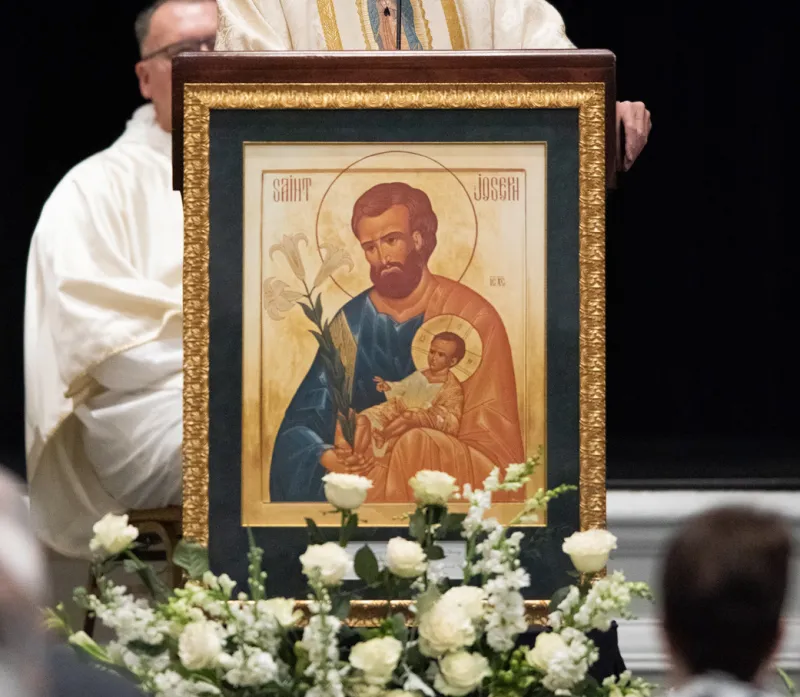
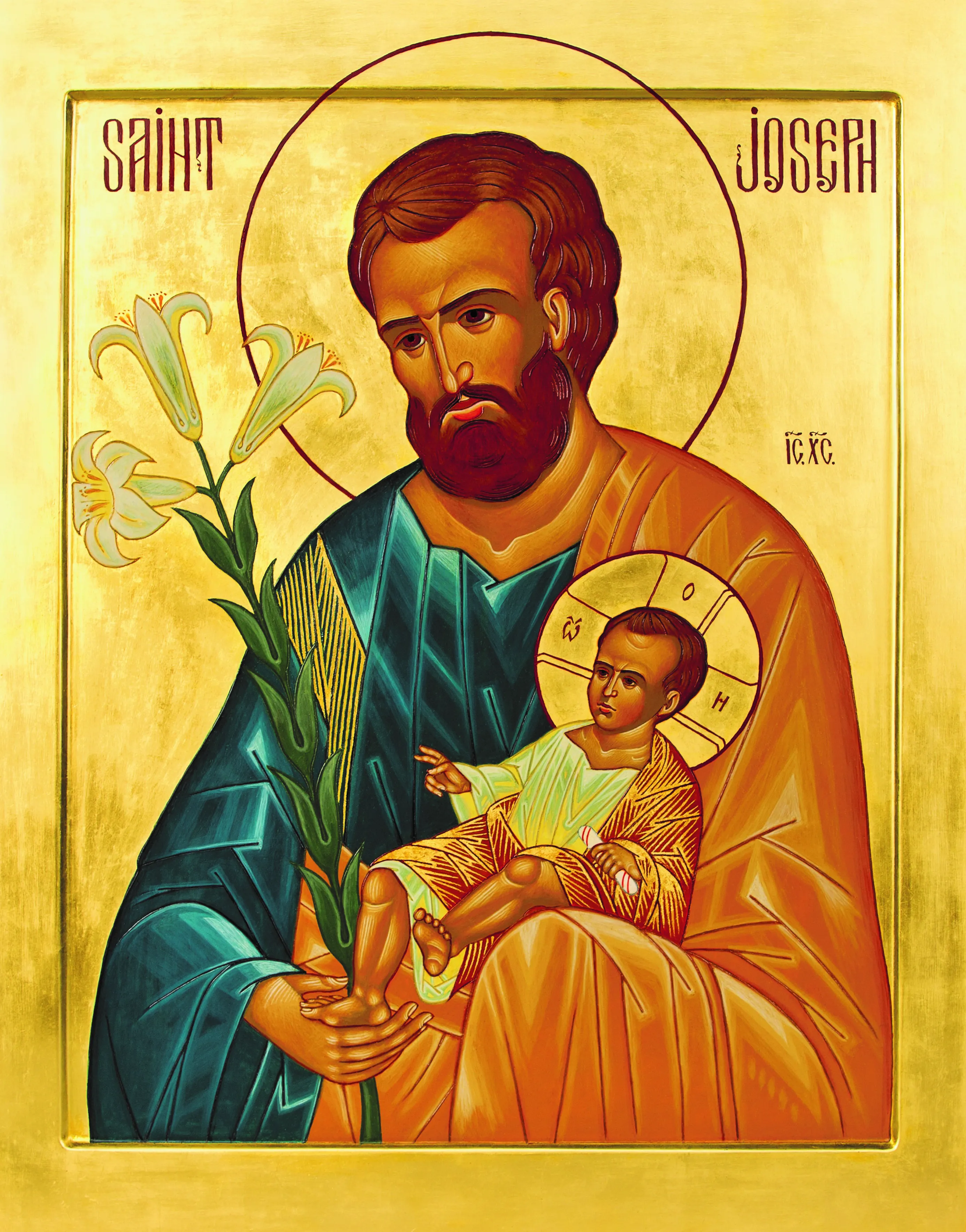
The Knights of Columbus announced the selection of this icon of St. Joseph holding the Child Jesus as the centerpiece of this year’s KofC prayer program. / Courtesy of Knights of Columbus
CNA Staff, Nov 9, 2021 / 16:14 pm (CNA).
As the state deputies of the Knights of Columbus gathered for their semi-annual meeting last weekend in Nashville, Tennessee, Supreme Knight Patrick Kelly encouraged the order’s leaders to grow in faith, expand the Order’s membership, and advance the Knight’s mission.
Kelly also introduced the Order’s new pilgrim icon prayer program, which features an icon of St. Joseph holding the child Jesus from St. Joseph’s Oratory in Montreal, Canada.
The Knights of Columbus (KofC) is the world’s largest Catholic fraternal organization, with more than two million members in 16,000 councils worldwide.
The pilgrim icon prayer program is a longstanding tradition for the KofC, in which every few years a new icon of a saint is selected to inspire the Knights and their communities. The icon is distributed to each of the Knight’s more than 75 jurisdictions and travels from council to council.
Councils at parishes will use the icon as centerpieces for “rosary-based” prayer services, a press release said. Our Lady of Guadalupe was the first icon during the conception of the program in 1979. Since the initiation of the program, almost 175,000 council and parish prayer services have been held with about 22 million participants.
Past images commissioned by the council have been icons of Our Lady of Perpetual Help, Our Lady of Częstochowa, Our Lady of Pochaiv, Our Lady of the Rosary, Our Lady of Charity, Our Lady Help of Persecuted Christians, and the Holy Family.
Following a Votive Mass in honor of St. Joseph on Saturday, Nov. 6 celebrated by Supreme Chaplain Archbishop William Lori of Baltimore, Kelly announced the featuring of the St. Joseph icon, which is inspired by Pope Francis’ Apostolic letter, Patris Corde. Pope Francis’s letter announced the year of St. Joseph that stretches from Dec. 8, 2020 to Dec 8, 2021.
Kelly, who received a private audience with Pope Francis last month, said that the Holy Father was grateful that the Knights chose St. Joseph to be “a central focus of our spiritual efforts.”
Kelly was accompanied at the meeting by his predecessor, Past Supreme Knight Carl Anderson, as well as Lori.
The choice for the newly commissioned icon of St. Joseph is no surprise, as Kelly has advocated for devotion to the saint since his installation as the Supreme Knight.
During his June installation, Kelly consecrated his administration to St. Joseph. “The example of St. Joseph teaches us how to be Knights of the Eucharist. He was the guardian of the first tabernacle — beginning with Mary herself when she bore Christ in her womb, and then in the home where he and Mary lived with Jesus,” he said at his installation address.
Also, in October, the Knights released a new documentary on St. Joseph, inspired by Pope Francis’s declaration of the Year of St. Joseph.
The Knights of Columbus’s pilgrim icon prayer program is a longstanding tradition, in which every few years a new icon of a saint is selected to inspire the Knights and their communities. This year, the Knights have chosen an icon of St. Joseph holding the child Jesus from St. Joseph’s Oratory in Montreal, Canada. Jeffrey Bruno, Courtesy of the Knights of Columbus.
During his address on Saturday, Kelly encouraged Knights and their communities to again entrust themselves to St. Joseph. Kelly implored the men to “give thanks to God for the gift of his fatherly example and ask St. Joseph to be a father to us” as we seek to “grow in our own imitation of St. Joseph’s quiet strength, integrity, and fidelity.”
Lori said that St. Joseph’s obedient faith and trustworthiness are “two virtues [that] ought to stand out in us as Knights of Columbus, and especially in us who are leaders among our brother Knights in the Order.”
“St. Joseph’s vocation to foster the earthly life of Jesus is, of course, unique, but all of us have been called to the obedience of faith,” Lori added. “Father McGivney envisioned his Knights, above all, as men of obedient faith, who, with their wives and children, would live their vocation to the fullest.”
“In choosing Joseph to care with a father’s love for the Incarnate Son of God, the Eternal Father recognized in St. Joseph a man of utmost integrity, a man who perhaps had no idea what God had in mind for him but nonetheless went about his daily life and work with honesty and reliability,” he said.
“A lot of men, especially young men, are looking for meaning and answers,” he said. “We offer both — a life of service and a life of meaning. Don’t just encourage men to adopt our initiatives; explain to them why our initiatives matter, and how the Knights can help them be the kind of men God is calling them to be,” he said.
Speaking of the Knight’s founder, Blessed Michael McGivney, Kelly told the state deputies on Friday, Nov. 5 that McGivney was a “man of action.” He said that McGivney “rose to meet the struggles” of his parishioners and community “head on,” and that by establishing the Knights of Columbus, he “gave men a place to stand as brothers, bound together in charity, unity, and fraternity.”
Kelly implored the Knights to fulfil the mission that McGivney started in his time. Kelly also called on the men to expand the Order’s membership by growing “deeper, as men of faith.”
On Nov. 7, at the meeting’s closing session, Kelly presented four Knights with the St. Michael Award for exemplary service to the Order.
The four recipients were: former director of chaplains for the KofC, Augustinian Father John Grace; former Supreme Warden George W. Hanna; Supreme Master Dennis Stoddard; and Col. Charles “Chuck” Gallina (USMC-Ret.), the supreme knight’s advisor for military and veterans affairs.