


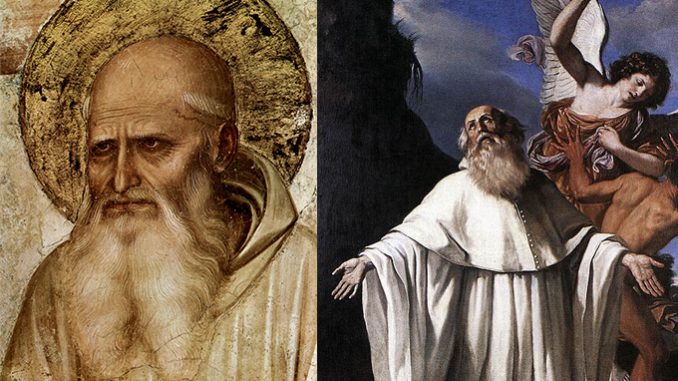
On June 19th, the Church celebrates the founder of a religious community that may not be very well known in the United States.
St Romuald (c. 951–June 19, 1027) was the founder of the Camaldolese. His life reads like a story of one of the desert fathers from centuries before his birth, but his legacy endures to the present day.
Romuald grew up in the city of Ravenna, Italy. Ravenna had long prided itself on its position as capital of the Western Roman Empire through most of the fifth century, and Romuald was born into one of the noble families of the city around the year 951. Throughout his early years, he enjoyed the “good life” of a young man of his time and station, a life he later saw as full of pleasure and sin.
At about twenty years old, he served as second for his father in a duel over a property dispute with a relative. His father killed the other man. This event so shocked Romuald that he fled his life of status and wealth and became a monk in order to atone for his involvement in the duel.
Romuald spent a few years in the monastery that he had joined, but he did not feel that it was rigorous enough for the life of penance that he wanted to lead. He took on extra penances, to the point that his brother monks were uncomfortable with how much austerity he had taken on. He obtained permission from his abbot to leave this first monastery and lived as a hermit in the rustic countryside, close to Venice, where he put himself under the spiritual direction of a more experienced hermit named Marinus.
After some time of maturing under Marinus, Romuald gathered a small band of followers around himself. He spent the last thirty or so years of his life founding monasteries in Italy. Some of these foundations were in the Benedictine tradition, though he taught a strict adherence to the rule. But his ideal seems to have been smaller communities, something along the lines of what Eastern Christians might call a lavra: a small group of solitaries that had individual huts centered around a chapel where they could meet for Mass and common morning and evening prayer.
One such foundation was in a field (campo) donated to the hermit-brothers by a man named Maldolus, so the community became known as the community in the Campo Maldoli, later shortened to Camaldoli.
Romuald’s disciples later gathered his teachings into a short series of principles, sometimes called his “rule.” Most versions run only about a hundred words in Latin. Here is an English translation I found:
Sit in your cell as in paradise, cast all memory of the world behind you; cautiously watch your thoughts, as a good fisher watches the fish. In the Psalms there is one way. Do not abandon it. If you who have come with the fervor of a beginner cannot understand everything, strive to recite with understanding of spirit and mind, now here, now there. When you begin to wander while reading, do not stop, but hasten to correct yourself by concentrating. Above all, place yourself in the presence of God with fear and trembling, like someone who stands in the sight of the emperor. Destroy yourself completely, and sit like a chick, content with the grace of God, for unless its mother gives it something, it tastes nothing and has nothing to eat.
Notice that this is not a detailed structure for living the monastic life like the Rule of St Benedict or even the Rule of St Augustine. There isn’t even advice on penitential and ascetic practices, the thing that so set apart Romuald from many of his contemporaries. Rather, the focus is on the interior life, on guarding the heart and the mind, on deep meditation on the Psalms, on keeping oneself always in the presence of God, and trusting in His grace.
In these few short words, Romuald comes across very much like a wise spiritual father, much in the tradition of the abbas of the Egyptian deserts. Contemplative prayer and complete trust in God were at the heart of religious life.
St Romuald died in the year 1027, in one of the monasteries he had founded, alone at prayer in his cell. Fifteen years later, St Peter Damian wrote a biography of Romuald, giving him as a model of the sort of reform in the Church that he and Pope St Gregory VII were calling for. His spiritual heritage has come down to our own day in two separate communities.
One Camaldese tradition combines monastic and eremetic life, based on the rule of St Benedict, but with more space for solitary prayer (OSB Cam). In the early years of the 1500s, the Camaldese monk, Blessed Paul Giustiniani, grew dissatisfied with this more mixed way of life and started a group following the traditions of St Romuald but living as small communities of hermits (Er Cam). There is one community from each tradition in the United States.
The Church presents St Romuald to us for several reasons. He is a reminder that even people who profess a belief in Christ can grow comfortable and cold, and that the only way forward is a life of prayer and sacrifice. He is a striking reminder that riches and influence and pleasure matter little compared to how we stand before God.
And at the end of his life as a traveling reformer and founder, he reminds us that prayer and action are meant to work together, never separately.
On his feast, the Church prays
Father,
through Saint Romuald
you renewed the life of solitude and prayer in your Church.
By our self-denial as we follow Christ
bring us the joy of heaven.
We ask thus through our Lord Jesus Christ, your Son,
who lives and reigns with you and the Holy Spirit,
one God, for ever and ever.
Amen.
If you value the news and views Catholic World Report provides, please consider donating to support our efforts. Your contribution will help us continue to make CWR available to all readers worldwide for free, without a subscription. Thank you for your generosity!
Click here for more information on donating to CWR. Click here to sign up for our newsletter.

Thank you for this informative, inspiring essay on the life and spirituality of St Romuald. We’re all called to one extent or another to contemplation.
Thank you for this biography of St Romuald. Our Church in Rhode Island has a chapel named after him. It was started years ago as a summer place of worship near the beach for the nearby summer cottages. Today it is open year around for the many permanent residents in the area. We function as one parish with two places of worship.