


Washington, D.C. Newsroom, Oct 10, 2021 / 09:19 am (CNA).
House Speaker Nancy Pelosi and her husband left Mass at a church in Rome Saturday evening due to a “security incident,” the church’s rector said.
“You probably heard or saw the commotion. Unfortunately, I guess, there was a security incident and sadly Speaker Pelosi and her husband had to leave,” Fr. Steven Petroff, rector of St. Patrick’s Church in Rome, said in a video posted on social media.
“She was going to do our second reading today, but of course her safety is most important,” he said.
Veteran Rome journalist Joan Lewis told CNA Sunday that she had spoken to Petroff, who told her that the security concerns stemmed from restive demonstrations going on in the streets of Rome Saturday that were moving into the area where St. Patrick’s is located.
“It was Pelosi’s security detail that made her leave Mass for her own safety,” Lewis said in an instant message exchange with CNA. “What Fr. Steve learned after Mass was that a large number of the anti-Green Card protestors were moving in the direction of Via Veneto and they appeared to be violent. This is what led her security team to insist that she leave the church to, we can assume, be moved to a more secure location.”
Lewis emphasized that Pelosi wasn’t the target of heckling, as some news reports suggested. You can watch Petroff addressing the incident during his homily in the Twitter post below.
Pro abortion American politician Nancy Pelosi ‘had to leave’ Mass in Rome today because of a ‘commotion’ and was unable to deliver a scheduled reading as a result. pic.twitter.com/0WYhRW08nw
— Catholic Arena (@CatholicArena) October 9, 2021
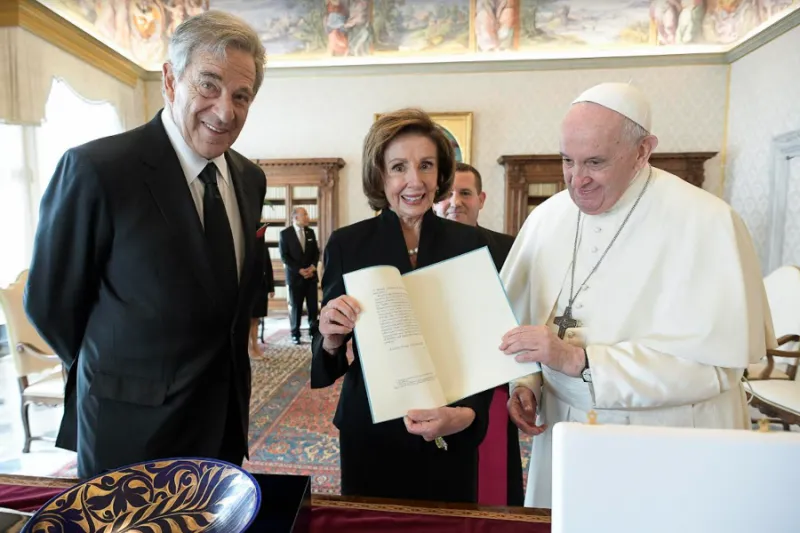
Pelosi, a leading Catholic politician who has clashed with her local ordinary, San Francisco Archbishop Salvatore Cordileone, over her support of abortion, traveled to Rome to give the keynote address at the opening session of the G20 Parliamentary Speakers’ Summit on Friday. On Saturday, she and her husband, businessman Paul Pelosi, met with Pope Francis and other top Vatican officials.
If you value the news and views Catholic World Report provides, please consider donating to support our efforts. Your contribution will help us continue to make CWR available to all readers worldwide for free, without a subscription. Thank you for your generosity!
Click here for more information on donating to CWR. Click here to sign up for our newsletter.


Let me ask a question from a position of neutrality: Why should any of us give a hoot about pre-born children when this woman gets hosted by a smiling Vicar of Christ and gets to read Holy Scripture from a Roman pulpit?
Let me re-phrase an answer: The follower of Christ gives all his hoot for pre-born children and no mind (other than prayer and sacrifice) to “this woman” and “a smiling Vicar of Christ.”
To turn away in nausea and disgust from the likes of these two re-writers of the laws and covenant of Christ is to turn the other cheek to them while offering both our cheeks to Christ.
Nancy ought to consider herself akin to the child in the womb. When threats arise to the child’s safety (chemical toxins, showers of saline, surgical suction or curettage threaten the child) is the child free to flee?
No. Nancy instead facilitates funding for more toxin, more saline, more suction and sharper knives. She allows, facilitates and finds ways to enforce further brutality.
Meanwhile, a whiff of a threat sends Nancy and her ‘guardians’ into a flurry of fear, so that she physically leaves the church, abandoning the place where the only person–Jesus the Christ–can save her. Truly she has no faith and does not discern His presence or His power to enforce His law.
Nancy perfectly exemplifies Aristotle’s Law of Noncontradiction: “It is impossible that the same thing can at the same time both belong and not belong to the same object and in the same respect.” Nancy cannot claim to be Catholic while acting against Catholicism’s basic precept.
Nancy will not be saved until and unless she converts and begins to save the innocent, vulnerable, and helpless to counteract the many she’s helped die. Her five alive weigh only so much in the scales of justice.
Nancy cannot be both Catholic and non-Catholic while she collects wages of sin. May God have mercy on such souls.
Maybe she used the commotion as any excuse to leave, because the Pope would not allow her to receive Holy Communion?
She left in order to avoid her own humiliation of being held in obeyance of Catholic teachings to receive communion.
She was invited to attend and participate in the mass and could have taken part of the communion procession, andreceived a blessing instead of communion as a good catholic should who’s not able to receive communion.
She was even invited to do a reading, which goes to show she is still welcomed by the Catholic Church, inspire of her contrary views that prevent her from receiving Holy Communion.
I think she wanted to avoid personal humiliation, and had her security team staged rushing her out for dramatic effect, as if she would not be safe in Vatican City.
If there was any real threat, a security team would have pulled out sooner, cancelled her appearance all together.