
Vatican City, Apr 20, 2017 / 03:06 am (CNA/EWTN News).- During his trip to Portugal for the centenary of the Fatima Marian apparitions next month, Pope Francis will canonize visionaries Francisco and Jacinta Marto, making them the youngest non-martyrs to ever be declared saints.
The children will be canonized during Pope Francis’ May 13 Mass in Fatima. The decision for the date was made during a April 20 consistory of cardinals, which also voted on the dates of four other canonizations, in addition to that of Francisco and Jacinta, that will take place this year.
Some martyrs who will soon be saints are diocesan priests Andrea de Soveral and Ambrogio Francesco Ferro, and layman Matteo Moreira, killed in hatred of the faith in Brazil in 1645; and three teenagers – Cristóbal, Antonio, and Juan – killed in hatred of the faith in Mexico in 1529, who will be canonized October 15.
Bl. Angelo da Acri, a Capuchin priest who died in October 1739, and Faustino Míguez, a Piarist priest who founded the Calasanziano Institute of the Daughters of the Divine Shepherd, will also be canonized October 15.
Cardinal Jose Saraiva Martins, the Prefect Emeritus of the Congregation for the Causes of Saints, is the man who was largely responsible for advancing the visionaries’ cause, paving the way for them to become the first canonized children who were not martyred.
Previously, the Portuguese cardinal told CNA, children were not beatified, due to the belief “that children didn’t yet have the ability to practice Christian heroic virtue like adults.”
But that all changed when the cause for Francisco and Jacinta Marto arrived on his desk.
Francisco, 11, and Jacinta, 10, became the youngest non-martyr children in the history of the Church to be beatified when on May 13, 2000, the 83rd anniversary of the first apparition of Our Lady at Fatima, Pope John Paul II proclaimed them “Blessed,” officially showing that young children can become Saints.
The brother and sister, who tended to their family’s sheep with their cousin Lucia Santo in the fields of Fatima, Portugal, witnessed the apparitions of Mary now commonly known as Our Lady of Fatima.
During the first apparition, which took place May 13, 1917, Our Lady asked the three children to pray the Rosary and make sacrifices for the conversion of sinners. The children did this and were known to pray often, giving their lunch to beggars and going without food themselves. They offered up their sacrifices and even refrained from drinking water on hot days.
When Francisco and Jacinta became seriously ill with the Spanish flu in October 1918, Mary appeared to them and said she would to take them to heaven soon.
Bed-ridden, Francisco requested and received his first Communion. The following day, Francisco died, April 4, 1919. Jacinta suffered a long illness and was eventually transferred to a Lisbon hospital, where she underwent an operation for an abscess in her chest. However, her health did not improve and she died Feb. 20, 1920.
Francisco and Jacinta “practiced Christian virtue in a heroic way,” Cardinal Martins said, explaining that among other things, one of the most obvious moments in which this virtue was apparent for him was when the three shepherd children were arrested and intimidated by their mayor on August 13, 1917.
Government stability in Portugal was rocky following the revolution and coup d’état that led to the overthrow of the monarchy and subsequent establishment of the First Portuguese Republic in 1910.
A new liberal constitution separating Church and state was drafted under the influence of Freemasonry, which sought to omit the faith – which for many was the backbone of Portuguese culture and society – from public life.
It was in this context that, after catching wind of the Virgin Mary’s appearance to Francisco, Jacinta and Lucia, district Mayor Artur de Oliveira Santos had the children arrested on the day Mary was to appear to them, and threatened to boil them in hot oil unless they would confess to inventing the apparitions.
At one point in the conversation at the jailhouse, Jacinta was taken out of the room, leaving Francisco and Lucia alone. The two were told that Jacinta had been burned with hot oil, and that if they didn’t lie, the same would happen to them.
However, instead of caving to the pressure, the children said: “you can do whatever you want, but we cannot tell a lie. Do whatever you want to us, burn us with oil, but we cannot tell a lie.”
“This was the virtue of these children,” Cardinal Martins said, noting that to accept death rather than tell a lie is “more heroic than many adults.”
“There’s a lot to say on the heroicness of children,” he said, adding that “because of this I brought their cause forward.”
Cardinal Martins was also the one to bring Lucia’s cause to the Vatican following her death in 2005. The visionary had spent the remainder of her life after the apparitions as a Carmelite nun.
Typically the must be a five-year waiting period after a person dies before their cause can be brought forward. However, after only three years Martins ask that the remaining two be dismissed, and his request was granted.
Although the diocesan phase of the cause has already been finished, Cardinal Martins – who knew the visionary personally – said Lucia’s process will take much longer than that of Francisco and Jacinta not only due to her long life, but also because of the vast number of letters and other material from her writings and correspondence that needs to be examined.
The cardinal, who will be present in Fatima with the Pope during his May 12-13 visit for the centenary of the apparitions, said he views the occasion as the conclusion of a process that began with him changing a norm regarding the view of children “and their heroic virtue.”
This process is important, he said, because it means there could be other children who practiced heroic virtue that can now be canonized, so “it’s certainly something important.”
“It needs to be seen that (children) are truly capable of practicing heroic virtue,” not only in Fatima, but “in the Christian life,” he said.
Although canonizations, apart from a few exceptions, are typically held in Rome, it was only recently that beatifications began to be held outside of Rome, in the local Church which promoted the new Blessed’s cause.
This change was made by Cardinal Martins in September 2005, after receiving the approval of Benedict XVI.
In the past, a beatification Mass in Rome would be presided over by the Cardinal-Prefect of the Congregation for the Causes of Saints during the morning, with the Pope coming down to the basilica to pray to the new Blessed in the afternoon. Cardinal Martins said he decided to change this because the beatification and the canonization “are two different realities.”
“While the canonizations had a more universal dimension of the Church, the beatifications have a more local dimension, where they (the Blessed) came from,” he said, noting that this is reflected even in the words spoken during the rites for each Mass.
“Because of this, I made a distinction: the beatification in their (the Blessed’s) own church, in their diocese, and the canonizations in Rome.”
The result was “a fantastic revolution,” he said, explaining that while maybe 2-3,000 people would participate in the beatification ceremonies in Rome, hundreds of thousands started to come for the local beatification Masses of new Blessed in their home dioceses.
The cardinal said that “it’s beautiful” to see people – many times including friends and family members of new Blessed – join in honoring their countryman, asking for their intercession, and seeking to follow their example.
He believes the custom will remain like this, adding that it is beautiful particularly from the standpoint of evangelization.
“The new Blessed says to their brothers, many of whom they knew, ‘I am one of you, one like you, so you must follow my path and live the Gospel in depth’,” the cardinal said, explaining that this is “a formidable act of evangelization, and with everyone happy about the new Blessed, they’ll immediately do what they say!”
Cardinal Martins said the decision was also prompted by the emphasis placed on local Churches during the Second Vatican Council.
“I thought, one of the most effective ways to highlight the importance of local Churches is to conduct in the local diocese the beatification of one of their sons,” he said.
 […]
[…]




There may be a pope and his idolators, some pastoral workers, or movements and associations with particularly unChristian ideologies which close themselves off to outsiders.
It’s all within the realm of possibility.
“Pope Francis said Jesus wants us to stop judging others and to worry about our own behavior first. ‘Indeed, the risk is to be inflexible towards others and indulgent towards ourselves,’ he noted.”
Actually, Matthew 7:2 has Jesus saying, “For in the same way you judge others, you will be judged, and with the measure you use, it will be measured to you.”
Jeremiah 34:17 also speaks to those brutally flexible reeds who see fit to bend the Lord’s commandments and to disregard Sacred Tradition. Jeremiah speaks the judgment of the Lord to those who judge the keepers of the Lord’s commandments and Catholic tradition as unloving and rigid. Yes, they are as rigid as Christ would have them be.
“Therefore this is what the LORD says: You have not obeyed Me; you have not proclaimed freedom, each man for his brother and for his neighbor. So now I proclaim freedom for you, declares the LORD–freedom to fall by sword, by plague, and by famine! I will make you a horror to all the kingdoms of the earth.”
I heard on yesterday’s news that wild boars have invaded Rome.
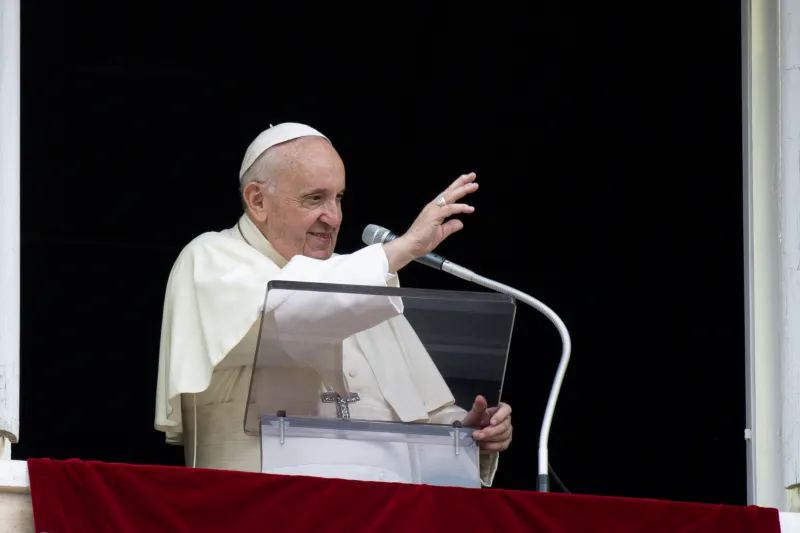
Pope Francis said Jesus wants us to stop judging others and to worry about our own behavior first.
The Pontiff who is not a theologian, not a liturgist, not a Canon lawyer and fundamentally very poorly catechized in the Catholic faith needs to be reminded that Jesus said otherwise. He also needs to engage in a thorough examination of conscience and amend his own judgmental behavior prior to his demise.
“And why even of yourselves, do you not judge that which is just?” Jesus Christ, Luke 12:57
St Aquinas states that man’s relations with foreigners are twofold: peaceful, and hostile. Therefore, each nation has the right to determine who should be admitted as citizens.
Even the good Samaritan did not take the man who was robbed and beaten with him. He helped him where he lived.
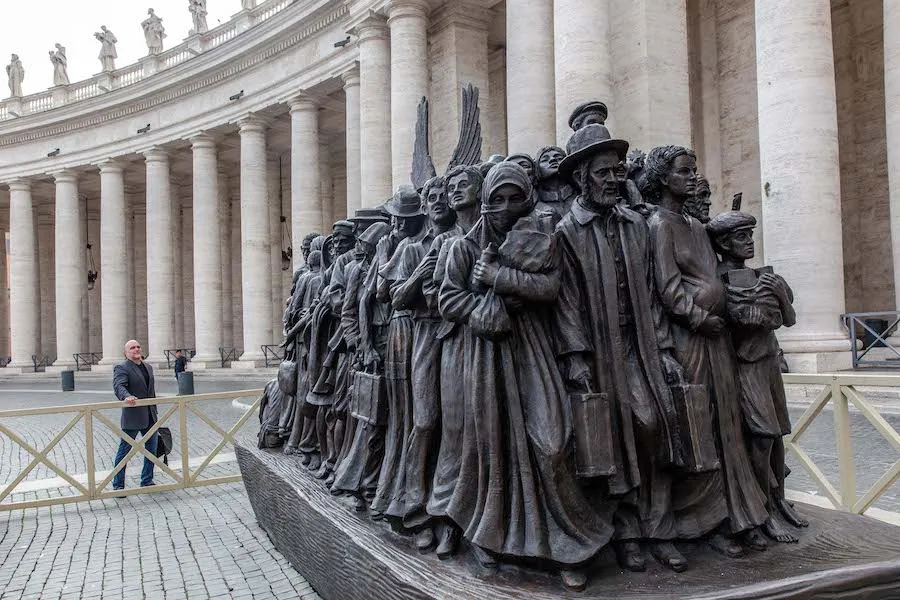
“Artist Timothy Schmalz, depicting migrants throughout history crowded together on a boat with the Holy Family”, is pure schmaltz. It’s art, though the theme is propaganda for a Vatican open border policy that’s destroying national identity. National and ethnic diversity are considered assets to cultural enrichment.
Welcoming, yes, and some would urge, even proselytizing.
But, here’s a side story…’bout a year ago I was early in the church, preparing as a lector, and off the street strolls a totally new young man. Never seen before. The few early parishioners are kneeling. The tabernacle resides, centered, in holy silence.
Off to the side, the newcomer ambles straight to the piano, assumes command, and begins playing as if he owned the place. I first discerned (!) and then suggested, politely, that as a walk-on perhaps he should not presume so much. (This is a parish church, after all, and a few minutes before Mass, and not a high school practice room or home rec room.)
He stops. But before heading back to the open door he approaches and, kicking the dust from his sandals, as it were, judges me and the entire parish over his shoulder: “this place is not very welcoming!”
Should I have offered Its/all/about/Me a doughnut? Should he have hung around for a bit of Eucharistic incoherence? In particular this side story—-examining my own behavior first—-what should I have done differently?
IMO the name you gave him is the answer to your question. The phrase “Be still and know that I am God” suggests itself to me at this point.
I also get the impression that he wanted to be offended so he could deliver bis exit line.
Nothing. Christlike admonition may have saved that pianist from a life of donut Christianity.
Like many, I have a lot of criticisms of Francis, but listening to him carefully he is obviously equating himself to the Devil. Well, I think he should simply go to confession and resolve to sin no more but also stop describing himself in Satanic terminology.’
The Church must be “welcoming”, to whom and what? Sin, heterodoxy, idolatry, leftist ideologies which aim to destroy and subvert the faith? The Chine Totalitarian regime? Certainly not Traditional Catholics, who simply want to celebrate the timeless Mass of Ages undisturbed. Certainly not ordinary Novus Ordo attending Catholics like myself, who were willing to give Francis a chance when he was first elected, and even tried to square his utterances with tradition and scripture, but got turned off of him due to his arrogance, tolerance of corruption (doctrinal, moral, sexual and financial), open contempt for the very people he is supposed to shepherd, refusal to teach the faith as was handed to him by his predecessors (and blatant contradiction of same, whether directly or indirectly).
As Fulton Sheen put it long ago, our problem is that we are too tolerant, not because we are intolerant. We cannot be “welcoming” to sin, error and immorality. We already tried that and it led directly to the McCarrick scandal and the sex abuse crisis.