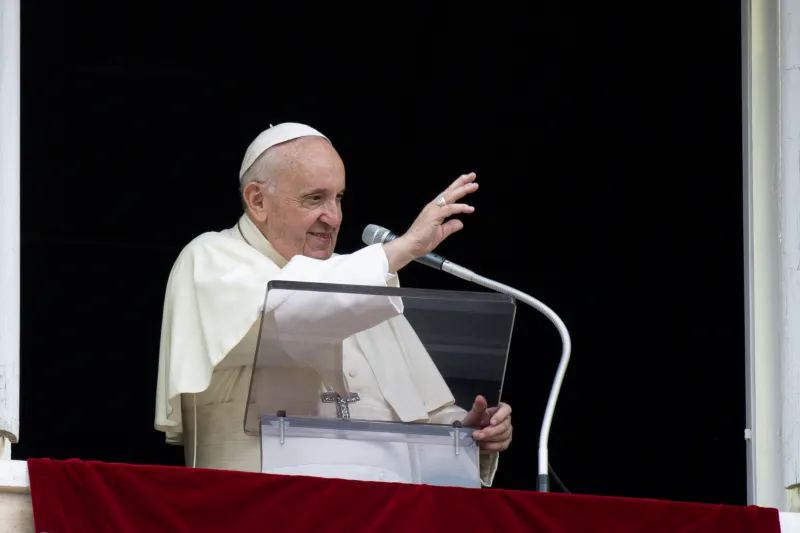
Pope Francis waves during the Angelus on Sept. 26, 2021 / Vatican Media
Vatican City, Sep 26, 2021 / 06:35 am (CNA).
Pope Francis on Sunday said the Catholic Church must be open and welcoming toward others, warning that division and exclusion come from Satan.
“We need to be vigilant about closure in the Church too,” he said before leading the Angelus prayer at the Vatican Sept. 26.
“Because the devil, who is the divider – this is what the word ‘devil’ means – always insinuates suspicions to divide and exclude,” he added.
Speaking from a window overlooking St. Peter’s Square, Francis said sometimes Catholics, instead of having humble and open communities, “can give the impression of being the ‘top of the class’ and keeping others at a distance.”
“Let us ask for the grace to overcome the temptation to judge and categorize,” he said, “and may God preserve us from the ‘nest’ mentality, that of jealously guarding ourselves in the small group of those who consider themselves good.”
Pope Francis warned that sometimes there are groups of people, such as a priest and his parishioners, some pastoral workers, or movements and associations with particular charisms which close themselves off to outsiders.
“All this runs the risk of turning Christian communities into places of separation and not of communion,” he stated. “The Holy Spirit does not want closedness; He wants openness, and welcoming communities where there is a place for everyone.”
After leading the Angelus, a traditional prayer about the Virgin Mary, the pope spoke about the Sept. 26 celebration of the World Day of Migrants and Refugees.
He said “it is necessary to walk together, without prejudice and without fear, placing ourselves next to those who are most vulnerable: migrants, refugees, displaced persons, victims of trafficking and the abandoned. We are called to build an increasingly inclusive world that excludes no one.”
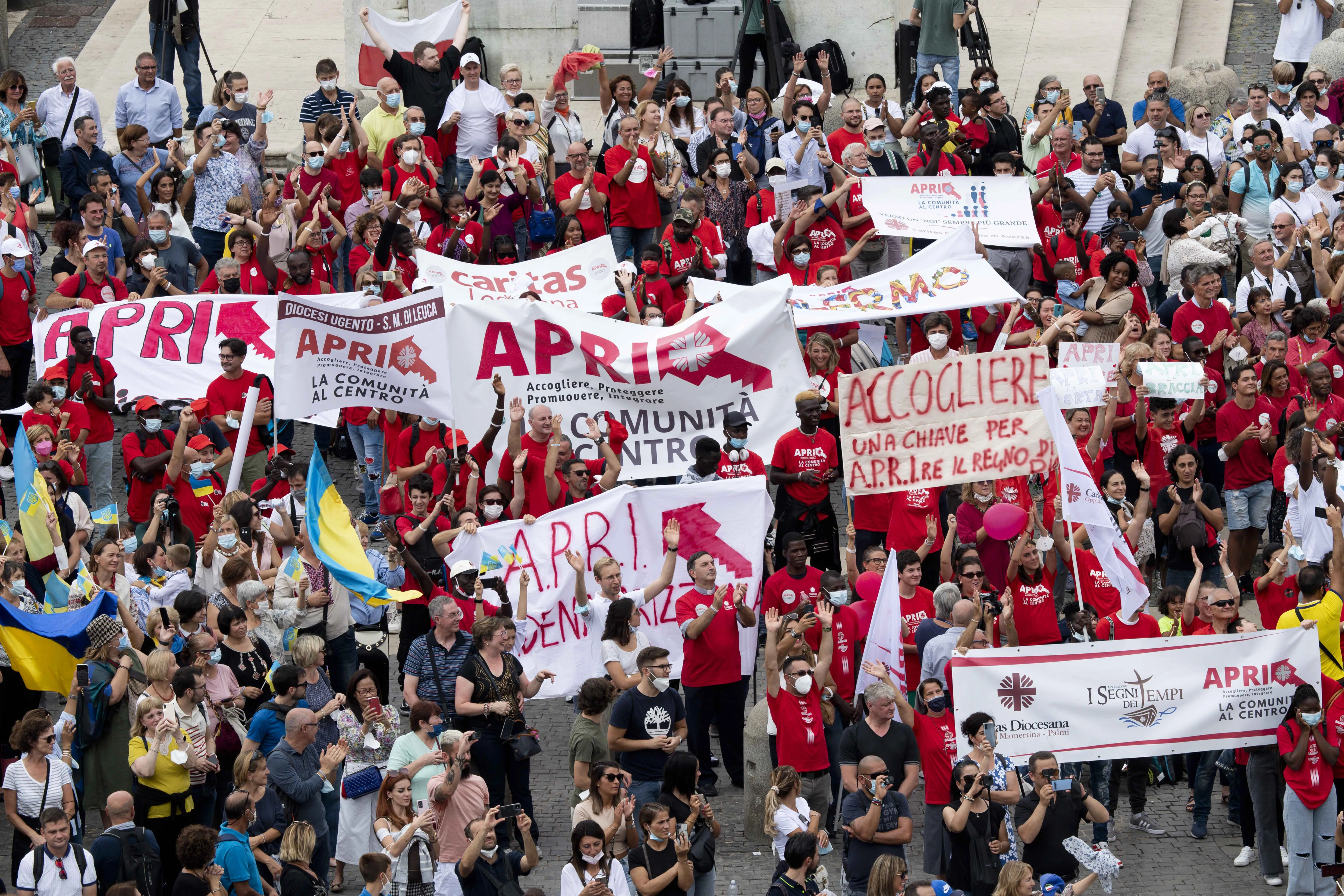
Francis greeted several groups with the aim of helping migrants and refugees, which were gathered below him in St. Peter’s Square.
Groups which help migrants and refugees cheer during the Angelus Sept. 26, 2021. Vatican Media.
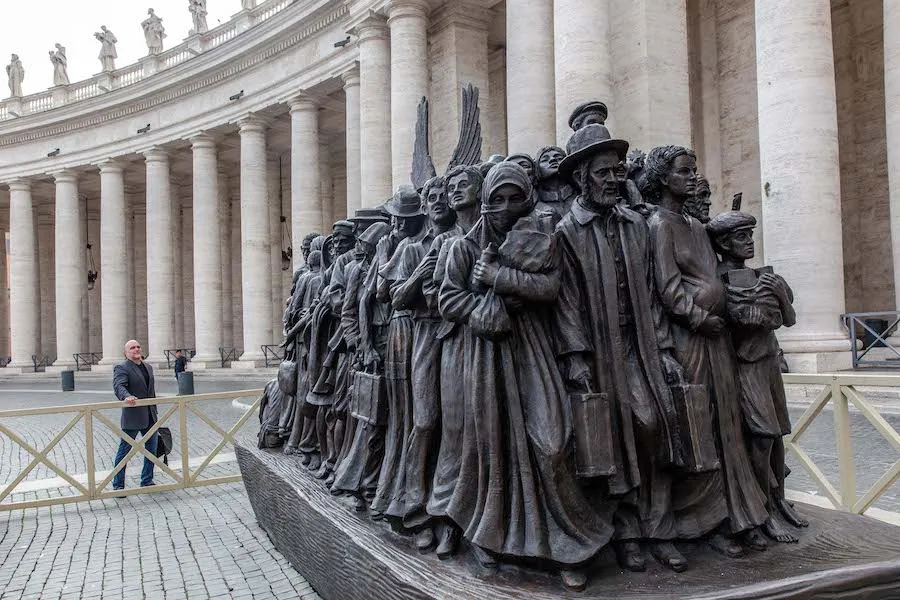
“Thank you all for your generous commitment,” he said. The pope then invited everyone present to visit the “Angels Unawares” sculpture before leaving the Vatican.
The 20-foot-tall bronze statue, unveiled in 2019, is based on Hebrews 13:2, “Be welcoming to strangers, many have entertained angels unawares.”
The sculpture, by Canadian artist Timothy Schmalz, depicts migrants throughout history crowded together on a boat with the Holy Family.
Pointing to the statue in St. Peter’s Square, Pope Francis said, “dwell on the gaze of those people and welcome in that gaze the hope of starting to live again that every migrant has today.”
“Go there, see that monument,” he urged. “Let’s not close the doors to their hope.”
<p>Canadian sculptor Timothy P. Schmalz poses next to his sculpture, ‘Angels Unawares.’ Daniel Ibanez/CNA.</p>
Before the Angelus, the pope also reflected on the day’s Gospel from St. Mark, in which the Evangelist recalls when Jesus said to his disciples: “If your hand causes you to sin, cut it off. It is better for you to enter into life maimed than with two hands to go into Gehenna, into the unquenchable fire.”
Pope Francis said Jesus wants us to stop judging others and to worry about our own behavior first. “Indeed, the risk is to be inflexible towards others and indulgent towards ourselves,” he noted.
“Jesus is radical, demanding, but for our own good, like a good doctor,” he continued. “Every cut, every pruning, is so we can grow better and bear fruit in love.”
“Let us ask, then: what is it in me that is contrary to the Gospel? What, in concrete terms, does Jesus want me to cut out of my life?”
“Let us pray to Mary Immaculate, that she may help us be welcoming towards others and vigilant over ourselves,” he concluded.
If you value the news and views Catholic World Report provides, please consider donating to support our efforts. Your contribution will help us continue to make CWR available to all readers worldwide for free, without a subscription. Thank you for your generosity!
Click here for more information on donating to CWR. Click here to sign up for our newsletter.
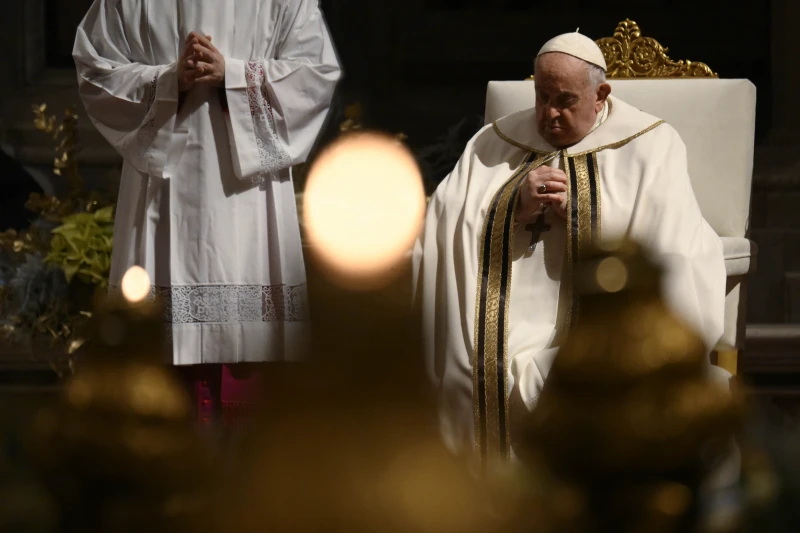
Pope Francis prays during Christmas Mass in St. Peter’s Basilica on Dec. 24, 2023. / Vatican Media
Vatican City, Dec 24, 2023 / 18:00 pm (CNA).
Below is the full text of Pope Francis’ homily for the Solemnity of the Nativity of the Lord, delivered on Dec. 24, 2023, in St. Peter’s Basilica.
“A census of the whole earth” (cf. Lk 2:1). This was the context in which Jesus was born, and the Gospel makes a point of it. The census might have been mentioned in passing, but instead is carefully noted. And in this way, a great contrast emerges. While the emperor numbers the world’s inhabitants, God enters it almost surreptitiously. While those who exercise power seek to take their place with the great ones of history, the King of history chooses the way of littleness. None of the powerful take notice of him: only a few shepherds, relegated to the margins of social life.
The census speaks of something else. In the Scriptures, the taking of a census has negative associations. King David, tempted by large numbers and an unhealthy sense of self-sufficiency, sinned gravely by ordering a census of the people. He wanted to know how powerful he was. After some nine months, he knew how many men could wield a sword (cf. 2 Sam 24:1-9). The Lord was angered and the people suffered. On this night, however, Jesus, the “Son of David”, after nine months in Mary’s womb, is born in Bethlehem, the city of David. He does not impose punishment for the census, but humbly allows himself to be registered as one among many. Here we see, not a god of wrath and chastisement, but the God of mercy, who takes flesh and enters the world in weakness, heralded by the announcement: “on earth peace among those whom he favors” (Lk 2:14). Tonight, our hearts are in Bethlehem, where the Prince of Peace is once more rejected by the futile logic of war, by the clash of arms that even today prevents him from finding room in the world (cf. Lk 2:7).
The census of the whole earth, in a word, manifests the all-too-human thread that runs through history: the quest for worldly power and might, fame and glory, which measures everything in terms of success, results, numbers and figures, a world obsessed with achievement. Yet the census also manifests the way of Jesus, who comes to seek us through enfleshment. He is not the god of accomplishment, but the God of Incarnation. He does not eliminate injustice from above by a show of power, but from below, by a show of love. He does not burst on the scene with limitless power, but descends to the narrow confines of our lives. He does not shun our frailties, but makes them his own.
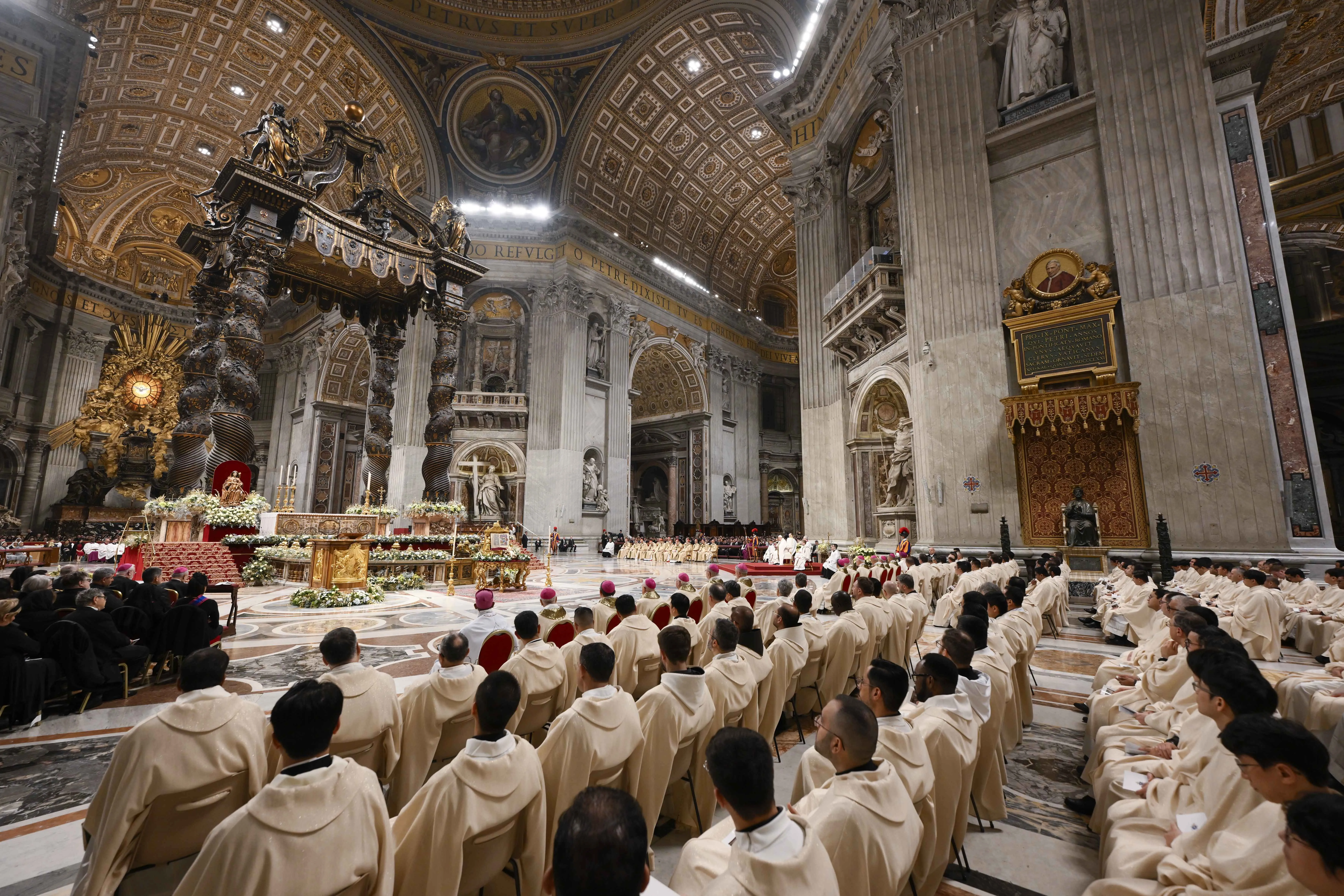
Christmas Mass in St. Peter’s Basilica on the night of Dec. 24, 2023. Vatican Media
Brothers and sisters, tonight we might ask ourselves: Which God do we believe in? In the God of incarnation or the god of achievement? Because there is always a risk that we can celebrate Christmas while thinking of God in pagan terms, as a powerful potentate in the sky; a god linked to power, worldly success, and the idolatry of consumerism. With the false image of a distant and petulant deity who treats the good well and the bad poorly; a deity made in our own image and likeness, handy for resolving our problems and removing our ills. God, on the other hand, waves no magic wand; he is no god of commerce who promises “everything all at once”. He does not save us by pushing a button, but draws near us, in order to change our world from within. Yet how deeply ingrained is the worldly notion of a distant, domineering, unbending, and powerful deity who helps his own to prevail against others! So many times this image is ingrained in us. But that is not the case: our God was born for all, during a census of the whole earth.
Let us look, then, to the “living and true God” (1 Thess 1:9). The God who is beyond all human reckoning and yet allows himself to be numbered by our accounting. The God, who revolutionizes history by becoming a part of history. The God who so respects us as to allow us to reject him; who takes away sin by taking it upon himself; who does not eliminate pain but transforms it; who does not remove problems from our lives but grants us a hope that is greater than all our problems. God so greatly desires to embrace our lives that, infinite though he is, he becomes finite for our sake. In his greatness, he chooses to become small; in his righteousness, he submits to our injustice. Brothers and sisters, this is the wonder of Christmas: not a mixture of sappy emotions and worldly contentment, but the unprecedented tenderness of a God who saves the world by becoming incarnate. Let us contemplate the Child, let us contemplate the manger, his crib, which the angels call “a sign” for us (cf. Lk 2:12). For it truly is the sign that reveals God’s face, a face of compassion and mercy, whose might is shown always and only in love. He makes himself close, tender, and compassionate. This is God’s way: closeness, compassion, tenderness.
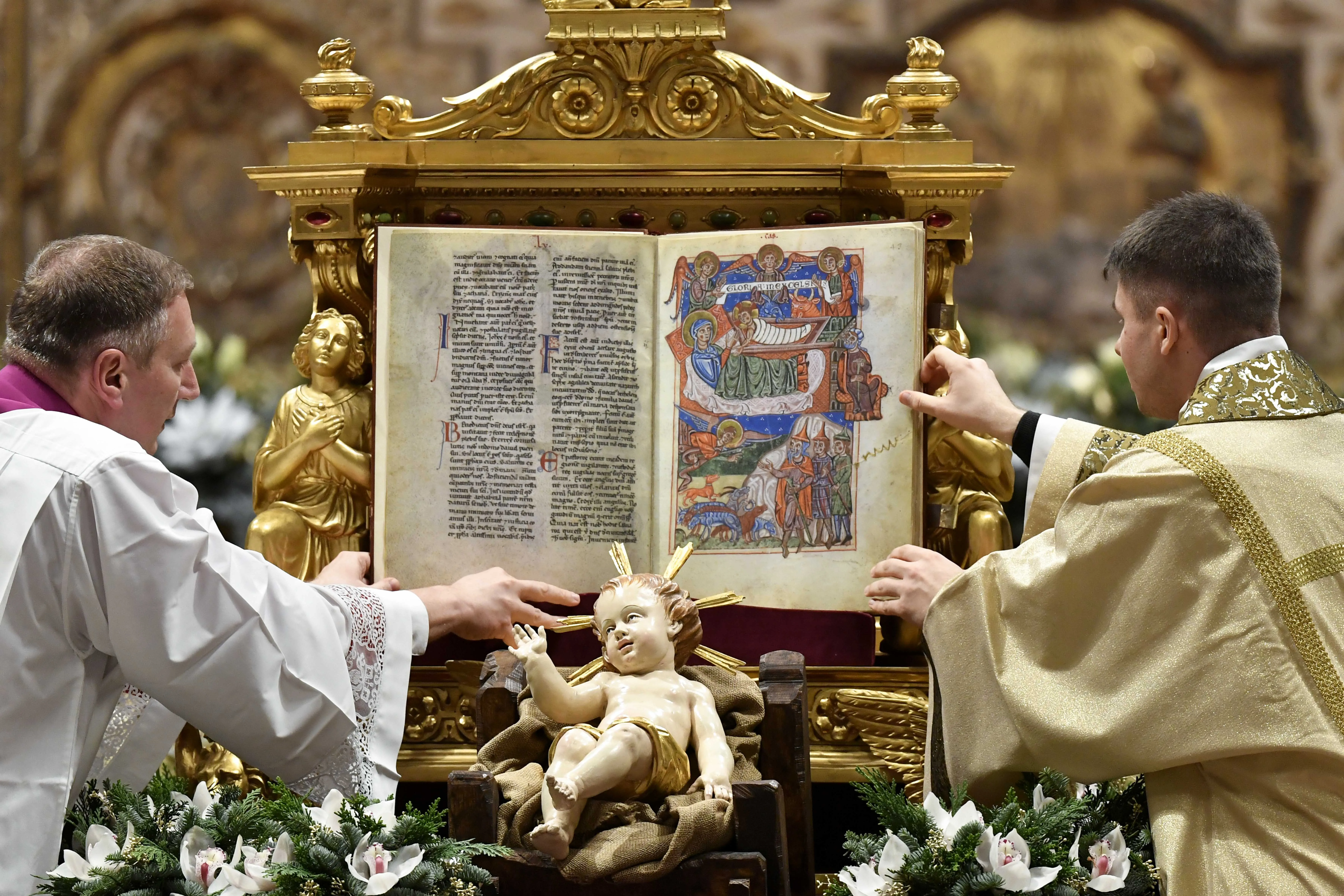
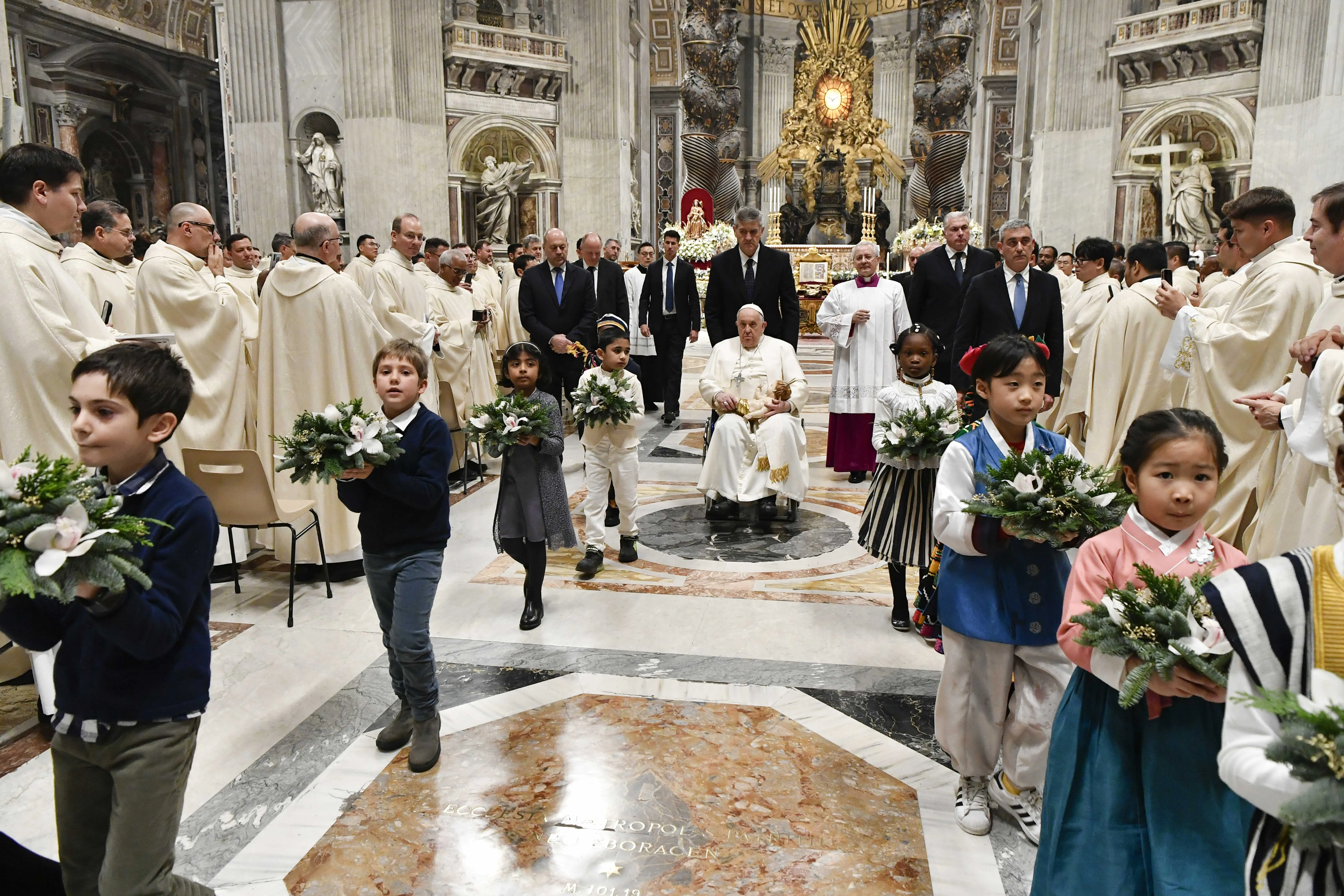
Pope Francis brings a figure of the Christ child over to the nativity scene inside of St. Peter’s Basilica at the end of Mass. Vatican Media
Sisters and brothers, let us marvel at the fact that he “became flesh” (Jn 1:14). Flesh: the very word evokes our human frailty. The Gospel uses this word to show us that God completely assumed our human condition. Why did he go to such lengths? Because he cares for us, because he loves us to the point that he considers us more precious than all else. Dear brother, dear sister, to God, who changed history in the course of a census, you are not a number, but a face. Your name is written on his heart. But if you look to your own heart, and think of your own inadequacies and this world that is so judgmental and unforgiving, you may feel it difficult to celebrate this Christmas. You may think things are going badly, or feel dissatisfied with your limitations, your failings, your problems, and your sins. Today, though, please, let Jesus take the initiative. He says to you, “For your sake, I became flesh; for your sake, I became just like you”. So why remain caught up in your troubles? Like the shepherds, who left their flocks, leave behind the prison of your sorrows and embrace the tender love of the God who became a child. Put aside your masks and your armor; cast your cares on him and he will care for you (cf. Ps 55:22). He became flesh; he is looking not for your achievements but for your open and trusting heart. In him, you will rediscover who you truly are: a beloved son or daughter of God. Now you can believe it, for tonight the Lord was born to light up your life; his eyes are alight with love for you. We have difficulty believing in this, that God’s eyes shine with love for us.
Christmas Mass in St. Peter’s Basilica on the night of Dec. 24, 2023. Vatican Media
Christ does not look at numbers, but at faces. However, who looks at him amid the many distractions and mad rush of a bustling and indifferent world? Who is watching? In Bethlehem, as crowds of people were caught up in the excitement of the census, coming and going, filling the inns, and engaged in petty conversation, a few were close to Jesus: Mary and Joseph, the shepherds, and then the Magi.
Let us learn from them. They stood gazing upon Jesus, with their hearts set on him. They did not speak, they worshiped. Tonight, brothers and sisters, is a time of adoration, of worship.
Worship is the way to embrace the Incarnation. For it is in silence that Jesus, the Word of the Father, becomes flesh in our lives. Let us do as they did, in Bethlehem, a town whose name means “House of Bread”. Let us stand before him who is the Bread of Life. Let us rediscover worship, for to worship is not to waste time, but to make our time a dwelling place for God. It is to let the seed of the Incarnation bloom within us; it is to cooperate in the work of the Lord, who, like leaven, changes the world. To worship is to intercede, to make reparation, to allow God to realign history. As a great teller of epic tales once wrote to his son, “I put before you the one great thing to love on earth: the Blessed Sacrament… There you will find romance, glory, honor, fidelity, and the true way of all your loves on earth” (J.R.R. TOLKIEN, Letter 43, March 1941).
Brothers and sisters, tonight love changes history. Make us believe, Lord, in the power of your love, so different from the power of the world. Lord, make us, like Mary, Joseph, the shepherds, and the Magi, gather around you and worship you. As you conform us ever more to yourself, we shall bear witness before the world to the beauty of your countenance.
Vatican City, Oct 5, 2017 / 04:49 am (CNA/EWTN News).- As the Chaldean Catholic Church begins their annual synod, Pope Francis kicked the meeting off by telling leaders of the eastern rite that given the new apprehensions arising from increasing political instability, they must urgently work to promote unity at all levels of society.
“If in fact a tragic page has closed in some regions of your country, it means that there is still much to be done,” the Pope said Oct. 5, urging Chaldean Church leaders in Iraq “to work tirelessly as builders of unity.”
This unity is especially important between pastors of the Chaldean Catholic Church and leaders of other Catholic rites in the area, who should work together in “promoting dialogue and collaboration among all the actors of public life” in helping to facilitate the return of displaced persons and to heal divisions, he said.
Francis stressed that this commitment to unity “is necessary now more than ever in the current Iraqi context, faced with new uncertainties about the future.”
“There is need for a process of national reconciliation and of a joint effort of all the components of society, to reach shared solutions for the good of the whole country,” he said, and voiced his hope that the “strength of spirit, hope and industriousness” characteristic of Iraqi society would never diminish.
He told the Church leaders to “remain firm” in their intention of “not falling into discouragement before the difficulties that still remain despite what has been done in the reconstruction work on the Nineveh Plain.”
Pope Francis spoke to participants in the Synod of the Chaldean Catholic Church, which is taking place from Oct. 4-8 in Rome,and comes on the tails of a recent Aid to the Church in Need conference on rebuilding towns and villages on the Nineveh Plains, during which Patriarch Luis Rafael Sako, Chaldean Patriarch of Baghdad, was a keynote speaker.
In addition to new fears and uncertainties roused by the recent referendum vote to liberate Iraqi Kurdistan from the Iraqi central government, making it an independent state, other talking points in the Chaldean synod will include forced migration, the return of displaced persons, the rebuilding of villages on the Nineveh Plains, Chaldean Church law, liturgical topics and vocational pastoral activities.
In his speech, the Pope said that given Iraq’s roots as a land of “civilization, encounter and dialogue” evangelized by St. Thomas the Apostle, it’s especially important that Christians in the region are united in promoting “respectful relations and interreligious dialogue through all components of society.”
He also encouraged them for a number of new vocations to the priesthood and religious life. However, with a general decline in vocations throughout the Church, Francis also cautioned against “welcoming into seminaries people who are not called by the Lord.”
“It’s necessary to examine well the vocation of youth and to verify their authenticity,” he said, explaining that formation in seminaries must be integral and “capable of including various aspects of life responding in a harmonious way to the four human, spiritual, pastoral and intellectual dimensions.”
The Pope also urged Chaldean Church leaders to work together with the Latin Church to address the diaspora of their faithful throughout the world, with an eye to the local ecclesial contexts in which they live, both from a numerical point of view, and that of religious liberty.
Special attention must be paid, he said, to the pastoral care of faithful in the territories where ancient eastern communities “have long been established,” while also promoting “communion and fraternity with the Latin rite communities in order to give the faithful a good witness without spreading divisions and disagreements.”
The Congregation for Oriental Churches will help in this task, Pope Francis said, and closed his address praying that the Chaldean Synod gathering would be “a fruitful moment of fraternal dialogue and reflection for the good of the beloved Chaldean Church.”
Chilean Cardinal Jorge Medina Estévez (1926-2021). / Biblioteca (BCN) Congreso Nacional de Chile via Wikimedia (CC BY 2.0).
Vatican City, Oct 4, 2021 / 14:00 pm (CNA).
Cardinal Jorge Arturo Medina Estévez, who led the Vatican’s liturgy office fo… […]
12 Comments
There may be a pope and his idolators, some pastoral workers, or movements and associations with particularly unChristian ideologies which close themselves off to outsiders.
“Pope Francis said Jesus wants us to stop judging others and to worry about our own behavior first. ‘Indeed, the risk is to be inflexible towards others and indulgent towards ourselves,’ he noted.”
Actually, Matthew 7:2 has Jesus saying, “For in the same way you judge others, you will be judged, and with the measure you use, it will be measured to you.”
Jeremiah 34:17 also speaks to those brutally flexible reeds who see fit to bend the Lord’s commandments and to disregard Sacred Tradition. Jeremiah speaks the judgment of the Lord to those who judge the keepers of the Lord’s commandments and Catholic tradition as unloving and rigid. Yes, they are as rigid as Christ would have them be.
“Therefore this is what the LORD says: You have not obeyed Me; you have not proclaimed freedom, each man for his brother and for his neighbor. So now I proclaim freedom for you, declares the LORD–freedom to fall by sword, by plague, and by famine! I will make you a horror to all the kingdoms of the earth.”
Pope Francis said Jesus wants us to stop judging others and to worry about our own behavior first.
The Pontiff who is not a theologian, not a liturgist, not a Canon lawyer and fundamentally very poorly catechized in the Catholic faith needs to be reminded that Jesus said otherwise. He also needs to engage in a thorough examination of conscience and amend his own judgmental behavior prior to his demise.
“And why even of yourselves, do you not judge that which is just?” Jesus Christ, Luke 12:57
St Aquinas states that man’s relations with foreigners are twofold: peaceful, and hostile. Therefore, each nation has the right to determine who should be admitted as citizens.
Even the good Samaritan did not take the man who was robbed and beaten with him. He helped him where he lived.
“Artist Timothy Schmalz, depicting migrants throughout history crowded together on a boat with the Holy Family”, is pure schmaltz. It’s art, though the theme is propaganda for a Vatican open border policy that’s destroying national identity. National and ethnic diversity are considered assets to cultural enrichment.
Welcoming, yes, and some would urge, even proselytizing.
But, here’s a side story…’bout a year ago I was early in the church, preparing as a lector, and off the street strolls a totally new young man. Never seen before. The few early parishioners are kneeling. The tabernacle resides, centered, in holy silence.
Off to the side, the newcomer ambles straight to the piano, assumes command, and begins playing as if he owned the place. I first discerned (!) and then suggested, politely, that as a walk-on perhaps he should not presume so much. (This is a parish church, after all, and a few minutes before Mass, and not a high school practice room or home rec room.)
He stops. But before heading back to the open door he approaches and, kicking the dust from his sandals, as it were, judges me and the entire parish over his shoulder: “this place is not very welcoming!”
Should I have offered Its/all/about/Me a doughnut? Should he have hung around for a bit of Eucharistic incoherence? In particular this side story—-examining my own behavior first—-what should I have done differently?
Like many, I have a lot of criticisms of Francis, but listening to him carefully he is obviously equating himself to the Devil. Well, I think he should simply go to confession and resolve to sin no more but also stop describing himself in Satanic terminology.’
The Church must be “welcoming”, to whom and what? Sin, heterodoxy, idolatry, leftist ideologies which aim to destroy and subvert the faith? The Chine Totalitarian regime? Certainly not Traditional Catholics, who simply want to celebrate the timeless Mass of Ages undisturbed. Certainly not ordinary Novus Ordo attending Catholics like myself, who were willing to give Francis a chance when he was first elected, and even tried to square his utterances with tradition and scripture, but got turned off of him due to his arrogance, tolerance of corruption (doctrinal, moral, sexual and financial), open contempt for the very people he is supposed to shepherd, refusal to teach the faith as was handed to him by his predecessors (and blatant contradiction of same, whether directly or indirectly).
As Fulton Sheen put it long ago, our problem is that we are too tolerant, not because we are intolerant. We cannot be “welcoming” to sin, error and immorality. We already tried that and it led directly to the McCarrick scandal and the sex abuse crisis.






There may be a pope and his idolators, some pastoral workers, or movements and associations with particularly unChristian ideologies which close themselves off to outsiders.
It’s all within the realm of possibility.
“Pope Francis said Jesus wants us to stop judging others and to worry about our own behavior first. ‘Indeed, the risk is to be inflexible towards others and indulgent towards ourselves,’ he noted.”
Actually, Matthew 7:2 has Jesus saying, “For in the same way you judge others, you will be judged, and with the measure you use, it will be measured to you.”
Jeremiah 34:17 also speaks to those brutally flexible reeds who see fit to bend the Lord’s commandments and to disregard Sacred Tradition. Jeremiah speaks the judgment of the Lord to those who judge the keepers of the Lord’s commandments and Catholic tradition as unloving and rigid. Yes, they are as rigid as Christ would have them be.
“Therefore this is what the LORD says: You have not obeyed Me; you have not proclaimed freedom, each man for his brother and for his neighbor. So now I proclaim freedom for you, declares the LORD–freedom to fall by sword, by plague, and by famine! I will make you a horror to all the kingdoms of the earth.”
I heard on yesterday’s news that wild boars have invaded Rome.
Pope Francis said Jesus wants us to stop judging others and to worry about our own behavior first.
The Pontiff who is not a theologian, not a liturgist, not a Canon lawyer and fundamentally very poorly catechized in the Catholic faith needs to be reminded that Jesus said otherwise. He also needs to engage in a thorough examination of conscience and amend his own judgmental behavior prior to his demise.
“And why even of yourselves, do you not judge that which is just?” Jesus Christ, Luke 12:57
St Aquinas states that man’s relations with foreigners are twofold: peaceful, and hostile. Therefore, each nation has the right to determine who should be admitted as citizens.
Even the good Samaritan did not take the man who was robbed and beaten with him. He helped him where he lived.
“Artist Timothy Schmalz, depicting migrants throughout history crowded together on a boat with the Holy Family”, is pure schmaltz. It’s art, though the theme is propaganda for a Vatican open border policy that’s destroying national identity. National and ethnic diversity are considered assets to cultural enrichment.
Welcoming, yes, and some would urge, even proselytizing.
But, here’s a side story…’bout a year ago I was early in the church, preparing as a lector, and off the street strolls a totally new young man. Never seen before. The few early parishioners are kneeling. The tabernacle resides, centered, in holy silence.
Off to the side, the newcomer ambles straight to the piano, assumes command, and begins playing as if he owned the place. I first discerned (!) and then suggested, politely, that as a walk-on perhaps he should not presume so much. (This is a parish church, after all, and a few minutes before Mass, and not a high school practice room or home rec room.)
He stops. But before heading back to the open door he approaches and, kicking the dust from his sandals, as it were, judges me and the entire parish over his shoulder: “this place is not very welcoming!”
Should I have offered Its/all/about/Me a doughnut? Should he have hung around for a bit of Eucharistic incoherence? In particular this side story—-examining my own behavior first—-what should I have done differently?
IMO the name you gave him is the answer to your question. The phrase “Be still and know that I am God” suggests itself to me at this point.
I also get the impression that he wanted to be offended so he could deliver bis exit line.
Nothing. Christlike admonition may have saved that pianist from a life of donut Christianity.
Like many, I have a lot of criticisms of Francis, but listening to him carefully he is obviously equating himself to the Devil. Well, I think he should simply go to confession and resolve to sin no more but also stop describing himself in Satanic terminology.’
The Church must be “welcoming”, to whom and what? Sin, heterodoxy, idolatry, leftist ideologies which aim to destroy and subvert the faith? The Chine Totalitarian regime? Certainly not Traditional Catholics, who simply want to celebrate the timeless Mass of Ages undisturbed. Certainly not ordinary Novus Ordo attending Catholics like myself, who were willing to give Francis a chance when he was first elected, and even tried to square his utterances with tradition and scripture, but got turned off of him due to his arrogance, tolerance of corruption (doctrinal, moral, sexual and financial), open contempt for the very people he is supposed to shepherd, refusal to teach the faith as was handed to him by his predecessors (and blatant contradiction of same, whether directly or indirectly).
As Fulton Sheen put it long ago, our problem is that we are too tolerant, not because we are intolerant. We cannot be “welcoming” to sin, error and immorality. We already tried that and it led directly to the McCarrick scandal and the sex abuse crisis.