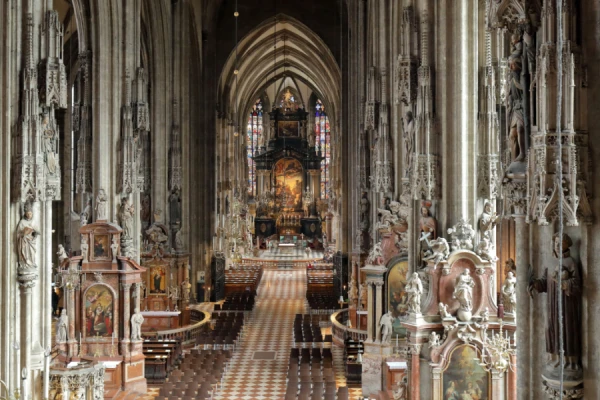
The high altar of St. Stephen’s Cathedral in Vienna, Austria. Credit: Bwag via Wikipedia (CC BY-SA 4.0).
CNA Staff, Jan 14, 2021 / 04:00 am (CNA).- Fewer people left the Catholic Church in Austria in 2020 than in the previous year, according to official figures released on Wednesday.
New statistics, published on Jan. 13, showed that 58,535 people formally left the Church in 2020, compared to 67,794 in 2019 — a drop of 13.7%.
All Austrian dioceses recorded a decline in the number of people leaving, reported CNA Deutsch, CNA’s German-language news partner, defying expectations in a year dominated by the coronavirus crisis.
Overall, the number of Catholics in Austria fell by around 1.5%, from 4.98 million in 2019 to 4.91 million in 2020.
Church authorities said that 3,807 people rejoined the Church or joined for the first time in 2020 — 28.7% fewer than in 2019, when 4,898 people joined or rejoined.
In addition, 461 people made use of their “right of withdrawal” in 2020. People invoking this right — known as “Recht auf Widerruf” in German — initially declared their intention to leave the Church but decided not to take the step after contacting Church officials within a three-month period.
“In any case, the decisive factors for the slight decline in the number of Catholics are not only the ratio of resignations to Church admissions but above all also the ratio of baptisms to deaths and of arrivals to departures,” said the bishops’ conference.
Other areas of the Austrian Church are defying the downward trend.
In November, the archdiocese of Vienna announced a rise in the number of men training for the priesthood.
Fourteen new candidates entered the archdiocese’s three seminaries this autumn. Eleven of them are from Vienna archdiocese and the remaining three are from the dioceses of Eisenstadt and St. Pölten.
If you value the news and views Catholic World Report provides, please consider donating to support our efforts. Your contribution will help us continue to make CWR available to all readers worldwide for free, without a subscription. Thank you for your generosity!
Click here for more information on donating to CWR. Click here to sign up for our newsletter.

Pope Francis stands on an altar erected outside the Parliament Building in Budapest’s Kossuth Lajos’ Square during a public outdoor Mass on April 30, 2023. / Vatican Media
CNA Staff, Apr 30, 2023 / 05:47 am (CNA).
During an outdoor Mass in Budapest on Good Shepherd Sunday, Pope Francis called on Hungarians to be “open and inclusive,” reflecting on how Jesus wants his flock to share the abundant life they’ve received from him.
“Though we are diverse and come from different communities, the Lord has brought us together, so that his immense love can enfold us in one embrace,” the pope said in his April 30 homily, speaking in bright sunshine to more than 50,000 people gathered in and around the Hungarian capital’s picturesque Kossuth Lajos Square.
“[A]ll of us are called to cultivate relationships of fraternity and cooperation, avoiding divisions,” he said, “not retreating into our own community, not concerned to stake out our individual territory, but rather opening our hearts to mutual love.”
Prior to Mass, held outside the city’s majestic neo-Gothic Parliament building, the pope was transported in his wheelchair to a specially constructed altar platform flanked by banners in the colors of the Vatican and Hungarian flags and simply adorned with a towering wooden crucifix.
Pope Francis and Cardinal Peter Erdő, the archbishop of Budapest (left) are shown at the outdoor Mass held in Budapest, Hungary, on April 30, 2023. Erdő was the principal celebrant of the Mass; since the pope’s knee injury has impeded his mobility, he has called on cardinals to take his place at the altar. Vatican Media
Cardinal Peter Erdő, the archbishop of Budapest, was the principal celebrant of the Mass; since the pope’s knee injury has impeded his mobility, he has called on cardinals to take his place at the altar.
In his homily, Francis zeroed in on “two specific things that, according to the Gospel, [the Good Shepherd] does for the sheep. He calls them by name, and then he leads them out.”
“The history of salvation does not begin with us, with our merits, our abilities, and our structures. It begins with the call of God,” the pope said.
“[T]his morning, in this place, we sense the joy of our being God’s holy people. All of us were born of his call.”
Pope Francis said he spoke especially “to myself and to my brother bishops and priests: to those of us who are shepherds.” He called on the faithful to be “increasingly open doors: ‘facilitators’ — that’s the word — of God’s grace, masters of closeness; let us be ready to offer our lives, even as Christ … teaches us with open arms from the throne of the cross and shows us daily as the living Bread broken for us on the altar.”
Seeing closed doors is “sad and painful,” the pope said. He referred specifically to the “closed doors of our selfishness with regard to others; the closed doors of our individualism amid a society of growing isolation; the closed doors of our indifference towards the underprivileged and those who suffer; the doors we close towards those who are foreign or unlike us, towards migrants or the poor.”
The pope’s plea was, “Please, let us open those doors! Let us try to be — in our words, deeds, and daily activities — like Jesus, an open door.”
As open doors, the Lord of life can enter our hearts, Pope Francis assured, with “words of consolation and healing.”
Pope Francis speaks during a public outdoor Mass in Kossuth Lajos Square in Budapest, Hungary, on April 30, 2023. Vatican Media
Speaking to his Hungarian hosts, he urged them to be “open and inclusive” and “in this way, help Hungary to grow in fraternity, which is the path of peace,” an apparent reference to the country’s contested migration policies.
While the pope has praised the country for being a leader in assisting persecuted Christians in other countries and welcoming more than a million war refugees from neighboring Ukraine, Prime Minister Viktor Orbán’s curbing of migrants from the Middle East and Africa is generally seen as being at odds with the pope’s call to openness. During the migrant crisis of 2015, Orbán sealed Hungary’s southern border with Serbia, closing off the main land route into Europe.
Pope Francis ended his homily with a reminder that Jesus “calls us by name and cares for us with infinitely tender love. He is the door, and all who enter through him have eternal life. He is our future, a future of ‘life in abundance.’
“Let us never be discouraged,” the pope said. “Let us never be robbed of the joy and peace he has given us. Let us never withdraw into our own problems or turn away from others in apathy. May the Good Shepherd accompany us always: with him, our lives, our families, our Christian communities and all of Hungary will flourish with new and abundant life!”
In his Regina Caeli reflection after the Mass, the pope referenced the ongoing fighting in Ukraine.
“Blessed Virgin, watch over the peoples who suffer so greatly. In a special way, watch over the neighboring, beleaguered Ukrainian people and the Russian people, both consecrated to you,” he said.
“You, who are the Queen of Peace, instill in the hearts of peoples and their leaders the desire to build peace and to give the younger generations a future of hope, not war, a future full of cradles not tombs, a world of brothers and sisters, not walls and barricades.”
Ending his three-day visit to Budapest, the pope is scheduled to deliver a speech on culture and academics Sunday afternoon at the Péter Pázmány Catholic University. He then will have a farewell ceremony at 5:30 p.m. local time before departing on his return flight to Rome.
CNA Staff, Sep 17, 2020 / 12:10 pm (CNA).- Fr. Tony Flannery, a Redemptorist priest from Ireland who was barred from public ministry by the Congregation for the Doctrine of the Faith, has declined to submit to four doctrinal propositions as a condition of returning to ministry.
“Fr Flannery should not return to public ministry prior to submitting a signed statement regarding his positions on homosexuality, civil unions between persons of the same sex, and the admission of women to the priesthood,” the CDF wrote to the Redemptorists, The Irish Times reported Sept. 16.
Fr. Flannery told the Irish daily, “I could not possibly sign those propositions.”
He was barred from public ministery in 2012 for his views on the nature of the sacramental priesthood and human sexuality. He had helped to found the Association of Catholic Priests, a group whose constitution places a special emphasis on “the primacy of the individual conscience” and “a redesigning of Ministry in the Church, in order to incorporate the gifts, wisdom and expertise of the entire faith community, male and female.”
Redemptorist leadership in Ireland had written to the order’s superior general, who in turn wrote to the CDF, seeking for Fr. Flannery to be allowed to minister again.
According to the Association of Catholic Priests, the CDF asked that Fr. Flannery, to return to ministry, sign a proposition that “according to the Tradition and the doctrine of the Church incorporated in the Canon Law (c. 1024), a baptized male alone receives sacred ordination validly.”
This proposition regarding the reservation of priesthood to men was supported by excerpts from St. John Paul II’s 1994 apostolic letter Ordinatio Sacerdotalis and Pope Francis’ 2020 apostolic exhortation La querida Amazonia.
Regarding the moral liceity of homosexual acts, Fr. Flannery was to submit to the proposition that “Since the homosexual practices are contrary to the natural law and do not proceedfrom a genuine affective and sexual complementarity, they are not approved by the moral teaching of the Catholic Church,” supported by a quote from the Catechism of the Catholic Church.
The priest was also asked to assent to the proposition that “The Marriage covenant, by which a man and a woman form with each other an intimate communion of life and love, has been founded and endowed with its own special laws by the Creator (CCC 1660). Other forms of union do not correspond to God’s plan for marriage andfamily. Therefore, they are not allowed by the Catholic Church.”
This proposition on marriage was supported by the Catechism of the Catholic Church and by Amoris laetitia, Pope Francis’ 2016 apostolic exhortation on love in the family.
Finally, Fr. Flannery was invited to submit to the proposition that “In so far as it contradicts the foundations of a genuine Christian anthropology, gender theory is not accepted by Catholic teaching,” supported by the Congregation for Catholic Education’s 2019 document “Male and female he created them”.
The priest told The Irish Times that he has long supported and emphasized “the necessity, of full equality for women, including ordination. How could I possibly sign that first proposition.”
He called the proposition regarding homosexual acts “appalling” and said, “I could not submit to it.” He noted that he voted in favor of same-sex marriage, and that “I don’t know enough about Gender Theory to have any strong views on it, and I don’t know where that one came from.”
We Are Church Ireland, a group that supports, among other things, women’s priestly ordination, said Sept. 17 that they “fully support and applaud Fr Tony Flannery’s decision not to sign the CDF document.”
They said the propositions of the congregation “are currently being widely discussed in the Catholic Church around the world, for example at the German Synodal Way.”
“We thought that under Pope Francis dialogue was being encouraged and that “silencing” would no longer be the tool of engagement,” the group stated.
In June 2018, Pope Francis sent a 28-page letter to German Catholics urging them to focus on evangelization in the face of a “growing erosion and deterioration of faith.”
“Every time an ecclesial community has tried to get out of its problems alone, relying solely on its own strengths, methods and intelligence, it has ended up multiplying and nurturing the evils it wanted to overcome,” he wrote.
Pope Francis said that participants in the “Synodal Way” faced a particular “temptation”, at the basis of which “is the belief that the best response to the many problems and shortcomings that exist, is to reorganize things, change them and ‘put them back together’ to bring order and make ecclesial life easier by adapting it to the current logic or that of a particular group.”
Paris, France, Apr 16, 2019 / 10:06 am (CNA).- As the roof of Notre-Dame de Paris burned Monday evening, young Frenchwoman Julie Brocas wandered the streets of the city – she did not want to go home, but she was too emotionally exhausted to conti… […]
Leave a Reply