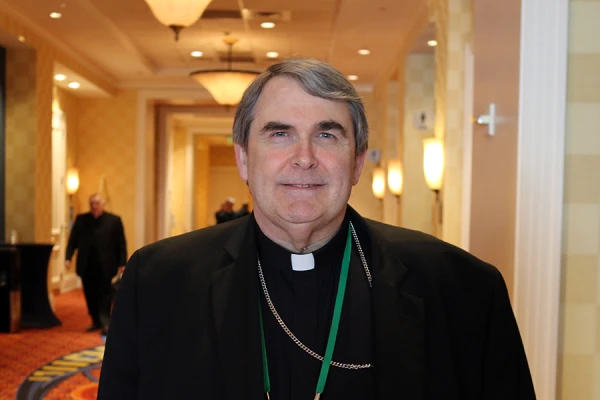
Bishop Michael Fisher outside the meeting hall during the 2019 USCCB General Assembly, June 12, 2019. Credit: Kate Veik/CNA.
Vatican City, Dec 1, 2020 / 05:45 am (CNA).- Pope Francis Tuesday appointed Bishop Michael Fisher, an auxiliary of Washington, to be the next bishop of the scandal-ridden Diocese of Buffalo, New York.
Fisher, 62, will take over leadership of Buffalo as the diocese faces a new lawsuit from the State of New York for failing to protect children from clergy sex abuse.
The diocese also filed for bankruptcy in February of this year, after it was named in hundreds of clerical abuse lawsuits filed in New York courts.
Fisher will be the 15th bishop of the western New York diocese, following Bishop Richard Malone, who resigned amid controversy in December 2019.
In September 2019, Bishop Malone’s former secretary leaked audio of conversations where Malone appeared to acknowledge the legitimacy of sexual harassment accusations made against a diocesan priest months before the priest was removed from active ministry.
A month later, the Vatican ordered an apostolic visitation of Malone’s diocese, which has been embroiled in scandal since November 2018, when Malone’s former assistant leaked records reportedly showing that the diocese worked with lawyers to conceal credible abuse allegations from the public.
While the diocese had reported the names of some priests credibly accused of abuse, it had not reported others, the records appeared to show. Bishop Malone denied claims that he had covered up abuse.
Six months later, Malone apologized for his handling of the case of Fr. Art Smith, a diocesan priest who faced repeated accusations of abuse and misconduct with minors.
Last week, New York’s Attorney General Letitia James filed a lawsuit in the state’s supreme court against the Diocese of Buffalo. Malone, retired auxiliary Bishop Edward Grosz, and Buffalo’s apostolic administrator, Bishop Edward Scharfenberger of Albany, were also named in the lawsuit.
The state alleges that the diocese, Malone, and Grosz failed to properly investigate claims of clergy sex abuse. The state also claims that diocesan leadership did not “refer unassignable priests to the Vatican,” monitor priests with credible accusations, or take necessary action against diocesan priests credibly accused of child sex abuse. It argued that, under state laws governing non-profits, the diocese did not act in “good faith” by failing to follow its own procedures on clergy sex abuse.
Fisher will be installed as bishop of the Diocese of Buffalo on Jan. 15, 2021, at the Cathedral of St. Joseph.
In a press release from the Diocese of Buffalo Dec. 1, Fisher said “though the challenges that currently confront the Diocese of Buffalo are many and significant, they are not equal to the resolve of so many committed laywomen and men, devoted priests, deacons and religious across Western New York, who are no less determined to reveal God’s transformative love that has the power to bind every wound, renew and make us whole.”
Bishop Fisher is the oldest of five children and a native of Baltimore, Maryland. After earning degrees in business administration and accounting at the University of Maryland, he worked as a comptroller for a psychiatric practice.
He discerned a vocation to the priesthood and was ordained a priest of the Archdiocese of Washington in 1990.
In 2006, Fisher was appointed vicar for clergy and secretary for ministerial leadership, with responsibility for vocations, formation and care of the clergy for the archdiocese.
Pope Francis named him auxiliary bishop of Washington in June 2018.
Over nearly 30 years of priesthood, Fisher served in several parishes and in leadership of different archdiocesan ministries, including on education, social justice, parish life, and youth.
He has also served on the archdiocese’s administrative board, clergy personnel board, priest council, and priest retirement board, and, according to the press release, his ministry “has involved the continuing education of priests, particularly in aiding new pastors in their roles and the planning and implementation of ongoing clergy training via convocations and retreats.”
Cardinal Wilton Gregory of Washington described Fisher as “an exceptionally compassionate and skilled servant of the Church.”
“His distinguished history as pastor, Vicar for Priests, and member of our Pastoral Administration have prepared him well for his new responsibilities in that diocese. While we will miss his deft pastoral talents, they will be warmly welcomed by the faithful, religious, and clergy of the Diocese of Buffalo,” Gregory said.
If you value the news and views Catholic World Report provides, please consider donating to support our efforts. Your contribution will help us continue to make CWR available to all readers worldwide for free, without a subscription. Thank you for your generosity!
Click here for more information on donating to CWR. Click here to sign up for our newsletter.
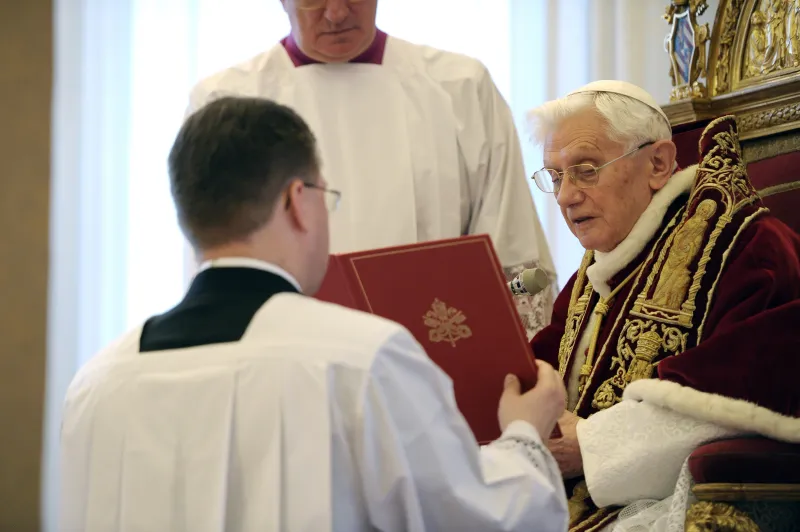
Pope Benedict XVI announced his intention to resign the papacy during a meeting of cardinals Feb. 11, 2013. The surprise announcement, which he made in Latin, took place in the Hall of the Consistory in the Vatican’s apostolic palace. / Vatican Media
Washington, D.C. Newsroom, Jan 2, 2023 / 06:00 am (CNA).
On Feb. 11, 2013, before a gathering of cardinals who had come to the Vatican expecting to hear the announcement of upcoming canonizations, Pope Benedict XVI dropped a bombshell.
After a few announcements about Church business at the conclusion of the meeting, the pope took out two sheets of paper and read a prepared statement in Latin.
“I have convoked you to this Consistory, not only for the three canonizations, but also to communicate to you a decision of great importance for the life of the Church. After having repeatedly examined my conscience before God, I have come to the certainty that my strengths, due to an advanced age, are no longer suited to an adequate exercise of the Petrine ministry,” the then 85-year-old pontiff told the gathering of the Catholic Church’s highest-ranking clergymen.
Because he spoke in Latin, the language used for official Vatican proclamations, reporters present did not at first realize that the pope had just stepped down.
‘Total surprise, total shock’
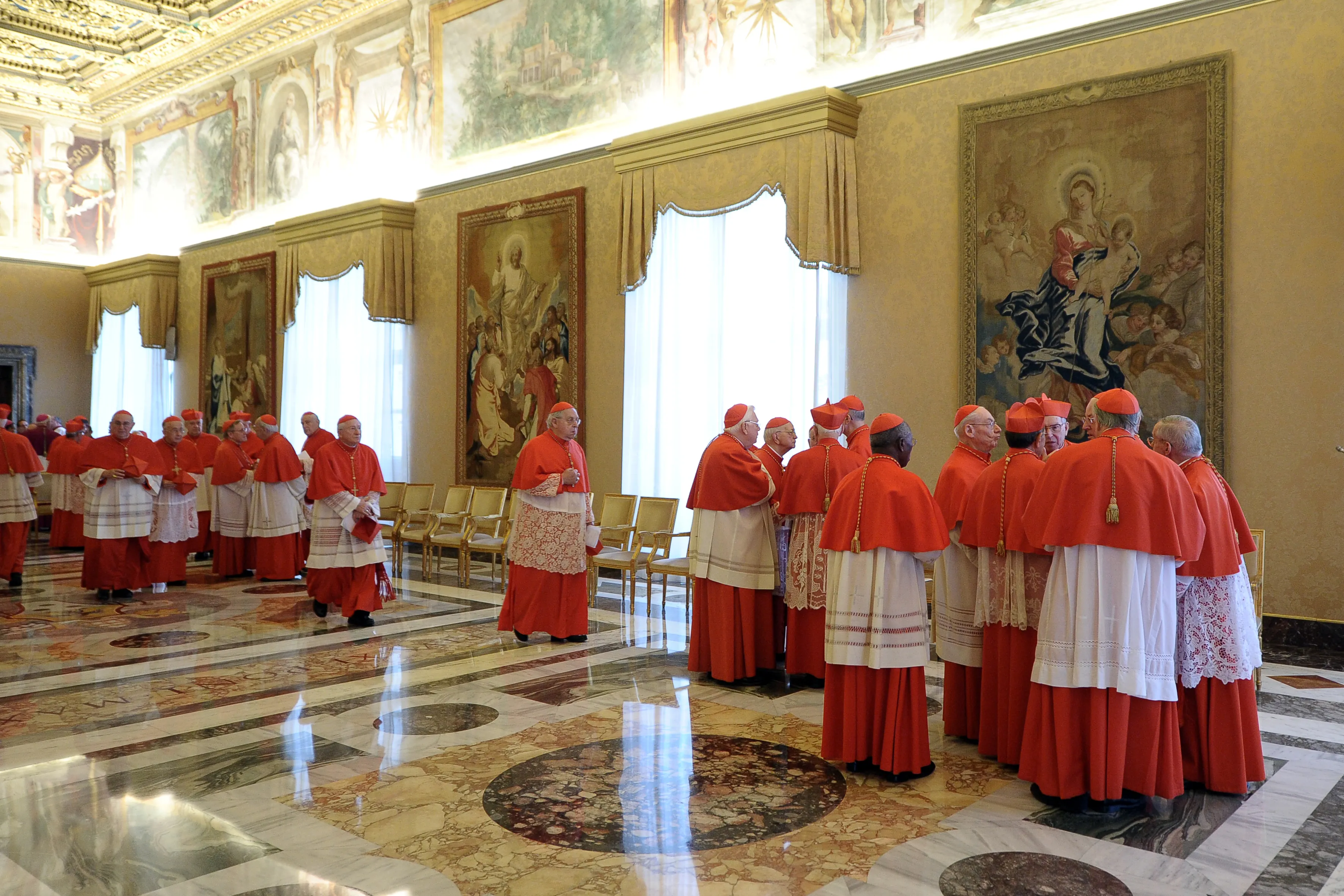
The assembled cardinals, on the other hand, who knew their Latin, reacted with stunned silence.
American Cardinal James Stafford later told CNA that the pope’s statement was received with “total surprise, total shock.”
“A cardinal who was sitting next to me said, ‘Did he resign?’ I said, ‘Yes, that’s what he did. He resigned.’ And we just all stood at our places.”
Cardinals react to Pope Benedict XVI’s announcement of his intention to resign the papacy Feb. 11, 2013. The surprise announcement, which Benedict made in Latin, took place in the Hall of the Consistory in the Vatican’s apostolic palace. Vatican Media
Nigeria’s Cardinal Francis Arinze, who was present that morning, said the announcement was a “surprise, like thunder that gives no notice that it’s coming,” reported The Catholic Telegraph.
In renouncing the papacy, Benedict became only the second pope in almost 600 years to voluntarily step down. In 1294, Pietro da Morrone, an elderly hermit, was crowned Pope Celestine V, but finding the demands of the job too much for him, he resigned after only five months.
In 1415, Pope Gregory XII also resigned, but under very different circumstances — he stepped down in order to end a crisis within the Church known as the Great Western Schism.
Title, white clothes, and papal coat of arms
What happened next with Benedict XVI was no less surprising to those who expected him to live as a retired cardinal.
In his last official statement as pope, before a general audience on Feb. 27, 2013, Pope Benedict assured the tens of thousands of people gathered to hear him speak as pope for the last time that even though he was stepping back from official duties, he would remain, in essence, pope.
“The ‘always’ is also a ‘forever’ — there can no longer be a return to the private sphere. My decision to resign the active exercise of the ministry does not revoke this,” Benedict said.
“I do not return to private life, to a life of travel, meetings, receptions, conferences, and so on. I am not abandoning the cross, but remaining in a new way at the side of the crucified Lord,” he told the crowd.
A day earlier, on Feb. 26, 2013, the director of the Vatican Press Office, Father Federico Lombardi, had silenced speculation over what Benedict would be called and what he would wear. He would, Lombardi said, retain the trappings of the papacy — most significantly, his title and dress.
“He will still be called His Holiness Benedict XVI,” Lombardi said. “But he will also be called Pope Emeritus or Roman Pontiff Emeritus.”
Lombardi said Benedict would continue to wear a white cassock but without the mozzetta, the short cape that covers the shoulders. The pope’s fisherman’s ring would be replaced by a ring from his time as cardinal. The red shoes would go as well, Lombardi said, and be replaced by a pair of brown ones.
“The city of León is known for beautiful shoes, and very comfortable shoes. And when the pope was asked what he wanted to wear he said, ‘I want the shoes from León in Mexico,’” Lombardi said at the press conference.
On May 2, the cardinal who designed Benedict’s coat of arms in 2005 told CNA that he had written the pope emeritus suggesting that his coat of arms would need to be redesigned to reflect his new status. Cardinal Andrea Cordero Lanza di Montezemolo proposed making the keys of St. Peter smaller and less prominent.
“That shows that he had a historic possession but not a current jurisdiction,” said the cardinal at the time.
Benedict, however, it seems, politely declined a new coat of arms. La Stampa reported the following year that the Vatican Publishing House’s manual of ecclesiastical heraldry in the Catholic Church contained the following note:
“Expressing deep appreciation and heartfelt gratitude to the author for the interesting study sent to him, [Benedict] made it known that he prefers not to adopt an expressive heraldic emblem of the new situation created with his renouncing of the Petrine Ministry.”
By his decision to continue to dress in white like the pope, retain the title of pope, and keep the coat of arms of his papacy, Benedict revealed that in giving up the “active exercise of the ministry,” he was not forsaking the role of pope altogether.
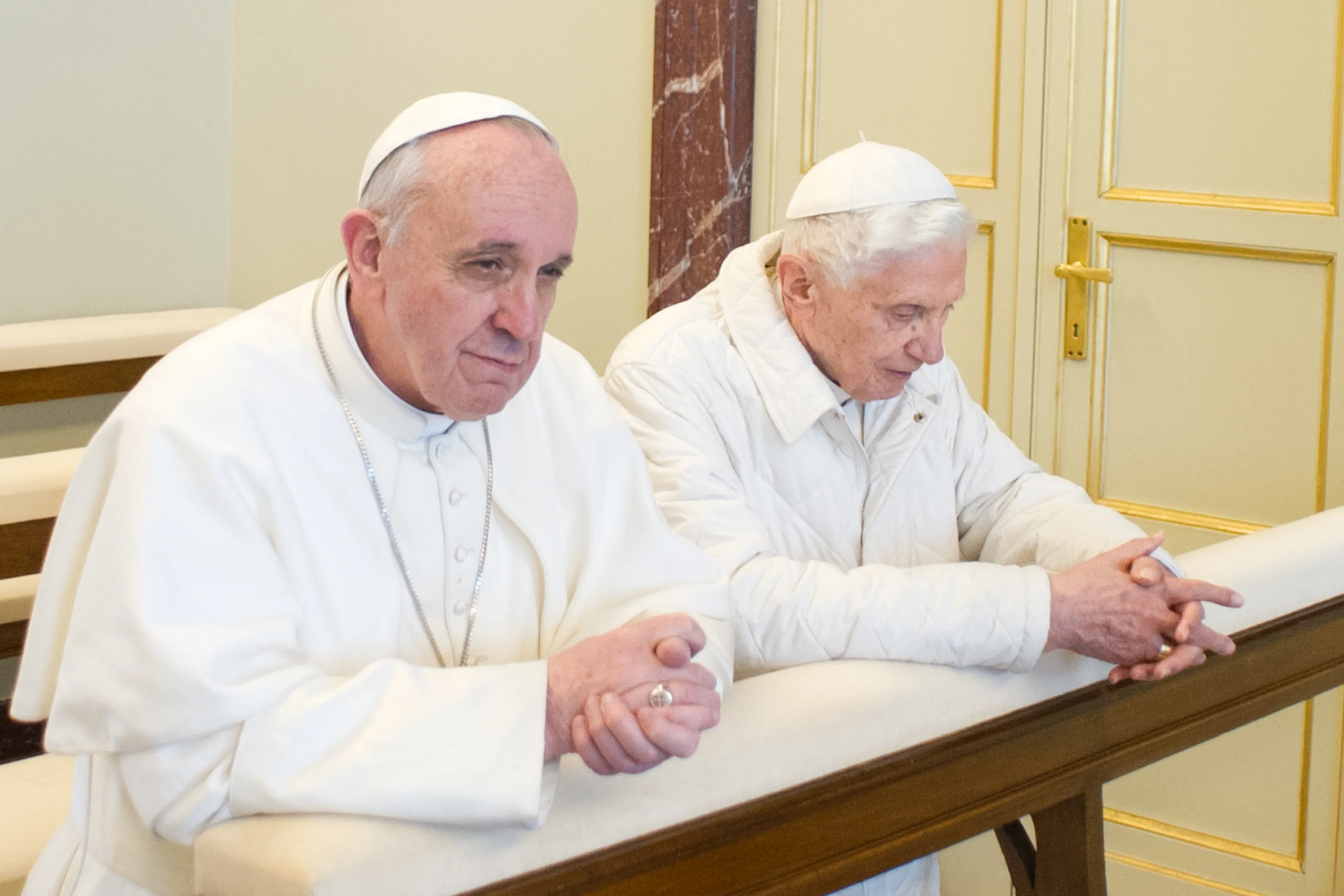
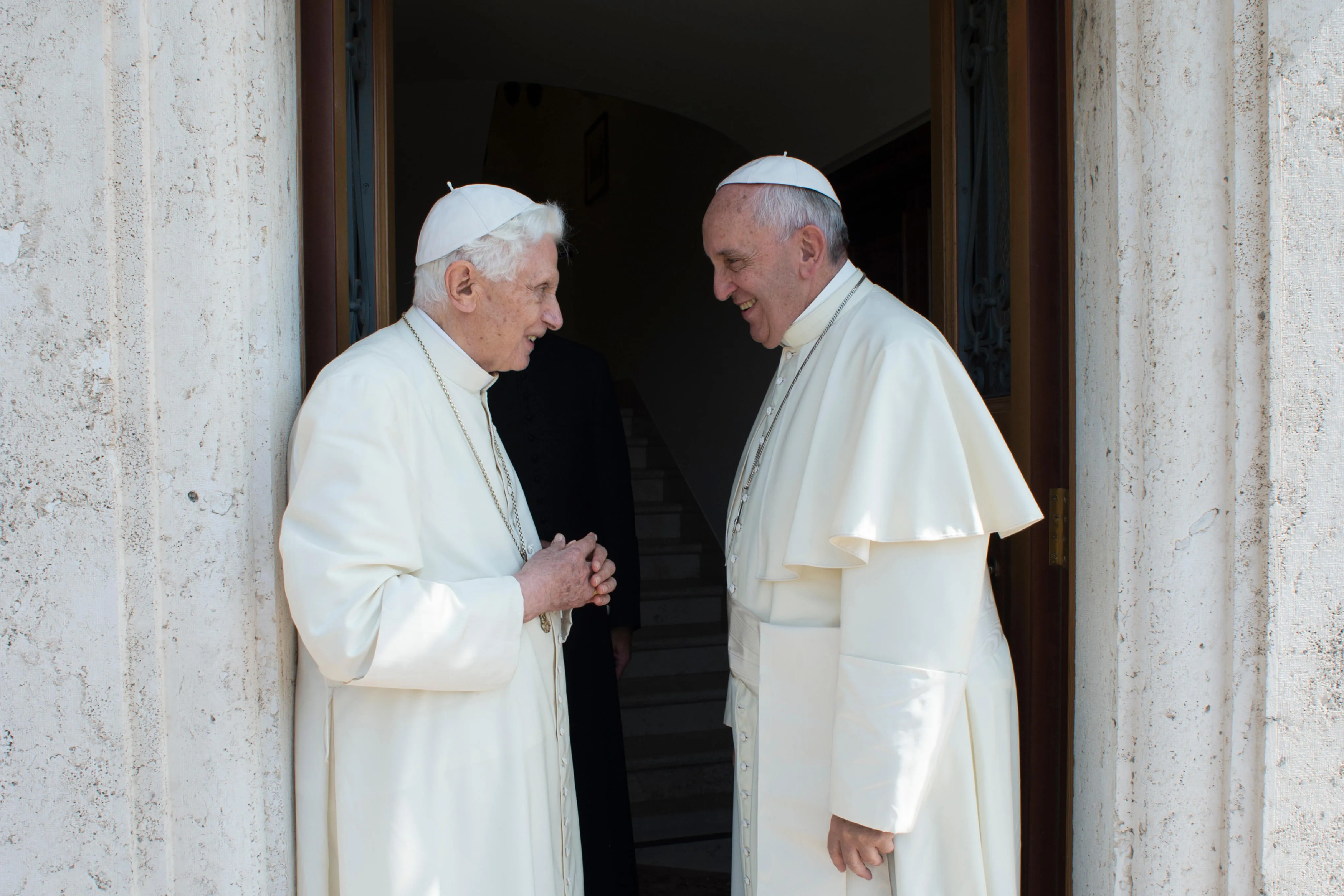
Pope Francis and Pope Emeritus Benedict XVI pray together at the papal residence in Castel Gandolfo March 23, 2013, their first meeting after Francis’ election. Vatican Media
An expanded Petrine ministry
In his 2013 announcement, Benedict clearly expressed his intention to step aside, even determining the date and time of his official departure. Nonetheless, his decision to keep the title of pope and maintain the ceremonial protocol that goes along with the papacy led some to speculate whether there were not actually “two popes.”
Benedict’s personal secretary and closest confidante, Archbishop Georg Gänswein, sought to clear up any confusion in 2016.
In a speech at the Pontifical Gregorian University in Rome on May 20, 2016, Gänswein said that Pope Francis and Benedict are not two popes “in competition” with one another but represent one “expanded” Petrine office with “an active member” and a “contemplative.”
Parsing Benedict’s speech, Gänswein explained that in stepping down, Benedict was not giving up his ministry.
“The key word in that statement is ‘munus petrinum,’ translated — as happens most of the time — with ‘Petrine ministry.’ And yet, ‘munus,’ in Latin, has a multiplicity of meanings: It can mean service, duty, guide, or gift, even prodigy. Before and after his resignation, Benedict understood and understands his task as participation in such a ‘Petrine ministry [munus],’” Gänswein said.
“He left the papal throne and yet, with the step he took on Feb. 11, 2013, he has not abandoned this ministry,” Gänswein explained, saying the latter scenario was something “quite impossible after his irrevocable acceptance of the office in April 2005.”
Benedict himself later made clear in an interview with his biographer Peter Seewald that he saw himself as continuing in his ministry. He said that a pope who steps down is like a father whose role changes, but always remains a father.
“Of course a father does not stop being father, but he is relieved of concrete responsibility. He remains a father in a deep, inward sense, in a particular relationship which has responsibility, but not with day-to-day tasks as such. It was also this way for bishops,” Benedict said.
“I think it is also clear that the pope is no superman and his mere existence is not sufficient to conduct his role, rather he likewise exercises a function.
“If he steps down, he remains in an inner sense within the responsibility he took on, but not in the function. In this respect one comes to understand that the office of the pope has lost none of its greatness, even if the humanity of the office is perhaps becoming more clearly evident,” Benedict said.
Benedict’s decision “not to abandon his ministry” inspired a cottage industry of conspiracy theories, with some questioning whether the pope emeritus truly stepped down because of his age and frailty.
George Weigel, author of the definitive biography of St. John Paul II, “Witness to Hope,” dismissed such speculation in an interview with CNA.
“I have no reason to think that there was anything more to Pope Benedict’s resignation than what he said was its cause: his conviction that he no longer had the strength, physical and intellectual, to give the Church what it needed from a pope,” he said.
“Everything else written about this is sheer speculation. Let’s take Benedict at his word,” Weigel said.
A life of prayer
In retiring to live in the Mater Ecclesiae Monastery in the Vatican Gardens, Benedict did not completely withdraw from the world. He attended public events in his new capacity as pope emeritus, received visitors, and pursued a life of fruitful study, writing, and prayer.
Pope Francis visits Pope Emeritus Benedict XVI at the Mater Ecclesiae monastery in Vatican City to exchange Christmas greetings Dec. 23, 2013. Vatican Media
Matthew Bunson, Catholic historian, author, and executive editor of EWTN News, told CNA that Benedict was determined not to exercise authority in his new role.
“He really embraced what it means to be pope emeritus, and refrained from making public comments, to instead live a life of prayer and reflection,” Bunson said.
“Benedict really was on retreat, and in prayer,” he said, “and that means we have his prayer for us as a Church.”
While becoming increasingly frail, Benedict continued to celebrate Mass daily with the other residents of the monastery and was known to enjoy spending time in the Vatican Gardens praying his daily rosary.
In the fall of 2021, more than eight years after Benedict stepped down, his private secretary, Gänswein, told Domradio in Cologne, Germany, that Benedict was “stable in his frailty.”
He described the pope emeritus as very weak physically but still clear in mind. Gänswein said he had not lost his “typical Bavarian humor.”
The meaning of Benedict’s renunciation for future popes
In 2013, after Benedict announced that he would step down as pope, Father Gianfranco Ghirlanda, a Jesuit theologian and canonist chosen by Pope Francis to be a cardinal, wrote an essay on what should happen when a pope steps down.
In the article, published in Civiltà Cattolica, Ghirlanda suggested the retiring Benedict take the title bishop emeritus of Rome.
“It is evident that the pope who has resigned is no longer pope; therefore he no longer has any power in the Church and cannot interfere in any government affair. One may wonder what title Benedict XVI will retain. We think that he should be given the title of bishop emeritus of Rome, like any other diocesan bishop who ceases,” he said.
In December 2021, at a congress on papal resignations, Ghirlanda took up the theme again.
“Having two people with the title of ‘pope,’ even if one added ’emeritus,’ it cannot be said that this might not generate confusion in public opinion,” he said.
To make clear that the pope who resigns is no longer pope, he said, he should perhaps be called “former Roman pontiff” or “former supreme pontiff.”
Pope Francis in July 2022 told reporters that if he were to retire from the papacy he would do things differently from his predecessor.
“The first experience went very well,” Pope Francis said, because Benedict XVI “is a holy and discreet man.”
In the future, however, “it would be better to define things or explain them better,” the pontiff added.
“I am the bishop of Rome. In that case I would be the bishop emeritus of Rome,” he said, and then suggested he would live in St. John Lateran Palace rather than at the Vatican.
St. Paul VI. / Credit: Catholic News Service, Public domain, via Wikimedia Commons
ACI Prensa Staff, Jul 25, 2024 / 18:30 pm (CNA).
On July 25, 1968, St. Paul VI published Humanae Vitae, an encyclical on the regulation of birth and the dangers … […]
1 Comment
At least the Holy Father selected someone well away from the scandals of McCarrick…Ooops. I guess we only have a small pool of secular catholics to pull from.




At least the Holy Father selected someone well away from the scandals of McCarrick…Ooops. I guess we only have a small pool of secular catholics to pull from.