


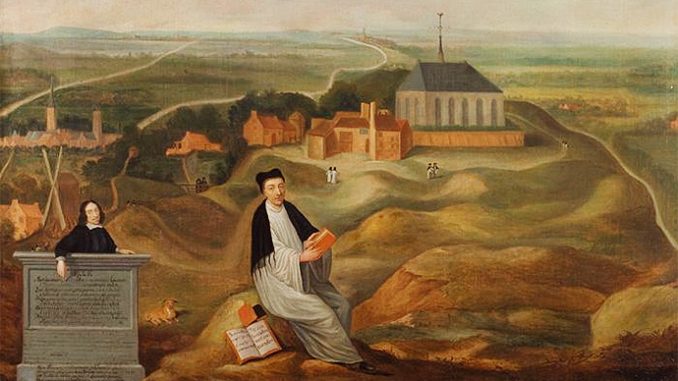
Apart from the Bible, The Imitation of Christ is considered the most widely read devotional book in the world. It has remained remarkably popular since it was first published in the Netherlands five centuries ago, and it has been translated into almost as many languages as the Bible itself. Although originally written in Latin, one can easily find multiple versions currently available in English: pocket-sized versions, cheap versions, hardcover versions with illustrations, imitation leather versions, illuminated though out-of-print versions, and even translations by noted authors, including Monsignor Ronald Knox.
Why has The Imitation of Christ remained so popular for centuries? Why have saints recommended it? And who wrote it?
Who was Thomas à Kempis?
It was initially published anonymously, but for two centuries everyone assumed that Thomas à Kempis was the author of The Imitation. However, in the seventeenth century, a furious debate erupted among various scholars who proposed certain French, German, and Italian spiritual writers instead. Eventually, based on the evidence of multiple reputable witnesses1 and a contemporary manuscript bearing Kempis’ name,2 scholars returned to the conclusion that Thomas à Kempis was the true author of The Imitation.
Thomas à Kempis was born in Kempen, Germany, in 1380. His father was a blacksmith, and his mother was a teacher. When Thomas was twelve years old, he accompanied his older brother Johann to study at a school in Deventer, Netherlands.
While at Deventer, Thomas encountered members of the Brothers of the Common Life, a religious community founded by a popular preacher named Gerard Groote. Groote was a deacon who emphasized personal devotion and encouraged a practical approach to spirituality. He established communities for men and for women. Members worked to support themselves, lived in common houses, and endeavored to live lives of poverty, chastity, and obedience. Each community followed a daily schedule of prayer and work, much like monasteries, although members did not take formal vows.
Disciples of Groote had founded a community in the city of Zwolle. They followed the structure of the Augustinian canons regular, but they also followed the rule of life of the Brothers of the Common Life. Thomas’ older brother Johann was a member of the Brothers and the prior at Zwolle, so when nineteen-year-old Thomas had completed his studies, he went to visit his brother. And he decided to join them.
Like other members of his community, Thomas was assigned the time-consuming but important task of copying books. During his lifetime, he copied the entire Bible four times. He became an Augustinian canon regular soon after arriving at the community, but ten years passed before he was ordained to the priesthood. He served as subprior to his community in Zwolle for many decades.
Thomas died around the age of ninety on May 1, 1471. There is a legend that his cause for canonization has been stalled for centuries because his body, when exhumed, showed signs that he was buried alive and that he tried to escape from his coffin. The presupposition is that he may have despaired of God’s mercy at that time.
This is somewhat unlikely since ninety-year-olds tend to be well aware of the unavoidable approach of death. Whether this legend about Thomas has some basis in fact, it is a flimsy reason for delaying the canonization of a man who was widely considered a holy man during his own lifetime. A better possible reason for the delay is offered below.
Why so popular? And for so long?
Today, Thomas is best remembered for his many writings. He wrote biographies of several contemporaries, including Gerard Groote, as well as books of prayers and meditations. But The Imitation of Christ is his masterpiece.
Saint Thérèse of Lisieux memorized entire passages of The Imitation, and Saint Thomas More said that it was one of the three books that everyone should own. It influenced Saints Francis de Sales and Ignatius of Loyola in their approaches to providing spiritual direction. In the Ignatian Spiritual Exercises, the retreatant is frequently told to consider reading The Imitation as part of their reflections. Even devout Protestants have referred to The Imitation in glowing terms, although some of them seem to feel it necessary to turn Thomas into a proto-Protestant Reformer to explain the brilliance of his spiritual insights.
Why has The Imitation of Christ remained so popular, even in translation and over many centuries?
The Imitation is composed of four books, with each book composed of a variable number of chapters. It is short, which is one of the keys to its success. The Imitation is easy to carry in a pocket or a purse, not a thick volume that requires a backpack.
While it can be read from cover to cover like a typical book, The Imitation can also be opened at random to find a sentence or two useful for meditation, whether one is walking, cleaning the house, or waiting for public transportation. In this, it is somewhat like the popular works of Saint Josemaría Escrivá—The Way, Furrow, and The Forge—which are short collections of brief meditations to help Catholics remain aware of God’s presence in their everyday lives.
While the reflections in The Imitation are often profound, they are not wordy or written for theologians. In fact, those with a tendency toward exactitude in their theological explanations might find it annoying to read this passage:
What does it avail you to argue profoundly of the Trinity if you be void of humility, and consequently be displeasing to the Trinity? … I would rather feel compunction than know its definition.3
Although there are a few references to monastic life in The Imitation, it is not difficult to translate those to ordinary modern life, changing “cell” or “chamber” to “bedroom” or “prayer corner”, for example:
If you would feel compunction in your heart, retire into your chamber and shut out the tumult of the world … You will find in your cell what you will often lose abroad.4
While translations vary, the four books in The Imitation are generally subtitled: 1) Helpful Counsels of the Spiritual Life; 2) Directives for the Interior Life; 3) On Interior Consolation, and 4) On the Blessed Sacrament. These topics are broad enough to apply to practically any Catholic seeking spiritual encouragement.
Some chapters of The Imitation consist of a dialogue between Christ and an unnamed disciple. This can be a tricky technique for a Catholic writer to use. If the writer’s underlying spirituality is not thoroughly biblical and faithful to the magisterium, one might end up censured by the Vatican for attributing un-Christlike words to Christ. But The Imitation’s chapter on “Four Things Which Bring Great Peace” is a classic example of Christlike spiritual guidance:
Christ: Son, now I will teach you the way of peace and of true liberty.
Disciple: Do, Lord, as You say, because this is delightful for me to hear.
Christ: Try, my son, to do the will of another rather than your own. Always choose to have less rather than more. Always seek to take the last place, and to be subject to everyone. Always desire and pray that the will of God be perfectly fulfilled in you. Behold, a man so disposed, enters within the confines of peace and quiet.5
Over the centuries, many wise priests, spiritual directors, and other holy souls have written books of spiritual direction. However, it is challenging to write about growing in virtue to a broad audience in a manner that is not too didactic or too emotional, too technical or too full of slang, too personal or too vague.
Why has Thomas not been canonized?
Reading The Imitation, on the other hand, is like listening to a pious friend who has spent many years trying to stay on the narrow path that leads to heaven and wants to help you arrive at the same destination. In fact, one of the most famous passages of the book reminds readers that the only way to reach heaven is by carrying one’s cross, the Cross of Christ.
In the cross there is salvation; in the cross there is life; in the cross there is protection from your enemies; in the cross there is infusion of heavenly sweetness; in the cross there is strength of mind; in the cross there is spiritual joy; in the cross there is the compendium of virtue; in the cross there is the perfection of sanctity. There is no health for the soul nor hope of eternal life, except in the cross. Therefore, take up your cross and follow Jesus, and you will attain eternal life.6
This may be the reason for the nearly universal appeal of The Imitation of Christ: it aids readers in placing Jesus Christ and His Cross at the center of their everyday lives.
But the Church canonizes people, not books. Since there has been confusion about whether Thomas is truly the author of The Imitation of Christ and since information about his personal life is limited, it would be somewhat difficult for the Church to declare him a saint. Also, there are theologians who might oppose his canonization because some of them are still annoyed about the quote stating it is “better to feel compunction than define it.”
In the sixteenth century, just when Thomas’ cause for canonization might have been pursued by the Church and the Brothers of the Common Life, the Protestant Revolution erupted. That event dramatically changed religious practice in Germany and the Netherlands, and it destroyed the communities of the Brothers of the Common Life in those countries.
Whether Thomas à Kempis is gazing on the face of God and is fit to be declared a saint of the Church, God alone knows. But when those of us who are still on earth need gentle, timeless advice about seeking peace in our daily lives, trusting more in God than in men, and loving Jesus above all things, we can turn to the pages of The Imitation of Christ.
And perhaps we can ask for strength from heaven, through Thomas’ intercession, if we are ever tempted to despair of the mercy of God.
Endnotes:
1 Francis Richard Cruise, Thomas à Kempis: Notes of a Visit to the Scenes in Which His Life Was Spent, With Some Account of the Examination of His Relics (Forgotten Books, 2018), 149-159.
2 Vincent Scully, “Thomas à Kempis,” The Catholic Encyclopedia, vol. 14 (New York: Robert Appleton Company), 1912, http://www.newadvent.org/cathen/14661a.htm.
3 Book I, chapter I, no. 3. All quotations used here are from the Daughters of St. Paul edition, dated 1983.
4 Book I, chapter XX, no. 5.
5 Book III, chapter XXIII, nos. 1-3.
6 Book II, ch. XII, no. 2.
If you value the news and views Catholic World Report provides, please consider donating to support our efforts. Your contribution will help us continue to make CWR available to all readers worldwide for free, without a subscription. Thank you for your generosity!
Click here for more information on donating to CWR. Click here to sign up for our newsletter.

A condensation of the Gospel call to sanctity. For all of us a valuable source of reminders and guidance to realistically answer Christ’s impossible command to “Be perfect, therefore, as your heavenly Father is perfect” (Mt 5:48). We either become saints now or made such by purification after death.
Dawn Beutner perceives, like most, that Thomas à Kempis is the author. Whoever wrote it Angel or man, content and the wide affirmation of that content affirm its inspiration by the Holy Spirit.