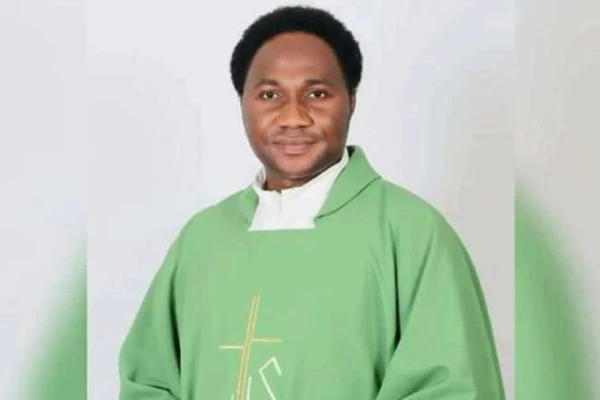
CNA Staff, Nov 27, 2020 / 08:20 am (CNA).- A Nigerian archbishop has asked for prayers for the safe release of a priest kidnapped in Abuja earlier this week.
Fr. Matthew Dajo was kidnapped on Sunday night. Police are currently working to negotiate his release, the archdiocesan spokesman, Fr. Patrick Alumuku, told CNA Nov. 27.
Archbishop Ignatius Kaigama of Abuja appealed for prayers for the abducted priest at a virtual event on persecuted Christians Nov. 25.
“My priest in Abuja was kidnapped and he is still in captivity. Kindly pray for his safe release, please,” the archbishop said.
Dajo was abducted by gunmen during an attack on the town of Yangoji, where his parish St. Anthony’s Catholic Church is located.
“Armed bandits raided the community and shot sporadically for about 30 minutes,” Fr. Kevin Oselumhense Anetor told CNA’s African news partner, ACI Africa.
“The gunmen scaled through the fence of the priest’s house, while others positioned themselves outside, before entering Fr. Matthew’s bedroom and whisking him away.”
Kidnappings of Catholics in Nigeria are an ongoing problem that not only affects priests and seminarians, but also lay faithful, Kaigama said.
“We have cases of abductions, detentions, and killings by terrorist groups, criminal herdsmen, bandits, and gangs of kidnappers to contend with,” he said.
“Last week, in one of our parishes in Abuja archdiocese behind the parish house, five children of the same parents were kidnapped, and the following day a woman preparing for her church wedding was also kidnapped. They have not been found.”
The Islamist group Boko Haram has been behind many of the abductions, including that of 110 students kidnapped from their boarding school in Feb. 2018. Of those kidnapped, one girl, Leah Sharibu, is still being held.
“Leah has become a symbol of Christian resilience against forced conversion,” the archbishop said.
He added that “however we must not forget the remaining 112 Chibok girls and others who are held captive with many either dead or forcefully married off,” referring to the kidnapping of 276 girls in the town of Chibok, Borno State, in 2014.
“Others like her are used as human shields, sex slaves, or bargaining chips for ransom from government and international organizations,” he said.
“The forceful abduction and conversion of underage Christians girls is real. On the other hand, Muslim girls who freely choose to marry Christian men face threats of death.”
Archbishop Kaigama spoke at a virtual event organized by Aid to the Church in Need UK for “Red Wednesday.”
Aid to the Church in Need began the annual Red Wednesday initiative in 2015 to draw attention to the plight of persecuted Christians around the world by illuminating in red major landmarks, such as the Colosseum in Rome and Westminster Cathedral in London.
At the event, the Nigerian archbishop appealed for support for his community as it struggled with the attacks of Boko Haram and other groups.
“Western nations need to pay the same attention to this reality as they vigorously do in their countries in the case of the COVID-19 pandemic,” he said.
“The Christian-dominated Middle Belt and some parts of northern Nigeria will have no future if groups like Boko Haram and allied terror groups continue to harass them.”
“The U.K. and other nations with Christians roots should speak and act more in favor of freedom in northern Nigeria.”
Kaigama said that the United Nations, the European Union, and key countries like the United States could also do more in sharing strategic intelligence and give more technical support in the face of these terrorist threats.
“We are united in prayer and action for Christians unjustly detained for their faith. We strongly urge that they all be set free,” he said.
If you value the news and views Catholic World Report provides, please consider donating to support our efforts. Your contribution will help us continue to make CWR available to all readers worldwide for free, without a subscription. Thank you for your generosity!
Click here for more information on donating to CWR. Click here to sign up for our newsletter.

At the end of the Mass of consecration on Nov. 1, 2023, María Ruiz Rodríguez shows the ring symbolizing her membership in the Ordo Virginum. That’s the only outward sign of her consecration. / Credit: Latin Patriarchate of Jerusalem
Jerusalem, Nov 12, 2023 / 07:00 am (CNA).
On the 25th day of the ongoing conflict between Israel and Hamas, the Church in Jerusalem welcomed a new consecrated member into its fold. María Ruiz Rodríguez made her consecration in the Ordo Virginum on Nov. 1, permanently rooting herself in the local ecclesiastical community.
“A thought crossed my mind, a temptation: ‘What purpose does this step serve in the midst of current events? Doesn’t the Church have more urgent matters to attend to than to stop and celebrate the consecration of a humble woman like me?’” Ruiz shared with CNA a few days later. But she said she was immediately aware of something else.
“I told myself: I cannot delay this commitment… In fact, uniting my life with the Church in a time of suffering is even more meaningful,” she said.
Cardinal Pierbattista Pizzaballa, Latin patriarch of Jerusalem, presided over the consecration of María Ruiz Rodríguez in the Ordo Virginum on Nov. 1, 2023, in the Church of the Latin Patriarchate of Jerusalem. With this consecration, Ruiz permanently rooted herself in the local Church. Credit: Marinella Bandini
Ruiz, now 42, is originally from Spain and arrived in Jerusalem in 2018 for a period of discernment. At that time, she was a member of the “Monastic Family of Bethlehem, the Assumption of the Virgin Mary and St. Bruno,” an institute of consecrated life established in France in 1950.
It was Ruiz’s first time in the Holy Land, even though the desire to visit the sacred places in the Holy Land had long been a dream in her heart.
Iconographer María Ruiz Rodríguez with the new Roman Missal in Arabic. The book is open on the page where she depicted the Crucifixion of Jesus. Credit: Marinella Bandini
“For two years, I set aside my savings to make a pilgrimage in 2000, the year of the Great Jubilee. However, in that very year, I entered the convent, so I gave up. I felt that Jesus was saying to me: ‘I am your Holy Land.’ In a way, I had already arrived in Jerusalem,” Ruiz said.
It was in the Holy Land that Ruiz first came into contact with some consecrated women of the Ordo Virginum.
“I was looking for my place and I felt called,” she said.
The Ordo Virginum, Ruiz continued, “is the oldest form of consecration in the Church”. Abandoned over the centuries in favor of the religious life, it was rediscovered with the Second Vatican Council as a form of life that, “in a radically transformed historical context” possesses “a surprising force of attraction” and is “capable of responding not only to the desires of many women to dedicate themselves totally to the Lord and to their neighbors, but also to the concurrent rediscovery by the particular Church of its own identity in communion with the one Body of Christ” (cf. Instruction “Ecclesiae Sponsae Imago” on the “Ordo Virginum”).
Iconographer María Ruiz Rodríguez at work in her studio. The image depicts Jesus walking on water and taking St. Peter’s sinking hand (Mt 14:22-33). Credit: Marinella Bandini
Consecrated women in the Ordo Virginum choose to live a life of virginity “for the sake of the kingdom of heaven” in a lay form of life. They do not wear religious habits, do not live in communities, have no common statutes or rules, or even superiors. Instead, they maintain a personal reference to the local bishop — in this case, Cardinal Pierbattista Pizzaballa — who acts as guarantor of their journey of discernment and presides over their consecration.
The sole commitment these consecrated women make is the “resolution of chastity,” which they express during the Rite of Consecration. The only symbol they wear is a ring, emphasizing the spousal character of this vocation, which reflects the mystery of the Church as “Bride of Christ.” Engraved in Ruiz’s ring is an inscription in Hebrew meaning “O my life,” referring to Christ, and the date of her consecration.
Iconographer María Ruiz Rodríguez on her terrace looking at the horizon. In the background are the walls of Jerusalem and the outline of the Basilica of the Dormition, November 2023. Credit: Marinella Bandini
Women who consecrate themselves in the Ordo Virginum support themselves through their jobs. Ruiz is an iconographer and has been working for the Latin Patriarchate of Jerusalem for about four years. She was drawn into a project aimed at renewing liturgical books — the Missal and the Evangeliary — with her artwork.
“I first approached iconographic art when I was a nun. It was first of all a spiritual journey, a path of prayer. More than an artistic expression, an icon is a profession of faith. Before beginning the work, I invoke the Holy Spirit and ask for forgiveness for my own sins and for those who will venerate these images. I was interested in this dimension of relationship,” Ruiz shared. She spent a year researching the style and colors.
“The patriarch asked me to create something that would speak to local Christians, who are Latin by tradition but Eastern by culture. A style that was uniquely mine yet rich in the entire iconographic tradition of the Church of Jerusalem. The art of Armenian manuscripts certainly had a significant influence on me.”
Iconographer María Ruiz Rodríguez at work in her studio. Currently, Ruíz is in the process of creating the images for the Gospels of Matthew and Mark. Credit: Marinella Bandini
The patriarch takes a personal interest in overseeing Ruiz’s work. “We read the Gospel together and choose which scenes to represent, taking into account the particularity of each evangelist. He particularly enjoys highlighting passages that are less frequently represented in the artistic tradition. This is a project close to his heart,” she told CNA.
Currently, Ruíz is in the process of creating images for the Gospels of Matthew and Mark.
“The process is very laborious and involves multiple stages for each page: the pencil lettering, the crafting of the icons, then the ink lettering and finally the gilding.” The plan is for a volume of about 200 pages with 250 images.
“Making this work in Jerusalem has a special value: I can visit the places where that Gospel was lived” but also “immerse myself in Jewish culture,” she said. “This has opened my eyes to the richness that Judaism brings to Christianity. There is a perfect continuity and at the same time an unprecedented newness in the person of Christ.”
The Church of the Latin Patriarchate of Jerusalem full of people on Nov. 1, 2023, for the Mass of consecration of María Ruiz Rodríguez in the Ordo Virginum. Credit: Latin Patriarchate of Jerusalem
Ruiz learned the local languages — Arabic and Hebrew. The Mass of her consecration brought together within one place all the diverse “souls” of the Jerusalem Church: priests, friars, religious, and laity, Arab Christians and Hebrew-speaking Christians, each hearing the word of God in their own language. There were migrants, foreigners, Jews, and Christians of various denominations.
The culminating moment of María Ruiz Rodríguez’s consecration in the Ordo Virginum. The celebration took place on Nov. 1, 2023, in the Church of the Latin Patriarchate of Jerusalem. Credit: Latin Patriarchate of Jerusalem
“I believe my being a foreigner is a blessing for this Church,” Ruiz said. “Why were there such different people in the church that day? Because I am neither Arab nor Jewish, and this allows me to bring both of these peoples into my heart together. In the praise of God we were one people, transcending the divisions that usually separate us. The Church in Jerusalem also needs this, to remember its universal vocation.”
Group photo at the end of the Mass of consecration of María Ruiz Rodríguez in the Ordo Virginum. With her (in the middle, with red shirt) there are other members of the Ordo Virginum, and the bishops of the Latin patriarchate of Jerusalem (from left to right: Giacinto-Boulos Marcuzzo, bishop emeritus; Monsignor William Shomali, general vicar and patriarchal vicar for Jerusalem and Palestine; Cardinal Pierbattista Pizzaballa, Latin patriarch of Jerusalem; Monsignor Rafic Nahra, patriarcal vicar for Israel). Credit: Latin Patriarchate of Jerusalem
With her consecration, Ruiz embarks on her new journey as a “living stone” of the Jerusalem Church: “I am certain that I am finally in the right place. It is not an act of heroism. I am simply where God wants me to be.”
Erbil, Iraq, Mar 5, 2021 / 11:19 am (CNA).- When Vida Hanna was told by the Archbishop Bashar Warda of the Chaldean Archeparchy of Erbil that Pope Francis was coming to Iraq, she thought to herself it was just another rumor.
Growing up in the Chaldean Catholic community in Erbil, Hanna, 27, was a little girl when there were rumors that St. John Paul II was planning to come to Iraq for the Jubilee 2000.
“But once I saw the official announcement from the Vatican, I knew this time it was for real,” she told CNA from her office at the Catholic University in Erbil.
Hanna, who graduated in communications at UC San Diego, is the director of public and international relations at the Catholic university, and Archbishop Warda appointed her coordinator of the Mass Pope Francis will celebrate March 7 at Erbil’s Franso Hariri Stadium.
“COVID has devastated the local economy, so organizing an event of this magnitude, even for the local Kurdish autonomous authorities, was financially impossible,” Hanna said. But according to her, the Knights of Columbus stepped in on their own initiative. “With their usual generosity and discretion, they made this dream possible for the whole community,” she added.
“Calling this event historical is almost an understatement for all minorities, especially Christian, after centuries of massacre, persecutions, and forced displacement.”
Once the funds were secured, Hanna convoked volunteers. They got far more than they expected to, because “all the Christian kids know that this is a once in a life opportunity.”
She then put the Catholic university IT managers to work on software that would guarantee high standards of identity recognition.
“This took quite an effort, because, as you can understand, the security standards have to be very high: we need to double check documents, correct name spellings, make sure they match IDs, and so forth,” she told CNA.
The volunteers were trained at the Catholic university, gathered information from Christians in a 50 mile radius from Erbil, and set up 30 computers at the campus. “The sign-in for the 10,000 available seats lasted two weeks, while simultaneously, a group of volunteers with church and government experts scouted the stadium, established perimeters, security areas, and contingency plans,” Hanna says.
She told CNA that with all this details taken care of, “the next challenge was transportation.” “Keep in mind, never before in Erbil, 10,000 people have been simultaneously transported to a single place in an orderly fashion. But we are now very confident that everything is in place and will work fine.”
Hanna is especially happy that the Mass is involving so many young people. Beside the 250 young volunteers, there are another 100 youth in the chorus that will accompany the Mass.
“All of the local young Christians are in awe that this is happening to them and their generation… and it is so much needed! Only the Holy Father can bring the sense of security, the inner peace, the hope for a society that accepts religious diversity,” she said.
During the Mass, local Muslim authorities will attend, and there will be a place reserved for other minorities such as the Yazidis. The celebration will include passages in Aramaic, Kurdish, Arabic, English, and Italian. “I will be doing one of the readings in Aramaic, the language of Jesus… so I am a bit nervous,” Hanna joked.
“But the important thing is that the Mass will be not only the celebration of Jesus’ sacrifice, but also a strong message to our young Christians: you can stay, you don’t need to leave, you can build a future here, in the land where we Christians have been for almost two millennia.”
Wau, South Sudan, Feb 19, 2021 / 10:45 am (CNA).- A Catholic health centre of the Diocese of Wau has temporarily shut down after all three doctors at the facility tested positive for Covid-19.
The administrator of Sika Hadid Primary Health Centre, Sr…. […]
Leave a Reply