Vatican City, May 14, 2020 / 07:15 am (CNA).- Pope Francis has donated $200,000 to support 400 scholarships in Lebanon in an expression of his concern for the country’s young people, the Vatican announced Thursday.
The Holy See press office said May 14 that Lebanon was experiencing a “severe crisis” that risked robbing younger generations of hope.
“It is becoming increasingly difficult to ensure that the sons and daughters of the Lebanese people have access to education which, especially in smaller areas, has always been guaranteed by ecclesiastical institutions,” it explained.
The press office said the pope had decided to send the donation to the apostolic nunciature in Lebanon “in the hope of achieving a gesture of solidarity.”
It clarified that the pope’s gift was sent in addition to aid channeled to the Middle East through an emergency fund created last month by the Vatican Congregation for the Oriental Churches.
It said that Pope Francis was taking the step “with the desire that all involved at national and international levels will responsibly pursue the search for the common good, overcoming every division and partisan interest.”
Lebanon has been rocked by protests that began Oct. 17 when the government announced new taxes on gasoline, tobacco and internet-based calls made over WhatsApp.
In his Angelus address Oct. 27, the pope commended protesters who had taken to the streets to challenge government corruption and financial mismanagement.
He said: “I address a special thought to the beloved Lebanese people, in particular to the young people, who in recent days have made their cry heard in the face of challenges and the social and economic problems of the country.”
The protests led to the resignation of Lebanon’s Prime Minister Saad Hariri Jan. 21 and the formation of a new government. Former education minister Hassan Diab was named the new prime minister, with support from the Iran-backed paramilitary group Hezbollah.
Alongside the political crisis, Lebanon has faced economic turmoil. Diab announced March 9 that Lebanon had defaulted on a $1.2 billion Eurobond for the first time.
The country, which has long been heavily indebted, now has a debt burden of more than $90 billion, which Reuters reported as the equivalent of around 170% of its gross domestic product.
Lebanon has entered talks with the International Monetary Fund as it seeks to emerge from its worst financial crisis in decades.
On March 15, the country imposed a state of emergency because of the coronavirus pandemic, which has claimed 26 lives as of May 14, according to the Johns Hopkins Coronavirus Resource Center.
Although there are no official census figures, around 40% of Lebanon’s 6.8 million population are estimated to be Christian, meaning that the country has the highest percentage of Christians of any Middle Eastern nation.
Lebanon is home to the Maronite Church, an Eastern Catholic Church in full communion in Rome and the country’s largest Christian community.
The Holy See press office said that Pope Francis had followed recent events in the country, which borders Syria and Israel, “with fatherly concern,” describing Lebanon as an example of “coexistence and fraternity” between religious groups.
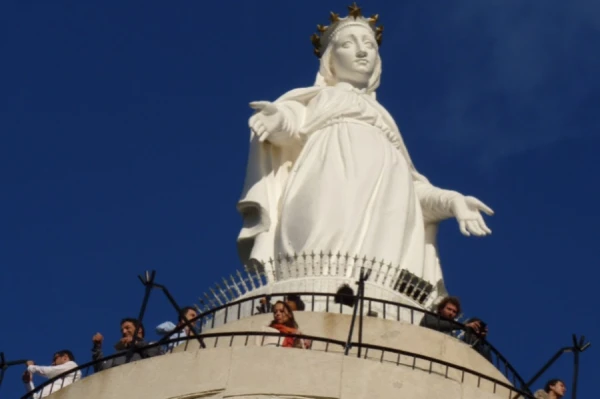
The press office statement ended with a prayer: “May the Mother of God, who watches over Lebanon from Harissa Mountain, protect the Lebanese people, together with the saints of the beloved Land of the Cedars.”
If you value the news and views Catholic World Report provides, please consider donating to support our efforts. Your contribution will help us continue to make CWR available to all readers worldwide for free, without a subscription. Thank you for your generosity!
Click here for more information on donating to CWR. Click here to sign up for our newsletter.
Iranian miners look on at the scene of a blast at a coal mine in Tabas in Iran’s Khorasan province on Sept. 22, 2024. The blast caused by a gas leak at the coal mine in eastern Iran has killed at least 50 people, state media said Sept. 22, in on… […]
Pope Leo XIV greets pilgrims at the Wednesday general audience in St. Peter’s Square, Wednesday, June 25, 2025 / Credit: Daniel Ibáñez/CNA
Rome Newsroom, Aug 16, 2025 / 04:00 am (CNA).
Saturday, Aug. 16, marks Pope Leo XIV’s 100th day as pope. Since his May 8 election as the first pope born and raised in the United States, the 69-year-old Chicago native has already left his mark on a jubilee year filled with papal liturgies and a surge in pilgrim enthusiasm.
Here are some of the highlights of the first 100 days of the new Holy Father:
Papal jubilee: Pope Leo offers 16 public Masses in 14 weeks
Pope Leo XIV began his papacy in the heart of the Church’s 2025 Jubilee Year of Hope, and he made the most of this opportunity to interact with Catholic pilgrims from across the globe by offering many Masses with the public.
Pope Leo XIV celebrates Mass for the Jubilee of Sport on June 15, 2025, in St. Peter’s Basilica at the Vatican. Credit: Vatican Media
Leo XIV offered 16 large public Masses in just 14 weeks — an average of more than one per week — including seven Masses in June alone. The pace marks a significant shift from the final years of Pope Francis’ pontificate when the aging pope was unable to offer Mass himself at the altar. Francis was present at only four Masses with the public in the same time period last year.
The papal Masses have drawn large crowds and significant attention, beginning with his first inaugural Mass, which brought 200 foreign delegations — including heads of state and royalty — to the Vatican. Since then, Leo has celebrated liturgies for the jubilees of Families, Priests, and Youth as well as on major solemnities and feasts including Pentecost, Corpus Christi, the Most Sacred Heart of Jesus, the Holy Trinity, Sts. Peter and Paul, and Mary, Mother of the Church.
Leo XIV is the first pope elected during a jubilee year since 1700.
Pope Leo XIV on the solemnity of Sts. Peter and Paul in Rome, June 29, 2025. Credit: Vatican Media
A singing pope
One of Pope Leo’s most unexpected moments came during his first Regina Caeli address, when he stunned a crowd of 200,000 in St. Peter’s Square by singing the Marian hymn rather than reciting it in Latin like his recent predecessors. Since then, he has continued chanting during liturgies and leading crowds in sung versions of the Our Father in Latin.
The move inspired the Pontifical Institute of Sacred Music to launch “Let’s Sing with the Pope,” an online series aimed at making Gregorian chant more accessible.
null
First American pope on White Sox stadium jumbotron
In June, the first pope born and raised in the United States appeared on the jumbotron at a gathering of American Catholics at Chicago’s Rate Field — home of his beloved White Sox. In a video message delivered entirely in English, Pope Leo urged young people to be “beacons of hope” and invited all to see that “God is reaching out to you, calling you, inviting you to know his son, Jesus Christ.”
It was the pope’s first direct address to his hometown since his election and one of the earliest papal speeches given entirely in English.
Pope Leo XIV addresses Catholic faithful on the scoreboard at Rate Field, home to the Chicago White Sox, during a celebration and Mass to honor his election as pope on June 14, 2025, in Chicago. Credit: Scott Olson/Getty Images
The new pope’s love of sports has led to some memorable moments. He blessed 159 cyclists as they passed through Vatican City in the final leg of the Giro d’Italia.
A self-described “amateur tennis player,” Pope Leo XIV joked with tennis star Jannik Sinner, ranked the world’s No. 1, whether his white cassock would meet Wimbledon’s requirement for all white attire.
Pope Leo XIV meets with Italian tennis star Jannik Sinner on May 14, 2025, at the Vatican. Credit: Vatican Media
The pope has also been gifted White Sox and Bears jerseys and has signed baseballs for enthusiastic pilgrims.
A voice for peace in Gaza and Ukraine
Pope Leo XIV’s first words were “Peace be with you all,” recalling the first greeting of the risen Christ recorded in Scripture. As wars continued and at times intensified during Pope Leo’s first months, the pope has continued to be a voice for peace.
In June, after U.S. airstrikes on Iranian nuclear facilities, Pope Leo urged world leaders “to stop the tragedy of war before it becomes an irreparable abyss.” Following an Israeli strike that killed three people at Gaza’s only Catholic church in July, he appealed for “a ceasefire, the release of hostages, and full respect for humanitarian law.”
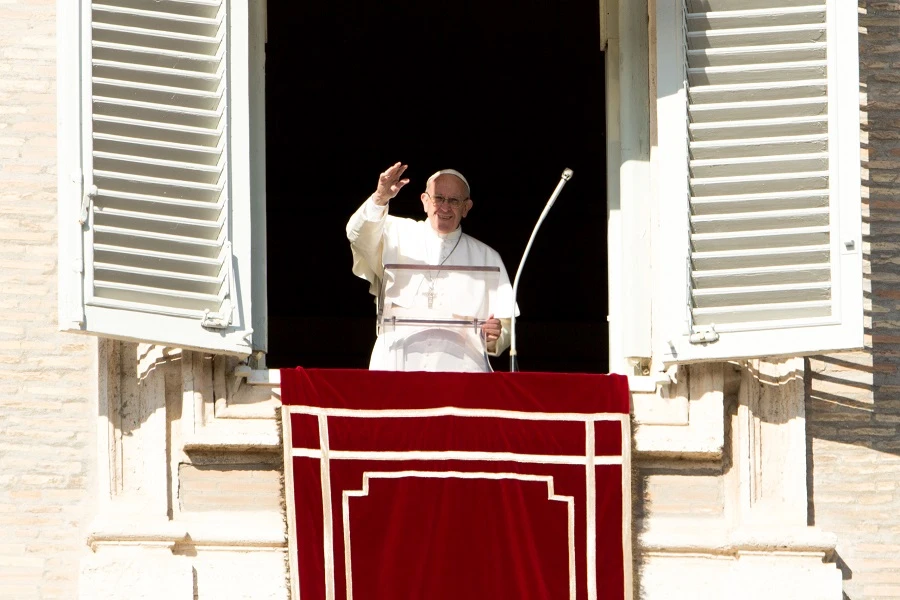
“Today more than ever, humanity cries out and pleads for peace,” the pope said during an Angelus from the window of the Apostolic Palace.
Leo also met with bishops and pilgrims from the Ukrainian Greek Catholic Church and welcomed Ukrainian President Volodymyr Zelenskyy to Castel Gandolfo in July, where the two discussed the urgency of “just and lasting paths of peace,” according to the Vatican.
Pope Leo XIV greets Ukraine President Volodymyr Zelenskyy at Castel Gandolfo on July 9, 2025. Credit: Vatican Media
Leo carries the Eucharist through the streets of Rome
Pope Leo personally carried the Blessed Sacrament through the streets of Rome during a Corpus Christi procession from the Archbasilica of St. John Lateran to the Basilica of St. Mary Major.
“Together, as shepherds and flock, we will feed on the Blessed Sacrament, adore him, and carry him through the streets,” he said. “In doing so, we will present him before the eyes, the consciences, and the hearts of the people.”
More than 20,000 people turned out for Leo XIV’s first Eucharistic procession as pope.
Pope Leo XIV leads a Eucharistic procession in Rome on June 22, 2025, for the feast of Corpus Christi. Credit: Daniel Ibañez/EWTN
Return to Castel Gandolfo
Pope Leo revived the papal tradition of spending summer days at the papal residence in Castel Gandolfo. During his two-week stay in July, he led public Masses in local parishes, greeted pilgrims as he led the Angelus prayer in Liberty Square, and received visiting dignitaries. His stay marks the first papal summer retreat in the lakeside town since the pontificate of Pope Benedict XVI.
The sun burst through raindrops right as Pope Leo XIV appeared in front of the apostolic palace of Castel Gandolfo to give the Angelus address on July 13, 2025. Credit: Hannah Brockhaus/CNA
Pope Leo introduces the world to great quotes by St. Augustine
A member of the Augustinian order, Pope Leo has quoted St. Augustine in nearly every one of his homilies as pope. In his first public words on May 8, he said: “I am an Augustinian, a son of St. Augustine, who once said, ‘With you I am a Christian, and for you I am a bishop.’”
Addressing 1 million young people at the Jubilee of Youth in August, he quoted Augustine’s “Confessions”: “You called, you shouted, and you broke through my deafness… I have tasted you, now I hunger and thirst for more.”
Pope Leo XIV greets crowds at the Jubilee of Youth on Aug. 3, 2025, at Tor Vergata in Rome. Credit: Vatican Media
A focus on artificial intelligence
Pope Leo has frequently spoken about artificial intelligence (AI), which is already shaping up to be a topic of interest in his pontificate with many hoping that he will address it in an encyclical.
Early on in his pontificate, Leo drew parallels between his namesake Pope Leo XIII, who responded to the industrial revolution with Rerum Novarum, and today’s digital revolution, explaining that the rise of AI poses “new challenges for the defense of human dignity, justice, and labor.”
“Humanity is at a crossroads, facing the immense potential generated by the digital revolution driven by artificial intelligence,” he warned in a message to the Geneva-based AI for Good Summit. “The impact of this revolution is far-reaching, transforming areas such as education, work, art, health care, governance, the military, and communication.”
Pope Leo XIV smiles during his Wednesday general audience on Aug. 13, 2025, in the Paul VI Audience Hall at the Vatican. Credit: Vatican Media
The Vatican website received a revamp shortly after Leo’s election, and insiders noted Leo’s relatively tech-savvy background, including a personal Twitter account prior to his papacy.
The pope also expressed concern in a speech to another AI conference about the negative effects that AI can have on the “intellectual and neurological development” of rising generations and the “loss of the sense of the human” that societies are experiencing.
Leo declares a new doctor of the Church
In one of his most significant theological gestures, Pope Leo named St. John Henry Newman, a 19th-century English convert from Anglicanism, a doctor of the Church — a rare title given to just 37 other saints. The title is granted in recognition of an already canonized saint’s significant contribution to advancing the Church’s knowledge of doctrine, theology, or spirituality.
Pope Leo XIV greets hundreds of thousands of youth and pilgrims ahead of a vigil at Tor Vergata, Rome, Saturday, Aug. 2, 2025. Credit: Mateusz Opila
Leo also approved the upcoming canonization of Blessed Carlo Acutis and Blessed Pier Giorgio Frassati in September as the first saints of his pontificate. He greenlit seven additional causes for canonization, including that of Blessed Bartolo Longo, a former satanist turned founder of the Marian shrine in Pompeii.
Carrying the cross before a million young people at the Jubilee of Youth
Pope Leo addressed the largest crowd of his papacy to date at the Jubilee of Youth, where an estimated 1 million young adults camped out in fields in Tor Vergata, southeast of Rome.
He surprised them by walking through the crowd to the stage, personally carrying the jubilee cross. During the evening vigil, he answered youth questions in English, Italian, and Spanish, offering reflections on loneliness, discernment, and friendship with Christ.
Pope Leo XIV leads young people from around the world in a procession, carrying the Jubilee Year Cross during the Jubilee of Youth this evening in Tor Vergata, on the outskirts of Rome. pic.twitter.com/XPjOnQg9p9
After Eucharistic adoration, chants of “Papa Leone!” echoed long into the night. Leo stayed past 10 p.m. — well beyond the scheduled end.
Earlier in the week, he made a surprise appearance at the opening Mass, joyfully proclaiming in English: “Jesus tells us: You are the salt of the earth. You are the light of the world!” and the crowd erupted in cheers.
Vatican City, Nov 19, 2017 / 05:52 am (CNA/EWTN News).- Pope Francis on Sunday cautioned against having a “mistaken” idea of God as harsh and punishing, saying this fear will end up paralyzing us and preventing us from doing good, rather than spreading his love and mercy.
“Fear always immobilizes and often leads us to make bad choices,” the Pope said Nov. 19. “Fear discourages us from taking the initiative, and encourages us to seek refuge in safe and guaranteed solutions, and so we end up doing nothing good.”
To go forward and grow on the path of life, he said, “we must not be afraid, but we have to trust.”
Pope Francis spoke to pilgrims in St. Peter’s Square during his Sunday Angelus address on the first-ever World Day for the Poor, which he implemented at the end of the Jubilee of Mercy.
In his speech, the Pope turned to the day’s Gospel reading from Matthew, which recounts the parable of the talents. In the passage, a master goes on a long trip and entrusts three servants with different talents, but when he returns, only two have gained profit from it, while the third buried his out of fear.
This parable “makes us understand how important it is to have a true idea of God,” Francis said, noting that the third servant didn’t really trust his master, but but feared him, and this fear prevented him from acting.
We shouldn’t think that God is “an evil, harsh and severe master who wants to punish us,” the Pope said, explaining that if we have this “mistaken image of God, then our lives cannot be fruitful, because we will live in fear and this will not lead us to anything constructive.”
Fear, he said, paralyzes us and so is self-destructive. So when faced with the unfaithful servant in this parable, each of us is called to reflect on what our idea of God really is.
Turning to the Old Testament, Francis noted how in Exodus God is described as “merciful and gracious, slow to anger, and abounding in steadfast love and faithfulness.”
Even in the New Testament, Jesus always demonstrated that God is not “a severe and intolerant master,” but a father full of “love and tenderness, a father full of goodness,” Francis said, and because of this, “we can and must have immense trust in him.”
Jesus, he said, shows us his generosity in various ways, through his words, actions, and his welcome towards all, especially toward sinners and the poor and vulnerable. But also with his admonishments, “which show his interest in us so that we do not waste our lives uselessly.”
This, the Pope said, is a sign of the great esteem God has for us, and having this knowledge ought to help us to take responsibility for our every action.
Concluding, Pope Francis said parable invites us to have “a personal responsibility and fidelity which become capable of continually placing ourselves on new roads, without burying the talent, which is are the gifts that God has entrusted to us and of which he will ask us to account for.”
After leading pilgrims in the Angelus prayer, the Pope made a series of appeals, the first of which was for the World Day for the Poor. He prayed that the poor and disadvantaged would be “the center of our communities” not just on special occasions, but always, “because they are the heart of the Gospel, in them we encounter Jesus who speaks to us and challenges us through their sufferings and their needs.”
He also drew attention to beatification of Fr. Solanus Casey yesterday in Detroit, saying the friar was “a humble and faithful disciple of Christ, who distinguished himself with an untiring service to the poor.”
“May his witness help priests, religious and laity to live with joy the link between the announcement of the Gospel and the love for the poor.”
Francis also offered special prayers for those living “a painful poverty” due to war and conflict, and renewed his appeal to the international community “to commit every possible effort in favor of peace, especially in the Middle East.”
He prayed especially for Lebanon, particularly for the country’s stability, “so that it may continue to be a message of respect and sharing for every religion and for the entire world.”
A final appeal he made was for the crew of an Argentine military submarine, who have been missing for several days without a trace.
After concluding the Angelus, Pope Francis made his way to the Vatican’s Paul VI Hall, where he had lunch with some 1,500 poor and needy in town for the World Day of the Poor.
Before the meal, Francis said a blessing for the food and for everyone there, asking the Lord “to bless us, to bless the meal, to bless those who prepared it, to bless all of us, our hearts, our families, our desires and our lives, that he give us health and strength. Amen.”
He also offered a blessing for all those eating in other soup kitchens throughout Rome. “Rome is full of these today,” he said, and asked for “a greeting and an applause” for the thousands of others participating in the event.
<blockquote class=”twitter-tweet” data-lang=”en”><p lang=”en” dir=”ltr”><a href=”https://twitter.com/hashtag/PopeFrancis?src=hash&ref_src=twsrc%5Etfw”>#PopeFrancis</a> says blessing before eating lunch, prays for the cooks, the guests, their families & charity organizations in <a href=”https://twitter.com/hashtag/Rome?src=hash&ref_src=twsrc%5Etfw”>#Rome</a>: asks that they receive "health & strength" <a href=”https://twitter.com/hashtag/WorldDayofthePoor?src=hash&ref_src=twsrc%5Etfw”>#WorldDayofthePoor</a> <a href=”https://t.co/jRrW0dN3xc”>pic.twitter.com/jRrW0dN3xc</a></p>— Elise Harris (@eharris_it) <a href=”https://twitter.com/eharris_it/status/932212710749691905?ref_src=twsrc%5Etfw”>November 19, 2017</a></blockquote>
<script async src=”https://platform.twitter.com/widgets.js” charset=”utf-8″></script>





Students – they are the future torch-bearers of the nation and the Planet.