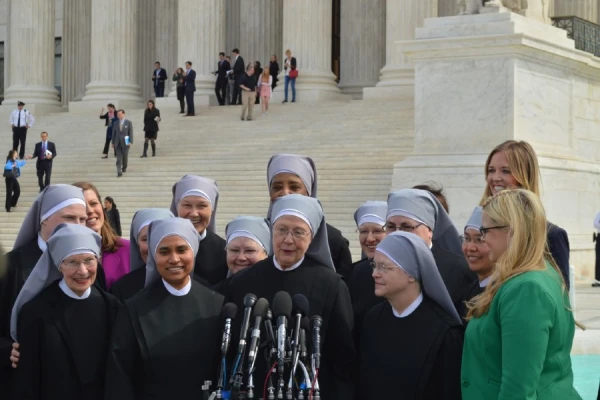
Washington D.C., Apr 3, 2020 / 03:30 pm (CNA).- The Supreme Court announced Friday that oral arguments in the case of the Little Sisters of the Poor have been postponed due to the coronavirus pandemic.
Oral arguments in Little Sisters of the Poor v. Commonwealth of Pennsylvania were originally scheduled for April 29, but the court announced on Friday that they would be postponed “in keeping with public health guidance in response to COVID-19,” together with other cases due to have been heard that week and the previous week.
The case of the Little Sisters involves their religious exemption from the HHS contraceptive mandate.
The states of Pennsylvania and California have sued the Trump administration to strip the religious community of their exemption to the mandate. In 2018, the Supreme Court allowed the sisters to intervene in the states’ lawsuits.
“In this trying time for our nation, the Little Sisters of the Poor are dedicated to protecting their elderly residents from the COVID-19 pandemic,” said Diana Verm, senior counsel at Becket which represents the sisters in court, in a statement released Friday.
“Now more than ever the Sisters need the freedom to focus solely on that mission.”
On Friday, the court announced that it “will consider a range of scheduling options and other alternatives if arguments cannot be held in the Courtroom before the end of the Term.”
The Little Sisters of the Poor have spent years in litigation related to the mandate. The 2010 Affordable Care Act mandated certain preventive coverage in health care, and the Obama administration interpreted the mandate to include coverage for contraceptives and sterilizations.
Afterward, the administration announced a process by which non-profits with religious or conscientious objections could notify the government, which in turn would direct their insurer or third-party plan administrator to provide the coverage in employee health plans.
Religious institutions, including the Little Sisters and Catholic dioceses, said that the “accommodation” still forced them to violate their religious beliefs in the provision of morally-objectionable procedures in employee health plans.
The case of the Little Sisters, bundled together with other cases, was heard by the Supreme Court which, in 2016, sent the case back down to lower courts, instructing the religious entities and the government to come to an agreement whereby the wishes of both parties could be attained.
In 2017, the Trump administration issued a rule exempting the Little Sisters and other religious entities from the mandate. State attorneys general for Pennsylvania and California then challenged the exemption in court.
The Little Sisters lost their case against Pennsylvania at the Third Circuit Court of Appeals in July of 2019, and lost their case against California at the Ninth Circuit Court in October. They appealed to the Supreme Court, which agreed in January to hear their case.
If you value the news and views Catholic World Report provides, please consider donating to support our efforts. Your contribution will help us continue to make CWR available to all readers worldwide for free, without a subscription. Thank you for your generosity!
Click here for more information on donating to CWR. Click here to sign up for our newsletter.

Chicago, Ill., Aug 27, 2023 / 18:42 pm (CNA).
Hundreds of thousands of young adults filled the streets of Lisbon, Portugal, for the 2023 World Youth Day in early August — gathering together for Mass, Eucharistic Adoration,… […]
CNA Staff, May 23, 2020 / 03:59 pm (CNA).- As the COVID-19 pandemic threatens to worsen an already tenuous food situation for millions across the globe, Catholic Relief Services (CRS) has announced a campaign to help address global hunger.
“Now is the time for us to lead the way forward to ensure that these communities have the support they need to make it through this crisis and beyond,” said CRS president and CEO Sean Callahan this week.
“If we don’t provide adequate food to children now, it will impact them for the rest of their lives.”
Catholic Relief Services warned that a food crisis already existed in many countries before the coronavirus pandemic hit. Now, unemployment, lockdowns, heightened food prices, and supply disruptions have made it even more difficult for impoverished families in many areas to get food.
“The shadow pandemic of worsening hunger is playing out in some of the world’s most vulnerable countries,” said Callahan.
The World Food Program has warned that the pandemic could double the number of people facing acute hunger or starvation, which already stands at 135 million.
Pope Francis has highlighted food insecurity in his homilies and addresses. In his comments on the COVID pandemic earlier this month, the pope noted that more than 3.7 million people have died from hunger so far this year. He warned of a “pandemic of hunger” that is not receiving adequate attention.
In response to the global crisis, Catholic Relief Services has launched a “Lead the Way on Hunger” campaign, calling for greater awareness, advocacy and fundraising to address global hunger rates.
The relief agency is encouraging Catholics to educate themselves and become involved in the effort to fight global hunger. It is asking Americans to contact their representatives in support of specific legislation, such as the Global Thrive Act (H.R. 4864), which would integrate early childhood development efforts – including health and nutrition assistance – into already-established foreign aid programs.
The campaign also encourages Catholics to donate to relief efforts when possible as a sign of solidarity with those who are suffering, and to help spread awareness on social media with the hashtag #LeadNow.
The U.S. Conference of Catholic Bishops has invited the faithful to offer a prayer at noon on May 24 as part of the campaign.
“At this critical time, CRS’ ‘Lead the Way on Hunger’ campaign is an important expression of our Church’s steadfast commitment to global solidarity, to working for the common good, and to the upholding of human dignity,” said Archbishop Bernard Hebda of St. Paul and Minneapolis, a member of the CRS board.
“We believe that each life, no matter how vulnerable, is precious.”
Catholic Relief Services is active in many countries to help alleviate food insecurity. In Guatemala, the agency is helping offer packages of rice, corn, beans and oil for children who are at risk of malnutrition and often receive their only meal of the day through distribution programs at their schools, which are now closed due to the pandemic. In the Philippines, CRS aided a home for people with disabilities to acquire a one-month supply of food and hygiene items.
Catholic Relief Services is also helping with instructions and supplies for hand-washing and sanitization, to help prevent the spread of the coronavirus.
Callahan urged Americans to be involved in efforts to alleviate acute hunger for the most vulnerable populations.
“The welfare of the next generation hangs in the balance,” he said.
“The Shroud of Turin: An Immersive Experience,” a $5 million, 10,000-square-foot museum on the chancery campus of the Diocese of Orange in Southern California opened to visitors on Nov. 19, 2025. / Credit: Everett Johnson, Diocese of Orange
Los Angeles, California, Nov 19, 2025 / 16:53 pm (CNA).
“The Shroud of Turin: An Immersive Experience,” a $5 million, 10,000-square-foot museum on the chancery campus of the Diocese of Orange in Southern California, opened to visitors Wednesday.
The museum is presented by Papaian Studios in partnership with the Diocese of Orange and Othonia Inc., an international team of specialists dedicated to exploring and sharing the mystery of the Shroud of Turin.
The 90-minute experience introduces visitors to the life, death, and resurrection of Jesus Christ, with a special focus on the Shroud of Turin, which many believe to be the burial cloth of Christ.
The 90-minute experience at the new Shroud of Turin museum on the chancery campus of the Diocese of Orange in California introduces visitors to the life, death, and resurrection of Jesus Christ, with a special focus on the Shroud of Turin, which many believe to be the burial cloth of Christ. Credit: Diocese of Orange
Inspired by the advanced technology incorporated in “Van Gogh Exhibition: The Immersive Experience” and the “Immersive King Tut,” the museum features 360-degree projection-room theaters as well as shroud replicas, interactive kiosks, a life-sized corpus, and a variety of artwork.
Jason Pearson of FiveHive Studios, which offers AI special effects and animation services, is a Catholic convert who worked with Othonia, a team of shroud specialists, to design the museum. Among his movie credits is Mel Gibson’s 2004 “The Passion of the Christ.” He has long had an interest in the shroud and has been a volunteer guide at the Shroud Center of Southern California located at the Santiago Retreat Center, also in the Diocese of Orange.
“Using technology on display like that of the Van Gogh or King Tut exhibits, we’re doing things that have never been done before,” Pearson told CNA.“Whether it be Jesus walking on water or through the streets of Jerusalem, or in the tomb at the moment of the Resurrection, we make use of sound and projections so that the visitor feels like he’s going back into a time machine and experiencing these things himself.”
“The Shroud of Turin: An Immersive Experience” located at the Christ Cathedral campus in the Diocese of Orange, California, opened to visitors on Nov. 19, 2025. Credit: Everett Johnson, Diocese of Orange
The museum is designed for everyone, Pearson continued, even those who have no religious background at all.
Located on the second floor of the campus’ Richard H. Pickup Cultural Center, the museum has three theater rooms. Using surround sound and images, including on the floor, the first room introduces the visitor to the person of Jesus Christ through presentation of 12 stories from his life, but each one is selected to show Christ’s connection to the supernatural (e.g. the Transfiguration). The next introduces the visitor to the shroud itself, including proof of its authenticity and what it tells us about the sufferings of Christ. The third is devoted to the Resurrection leading the viewer to ponder a pointed question: Who do you believe the man on the shroud is?
The third theater exits into the museum area, which includes displays of reproductions of items that were part of the passion of Christ, including a flagellum (whip), the crown of thorns and nails, as well as a reproduction of what the tomb of Christ might have looked like.
The new Shroud of Turin museum uses AI and 360-degree tech to explore Christ’s life and resurrection. Credit: Everett Johnson, Diocese of Orange
Other exhibits include an AI presentation of Secondo Pia (1855–1941) who, while photographing the shroud in 1898, discovered that its negative image offered a clearer image of the man on the shroud with a detail in his face that could not been seen by the naked eye. Another traces the history of the iconography of Christ, demonstrating how accurate, when comparing it to the shroud image, many of the icons were. And, one compares the Sudarium of Oviedo, or the facial cloth that covered Christ’s face after his death, to the image on the shroud.
Pearson hopes that the museum will be a prototype for additional shroud museums in different regions of the country. Inquiries have been made about establishing shroud museums from places as far away as Kuala Lumpur in Malaysia.
One portion of the museum is dedicated to the science of the shroud, and two kiosks allow visitors to ask questions of a digital Father Robert Spitzer, who has extensively researched the shroud over the past 20 years. Credit: Everett Johnson, Diocese of Orange
One portion of the museum is dedicated to the science of the shroud, and two kiosks allow visitors to ask questions of a digital Father Robert Spitzer, who has extensively researched the shroud over the past 20 years. Spitzer, who has an office at Christ Cathedral, noted that he was pleased with the museum’s opening. “It gets the pedagogy right, it’s biblically accurate, and they tell me the visual imagery is amazing.” (Spitzer has gone blind in recent years.)
He continued: “And while we welcome anyone, we especially hope many young people will come to learn about the shroud and lead many to come to know more deeply the person of Jesus Christ.”
Nora Creech is on the leadership team of Othonia and helped develop content for the museum. “We want people to come with an open mind, explore, and ask questions. We want them to ask, ‘Who is the man of the shroud?’” she said.
One special target group of the museum, Creech said, is younger people, “many of whom have not been brought up with knowledge of who Jesus is. That is why we seek first to introduce people to Jesus so that they will become interested in his burial shroud.”
Pearson agreed and related the story of two young women who visited the Shroud Center and began weeping, asking: “Why hasn’t anyone told us about him?”
But while the shroud is important in showing us what Jesus suffered, Creech continued, we also need the Church and the Scriptures “to learn why he suffered.”
Auxiliary Bishop Timothy Freyer blesses the new Shroud of Turin museum on the chancery campus of the Diocese of Orange in Southern California, opened to visitors Wednesday, Nov. 19, 2025. Credit: Kaylee Toole, Diocese of Orange
Orange Auxiliary Bishop Timothy Freyer, who played a key role in bringing the museum to Christ Cathedral, noted that his favorite feature was the reproduction of the crown of thorns, which, contrary to most artistic renditions, was actually shaped like a helmet or cap. He continued: “I’ve been impressed with the entire exhibition. It is very engaging, and I believe it will be an important tool in helping visitors come to know Christ better.”
Also among those excited to see the opening of the museum was Gus Accetta, a physician who has devoted much of his free time to studying the shroud. In 1996, he founded the Shroud Center in Huntington Beach, since relocated to the Santiago Retreat Center and welcoming 25,000 visitors annually.
“It’s a wonderful exhibit,” he said. It not only looks at the shroud but the whole life of Christ, of which the shroud is just a part.”
A crown of thorns from the “Shroud of Turin: An Immersive Experience,” a $5 million, 10,000-square-foot museum on the chancery campus of the Diocese of Orange in Southern California. The museum opened to visitors on Nov. 19, 2025. Credit: Diocese of Orange
The Shroud of Turin experience will be on display at Christ Cathedral at least through 2030. The museum is located on Christ Cathedral campus, 12141 Lewis St., Garden Grove, California, a few miles away from Disneyland and the Anaheim Convention Center. For more information, visit the website www.theshroudexperience.com.
Leave a Reply