No Picture
News Briefs

Scientific photos of Shroud of Turin published

April 11, 2019 CNA Daily News 0

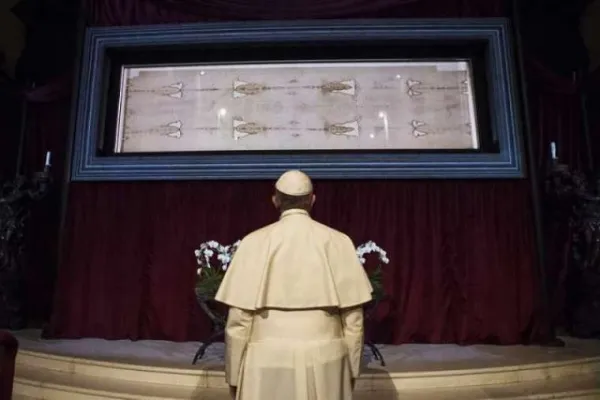
Denver, Colo., Apr 11, 2019 / 11:45 am (CNA).- A new website aims to make available to Catholics and researchers a collection of photographs of the Shroud of Turin by a scientific photographer who was part of a research project that spent more than one hundred hours conducting tests on the shroud.

The Shroud of Turin is a linen cloth 14 feet 5 inches long by 3 feet 7 inches wide, which shows the image of a man tortured and crucified. It is held by many Catholics to be the burial cloth that wrapped the body of Jesus after his death on the cross.

From 1977 to 1981, a team of physicists, chemists, pathologists, and engineers from universities and U.S. government laboratories conducted the Shroud of Turin Research Project, which concluded that “the shroud image is that of a real human form of a scourged, crucified man. It is not the product of an artist. The blood stains are composed of hemoglobin and also give a positive test for serum albumin. The image is an ongoing mystery and until further chemical studies are made, perhaps by this group of scientists, or perhaps by some scientists in the future, the problem remains unsolved.”

The project’s final report added that “no pigments, paints, dyes or stains” were found on the shroud’s fibers, adding that “it is clear that there has been a direct contact of the Shroud with a body, which explains certain features such as scourge marks, as well as the blood. However, while this type of contact might explain some of the features of the torso, it is totally incapable of explaining the image of the face with the high resolution that has been amply demonstrated by photography.”

“The scientific consensus is that the image was produced by something which resulted in oxidation, dehydration and conjugation of the polysaccharide structure of the microfibrils of the linen itself. Such changes can be duplicated in the laboratory by certain chemical and physical processes. A similar type of change in linen can be obtained by sulfuric acid or heat. However, there are no chemical or physical methods known which can account for the totality of the image, nor can any combination of physical, chemical, biological or medical circumstances explain the image adequately.”

Vernon Miller was the official scientific photographer of the Shroud of Turin Research project. His photographs, and magnified micrographs of various aspects of the shroud, are now freely available to view or download at shroudphotos.com. Photographs taken under ultraviolet light are also available for download. Organizers of the site say that it was Miller’s wish that his photograph’s be digitized and made available to those who have never seen them. The site is the first place to publish a digitized and organized catalog of Miller’s work.

Miller recognized the power of images of the shroud.

“Worldwide interest in the Shroud of Turin was stimulated by the first photographs of it in 1898 when photography was in its infancy. Up to that time, people who looked at the cloth found it faint. It took the camera, with its negative image [of the man], to appreciate it,” he said after the research project was completed.

The shroud has been in Turin, Italy since 1578, has been the subject of thousands of scientific investigations from diverse specialties, and more than 32,000 photographs have been taken of it. The Church’s official position on the shroud is one of neutrality.


[…]

No Picture
News Briefs

Rome’s ‘Holy Stairs’ uncovered for the first time in 300 years

April 11, 2019 CNA Daily News 1

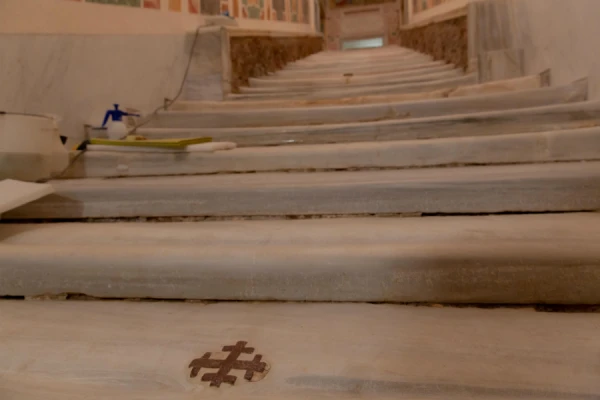
Rome, Italy, Apr 11, 2019 / 03:01 am (CNA).- The bare, white marble of Rome’s ‘Scala Sancta,’ which are believed to be the stairs trod by Christ on the day of his trial and death, are exposed and visible to pilgrims for the first time in almost 300 years.

The stairs, encased in wood since the 1700s, will be uncovered for veneration from April 11 to June 9, the feast of Pentecost. During this time, pilgrims may ascend the marble steps on their knees.

“We thought this opportunity was important,” Paolo Violini, the head of the restoration of the staircase, told EWTN. He said the idea to open the Holy Stairs to the public came when they removed the wood to restore it and discovered the beautiful white stairs beneath.

“No one had ever thought to be able to climb the marble stairs. It was simply restoration work, maintenance work of the wood covering them,” Violini said.

“The moment we saw what was underneath, the idea came to open them publicly… for the devoted, even for a brief period and for what is possible, obviously, for the conservation of the marble.”

“As long as the restoration of the wood is not finished, and it is not covered, it will be possible on the part of the faithful to climb to the top on one’s knees,” he said.

The Holy Stairs are held to be those which led to the praetorium of Pontius Pilate in Jerusalem, and which Christ would have ascended on his way to the trial before his Crucifixion.

According to tradition, the stairs were brought to Rome by St. Helena in the 4th century. The mother of Constantine the Great, it is believed that she restored many sites in the Holy Land and discovered the True Cross, in addition to other relics.

The stairs, which are near the Archbasilica of St. John Lateran, were first opened to the public more than 400 years ago by Sixtus V.

In 1724, Servant of God Benedict XIII covered the Holy Stairs in wood for their protection, since the marble had already begun to be worn down significantly by pilgrims over the prior century, Violini explained.
 
The marble under the wood has not been seen since then, he stated, and their “re-uncovering” during the end of Lent and Easter is a “highpoint.”

The Holy Stairs have been closed for over a year for restoration of the frescoes on the walls surrounding the steps and leading up to a once-private papal chapel, the Church of St. Lawrence.

The renewal of the wooden planks over the stairs was the final step.

But when the restoration workers removed the wood, they found deep divots in the center of the steps. “It was a surprise for all of us to see the state of conservation of these steps, with this central consumption, which digs a rather deep furrow, to the point that for some of the steps the whole depth is consumed,” Violini noted.

“But, going forward with the uncovering of the steps, we realized that it is nothing more than a sign of the use, of the consumption, of the pilgrims who went up on their knees,” he explained. “The furrow in the center was caused by the tip of the shoe that, resting on the step below, served to give the push to climb the next step.”  

Before being removed, the wood encasing the steps had squares cut out where pilgrims could reach down to touch the marble. There were also glass cases protecting spots believed to have marks of the bloody footprint of Christ.

Pilgrims who visit the stairs must ascend them on their knees as a sign of piety and reverence but can choose how they wish to pray while doing so. Those who cannot climb on their knees may kneel on the first step and then walk up one of the other staircases to reach the top.

There is also a plenary indulgence, or the remittance of temporal punishment due to sins which have already been forgiven, attached to ascending the entire staircase.

The usual conditions for a plenary indulgence must be met: the individual must be in the state of grace and have complete detachment from sin. The person must also pray for the pope’s intentions and sacramentally confess their sins and receive Communion up to about twenty days before or after the indulgenced act.

Alternately, a partial indulgence may be gained for every step climbed while meditating on the Passion of Christ.

[…]

No Picture
News Briefs

In a changed country, poor Americans miss the benefits of marriage most

April 10, 2019 CNA Daily News 0

Denver, Colo., Apr 11, 2019 / 12:03 am (CNA).- Marriage has major benefits for children, adults, and society as a whole, said a marriage scholar this week, and the poor and less educated are suffering most from the widening class divide between those who get married and those who don’t.

“What we’re seeing today in America is that upper middle-class Americans are much more likely to get and stay married compared to less educated, working class Americans – that’s the marriage divide in brief,” Dr. W. Bradford Wilcox, a sociology professor and director of the National Marriage Project at the University of Virginia, told CNA April 9.

This divide in family structure is not just a private matter.

“Kids who are born and raised in a stable married family are much more likely to do well in school, to flourish in the labor market later on in life, and themselves to forge strong stable families as adults,” Wilcox said. “Coming from a strong stable family gets kids off to the best start, typically.”

Wilcox spoke on the American marriage divide Tuesday evening at Colorado Christian University in the Denver suburb of Lakewood.

There were “minimal class divides” in American married life 50 years ago, but not today. While 56% of middle- and upper middle-class adults are now married, only 26% of poor adults and 39% of working-class adults are.

The divorce rate has generally decreased since the 1970s, but the most educated married couples tend to divorce the least. Highly educated Americans became much more likely to favor restrictive attitudes towards divorce, while the least educated became much less likely to do so.

“We live in an increasingly segregated country where people tend to live in neighborhoods or communities that mirror their own class, and family makeup,” Wilcox said. Many middle-class Americans live in neighborhoods “dominated” by married families.

By contrast, working-class and poor Americans live in communities with many single people, cohabiting couples and single parent families. From their perspective, “marriage is in much worse shape,” Wilcox said. People in more affluent communities, perhaps without realizing it, “live in a social world where families are pretty stable, most kids are being raised in two-parent families, and everyone benefits from that reality.”

Out-of-wedlock births also show class divides: 64% of poor children are born to an unmarried mother, compared to 36% of the working class and 13% of the middle and upper middle classes. While in 1953, only 20% of children of women with a high school degree or less lived in a single-parent home, that number had risen to 65% in 2012.

While the college educated and affluent tend to have relatively high-quality, stable marriages, poor and working-class Americans are more likely to be struggling.

Today’s upper-middle class stresses marriage before childbirth and rejects “easy divorce.” They have the most families with a male breadwinner and are the most active in religion and civic life.

Wilcox attributed these changes to factors including cultural shifts; changes in the economy due to a post-industrial foundation; a general withdrawal of individuals from social institutions; and public policy.

Children raised in intact, married homes are more likely to avoid poverty, prison and teen pregnancy. They have better economic upward mobility than children raised by a single parent. There is less risk of downward mobility. Child poverty would be about 20% lower if marriage rates had remained as high as in the 1970s, Wilcox said.

Children of cohabiting couples face worse outcomes than children raised by single parents in areas like substance abuse, high school graduation rates, and psychological well-being. They face a higher risk of physical, emotional or sexual abuse. Cohabitation features less adult commitment, less trust, and less fidelity than married parents and suffers more family instability.

Divorce is one of the practices that leads to cohabitation, said Wilcox.

The decline in religious attendance among working class Americans is far more severe than among upper middle-class or college-educated Americans.

“The story here is in part an economic story: when people feel they can’t maintain a decent middle class lifestyle economically, they’re less likely to go to church,” Wilcox told CNA. “They’re more likely to feel they don’t belong in a church community.”

The significant shift in sexual mores, family stability, and non-marital childbearing has affected working class Americans “especially hard” and their lifestyle doesn’t fit a church ideal, Wilcox suggested.

“If you’re divorced, if you’re cohabiting, if you’re a single mother or a non-essential father, the church can seem like an off-putting place for you,” he said.

Clergy tend to be college-educated and have a natural affinity with some instead of others. Preaching, teaching and ministry has a middle-class or upper middle-class gloss. Wilcox pointed to young adult ministries among Catholics and Evangelicals that secure significant resources to serve those in college, but lack resources for non-college track young adults.

He suggested that preaching geared toward the upper middle class tends toward the “therapeutic and comforting,” whereas “clearer and bolder” preaching and teaching might appeal more to the working class.

The rise of quality, inexpensive entertainment also means it is more likely for people to stay home from worship services, regardless of beliefs.

One possible reason for the changes in class-segmented opinions and behaviors in the past 50 years is upward or downward mobility based on success or failure to form families. Those who follow a “success sequence” could have risen in economic class and education level.

“Part of the story is that in the 1970s, working-class Americans were more heterogeneous in terms of religion, work, and family orientation, whereas today, working-class and poor Americans, if they’re native-born, tend to be less religious, more erratic in family life, and more distant from community and civic institutions,” said Wilcox.

To help bridge this family divide, it is important to cultivate “friendship and civic ties across class lines, and for our churches and civic institutions to do more to integrate people across class lines.”

“Unless poor and working class people have more access to strong and stable models of family life and access to social networks that middle class folks have in terms of job opportunities and the like, we’re not going to address very successfully this marriage divide in America,” he said.

Other civic institutions, like youth athletic leagues, tend to cater to the middle or upper middle class, who provide significant financial support for their children’s sports.

“We should challenge our local athletic non-profits and civic trusts to do more to make sure they are economically integrated,” Wilcox suggested.

Public policy also has “marriage penalties” that hinder people at the upper limits of eligibility for welfare, child care subsidies, and tax credits.

“Nobody intended this but it’s a perverse reality built into the system.” Wilcox said.

While marriage was formerly penalized among the poorest Americans because welfare was targeted at them, the eligibility threshold has risen since the ‘80s. The lower middle class, those in the second-lowest economic quintile, are now the most likely to be penalized and face disincentives to marry, and even incentives to divorce to secure their economic situation.

A couple living together with children might put off marriage because it could harm their children’s access to health care or their access to child care subsidies.

According to Wilcox, communities with weak commitments to marriage and family would benefit from public recognition of a permanent marriage for the sake of children in ways that shape people’s thinking and behavior.

Younger adults in these communities tend to suffer from more marginal employment opportunities, and young men especially need stronger opportunities for education and vocational training. Young men need “a stronger sense of their own self-worth as workers and providers” which can improve their ability to think of marriage as a legitimate option and their ability to be seen as marriageable, he said.

[…]

No Picture
News Briefs

Australian pro-lifers lose challenge to abortion clinic buffer zones

April 10, 2019 CNA Daily News 1

Canberra, Australia, Apr 10, 2019 / 04:03 pm (CNA).- Australia’s high court on Wednesday threw out cases brought by pro-life activists challenging “buffer zone” laws in Victoria and Tasmania that bar any protests within 150 meters (nearly 500 feet) of a clinic or hospital that performs abortions.

In its April 10 decision, the court said that “given that the proscription leaves protesters free to conduct protests in relation to terminations outside the access zone, and that there is no evidence or other reason to accept that political protest against terminations outside the access zone is any less effective as a tool of political persuasion than protest within”, the buffer zones’ effect on political freedom was “negligible”.

The Victorian case was brought by Kathleen Clubb, a pro-life campaigner who was fined $5,000 in 2016 for “communicating about abortion” to a woman using an abortion clinic. The same year, Graham Preston was fined $3,000 for violating Tasmania’s similar buffer zone law.

Both plaintiffs argued that the laws violate their freedom of speech, since they prohibit political speech in a place where “communications on [abortion] are likely to occur and be most politically resonant.”

Clubb has said that “the prohibition applies whether or not discomfort is caused, and irrespective of the political significance of the communication in the circumstances” and that the appeal asked “whether a prohibition of that kind is compatible with a constitution which protects a freedom of political communication.”

Their lawyers had argued that because there are already laws in both states that protect against harassment and intimidation, the only further effect of the buffer zone laws is essentially to ban peaceful protest, and that Australia grants an implied freedom to political speech.

The court responded to the “implied freedom” argument saying that “it is no part of the implied freedom to guarantee a speaker an audience, much less a captive audience.”

It added that “the limited interference with the implied freedom is not manifestly disproportionate to the objectives of the communication prohibition. The burden on the implied freedom is limited spatially, and is confined to communications about abortions. There is norestriction at all on political communications outside of safe access zones. There is no discrimination between pro-abortion and anti-abortion communications. The purpose of the prohibition justifies a limitation on the exercise of free expression within that limited area.”

The governments of Victoria and Tasmania had contended that the laws are designed to allow women to access legal medical services.

The Australian Capital Territory, the Northern Territory, New South Wales, and Queensland have similar buffer zone laws.

Buffer zones are being debated elsewhere, including in the United Kingdom. British Home Secretary Sajid Javid rejected proposals for buffer zones around abortion clinics throughout England and Wales as disproportionate in a Sept. 13, 2018 decision, after finding that most abortion protests are peaceful and passive. Local jurisdictions in England and Wales are able to establish their own buffer zones.

In the United States, three states have passed buffer zone laws: Colorado, Montana, and Massachusetts.

[…]

No Picture
News Briefs

South Korea’s abortion ban could be overturned this week

April 10, 2019 CNA Daily News 1

Seoul, South Korea, Apr 10, 2019 / 11:09 am (CNA).- A pro-life doctor in South Korea is asking the international community for prayers, as the country’s constituional court considers whether to overturn its national abortion ban April 11.

Around 1,000 South Koreans rallied April 6 at a March for Life in Seoul’s Gwanghwamun Square ahead of the Constitutional Court ruling on the country’s abortion law, which currently prohibits abortion except in the case of rape, incest, genetic disease, or risk to the mother’s health.

“We have done our best to protect the life of fetuses. Now we can only pray for life,” Brother James Shin told CNA following the march.

Shin is a doctor and religious brother who provides medical care to the the poor and is active in South Korea’s pro-life movement.

Abortion advocates are calling on the court to allow abortions within the first 12 weeks of pregnancy, and to add social and economic reasons to the exceptions allowing for abortion further into pregnancy, Shin said.

At least six judges on Korea’s nine-member Constitutional Court, due to rule April 11, are needed to declare the current law unconstitutional.

The Archbishop of Seoul, Cardinal Andrew Yeom Soojung, has been an outspoken advocate for the protection of unborn life in South Korea’s national debates.

“Human dignity cannot be decided by majority vote or judged by socioeconomic standards,” Cardinal Yeom said at a Mass for Catholic congressmen last month.

The cardinal also called for an end to the death penalty in Korea. “Human life is the most important and fundamental gift, which is a source of all human rights. The death penalty is a serious insult and sin against everyone’s right to life,” he said.

Abortion is known to be common in South Korea, despite being against the country’s criminal code. Women obtaining an illicit procedure can be sentenced to a year in prison or a fine of under $2,000, while doctors can be jailed for up to two years, but the law is rarely enforced.

About 340,000 abortions are performed annually in South Korea, while 440,000 child births are reported, according to a 2012 study published in the International Journal of Law, Policy and the Family.

“In high-income South Korea … safe but clandestine procedures are widely available, despite a fairly restrictive law,” said the Guttmacher Institute, which provides research and analysis to “advance sexual and reproductive health and rights,” in a 2018 report.

The current case being considered by Korea’s Constitutional Court was brought to court by an obstetrician prosecuted for performing 69 illegal abortions between 2013 and 2015.

At his confirmation last September, the Chief Justice of Korea’s Constitutional Court, Yoo Nam-seok, said, “I think we need to consider ways to allow women’s termination of pregnancies in early stages for social and economic reasons through consultations with doctors and professionals,” the Korea Herald reported.

Brother Shin characterized the current cultural atmosphere in South Korea as leaning towards “pro-choice.” He said that he wants to bring the movie “Unplanned” to Korea to raise awareness of the reality of abortion.

“We need people’s prayers for Korea,” he said.

[…]