

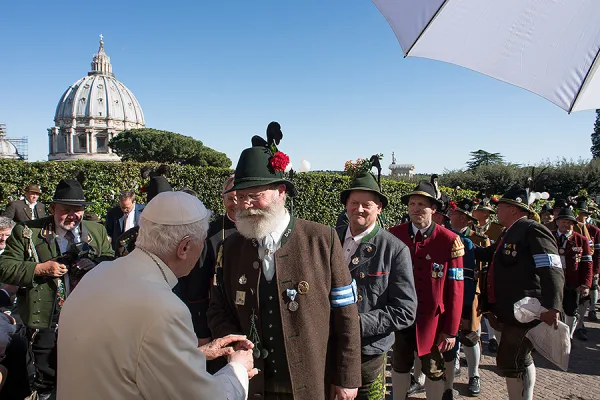
Würzburg, Germany, Dec 20, 2019 / 10:24 am (CNA).- In what came as a surprise to many members of the Catholic elite in Germany, Pope emeritus Benedict XVI has launched a foundation for Catholic journalism in his home country.
“I want the Catholic voice to be heard,” the retired Roman pontiff, who has resided in a Vatican monastery since his 2013 resignation, said of his decision.
Named after a weekly Catholic newspaper, the goal of the “Tagespost Foundation for Catholic Journalism” is to raise the equivalent of about $500,000 in 2020 to invest in training young journalists and to support a variety of projects, including research into issues of biomedical ethics, in Germany.
Given that the country’s tax-rich dioceses and powerful bishops’ conference are already financing a wide array of media projects and news outlets that provide training, including a dedicated Catholic journalism school based in Munich, the initiative by the pope emeritus was recognized by both supporters and critics as a strategic move to bolster orthodox Catholic reporting independent of episcopal and other influences.
The “Society of Catholic Journalists” criticised the move, saying it raised concerns as to why the pope emeritus decided to undertake this initiative without involving the existing journalism school.
With a few notable exceptions – such as the German edition of Catholic News Agency, CNA Deutsch – the infrastructure of Catholic media and its representational bodies in Germany are deeply embedded in the overall structures and bodies of the Church there.
Given the church tax system, the Kirchensteuer, and a number of historical arrangements, the Catholic Church, together with the Lutherans, is the second largest employer in Germany after the state.
The pope emeritus’ decision to establish a foundation independent of this structure became public at a time where the very newspaper that carries the name of the new foundation was criticised by the president of the Central Committee of German Catholics.
Thomas Sternberg mentioned both the “Tagespost” and a private Austrian website as Catholic media in an interview in which he warned about nationalism and “hard-minded media”.
Speaking to CNA Deutsch, the CEO and editor-in-chief of the newspaper, Oliver Maksan, roundly rejected the criticism, decrying it as a political ploy and attempt to silence voices critical of the “Synodal Process”, by labelling these as “right-wing”.
If you value the news and views Catholic World Report provides, please consider donating to support our efforts. Your contribution will help us continue to make CWR available to all readers worldwide for free, without a subscription. Thank you for your generosity!
Click here for more information on donating to CWR. Click here to sign up for our newsletter.


B16 has served the Church with dedication and distinction. May he be blessed with good health.
We read: “Given that the country’s tax-rich dioceses and powerful bishops’ conference are already financing a wide array of media projects and news outlets that provide training, including a dedicated Catholic journalism school based in Munich […]”
MUNICH?!! Why are we reminded of British Prime Minister Neville Chamberlain’s return from the same Munich in 1938 to announce “peace in our time”?
Today, that historical symbol of appeasement (re German annexation of the Sudetenland) finds its ECCLESIAL PARALLEL in the annexation of possibly legitimate synodality by the “synodal process”, plus further annexation of this process by engulfing Secularism, all aided and abetted by a vanguard of bully-pulpit clerics and a coalition of Tennis Court activists embedded within the Church (the Central Committee of German Catholics).
How dare ANY Catholic of the universal Church to presume to found any journalism initiative outside the “wide array of media projects” poised within the synodal bubble!
Who knows, the somewhat-pruned synodal agenda of now remaining “non-binding”—BUT of propagandizing the entire Church for at least the next two years—-might not be the only game in town. Maybe history won’t repeat itself.
Is this school going to teach RC journalists not to be so fawning over the papacy?
Good news during a dismal time. Especially with the recent Pontifical Biblical Commission anthropological research paper What is Man. The subchapter ending implies traditional moral censure of homosexual behavior is due for revision. “Intelligent interpretation” of that censure in Sacred Scripture is to be assessed in its historical context and in light of “scientific contributions”. Edward Pentin gave a sober balanced review NCR. Not an editor I’m freer to be less sober. At least these journalists will not fawn over Pope Francis. It should be obvious they are being happily selected and drawn into emeritus Benedict’s expanding counter narrative mission [my view is this is all providential]. My hope however is Benedict will not receive an eviction notice from the Vatican Landlord. Although if he does Wurzburg is a great town. As a young infantryman I was stationed down the road at Aschaffenburg.
Wow! Still on the ball, I see!
Gilberta