

 By
“I really enjoy the gift of a Black Catholicism, Black Catholic spirituality, and it certainly does have a place in the universal Church,” Bishop Robert Boxie said.
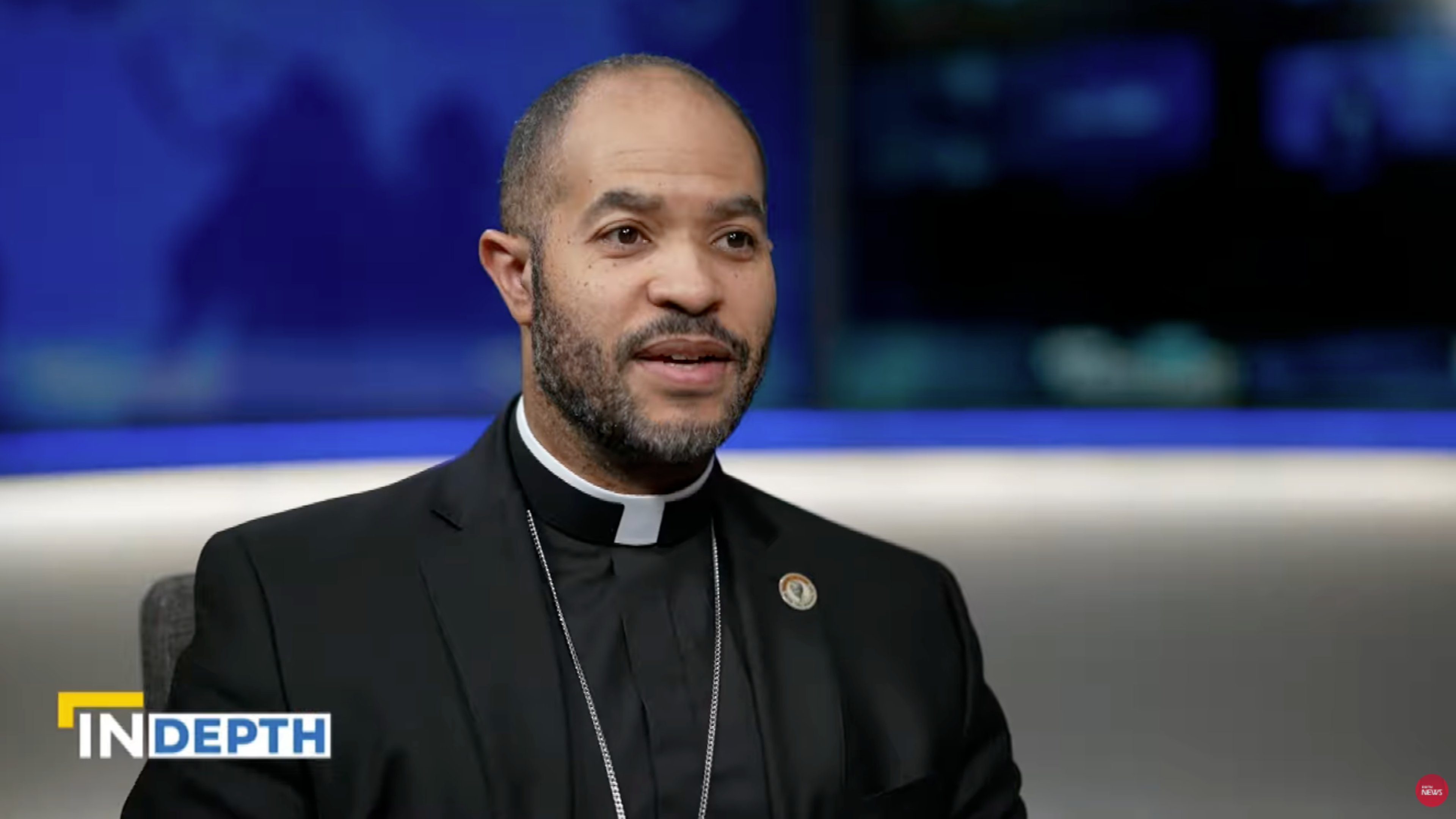
Bishop Robert Boxie reflected on why the United States has so few Black Catholic bishops, citing “racism” as the short answer.
“I really enjoy the gift of a Black Catholicism, Black Catholic spirituality, and it certainly does have a place in the universal Church,” said Boxie, an auxiliary bishop of Washington.
Boxie is a former lawyer and graduate of Vanderbilt University and Harvard Law School. He is now the youngest bishop in the United States.
“The last time that an African American bishop had been ordained was 10 years prior. When I was appointed a couple of months ago, I became the second African American bishop in the entire United States,” Boxie explained in an interview with “Vatican Access,” a Catholic News Service podcast.
“We have a total of four active Black bishops, but there are only two African American bishops,” he said. “We need Black bishops in the United States … And I am OK with being a voice for the Black community that needs to be in the hierarchy of the Church.”
When asked why there are so few Black bishops, Boxie said: “The short answer is racism.”
“People may not want to hear that. People may not agree with that. But the short answer is racism.”
“For a long time, Black men were not accepted or allowed in seminary,” he said. “We had the first recognized African American priest, Father Augustus Tolton, Venerable Augustus Tolton, whose cause for canonization is currently underway … But it took so much more than an arm and a leg for him to even be … allowed to study for the priesthood.”
“So after him, it was a while before dioceses, and bishops, and religious communities would accept African American men. And when they did accept them, they experienced racism and discrimination and injustice and all the things that we would not associate, or should not associate with, the Church.”
Racism within the Church
Boxie shared his own personal experience with racism in the Church, even during his time in seminary.
“There was a time in seminary where my next-door neighbor … had a Confederate flag in their room and … I was totally taken aback by that,” Boxie said.
“I would never go in his room … We would talk outside in the hall. I wouldnʼt go in his room as long as he had that flag up,” Boxie said.
“Eventually he did take it down and he eventually discerned out of seminary. And so we didnʼt really talk … much about it.”
About seven years later, “during COVID, during 2020, and the summer of George Floyd … all of these things were sort of being revealed and uncovered in the United States — disparities within our country.”
During that time, he said, “I got a Facebook message from him saying that … he was working at a Catholic school with a large minority population, large number of African American students and Hispanic students.”
“He realized, for himself, how wrong that was seven years prior for him to have that Confederate flag in his room, especially at a seminary. And he wanted to have a conversation to apologize.”
“We had a really wonderful conversation” and “I accepted his apology,” Boxie said. “We had a real honest conversation about race, the Church, and how we can be healers.”
The conversation addressed “how we can help to bridge these gaps, these disparities, the misunderstanding, all the things that pull us apart, how we can in fact be healers and bridge builders in the Church,” Boxie said.
In the interview, Boxie noted other areas where Black Catholics lack presence in the Church, specifically noting “images” in Catholic churches.
“In our churches, we often only see white saints,” he said. “I have no problem with that. Thereʼs nothing wrong with that. But thatʼs not the only view, or the only image, or icon of holiness that we can aspire to.”
He noted that seven Black Catholics who lived in the United States are currently in line for canonization.
“I feel as though every parish in the United States should have images of them in their church in some form or fashion, because these were Americans who were raised and formed in this country who have an authentic … Catholic American spirituality,” he said.
The Church has the answers on race
Boxie has previously said that “culture does not have the answers” in regard to race. In his recent interview, he was asked whether the Church has the answers, to which he said that it does.
Itʼs “not just Catholic social teaching, which … Pope Leo very beautifully expresses in Magnifica Humanitas, but this goes all the way back to the very beginning … just the dignity of the human person.”
“Thatʼs a core tenet of what we believe as Catholics and certainly part of the foundation for Catholic social teaching.”
It is about “the human person being made in the image and likeness of God, with an inherent dignity, an infinite dignity, a magnificent dignity that transcends race and culture and geography and language and land,” Boxie said.
“The Church has proclaimed, from the beginning, the dignity of the human person — thatʼs from her teaching, her doctrine, Scriptures. The problem is that we have not always been faithful to that.”
“When we have turned away from that, or when we have been unfaithful to that teaching and gone astray, then thatʼs when problems such as this racism have arisen,” Boxie said.
Being labeled a ‘DEI bishop’
Boxie also addressed the subject of diversity, equity, and inclusion (DEI), which he said has been “hijacked.”
Diversity, equity, and inclusion are “biblical” concepts and are “part of our Catholic tradition,” he said. DEI was originally “trying to correct a number of institutional wrongs that have occurred in our country,” in employment, education, housing, healthcare, and other “disparities.”
Now, Boxie said he believes there is a “negative association” with DEI.
It is now seen as taking “something away from a white person who deserves it, who merits” and “giving it to a Black person, or a brown person, or a minority who doesnʼt deserve it, who doesnʼt merit it. Thatʼs what the association is right now, and itʼs just not true.”
“Some people may believe that I have been selected, picked, because Iʼm Black,” Boxie said about his appointment as bishop.
“Iʼve thought about this, Iʼve reflected on this. And you know what? Iʼm actually OK with that … because I think my background, my formation, my experience, even though it has been … limited, I think it has prepared me for this moment.”
“I do fundamentally believe that even though in my mind … we never feel ready for whatever the Lord calls us to, but I know that he … has been providing the grace.”
Also, “we need Black bishops in the United States,” he said. “We need the voice of African American bishops, men in the hierarchy in the Church structure to be more of an advocate for the Black Catholic community.”
“I think that the pope has realized that this voice needs to be at the table. And what better way to have a Black Catholic voice than a Black Catholic bishop?”
If you value the news and views Catholic World Report provides, please consider donating to support our efforts. Your contribution will help us continue to make CWR available to all readers worldwide for free, without a subscription. Thank you for your generosity!
Click here for more information on donating to CWR. Click here to sign up for our newsletter.

So glad this guy is not my Bishop. “The short answer is racism”. Really?? Thats the best he can do? Well, lets look at the statistical reality . African Americans only make up about 13% of the American population .About 8% of those are catholic. Half of those are women. I dont know how many are not avid church goers but like the rest of the population, lets say 30% attend church. That leaves us with 2 1/2 percent of the population who might have enough religious exposure to think about the priesthood.. Now, how many of those get a calling to the priesthood, and how many of THOSE would then be qualified to become a Bishop? The answer is almost none. Its interesting to note he mentions the Black Bishops who are working here who are NOT American. So are we to believe that the church here is racist, yet it doesnt mind hiring black people from out of the country, but doesnt want to promote from within the country??? It seems highly unlikely. Very few priests get elevated to Bishop, no matter what color they are.
I didnt enjoy his story about the apparently southern seminary friend with a confederate flag. Did that seminarian ever act in a hostile manner toward him? if so he failed to mention it. In fact it seemed like they talked often. Its true the man called in later years to “apologize” . For what? Being a southerner? Or maybe he just absorbed all the hysteria about the confederate flag that was all the rage a few years back and suddenly felt a need to accept blame of some sort. . The Confederate flag may have been politically charged during the civil war but that was 150 years ago. Now its nothing but a local cultural relic. I personally think this bishop read racism into a situation which didnt exist. If the man was really a racist, I doubt he would have talked to the bishop at the time at all. Nor would he have phoned him later years.
An awful lot of us are tired of hearing every problem in the world is caused by racism. Its super disappointing hearing it from a bishop who should know better.
What strikes me about your comment is that you dismiss the possibility of racism before examining any evidence.
You reduce racism to overt personal hostility. Your reasoning appears to be: “The seminarian talked to him, therefore he wasn’t racist.” But those things are not mutually exclusive. People can have racial biases, make racial assumptions, or participate in exclusionary environments while still being perfectly cordial to members of other races.
The Confederate flag example is particularly revealing. You insist that because the flag is a “local cultural relic,” Bishop Boxie must have misread the situation. But that simply assumes your interpretation is the correct one. For many Black Americans, the Confederate flag is associated with a government founded in defense of slavery and a long history of racial exclusion. You don’t have to agree with that interpretation, but dismissing it as “hysteria” is not an argument. It is a refusal to take another person’s experience seriously.
You also create a false choice: either the Church is racist or it appoints Black bishops. Reality is usually more complicated. A person can acknowledge obstacles facing Black clergy without claiming every bishop, priest, or appointment process is motivated by racial animus. Structural disadvantages do not require a conspiracy.
Most importantly, your statistical argument does not actually address the bishop’s claim. Even if Black Catholics are a relatively small percentage of the Catholic population, that fact alone does not tell us whether Black priests have faced additional obstacles, fewer opportunities for mentorship, less visibility to decision-makers, or other challenges. The statistics neither prove nor disprove his argument.
What I find disappointing is not disagreement with the bishop. Reasonable people can disagree. What is disappointing is the assumption that a Black bishop discussing racism must simply be imagining it. You seem far more willing to question his lived experience than to consider the possibility that he may have insights into the issue that you do not.
If a Black bishop says he has encountered racism in the Church, the intellectually serious response is to examine the evidence. It is not to declare in advance that racism could not possibly be involved.
“I didnt enjoy his story about the apparently southern seminary friend with a confederate flag.”
Racism is a sin. You are not meant to enjoy hearing about sin. The Confederate flag is racist. You are welcome.
The civil rights movement will fail if DEI is the overriding trump rule – then the country or institution will go “down hill.” We’ve seen this when a white person was selected for a job when they shouldn’t have been.
Bishop Boxie is a RACIST!
He looks at the Body of Christ not in terms of the Good, the True and the Beautiful but in terms of a person’s skin color.
What the Catholic Church needs is fewer racist bishops.
Oh dear! I see the pot calling the kettle black again. Projection is a helluva drug, isn’t it?
Racism is a two sided coin as are all judgmental attitudes that stop one from even “entering the room” of a person judged as being a racist…by a person decrying racism…
Standing up for one’s civil rights as those rights exist within the context of the established government is a valid position and may well serve to also benefit those unwilling or unable to stand up for themselves, especially in a secular democracy that supposedly represents all of the citizenry of the same.
Demanding that all others agree with and uphold a special status of a small minority while placing a blame on the majority for past ill treatment may well represent a reversed sense of racism.
The Church is not a democracy nor a democratic institution. It is a hierarchy entrenched since Pope Nicolas I (800 – 867 AD) and his pronouncement that the pope was / is infallible when speaking as the sole moral authority on the faith.
Is the good Bishop denying that authority as he appears to be demanding that a small minority in the US Catholic faith be over represented?
How very “American” of him…
“Is the good Bishop denying that authority as he appears to be demanding that a small minority in the US Catholic faith be over represented?”
Sounds actually very Rad Trad of him when you put it that way.
Does Bishop Boxie comprehend that one purpose of his DEI was to mainstream the fallacy of the homosexual lifestyle into the Catholic Church…by attaching it to the trendy fallacy of identity politics?
Does Bishop Boxie comprehend that one purpose of the DEI slogan (diversity, equity, inclusiveness?), which he invokes, was to normalize the immoral homosexual lifestyle by attaching it to legitimate civil rights politics?
In his “Letter from a Birmingham Jail,” Martin Luther King Jr. still attached his cause to the natural law, not to trendy identity politics.
The real answer is probably much more nuanced. Bishops of any stripe just don’t come from nowhere. It isn’t as simple as putting a want ad for a bishop on Indeed or Monster and adding “equal opportunity employer” at the end. Black bishops are made in the same ways as any others– first, a black Catholic husband and wife have to go to the Catholic church regularly and have male children. Those male children need at least one role model and encouragement from the family to become priests. Then they have to do all the usual things that priests do before being in a position to become bishops. Finally, when asked, they have to accept the role, unlike the reported 1/3 who turn down episcopal ordination.
While racism may play some role in making black Catholic families feel unwelcome from the start, a lot of it comes from the same factors that resulted in numerous ethnic parishes being established all over the place. I have mentioned before the small village that once had a half a dozen Catholic parishes of various ethnicities, all within minutes of one another. People– including blacks– naturally tend to want to associate with others who are like them. People may even choose a church based not on doctrinal content but rather for cultural reasons. Thus, dropping the “racist” epithet and leaving it at that is rather a narrow-minded way to view the situation.
Amen Bishop Boxie.
“There is neither Jew nor Gentile, neither slave nor free, nor is there male and female, for you are all one in Christ Jesus.” Galatians
Who cares whether or not the U.S. has very few black bishops? I’m colorblind, it doesn’t matter to me what skin color you are.
The ones who focus on racism and talk about stupid things like this are the real racists.