Asmara, Eritrea, Jul 24, 2019 / 10:37 am (CNA).- The Eritrean government’s recent closure of all Catholic-run health clinics in the country will have devastating effects for the people of the country, warned the pontifical foundation Aid to the Church in Need.
Sources in the country told the agency that the situation is dire and denounced the international indifference and lack of response.
“They are preventing us from offering what little we could give, in places where no one cares for the population, not even the state,” a source told Aid to the Church in Need, according to Vatican News.
“What will the people do?”
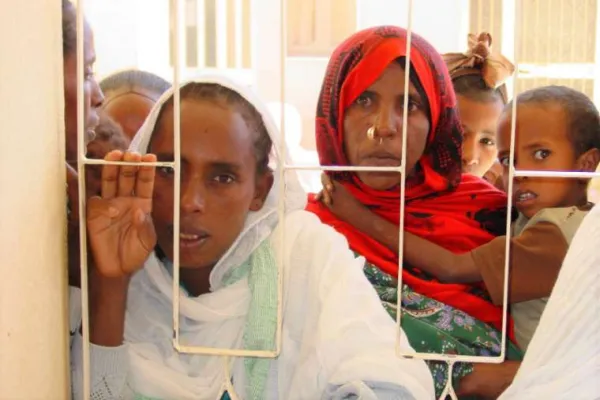
Last month, military forces arrived at the Church’s 22 health care clinics, telling patients to return to their homes, and subsequently guarding the buildings.
The government justified its seizures of the property under a 1995 decree restricting social and welfare projects to the state. The decree has been used intermittently since then to seize or close ecclesial services.
According to the BBC, analysts believe the recent seizures were retaliatory, after the Church in April called for reforms to reduce emigration. The bishops had also called for national reconciliation.
When the government interrupts the work of the Church, it is the people who suffer, Aid to the Church in Need said.
The agency argued that government-run hospitals lack the equipment and resources to take over the operations of the closed Church-run facilities, particularly in rural areas, Vatican News reported.
The agency also noted that the Catholic health care centers served people of all faiths. Some 95% of Eritreans are non-Catholic.
The Eritrean bishops have objected to the seizure of the clinics, stressing that the Church’s social services are not an act of opposition to the government.
“Any measure that prevents us from fulfilling … the obligations that come to us from the supreme commandment of brotherly love is and remains a violation of the fundamental right of religious freedom,” the bishops said in a statement.
Eritrea is a one-party state whose human rights record has frequently been deplored. Government seizure of Church property in the country is not new.
In July 2018, an Eritrean Catholic priest helping immigrants and refugees in Italy told EWTN that authorities had recently shut down eight free Catholic-run medical clinics. He said authorities claimed the clinics were unnecessary because of the presence of state clinics.
Christian and Muslim schools have also been closed under the 1995 decree designating the state as sole provider of social services, according to the US Commission on International Religious Freedom’s 2019 annual report.
Eritrea has been designated a Country of Particular Concern since 2004 for its religious freedom abuses by the US Department of State.
Many Eritreans, especially youth, emigrate due to a military conscription or a lack of opportunities, freedom, education, and health care.
A July 2018 peace agreement between Ethiopia and Eritrea, which ended a conflict over their mutual border, led to an open border which has allowed for easier emigration.
If you value the news and views Catholic World Report provides, please consider donating to support our efforts. Your contribution will help us continue to make CWR available to all readers worldwide for free, without a subscription. Thank you for your generosity!
Click here for more information on donating to CWR. Click here to sign up for our newsletter.
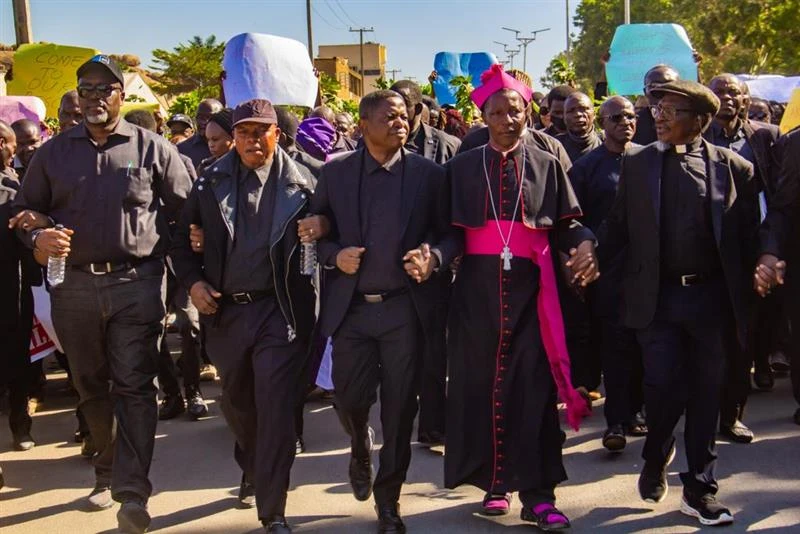
Catholic Archbishop Matthew Ishaya Audu of Jos marches alongside evangelical leader Rev. Dr. Gideon Para-Mallam in front of the Plateau state governor’s office building in Jos, Nigeria, Jan. 8, 2024. / Credit: Photo courtesy of Rev. Dr. Gideon Para-Mallam, photo by Plateau State Government Media Team.
Washington, D.C. Newsroom, Jan 9, 2024 / 15:30 pm (CNA).
Thousands of Christians rallied yesterday in front of the governor’s office in Nigeria’s Plateau state to demand action after more than 200 were killed in a series of Christmas massacres.
The attacks, which targeted Christian villages beginning Dec. 23 and continuing through Christmas day, left Christian communities in Nigeria’s Plateau state reeling. Photos obtained by CNA after the attack showed villagers burying their slain relatives and loved ones in mass graves.
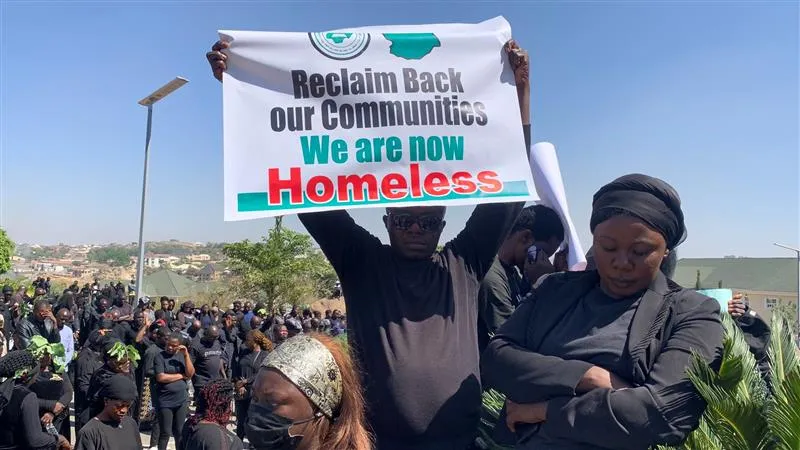
According to Rev. Dr. Gideon Para-Mallam, an evangelical leader who helped to organize the rally, the attacks also left 15,000 people displaced without homes.
Among the demands being made by the protestors, Para-Mallam said that they asked for an “urgent humanitarian relief material response by the state and federal government” and for the arrest of the perpetrators of the Christmas massacre, which he called a “genocidal,” “terrorist” attack.
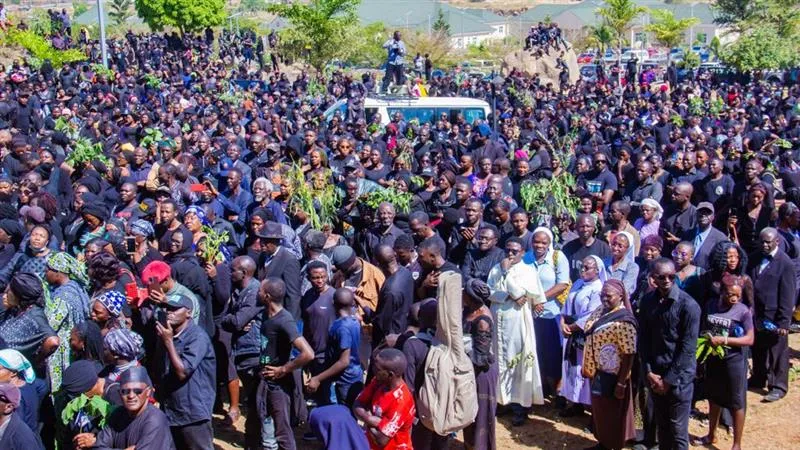
Thousands of Christians peacefully and prayerfully march to a rally in front of the Nigerian Plateau state governor’s office building in protest of the 2023 Christmas massacre that left over 200 Christian Nigerians dead, Jan. 8, 2024. Credit: Photo courtesy of Rev. Dr. Gideon Para-Mallam, photo by Plateau State Government Media Team.
The attack marks the latest instance of terrorists targeting Christian Nigerians on significant Christian feast days. In 2022, on Pentecost Sunday, 39 Catholic worshippers were killed at the St. Francis Xavier Owo Catholic Parish in Ondo Diocese.
Religious freedom advocates believe that militant Muslim Fulani herdsmen were responsible for the Christmas attacks. In Nigeria as a whole, at least 60,000 Christians have been killed in the past two decades. An estimated 3,462 Christians were killed in Nigeria in the first 200 days of 2021, or 17 per day, according to a new study.
Due to continued attacks, Nigeria is one of the most dangerous countries in the world to be a Christian, according to a 2023 report by the advocacy group International Christian Concern.
Para-Mallam told CNA that Nigeria’s middle belt region, of which Plateau state is a part, has “suffered sustained attacks for over a decade now with destruction of lives and properties.”
The thousands of protestors at the rally, he said, were “mournful, angry, but surprisingly joyful.”
Their “central objective,” he explained, was “to ask for an end to the killings not just in Plateau but Nigeria and seek justice for the people.”
Just-In: CAN Plateau State Chapter is having a Peaceful Walk to Government House pic.twitter.com/YbFRqtFI9J
“Above all, it was very peaceful and prayerful,” he added. “The old, the young all together felt that we had to do what we had to do to get our message across.”
According to Para-Mallam, the crowd numbered about 5,000 and included both Catholics and Protestants. Together, he said, they peacefully and prayerfully marched, ending in front of the governor’s office building in the city of Jos. Archbishop Matthew Ishaya Audu of Jos and several Catholic priests also took part in the march and rally, according to Para-Mallam.
The demonstration was “mournful, angry, and surprisingly joyful,” according to Rev. Dr. Gideon Para-Mallam. Credit: Photos by Nigerian multimedia journalist Jœy Shèkwônúzhïbó, used with permission.
The rally was organized with the help of the Christian Association of Nigeria (CAN), a coalition of Nigerian Christian Churches and groups that includes the Catholic Church in Nigeria.
Para-Mallam said the purpose of the demonstration was to “mourn in solidarity” with the devastated communities as well as to show them that the Church “cares” and “identify with them in the moment of suffering and mourning.”
A secondary purpose for the rally, Para-Mallam said, was to “get the Church on the Plateau to unite and to speak with one voice around the issues of social justice” and to “create awareness nationally and globally about the Christmas season attack.”
Para-Mallam said that Plateau’s governor, Caleb Mutfwang, addressed the crowds at the rally and was “sympathetic and understanding and spoke well on the pains of his people.”
Mutfwang condemned the attacks shortly after they occurred in a Dec. 26 statement in which he said: “This has indeed been a gory Christmas for us.”
“He promised to relay our concerns to the president and committed to work with the president to end the killings in the Plateau state,” Para-Mallam said.
Despite the governor and president voicing their support for the impacted communities, several religious freedom advocates have been critical of the lack of government response to the growing terrorist attacks.
Maria Lozano, a representative for the papal relief group Aid to the Church in Need, told CNA after the attacks that tangible government support was largely absent after the Christmas massacre and that a “lack of response from the government” over the years has worsened the situation in the region. The absence of government support, Lozano said, has forced Christian churches to take on the “primary responsibility of providing assistance.”
Para-Mallam asked for Christians outside of Nigeria to help by offering prayer, advocacy, and humanitarian intervention.
“We also want fellow believers to encourage policymakers to encourage the Nigerian government to do more to end the killings in general and particularly those targeted at Christians,” he said.
For several years now, religious freedom advocates have criticized the U.S. government for failing to include Nigeria in the State Department’s “Countries of Particular Concern” list, which some consider to be America’s most effective tool to encourage foreign governments to address the persecutions in their countries.
“There is no justification as to why the State Department did not designate Nigeria or India as a Country of Particular Concern,” said U.S. Commission on International Religious Freedom chair Abraham Cooper and vice chair Frederick Davie in a Jan. 4 statement.
Cooper and Davie mentioned the Christmas massacre as “just the latest example of deadly violence against religious communities in Nigeria.”
Speaking on “EWTN News Nightly” on Monday, Davie said that the decision to leave Nigeria off the list was “particularly” concerning and a “huge mistake.”
Davie told EWTN that “there are some who are saying that the government [of Nigeria] if it is not actively participating in some of this religious persecution is actually standing by and not doing what it can to prevent it.”
“We just believe,” Davie explained, “that by designating Nigeria a Country of Particular Concern, the United States puts itself in a position to work more closely with the government of Nigeria to address some of those fundamental security issues that are going unattended to.”
Despite this, the State Department has left Nigeria off the Countries of Particular Concern list since 2021.
Devasting flooding has hit the city of Maiduguri in northeastern Nigeria, and the diocese there is appealing for assistance and prayer. / Credit: Diocese of Maiduguri/ACI Africa
ACI Africa, Sep 12, 2024 / 11:00 am (CNA).
The Diocese of Maidugur… […]
Peace reigns inside Dar Mariam, the residence of the Salesian Sisters in Sudan despite the fact that it has been surrounded by heavy gunfire and bombed multiple times as war rages on in the northeastern African country. / Credit: Father Jacob Th… […]




Leave a Reply