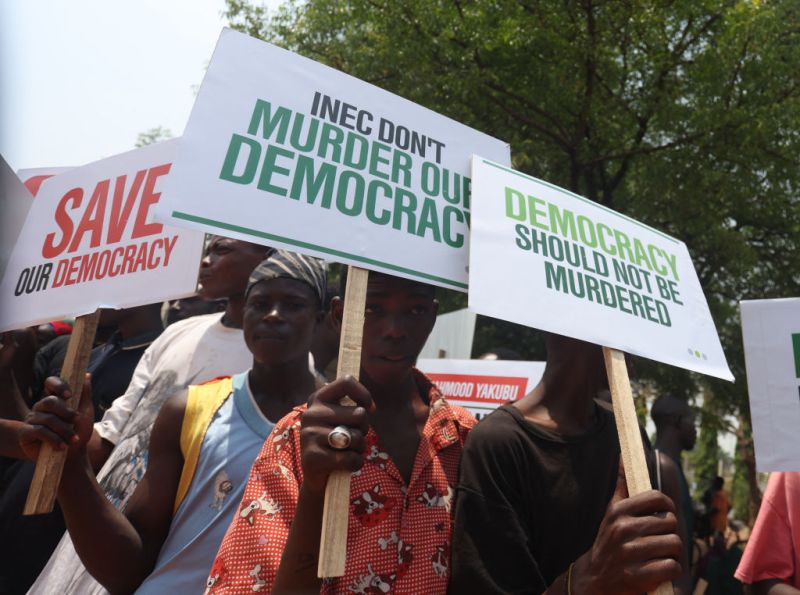
 A group of people protest the outcome of the 2023 presidential elections and the emergence of the candidate of All Progressives Congress’ (APC) Bola Tinubu as the president-elect in Abuja, Nigeria, on March 1, 2023. / Photo by KOLA SULAIMON/AFP via Getty Images
Washington D.C., Mar 1, 2023 / 15:45 pm (CNA).
Bola Tinubu, candidate of the incumbent All Progressives Congress Party, has been named by Nigeria’s electoral commission the outright winner of the country’s presidential election.
However, the country’s Catholic bishops, among others, have sharply criticized the Independent Nigerian Election Commission (INEC) for its handling of the vote count and called for the government to address complaints raised by voters and the other political parties.
“The delay in the electronic transmission of the results of the polling units to the INEC results viewing portal before their announcement at the collation centers raised suspicion in many minds about the transparency of the entire process,” read a statement from Archbishop Lucius Iwejuru Ugorji of Owerri, the president of the Catholic Bishops’ Conference of Nigeria.
“There is, therefore, palpable tension in the air and agitations not just by some political parties but by a cross-section of the Nigerian population,” he said.
“No matter how long it takes, INEC has to ensure that it does the right thing now to ensure that the sanctity of the collective will of the electorate is not violated, so as to restore the confidence of the citizenry in our government and its institutions,” the archbishop continued. “As the saying goes, it is no use running when one is on the wrong road.”
Tinubu is a Muslim politician from the Yoruba ethnic tribe representing the party of the current president, Muhammadu Buhari, who is completing his second term in office and was not eligible to run again.
Voter turnout was only 29%, far lower than the last election in 2019, and video-documented claims of vote switching and voter intimidation were rife.
The field of candidates represented 18 parties, but the key challengers to Tinubu and the All Progressives Congress (APC), the ruling party, were the Peoples Democratic Party, headed by Atiku Abubakar, a Fulani Muslim, and the Labour Party, headed by Peter Obi, an Igbo Roman Catholic.
Considered a high-stakes election because of Nigeria’s size and influence in West Africa, observers had expressed hope that a peaceful transfer of power to a civilian government would bode well for the nation’s war against radical Islamist insurgents.
The massacres of Christian farmers in war-torn Benue State on Election Day, Feb. 25, underscored the violent situation that Christians in particular face in the predominantly Muslim country.
Fulani terrorists had warned the citizens not to go to the polling stations in the weeks prior to the election, according to media reports. At least 10 citizens who had voted on Saturday were murdered in their shelters late at night after voting, Father Remigius Ihyula, a Catholic priest in Makurdi, said in a text message to CNA.
INEC reported that APC had fulfilled the constitutional requirements of gaining a plurality of votes in at least 24 states as well as the Federal Capital Territory of Abuja.
The 70-year-old Tinubu brushed aside challenges to the integrity of the counting process and commended INEC for “running a free and fair election.”
“The lapses that did occur were relatively few in number and were immaterial to the final outcome,” the declared winner said in a prepared statement.
“With each cycle of elections, we steadily perfect this process so vital to our democratic life,” he said. “Today, Nigeria stands tall as the giant of Africa. It shines even brighter as the continent’s biggest democracy.”
Charges of fraud
Opposition parties had walked out of the tabulation process Monday charging fraud and criminal intimidation of their voters.
“We party agents are not here to rubber stamp the electoral fraud cooked up between INEC and the APC,” said Sen. Dino Melaye, spokesman for the People’s Democratic Party, according to Nigerian media reports.
“We have records [showing] where the Bimodal Voter Accreditation Systems [scanners that verify voter authenticity and upload results] were not used and yet the results have been announced,” Melaye said.
Obi’s Labour Party has vowed to fight the result in court. “We will sue for an annulment for sure. This is the worst election since Nigeria re-entered civilian rule in 1999,” Barrister Yakubu Bawa, a leader of Obi’s legal team, told CNA.
Bawa alleged that the voting results of polling units in Lagos State were stopped from uploading to the election commission server and that in Rivers and Delta States the tabulation results were falsified.
This year the election commission attempted to subvert fraud by setting up electronic voter identification through the Bimodal Voter Accreditation System at the polling units and to upload the results from the polling units to avoid manipulation of paper ballot tallies.
But fraudsters found a way to work around the system, said Kunle Lawal, executive director of The Electoral College of Nigeria, an observer group in Lagos.
“Some ingenious Nigerian politicians were able to evade the electronic system due to the failure of the polling units to upload their results electronically. In many cases the signed and stamped voter tallies at the polling units differed from the results registered at the INEC collation center,” he told CNA.
Election observers in the U.S. expressed cautious disapproval. The International Republican Institute and the National Democratic Institute faulted the government for disenfranchising many Nigerians, citing “logistical challenges” that could have been anticipated and avoided.
“Logistical failings caused late openings across the country, creating tensions, and the secrecy of the ballot was compromised in some polling units given overcrowding,” according to the blue-ribbon panel of observers representing the Republican and Democrat parties in the United States. “The combined effect of these problems disenfranchised Nigerian voters in many parts of the country, although the scope and scale is currently unknown.”
There likely will not be enough evidence to annul the result, according to a U.S.-based nongovernmental organization that tracks human rights abuses in Nigeria.
“Will the election be annulled? Probably not. Unless Nigerians and the international observers unite to discover and report the truth, Nigeria’s democracy will be a façade,” Kyle Abts, executive director of the International Committee on Nigeria, told CNA.
“It is becoming clear that INEC was too lax in their approach to collecting and reporting votes. There are reports of ballot stuffing or missing ballot boxes along with polling stations never opening,” Abts added.
In the weeks leading up to the election, the nation’s Muslim leaders called upon believers to back the all-Muslim ticket of Bola Tinubu and Kashim Shettima, calling it a “political jihad.” All other leading parties were headed by tickets that balanced a Muslim candidate with a Christian candidate, an informal tradition encouraged by the nation’s constitution.
The voting patterns fell along sectarian lines, according to Nina Shea, a senior scholar at Hudson Institute.
“The Christian vote was split between the PDP and the Labour Party, but the Labour Party couldn’t attract Muslim votes. I am astonished that Obi’s party didn’t have a strategy to avoid having the Christian vote split,” Shea said.
[…]



Leave a Reply