
Rome, Italy, Feb 10, 2018 / 12:00 am (CNA).- Rome’s Pontifical Gregorian University will begin offering a two-year licentiate course in protecting minors, a move Fr. Hans Zollner SJ, said is a sign of the progress the Church has made in terms of abuse-awareness and prevention.
“In most countries ten years ago, five years ago, there was no talk about safeguarding. Now you have degree programs, certificates, diplomas,” he told CNA in a Feb. 9 interview.
“Why has this developed? Because people realize it’s not only done by talking about it or by writing about it in articles or pointing the finger to this or that institution. What needs to be done is serious study.”
Fr. Zollner has been a member of the Pontifical Commission for the Protection of Minors and heads the Center for Child Protection (CCP) at the Gregorian University, which is offering the new licentiate course.
The two-year course will launch in October 2018 as an interdisciplinary university degree. Classes will be taught in English, and those who enroll will also participate in an internship based on their respective academic backgrounds.
The first semester will be dedicated to exploring the work of safeguarding minors, while the second will dig deeper into more theoretical study of what ‘safeguarding’ fully means. In the third semester students will participate in internships, and the final semester will be dedicated to writing a thesis.
The new licentiate was announced Feb. 9 during the graduation ceremony for the university’s one-semester diploma course in safeguarding minors, which was launched by the CCP in 2016.
The objective of the diploma course is to form people who will eventually become child protection officers for dioceses, religious congregations, and similar organizations, as well as advisers and trainers in the field of safeguarding.
In his comments to CNA, Zollner said while other similar courses exist, the licentiate will be unique, because to his knowledge, it’s the “very first full time, two-year academic program that is multidisciplinary and transdisciplinary” while also taking into account Pope Francis’ new Apostolic Constitution “Veritatis Gaudium” on the nature and curriculum of ecclesiastical universities and institutions.
The licentiate, he said, is needed because although the diploma course gives a solid foundation child abuse prevention, “we also need people who are capable of adapting, inventing, creating new approaches to safeguarding in very different environments.”
While the diploma course allows students to gain the knowledge and experience needed in order to implement guidelines and policies when they go back to their countries and dioceses, the licentiate will take it a step further, he said.
“The scale of the problem and the breadth of the different issues that have to be tackled is enormous, and we Westerners don’t have very much understanding of what’s going on in some areas of the world,” Zollner said.
“We hope that we can get a real foot on the ground with people who are formed in-depth and know how to transmit a message that goes from head to heart. That’s for us a goal with this new licentiate.”
He said that from what he’s seen, the results of the diploma course have been largely positive, which is significant given the challenge of having people come together from various cultures with different attitudes in terms of talking about about child sexual abuse.
But despite the challenges, Zollner said “we have seen a transformation in a good number of them. I have been at the beginning and end of the semester with them and you see the difference not only in language, not only in how they use words, but in the whole attitude, how they talk about survivors of abuse.”
“It’s not anything threatening, anything disturbing, sort of difficult to talk about, it is, but now they have the capacity to really empathize, to be compassionate, to really do what they will be asked to do, which is to accompany victims and do whatever they need to do so that abuse is prevented.”
This year there were 18 graduates of the diploma course, which was coordinated by Prof. Dr. Karlijn Demasure, executive director of the CCP, and Dr. Katharina A. Fuchs. Diplomas were awarded by the Institute of Psychology of the Pontifical Gregorian University, which founded the CCP in 2012.
Students who received their diploma came from all over the world, including countries such as Czech Republic, Ghana, India, Japan, Lebanon, Mozambique, Nigeria, Slovakia, Taiwan, Tanzania, Thailand and the United States.
One of the graduates, Sr. Perpetua of the Congregation of Saint Therese of the Child Jesus, who comes from the Bukoba diocese of Tanzania, told CNA that she signed up for the course “because there is a need to create awareness in my country because people are not aware about child sexual abuse.”
She said she feels “empowered” after taking the course, and that when she returns to her diocese, “I’ll create awareness by education, by educating the children at the school, at universities, parents and society at large.”
Similarly, Perla Freed, Director of the Safe Environment program for the Archdiocese of Atlanta, said “people don’t want to talk about child sexual abuse because it’s not a happy subject,” but she enrolled in the course because she wanted “more of an awareness of this problem and how to confront it.”
Not having background in topics such as theology or canon law, Freed said getting formation in these areas was “a very good model” to follow in studying the various aspects of abuse and prevention.
She said she is looking forward to returning to her diocese where she can implement what she’s learned, specifically in terms of prevention and victim assistance.
When it comes to abuse, “every case is heartbreaking and shouldn’t happen,” she said, but stressed that the Catholic Church “is making a lot of efforts to ensure that those people are taken care of.”
“I think the Catholic Church, in the U.S. and in other countries, is an example of what everybody should be doing on child safeguarding all over the world,” she said. “We have the programs for schools, we have the training for adults working with those children and young people, so we’re an example of what other public schools systems and other organizations working with youth should follow.”
In his comments to CNA, Zollner said the model of the course has been replicated by other entities throughout the world, including in Manila and in Mexico City, as well as in other institutions at the university.
 […]
[…]


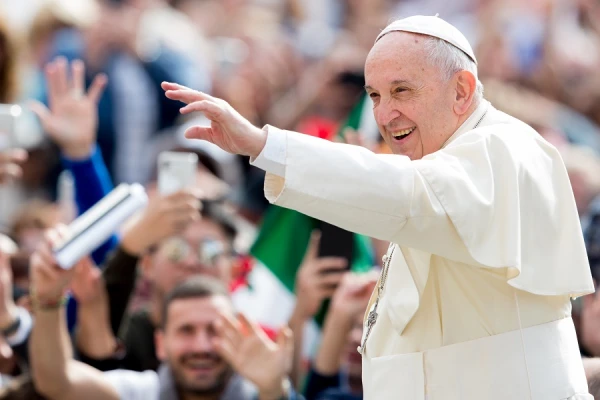

Pope Francis references the Apollo XI moon landing on July 20, 1969…
A little-known detail of that story is that the commanding officer of the Apollo XI Recover Ship (aircraft carrier, USS Hornet, CVS-12) at the “splashdown” site in the southern Pacific (July 24) was Capt. Carl J. Seiberlich (later Rear Admiral). Seiberlich was a very devout (and Marian) Catholic his entire life, and during the recovery mission corresponded directly with Pope Paul VI.
The Pope responded by extending his papal blessing to the entire Hornet crew, which was received on September 6 and read by the Catholic chaplain over the ship’s intercom. This was still in the Pacific and at “lights-out,” beneath a Milky Way of not less than a billion visible stars. (One has never really seen the Creator’s Milky Way unless on a moonless night at least 1,000 miles away from the nearest city lights, say, Honolulu).
The papal message (from my journal as a crew-member junior officer):
“The Secretariate of State is graciously directed by the Holy Father to acknowledge receipt of the special philatelic envelope [now in the incomparable Vatican stamp collection] from the Captain and Crew of the USS Hornet….and in expressing His sincere appreciation of the loyal filial devotion which prompted this gesture, has the honour to convey, in pledge of abundant divine graces, the paternal Apostolic Benediction of His Holiness.”
Marvelous account.
Pope Francis inspires us: “May the memory of that great step for humanity [Apollo XI] ignite the desire to progress together towards even greater goals: more dignity for the weak, more justice among peoples, more future for our common home.” As a FOOTNOTE (in support), we might still remember also the global CONTEXT for Apollo XI…
Goals can be a mixed bag. On the one hand, writer Saul Bellow commented that this technical achievement of Apollo was not much more than “the Protestant Ethic with nowhere else to go” (Life Magazine). But on the other hand, the threat then to “more justice among peoples” was the ATHEISTIC STATE SYSTEM sponsored by the Soviet Union. AND part of that threat was Soviet technical superiority in rocket delivery systems, for potential use in intercontinental ballistic missiles armed with nuclear warheads.
How soon we forget the depths of the Cold War… Apollo XI involved both a lunar landing craft AND a catch-up in rocket technology—a morally anguishing addition to the needed nuclear-deterrent (and box canyon) of what had become Mutual Assured Destruction (MAD). The Cuban Missile Crisis of 1963 was only a few years back.
(The totally unexpected DISMANTLING of the Soviet Union in 1991 came largely at the hands of St. Pope John Paul II, a teacher of very prudential judgment/strategies AND of moral absolutes and, therefore, of the irreducible difference between the two.)
As if the Cold War were not enough, in the 1960s the UNITY of the United States was unraveling—a bit like Church unity today (?). Watts in Los Angeles, Washington DC, and many other cities were torched in the late 60s. Part of the overall moral devolution was the so-called Sexual Revolution—-which within the Church today undermines the pope’s moral message, and which overall has gone septic as “gender theory.”
SO, underpinning our “GREATER GOALS”, then, is steadfast moral clarity about the nature and “transcendent dignity of the human person”—-the very core of the Catholic Social Teaching (CST).
The global CONTEXT today? Advanced despair and distraction, yielding to: (1) not Communism, but resurgent SOCIALISM—-which is not to be confused with CST’s “solidarity”—-but as “Communism with the claws retracted” (Whittaker Chambers). And, (2) engulfing ISLAM: belief in a God other than ourselves (yes!), but then a denial of the self-disclosed inner nature of this (Triune) Oneness: a Father of infinite love, all the way through, and willfully shared with receptive human nature.
Pope Francis is so right to champion solidarity, a need crystalized forever by Apollo 8’s photo of “Earthrise”, when he also clarifies that the Church, in Christ and with Mary, is more than just another non-governmental organization devoted to social uplift.