

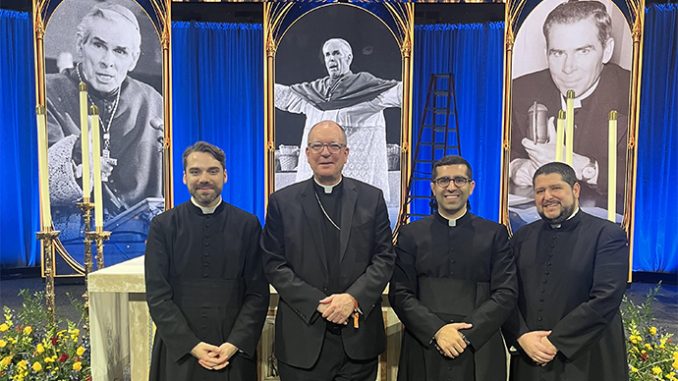
This week, I traveled to St. Louis with thousands of other Catholics from throughout the country for the Beatification Mass of Fulton Sheen. It was deeply uplifting to see so many people gathered together who, at some point in their lives, had been touched by the ministry of the Church’s newest blessed—an apostle of the preached and written word and one of the most effective evangelizers of the modern age. Many came not simply to remember his life and ministry, but to give thanks for his witness and to seek his intercession as a blessed before the throne of grace.
The Beatification Mass was celebrated by the pro-prefect of the Vatican’s Dicastery for Evangelization, Cardinal Luis Tagle, at the Dome at America’s Center, a large arena in the heart of St. Louis. Of the fifty thousand in attendance, with dozens of bishops and hundreds of priests and seminarians among them, one had perhaps the most unique perspective on the occasion: Bishop John Barres of the Diocese of Rockville Centre, New York.
Bishop Barres was baptized by Fulton Sheen himself on October 2, 1960, at St. Augustine Church in Larchmont, New York. His connection to Sheen, however, goes back even further. Bishop Barres’s parents, Oliver and Marjorie, were both Protestant Congregationalist ministers who, after years of studying and reflecting on the Christian faith, converted to Catholicism in 1955. Their journey into the Catholic Church became the subject of Oliver Barres’s book, One Shepherd, One Flock.
Oliver Barres’s conversion also brought the family into close contact with Fulton Sheen. He eventually worked alongside Sheen at the Society for the Propagation of the Faith, supporting Sheen’s missionary work around the world. It was in the midst of this friendship and collaboration that Sheen baptized the infant John Barres and his older sister, Clare. Decades later, John Barres would himself become a bishop and a successor to the apostles.
Today, as bishop of Rockville Centre (Long Island, NY), he carries with him not only the joy of having been baptized by Sheen, but a lifelong appreciation for the man whose preaching and writing helped lead his own family into the Catholic Church. This was reflected in a recent pastoral letter he issued to the people of his diocese in anticipation of the beatification.
Bishop Barres was kind to answer a few questions for the readership of The Catholic World Report when I met with him in St. Louis before the Beatification Mass:
CWR: Fulton Sheen is rightly remembered for his extraordinary brilliance as a preacher, writer, and communicator. But what do you believe was at the heart of his holiness? What heroic virtues or aspects of his spiritual life do you think most clearly explain why the Church has recognized him as a blessed?
Bishop Barres: Blessed Fulton Sheen was a priest through and through. This beatification is a great gift to priests everywhere, providing a great model of heroic virtue on how to live the priesthood. To understand Sheen’s sanctity, we must view it through the lens of how he lived as a priest. We must look beyond his intellectual achievements to the mystery of the cross, which shaped his entire identity as a priest. Sheen understood that every dimension of the Church’s worldwide mission, and indeed every human destiny, must pass through the horizontal and vertical beams of the cross of Jesus Christ.
This conviction lies at the heart of Sheen’s spirituality of the priesthood. In his three books on the priesthood—The Priest Is Not His Own, Those Mysterious Priests, and Treasure in Clay—he repeatedly teaches that a priest must embrace the mystery of the cross in all its rough contours if he is truly to live out his vocation. Through ordination, a priest receives an extraordinary ontological gift, yet he remains a man subject to human weakness, the seven capital sins, and the temptations of the world, the flesh, and the devil.
It is only by embracing the cross that he can reconcile the grandeur of his priestly identity with the reality of his human frailty. As Sheen observed, it is very hard for a priest to carry and embrace the cross, but it is harder not to. The cross is not an obstacle to priestly fulfillment, but the very means by which a priest discovers how to live his vocation in his own historical circumstances and in the particular place to which the Holy Spirit has sent him.
Sheen’s life reminds us that the cross is the meeting place of human weakness and divine strength. It is precisely through embracing the cross, rather than fleeing from it, that the priest is conformed to Jesus Christ and discovers the fullness of his vocation.
Ultimately, Sheen’s holiness is inseparable from his profound understanding of divine grace and mercy. In Treasure in Clay, he candidly reveals his own struggles, offering hope to every priest who experiences the tension between his sacred calling and his personal weaknesses.
I find his reflections on St. Thérèse of Lisieux and Vladimir Lenin particularly compelling as they illustrate the transformative power of grace. Thérèse recognized what she might have become without divine mercy, while Sheen contemplated what Lenin might have become had he cooperated with that same grace. Holiness, therefore, is not the achievement of extraordinary human talent or the absence of weakness, but the fruit of surrendering oneself to God. Sheen’s life reminds us that the cross is the meeting place of human weakness and divine strength.
It is precisely through embracing the cross, rather than fleeing from it, that the priest is conformed to Jesus Christ and discovers the fullness of his vocation.
CWR: What do you believe the beatification of Fulton Sheen signifies for the Church in the United States today? In particular, what can priests and lay faithful learn from his life and witness at a time when the Church is seeking to evangelize a culture increasingly distant from the faith?
Bishop Barres: The beatification is an opportunity to reflect on his extraordinary ability to communicate the Catholic faith to the modern world. Trained in philosophy at Louvain, Sheen understood that ideas have consequences. He recognized the profound influence of Freud, Marx, and Nietzsche on modern culture and proclaimed the liberating power of Catholic truth. He reminds us today that the truths of our faith are interconnected and that we must proclaim them with clarity and conviction.
Yet Sheen’s extraordinary effectiveness as an evangelist flowed from his contemplative life, particularly his daily Holy Hour and his profound devotion to the Mass. He understood the cosmic significance of the Eucharist and its relationship to the Church’s worldwide mission. I believe his beatification offers an opportunity to renew this contemplative understanding of evangelization. When Catholics throughout the world unite their prayers, sacrifices, and daily crosses to Christ for the Church’s mission, they participate directly in the work of evangelization.
This mission belongs to every Catholic, especially the laity, who are called to bring the light of Christ into their families, workplaces, friendships, and every dimension of secular society. Sheen reminds us that evangelization begins in contemplation but must bear fruit in the world. His example offers a compelling model for the new evangelization: a Church deeply rooted in prayer, faithful to the fullness of Catholic truth, and courageous in proclaiming Christ to an increasingly secular world.
CWR: Of Archbishop Sheen’s many books, is there one you would especially recommend to Catholics today, and why?
Bishop Barres: Two years ago, we experienced the National Eucharistic Revival in Indianapolis and Eucharistic pilgrimages throughout the nation. All our dioceses have held Eucharistic congresses and Eucharistic pilgrimages through the streets of our parishes and dioceses.
I believe that a key dimension of an ongoing Eucharistic revival—and of an ongoing experience of the cosmic power of the Catholic Mass to drive the Church’s worldwide mission—is a biblical revival. There is no Eucharistic revival without a biblical revival because the rituals of every sacrament are intensely biblical. Look at the Mass: its prayers are biblical, and there is an interdependence between the Liturgy of the Word and the Liturgy of the Eucharist.
That is the preface to my recommendation: Sheen’s Life of Christ.
It is a classic work that will help both Catholic and non-Catholic readers enter into the inspired Word of God and be transformed by it. It will help them to worship, so that the lights go on when they worship at Mass and participate in every dimension of the sacraments. Scripture is critical. Bishop Sheen, of course, would point us toward the fact that there is no substitute for praying with the inspired texts themselves.
But his commentaries and his use of G. K. Chesterton’s paradoxes in Life of Christ—and really throughout all his writings—frame things in provocative ways. They prevent you from being superficial. They drive you more deeply into the text and more deeply into your own spirit of holiness and mission.
If you value the news and views Catholic World Report provides, please consider donating to support our efforts. Your contribution will help us continue to make CWR available to all readers worldwide for free, without a subscription. Thank you for your generosity!
Click here for more information on donating to CWR. Click here to sign up for our newsletter.
Leave a Reply