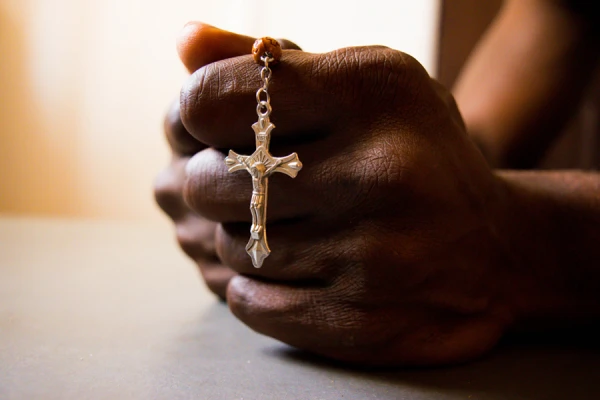
Rome, Italy, Jun 27, 2019 / 01:19 pm (CNA).- The Global Rosary Relay aims to have 1 billion Hail Marys said for the sanctification of priests June 28, the feast of the Sacred Heart of Jesus.
“This is the world family all joining together as one on Friday and praying for the sanctification of our priests,” Global Rosary Relay founder and organizer Marion Mulhall told CNA June 27.
With prayer locations in more than 70 countries this year, the relay is carefully timed with the recitation of the rosary every half hour.
The relay begins with the joyful mysteries in South Korea and then is passed off to Russia for the luminous mysteries, followed by the sorrowful mysteries in China before continuing on to India, Vietnam, the United Arab Emirates, Uganda, Israel, and many other countries across Europe and the Americas.
“Ten years ago when we began the global rosary relay, we had 24 single locations in 24 countries for the 24 hour clock. This year we have 255 single prayer locations in every single corner of the planet,” Mulhall said. “The whole world is in prayer the whole day.”
“Anybody who prays the rosary on Friday — it doesn’t matter what time it is or where they are — can be pretty much guaranteed that they are joining, even if they may not realize it, with a participating prayer location around the world,” she said.
Mulhall explained that she felt personally called 25 years ago to “promote the priesthood at any price,” and this led to the creation of the World Priest Apostolate which organized campaigns to pray for priests for many years before starting the Global Rosary Relay ten years ago.
Saint Pope John Paul II declared the Feast of the Sacred Heart to be the World Day of Prayer for Priests in 2002. In 2016, the final rosary of the relay was led by the president of the Pontifical Council for the Promotion of the New Evangelization.
This year, a rosary will be said in Rome at 6pm local time for Pope Francis and his intentions.
Mulhall said that social media live streams and television broadcasts of the rosary on EWTN and other Catholic channels have led to tremendous growth of the rosary relay in recent years.
“Last year, 700 million Hail Marys were prayed and 12-14 million people joined in prayer, so to go for 1 billion Hail Marys is actually not that hard with the help of global TV broadcasts,” she said.
“She [Our Lady] is watching out for her priestly sons all the time and she is always asking us to pray for her most beloved sons,” she said.
If you value the news and views Catholic World Report provides, please consider donating to support our efforts. Your contribution will help us continue to make CWR available to all readers worldwide for free, without a subscription. Thank you for your generosity!
Click here for more information on donating to CWR. Click here to sign up for our newsletter.

CNA Staff, Dec 15, 2020 / 12:24 am (CNA).- A Scottish member of Parliament is calling on the UK government to end a two-child limit on tax credits and other benefits for children, which is believed to be a leading factor for many women seeking abortion… […]
The community of Discalced Carmelites of Lucena in Spain is being forced to leave after the order’s presence of more than 400 years in the city due to lack of vocations. / Credit: Diocese of Córdoba, Spain
Pope Francis celebrates Christmas Mass in St. Peter’s Basilica Dec. 24, 2020. / Vatican Media.
Greccio, Italy, Dec 17, 2021 / 04:00 am (CNA).
In 2019, Pope Francis issued an apostolic letter on the meaning and importance of the Christmas nativity scene. He signed the document, Admirabile signum (“Enchanting image”), on Dec. 1 that year, at the Shrine of the Nativity in Greccio, a hilltown in the Italian region of Lazio.
The choice of Greccio was significant, because it was there in 1223 that St. Francis of Assisi created history’s first nativity scene.
In the apostolic letter, widely regarded as one of the most moving documents of Francis’ pontificate, the pope sets out “to encourage the beautiful family tradition of preparing the nativity scene in the days before Christmas.”
Here are 10 things that Pope Francis wants us to learn from the nativity scene, drawn from Admirabile signum.
1.The nativity scene is like a living Gospel. The depiction of Jesus’ birth is “a simple and joyful proclamation of the mystery of the Incarnation of the Son of God,” the pope writes. The nativity scene invites everyone who contemplates it “on a spiritual journey, drawn by the humility of the God who became man in order to encounter every man and woman.”
The Vatican Nativity scene. Agencia Andina
2. The custom is rooted in the Bible. The pope underlines that the nativity scene rises from “the pages of sacred Scripture.” St. Luke’s Gospel says that Mary “gave birth to her firstborn son and wrapped him in swaddling cloths, and laid him in a manger, because there was no place for them in the inn” (2:7). The manger is the focus of nativity scenes. Indeed, the Italian word for nativity scene is “presepe,” from the Latin word “praesepium,” meaning “manger.”
Pope Francis visits the site of the first nativity scene in Greccio, Italy, on Jan. 4, 2015. Vatican Media.
3.The tradition was born in an unassuming Italian town. St. Francis of Assisi stopped in Greccio in November 1223, probably on his way back from Rome after receiving papal approval for the Rule of his religious order. Fifteen days before Christmas, he asked a local man named John to help him “bring to life the memory of that babe born in Bethlehem, to see as much as possible with my own bodily eyes the discomfort of his infant needs, how he lay in a manger, and how, with an ox and an ass standing by, he was laid upon a bed of hay.” On Christmas Day, St. Francis was joined by his friars and people from the surrounding area before a manger full of hay, watched over an ox and a donkey.
Pope Francis blesses nativity scenes near the Vatican Dec. 9, 2019. .
4.The first nativity scene was connected to the Eucharist. Describing the scene in Greccio that day, Pope Francis writes: “All those present experienced a new and indescribable joy in the presence of the Christmas scene. The priest then solemnly celebrated the Eucharist over the manger, showing the bond between the Incarnation of the Son of God and the Eucharist.” Unlike in nativity scenes today, the pope says, there were no statues. Instead, “the nativity scene was enacted and experienced by all who were present.”
Nativity scene. . Ben White Photography via Unsplash.com.
5.The original nativity scene inspired a vision. The pope recalls that one of the witnesses to the first nativity scene saw “a marvelous vision.” Thomas of Celano, the first biographer of St. Francis, wrote that “one of those present saw the Baby Jesus himself lying in the manger.”
. fotorutkowscy / Shutterstock.
6.The nativity scene is a means of evangelization. The pope says that by creating the nativity scene, St. Francis “carried out a great work of evangelization” that continues to touch hearts to this day. The saint had discovered “a simple yet authentic means of portraying the beauty of our faith” that was accessible to all.
Pope Francis incenses the nativity scene in St. Peter’s Basilica Dec. 24, 2017. . Vatican Media.
7.The manger is a sign of God’s love. Pope Francis writes that nativity scenes resonate so deeply because they show God’s tender love. They proclaim that “the Creator of the universe lowered himself to take up our littleness.” They engage the senses and imagination, helping people “to ‘feel’ and ‘touch’ the poverty that God’s Son took upon himself in the Incarnation.”
A detail from the monumental Nativity scene of the Castelli. . YouTube.
8.The nativity scene contains a call to service. The pope says that the Christmas crib contains an implicit message. “It summons us to follow him along the path of humility, poverty, and self-denial that leads from the manger of Bethlehem to the cross,” he writes. “It asks us to meet him and serve him by showing mercy to those of our brothers and sisters in greatest need.”
The Nativity, by Rogier van der Weyden, part of the Bladelin Altarpiece. Public Domain.
9.Even a nativity scene’s landscapes are meaningful. The pope notes that depictions of the Nativity often include “the ruins of ancient houses or buildings.” He writes: “More than anything, the ruins are the visible sign of fallen humanity, of everything that inevitably falls into ruin, decays, and disappoints. This scenic setting tells us that Jesus is newness in the midst of an aging world, that he has come to heal and rebuild, to restore the world and our lives to their original splendor.”
Courtney Mares.
10.Nativity scenes nourish devotion to Mary and Joseph. The pope observes that the Virgin Mary is shown as “a mother who contemplates her child and shows him to every visitor.” In her, “we see the Mother of God who does not keep her Son only to herself, but invites everyone to obey his word and to put it into practice.” St. Joseph stands at Mary’s side, protecting her and the Christ Child. The nativity scene reminds us that Joseph “entrusted himself always to God’s will, and put it into practice,” encouraging us to do the same.
Leave a Reply