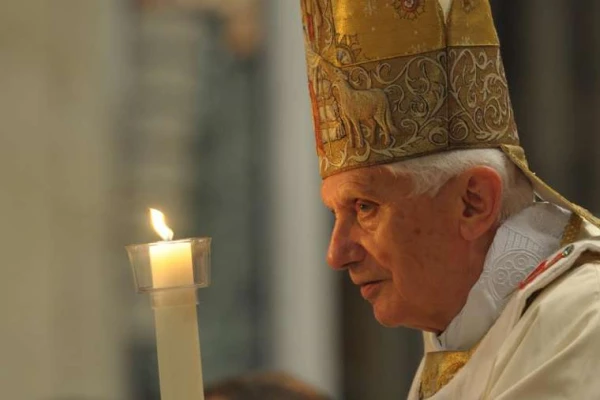
Vatican City, Jun 18, 2019 / 11:01 am (CNA).- Pope Benedict XVI is not dead and did not recently suffer a stroke, the Vatican confirmed on Tuesday.
On Monday, rumors circulated on Twitter and other social media platforms that the Pope Emeritus had suffered a “mild ischemia” – a kind of stroke.
“The rumours are false,” Alessandro Gisotti, director ad interim of the Press Office of the Holy See, confirmed to the Catholic Herald on Tuesday.
Archbishop Georg Gänswein, Benedict’s personal secretary, called the rumors “fake news,” Edward Pentin reported on Twitter.
On multiple occasions over the past several years, Vatican officials have had to quash similar rumors that the small, white-haired nonagenarian is close to death.
Benedict XVI resigned from the papacy in 2013, citing advanced age and declining strength that made it difficult to carry out his ministry. He was the first pope to resign in nearly 600 years.
If you value the news and views Catholic World Report provides, please consider donating to support our efforts. Your contribution will help us continue to make CWR available to all readers worldwide for free, without a subscription. Thank you for your generosity!
Click here for more information on donating to CWR. Click here to sign up for our newsletter.
Rosary beads and tributes are placed on the sculpture of St. John Paul II on March 13, 2025, at the main entrance of Gemelli Hospital in Rome, where Pope Francis is being cared for. Today marks the 28th day since Pope Francis was hospitalized in… […]
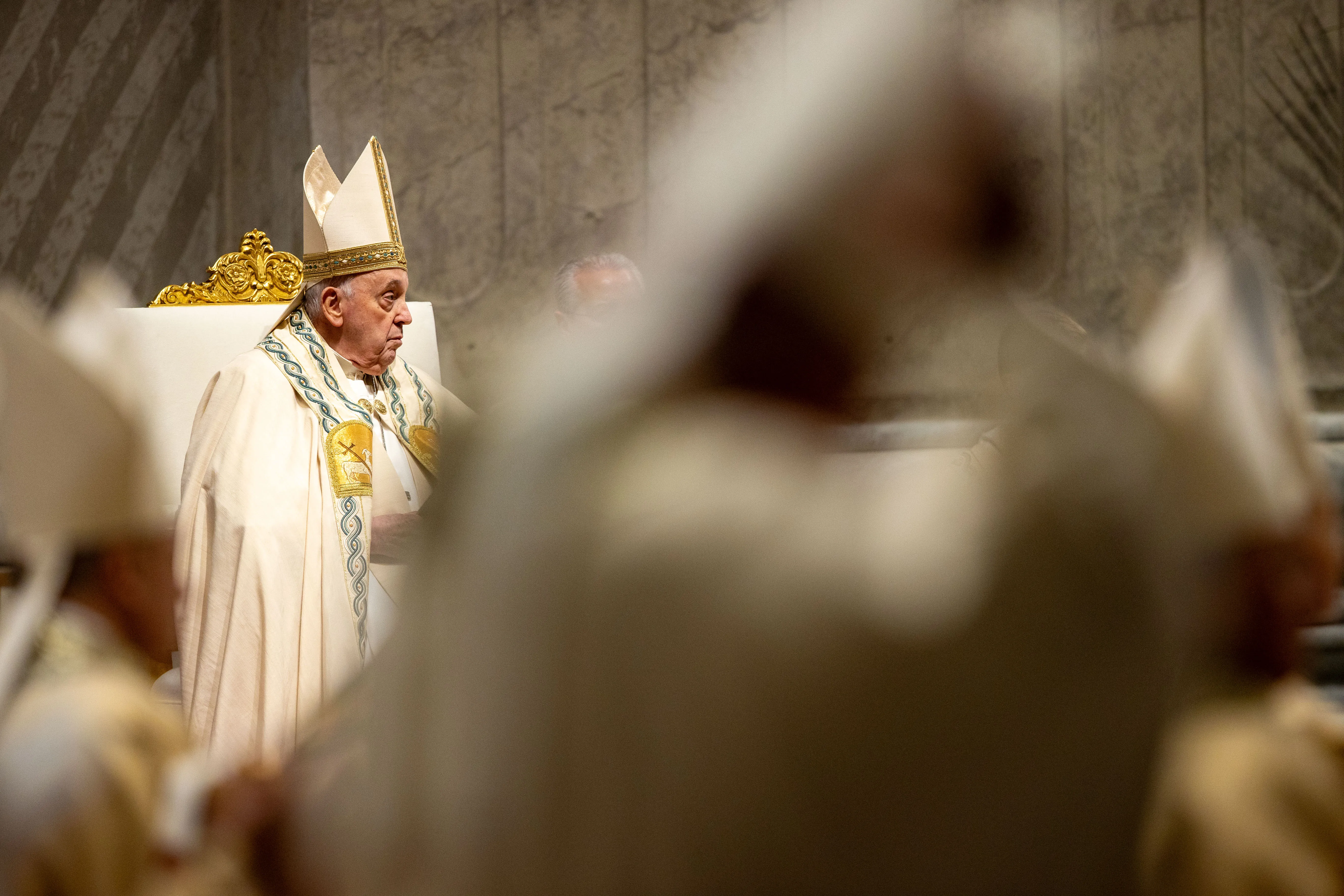
Pope Francis presides at the Vatican’s Easter Vigil, Saturday, March 30, 2024 / Daniel Ibanez/CNA
Rome Newsroom, Mar 30, 2024 / 17:22 pm (CNA).
Pope Francis on Saturday evening presided over the Easter Vigil Mass at Saint Peter’s Basilica, reflecting on the gravity of Easter as a symbol of God’s reborn hope and the ultimate testament of life over death.
There were some concerns on Friday night about the pope’s wellbeing after the Holy Father canceled his attendance at Rome’s Via Crucis (Way of the Cross) at the last minute. The Holy See Press Office said the pope made the decision “to conserve his health” for the lengthy Easter Vigil liturgy.
“This is the Pasch of Christ, the revelation of God’s power: The victory of life over death, the triumph of light over darkness, the rebirth of hope amid the ruins of failure. It is the Lord, the God of the impossible, who rolled away the stone forever,” the pope said on Saturday in front of nearly 6,000 faithful gathered in Saint Peter’s Basilica.
Pope Francis celebrates the Vatican’s Easter Vigil, Saturday, March 30, 2024. Daniel Ibanez/CNA
“He is the one who brings us from darkness into light, who is bound to us forever, who rescues us from the abyss of sin and death, and draws us into the radiant realm of forgiveness and eternal life,” the pope continued in his homily.
The dramatic liturgy opened with Saint Peter’s Basilica shrouded in darkness. The Holy Father was positioned in front of the 15th century Filarete Door (covered in a white curtain and an embroidered tapestry of the resurrected Christ).
The pope inscribed a cross and the alpha and omega (the first and last letters of the Greek alphabet) on the white paschal candle, symbolizing Christ’s resurrection and the Christian hope of a new life in him.
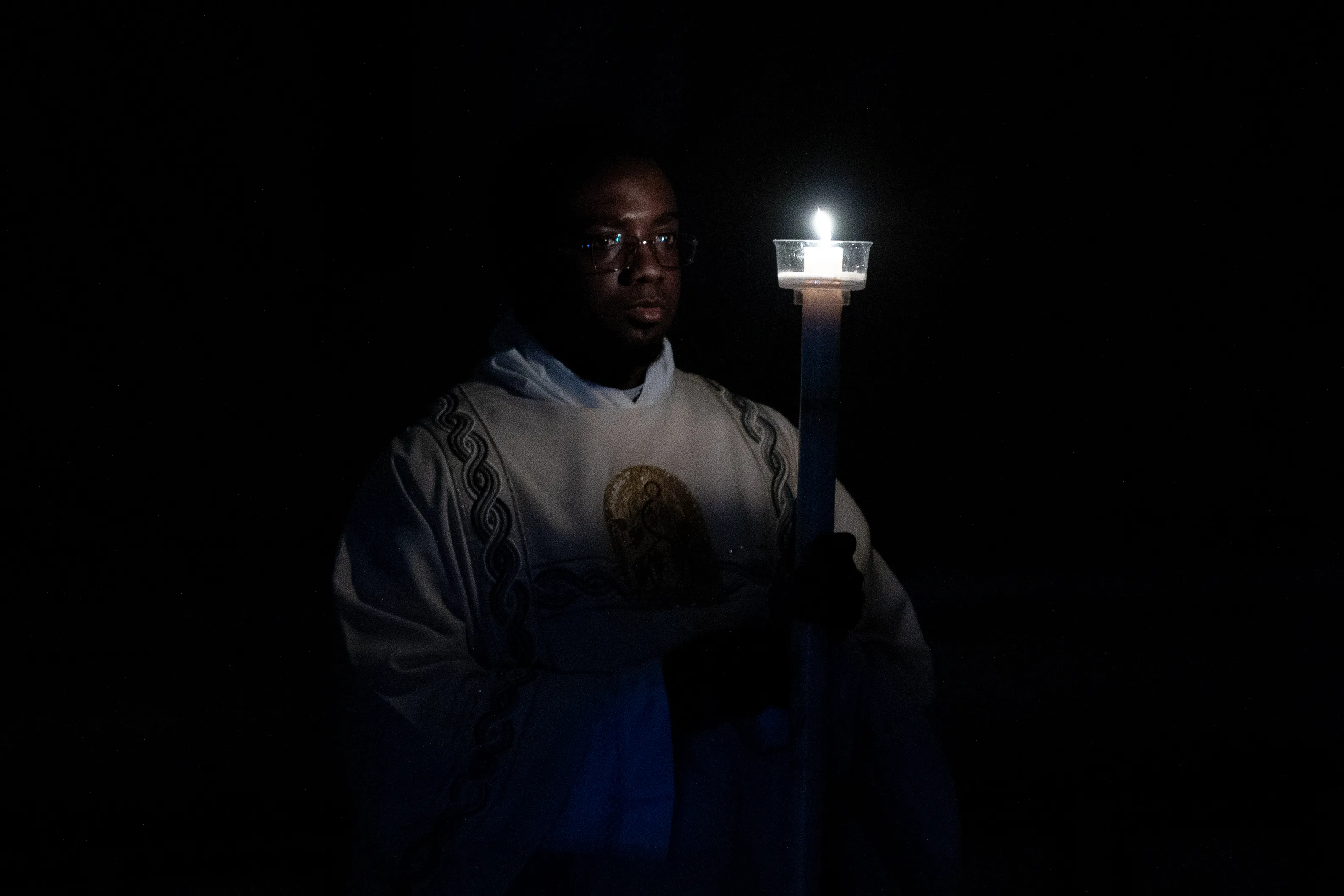
Processing up the central nave of the basilica, a deacon carried the candle, pausing and chanting at three different times “Lumen Christi” (Light of Christ) to which the congregation responded “Deo Gratias” (Thanks be to God).
The paschal candle is processed at the Vatican’s Easter Vigil, Saturday, March 30, 2024. Daniel Ibanez/CNA
This moment was followed by the chanting of the Exultet, or the Easter proclamation, an ancient prayer which invites the faithful to join the church in celebrating Christ’s resurrection.
Pope Francis opened his homily by reflecting on the anguish and consternation of the women depicted in the Gospel who with “the tears of Good Friday … not yet dried” approached the tomb that had been obstructed with a stone.
“That stone, an overwhelming obstacle, symbolized what the women felt in their hearts. It represented the end of their hopes, now dashed by the obscure and sorrowful mystery that put an end to their dreams.”
“That stone marked the end of Jesus’ story, now buried in the night of death. He, the life that came into the world, had been killed,” the pope continued.
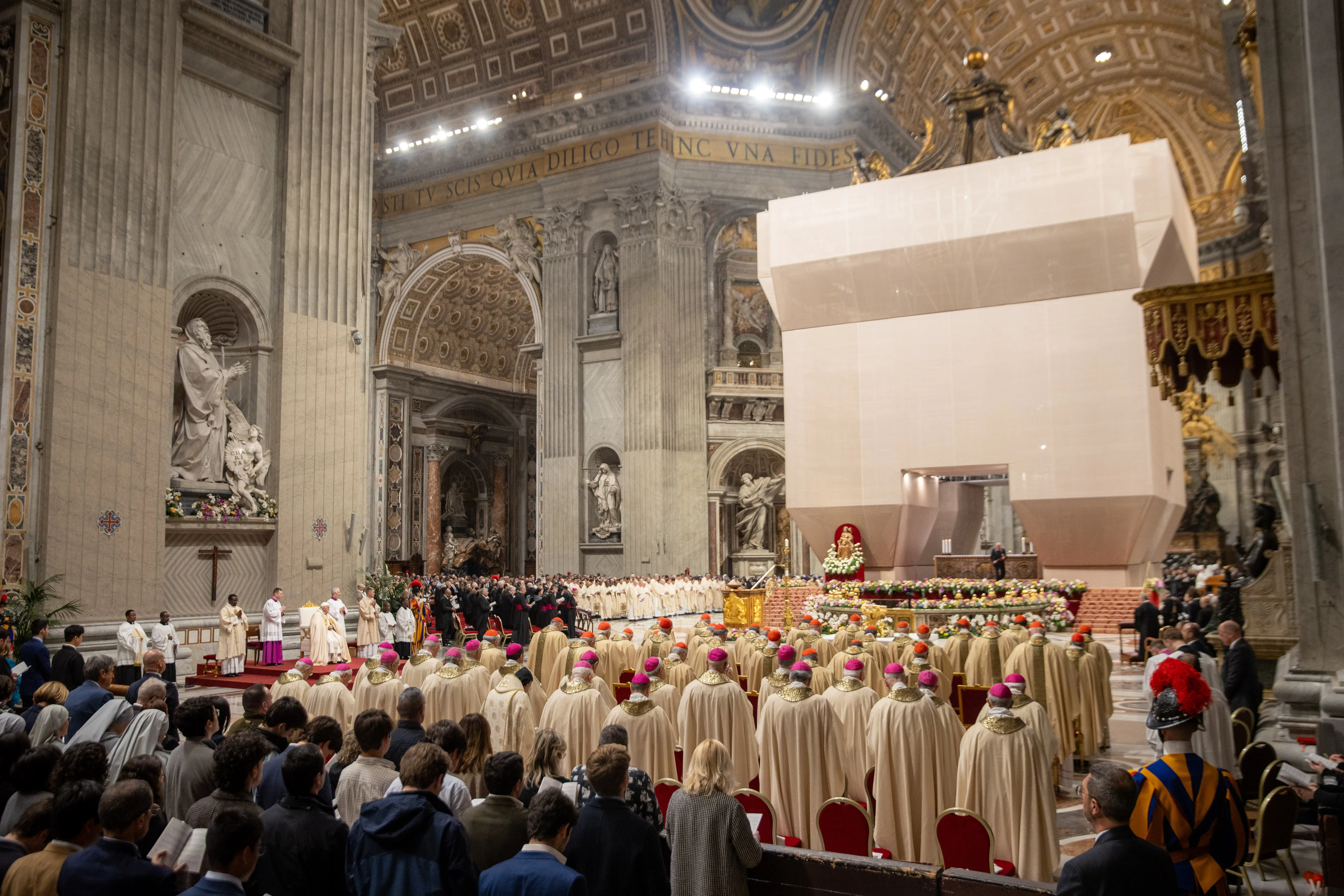
Clergy and visitors assemble at the Vatican’s Easter Vigil, Saturday, March 30, 2024. Daniel Ibanez/CNA
But, the pope noted, the women, upon casting their gazes upward, found the stone rolled away, a moment showcasing “the victory of life over death, the triumph of light over darkness, the rebirth of hope amid the ruins of failure.”
The pope related the initial anguish, and hope, of the women present at the sepulchre, noting that today we each “encounter such ‘tombstones’ on our journey through life in all the experiences and situations that rob us of enthusiasm and of the strength to persevere.”
Yet the pope implored the faithful to not succumb to despondency but instead draw hope from the resurrection.
“If we allow Jesus to take us by the hand, no experience of failure or sorrow, however painful, will have the last word on the meaning and destiny of our lives. Henceforth, if we allow ourselves to be raised up by the Risen Lord, no setback, no suffering, no death will be able to halt our progress towards the fullness of life.”
“Then no stone will block the way to our hearts, no tomb will suppress the joy of life, no failure will doom us to despair,” the pope continued. “Let us lift our eyes to him and ask that the power of his resurrection may roll away the heavy stones that weigh down our souls.”
Following a brief moment of reflection at the end of the homily, Pope Francis opened up the baptismal rite. With the blessing of the water, and a public recitation of vows, the Holy Father personally baptized eight adults: four Italians, two Koreans, a Japanese man, and an Albanian.
Vatican City, Dec 4, 2017 / 05:01 am (CNA/EWTN News).- On Monday the Vatican announced Pope Francis’ appointment of Oratorian Fr. Mario Alberto Aviles as auxiliary bishop of the Diocese of Brownsville.
He joins Bishop Daniel E. Flores, who has served as the sixth bishop of Brownsville since February 2010.
Aviles, who has served as Procurator General of the Confederation of the Oratory of St. Philip Neri since 2012, has also been appointed the titular bishop of the See of Cataquas in modern-day Algeria.
The Oratory of St. Philip Neri is a pontifical society of apostolic life made up of Catholic priests and lay-brothers. There are 86 congregations around the world, including several in the United States.
The Procurator General acts as the representative of the congregations to the Holy See, usually residing in Rome.
Aviles, 48, was born in Mexico City on Sept. 16, 1969. In 1986 he entered the Oratory of St. Philip Neri in Mexico City, two years later moving to the Pharr Oratory in the Diocese of Brownsville.
He first attended the Catholic Panamerican University in Mexico City, then transferred to Rome to study philosophy and theology at the Pontifical Athenaeum Regina Apostolorum University.
He received a master’s of divinity at the Holy Apostles Seminary in Cromwell, Conn. in 2000. He also has a master’s degree in Educational Leadership from the University of Phoenix.
On July 21, 1998 he was ordained a priest for the Confederation of the Oratory of St. Philip Neri.
From his ordination he was Parochial Vicar of the parish of St. Jude Thaddeus in Pharr, Texas until 2002, he then served as parish priest of Sacred Heart parish in Hidalgo.
He was Dean of the Oratory Academy and Oratory Athenaeum in Pharr from 2005-2012 and a member of the Diocesan Pastoral Council at Brownsville since 2011.
He has been Procurator General of the Confederation of the Oratory of St. Philip Neri since 2012 and speaks Spanish, English and Italian.
The Diocese of Brownsville, formed in 1965, encompasses the counties of Willacy, Cameron, Hidalgo and Starr at the southern border of Texas. Cameron, Hidalgo and Starr also border the Rio Grande River, which divides the Diocese of Brownsville from the dioceses of Matamoros and Nuevo Laredo in Mexico.
The diocese is 4,226 square miles in area with a population of approximately 978,369 inhabitants, of which 831,613 are Catholic.




Leave a Reply