

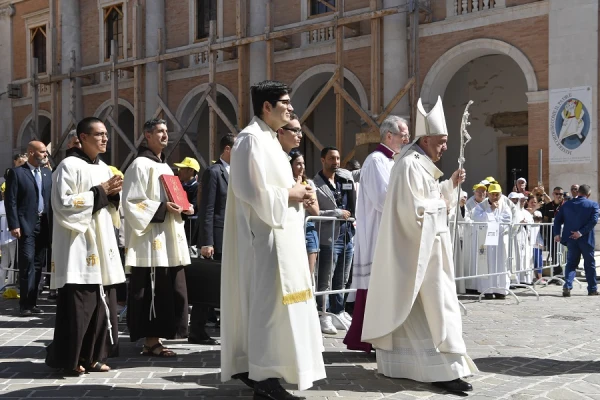
Camerino, Italy, Jun 16, 2019 / 06:09 am (CNA).- Hope, which is more than mere optimism, gives one a deep-rooted confidence in the love and care of God, no matter what has happened, Pope Francis said Sunday.
Hope “does not expire, because it is based on the fidelity of God. The hope of the Spirit is not even optimism. Born deeper, it rekindles at the bottom of the heart the certainty of being precious because loved,” the pope said June 16.
“It is a hope that leaves peace and joy inside, regardless of what happens outside. It is a hope that has strong roots, which no storm of life can uproot,” he added. “It is a hope that, says St. Paul, ‘does not disappoint’ – hope does not disappoint! – which gives the strength to overcome all tribulations.”
Pope Francis said Mass in Camerino, Italy during a day visit to the Archdiocese of Camerino-San Severino Marche. The area was one of those affected by the earthquakes which struck central Italy in 2016 and 2017. The Mass was said in the square outside the cathedral, which is still under reconstruction after being damaged in the earthquake.
In his homily, Francis spoke to those who suffered damage, injury, or loss due to the earthquakes.
“When we are troubled or wounded – and you know well what it means to be troubled, wounded – we are led to ‘nest’ around our sadness and our fears,” he said, noting that the Holy Spirit can free people from these “nests.”
“The Spirit feeds us with living hope. Invite him. Let us ask him to come to us and he will come near. Come, Comforter Spirit! Come give us some light, give us the sense of this tragedy, give us the hope that does not disappoint. Come, Holy Spirit!” he prayed.
The pope also reflected on a line from the day’s Responsorial Psalm: “What is man that you should be mindful of him…” This question, he said, could come also in the face of “collapsed houses and buildings reduced to rubble.”
“What is man ever? What is he, if what you raise can collapse in an instant? What is he if his hope can end in dust?”
The truth, Francis said, is that “God remembers us as we are, with our frailties.”
“No one is contemptible in his eyes, each has an infinite value for him: we are small under heaven and powerless when the earth trembles, but for God we are more precious than anything.”
Before praying the Angelus following Mass, Pope Francis told the people of the diocese he came in order to be near to them and to pray with them, saying, “I pray to the God of hope, so that what is unstable on earth does not shake the certainty we have inside.”
God remembers everyone and he can heal the memories of that difficult time, he said. “God helps us to be builders of good, consolers of hearts. Everyone can do a little good, without waiting for others to start.”
Entrusting the diocese to the Virgin Mary, he prayed: “May she who animated the first community of Jesus’ disciples with her motherly presence, also help the Church today to give good witness to the Gospel.”
Before returning to the Vatican in the afternoon, the pope met with around 200 children who had received their first Holy Communion and with their parents and catechists.
If you value the news and views Catholic World Report provides, please consider donating to support our efforts. Your contribution will help us continue to make CWR available to all readers worldwide for free, without a subscription. Thank you for your generosity!
Click here for more information on donating to CWR. Click here to sign up for our newsletter.


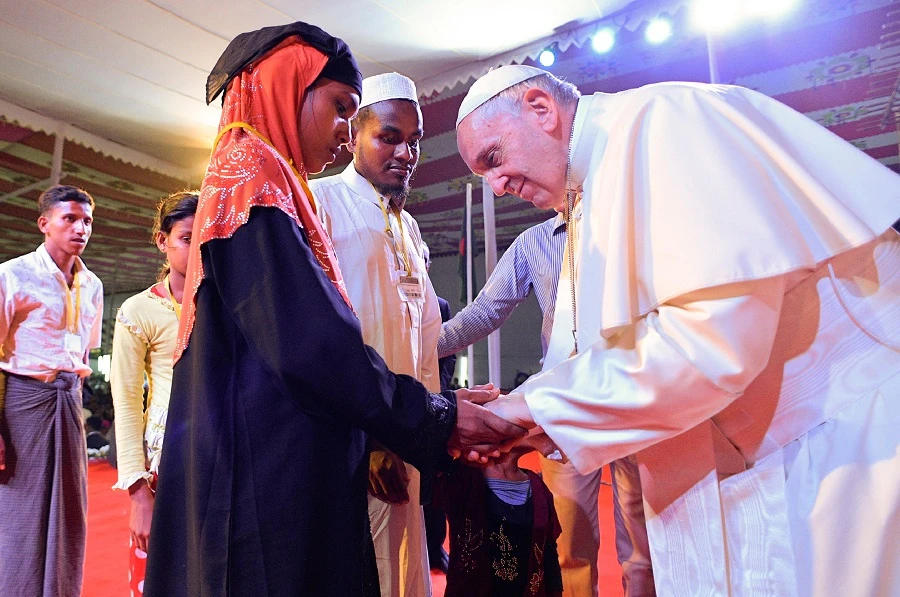
Hope Springs Eternal in the human breast. Though it is eternal loss once having passed those dreadful portals so well prefaced by Dante. There are no words to accent its immensity. The soul splitting dilemma we have is choice. Whether Francis offers us a truly compassionate approach to a troubled divided world suffering aplenty divorce ever on increase. We might make the case for a merciful pontiff desiring to loosen conviction that conjugally active D&R remain in an unlawful state of irreconcilable adultery. This v a perceived hard line approach of Emeritus Benedict XVI. Cardinal Burke and Bishop Schneider’s Declaration of Truths is consistent with Benedict’s recent letter to German Bishops made universal thru the media. Sandro Magister expounded on the Pope’s thought to Romanian Jesuits published by Fr A Spadaro SJ in his journal. It explains the Pontiff’s vision of a milder more attentive, “listening” approach to the wisdom of the sensus fidei apparently on the question of communion for D&R. Pope Francis cited two saints Peter Faber and Peter Canisius reasoning the milder less combative demeanor of Fr Faber was more suited to the times. We may feel compelled to believe there are exceptions among the many D&R and that a compassionate God might be disposed to remedy the tragedy of divorce and remarriage. Although this seems to have at least merit for consideration the facts on the ground speak otherwise. The issue for many clergy including distinguished laymen Josef Siefert, Roberto de Mattei is that the premises of Amoris Laetitia effectively remove the ability to uphold an Apostolic doctrine on adultery. The precise reason is those premises citing mitigating circumstances and inviolability of conscience make that impossible. That is proved by the laissez faire policies consequently permitted by Malta, Argentina, Philippines, Germany and elsewhere – once having adopted Amoris Laetitia. Pope Francis hasn’t intervened in any of these instances. That may indicate intent may be other than presumed limited exceptions. This is a decision, a choice that must be made. Ambivalence will not save a troubled and wounded Church. Anymore than a vision of hope for the village of Camerino empty of mention of salvation found in the wounded crucified Christ.
Those of you who enjoy seeing references to Dante in blog posts may enjoy today’s Catholic Thing posting:
Transgenderism and Perfect Freedom
by Robert Royal
MONDAY, JUNE 17, 2019
https://www.thecatholicthing.org/2019/06/17/transgenderism-and-perfect-freedom/
The illustration of Canto XXXIV by Alberto Zardo is impressive.
Confusion is not a gift of the Holy Spirit, but it is definitely a tool of satan.
This pope speaks well of virtues, as well as Christian ideals, yet what he does, and fails to do are in direct contradiction to much of what he speaks.
Heresy is not limited to what a person says, but also includes what they do, and consciously avoid doing, especially when there are ulterior motives behind the omission.
This one is consistently omissive when it suits him, and consistently biased in a certain direction when he acts.