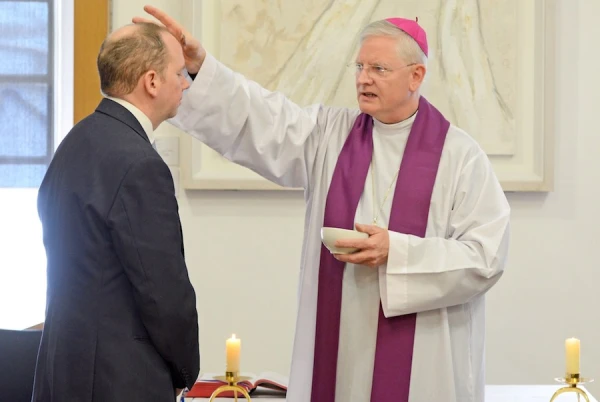
Edinburgh, Scotland, Mar 6, 2019 / 02:05 pm (CNA).- The Scottish Parliament hosted a Blessing and Distribution of Ashes for the first time this year, with Archbishop Leo Cushley of St. Andrews and Edinburgh presiding.
Archbishop Cushley reflected during the March 6 service on the gesture of receiving ashes, which he said reminds us “that we are dust.”
“[A]nd, yes, it is about sinfulness, it is about acknowledging that we need God’s help, that we are fragile, that we are mortal, that we have been disobedient and that we want to regain our relationship with Almighty God,” he continued.
The Ash Wednesday service took place in a committee room in the parliament’s Queensberry House, according to a press release from the archdiocese.
It was sponsored by Member of Scottish Parliament Elaine Smith, who said in a statement that “it was lovely to have the Archbishop come and distribute ashes to those who work within the Scottish Parliament.”
Anthony Horan, parliamentary officer for the Scottish Bishops Conference, said he was pleased to see “such a cross-party representation” of members of parliament and their staff.
“I believe the Church has something good and positive to offer society,” he said in an archdiocesan statement, adding that it was an honor “to be invited and welcomed to the Scottish Parliament in this special way.”
Horan said he hopes more Catholic events will take place in Parliament in the future. Last year, Mass was celebrated for the first time in Parliament during Holy Week.
Smith also commented on the good turnout at the Ash Wednesday event, saying she would like “repeat this service every Lent, if possible, as well as hosting a Mass during Holy Week.”
In reflecting on the meaning of the ashes distributed at the start of Lent, Archbishop Cushley stressed the importance of recognizing the sin in one’s life and having a desire to repent and be reunited with God.
“I think that is a very good and very wholesome thing for us to do and it takes genuine human maturity to be able to do that sincerely and to wish to improve oneself in order to become the Child of God we were always meant to be.”
If you value the news and views Catholic World Report provides, please consider donating to support our efforts. Your contribution will help us continue to make CWR available to all readers worldwide for free, without a subscription. Thank you for your generosity!
Click here for more information on donating to CWR. Click here to sign up for our newsletter.

Father Marko Rupnik, SJ. / Screenshot Vatican News
Rome Newsroom, Jan 11, 2023 / 13:00 pm (CNA).
Jesuits in Slovenia have asked for forgiveness from the women who have have accused Father Marko Rupnik, S..J, of spiritual and sexual abuse, sayin… […]
Father Martin Lintner, OSM, teaches at the Philosophical-Theological College in Brixen (PTH Brixen). / Screenshot of Cultural Center Gustav Mahler & Guesthouse YouTube video
CNA Newsroom, Jul 3, 2023 / 09:27 am (CNA).
The professor of moral… […]
Four men carry a statue of St. Bonaventure during a candlelight procession on July 14, 2023, in Bagnoregio, Italy, his birthplace, on the vigil of the saint’s feast day. / Patrick Leonard/CNA
Bagnoregio, Italy, Jul 15, 2023 / 12:15 pm (CNA).
The birthplace of St. Bonaventure, a 13th-century intellectual giant now revered as a doctor of the Church and the “second founder” of the Franciscans, paid homage to its patron Friday night on the vigil of his feast day with music, prayers, and a candlelight procession.
For the citizens of Bagnoregio, an idyllic town nestled in Italy’s Lazio region about a 1½ drive north of Rome, the July 15 feast is both a solemn holy day and a wellspring of civic pride. Bonaventure’s “braccio santo,” or holy arm — the only surviving relic of the saint — is kept in a silver, arm-shaped reliquary housed in a side chapel of Bagnoregio’s Cathedral of San Nicola and San Donato.
Religious sisters participating in a candlelight procession on July 14, 2023, in Bagnoregio, Italy, in honor of the town’s patron saint and native son, St. Bonaventure. Patrick Leonard/CNA
Friday’s procession, which commenced at the cathedral, was led by the town’s confraternities of the Most Blessed Sacrament, St. Francis, and St. Peter. Following them were a brass band, a statue of the saint adorned with flowers and carried by four men, and a priest carrying the holy arm. Then came Cardinal Fortunato Frezza, numerous priests, and this year’s first communicants, followed by other religious and residents.
As the participants made their way down the candlelit Via Roma, onlookers watched from windows, balconies, and restaurants bustling with patrons on a warm summer evening.
A resident of Bagnoregio, Italy, watches a candlelight procession through the streets of the town in honor of its patron saint, St. Bonaventure, on July 14, 2023. Patrick Leonard/CNA
Arriving at the piazza Sant’Agostino, Cardinal Frezza, standing beneath a monument of Bonaventure, offered a brief reflection on the importance of the saint and of procession as a form of popular devotion.
The relic “gives us strength to sustain our weakness … It is a relic that is alive and active,” observed the cardinal, a noted biblical scholar. It is “an arm that teaches,” he said, the very right arm that “wrote his works of great intellect and wisdom.”
The cardinal closed his brief catechesis by saying “our life is a holy procession, an itinerary of the mind towards God.” Here he was playing on the title of one of Bonaventure’s most important theological works, Itinerarium Mentis in Deum, “The Journey of the Mind to God.” Following a benediction with the relic, the procession continued down Via Fidanza, looping around the main gate and then back up Via Roma to the cathedral. The faithful entered and Cardinal Frezza imparted the final blessing, again with the relic.
Cardinal Fortunato Frezza leads a prayer service on July 14, 2023, in Bagnoregio, Italy, in honor of the town’s patron saint and native son, St. Bonaventure. Patrick Leonard/CNA
The Franciscans’ ‘second founder’
Born in 1217 (or 1221, according to some accounts) as Giovanni Fidanza in Civita di Bagnoregio (then in the territory of the Papal States), he displayed great acumen and intellectual curiosity. He was, however, plagued by ill health in his youth. His mother called upon the intercession of St. Francis of Assisi, and he was, according to the legend, miraculously cured.
The young Bonaventure studied at the nearby Franciscan convent. Given his great talent, at 18 he left Bagnoregio to study in Paris, then the intellectual capital of Europe.
He joined the Franciscan Order of Friars Minor in 1243. At the University of Paris, he studied under the renowned Franciscan theologian Alexander de Hales; in 1257 he earned his teaching license (magister cathedratus) in theology there. Bonaventure was a contemporary of St. Thomas Aquinas, whom he met as they were both teaching at the university. The two future doctors of the Church were united in defending the then-nascent Franciscan and Dominican orders, whose orthodoxy was called into question by the secular clergy.
A statue of St. Bonaventure is shown during a candlelight procession on July 14, 2023, in Bagnoregio, Italy, his birthplace, on the vigil of the saint’s feast day. Patrick Leonard/CNA
Bonaventure’s teaching career was cut short; in 1257 when he was appointed minister general of the Franciscan order, which was then plagued by internal factionalism due to divergent understandings of Francis’ spirituality following his death.
To rectify this, Bonaventure spent much time traveling around Europe to help maintain the unity of the order. In 1260 went to Narbonne, France, to solidify the rule of the order and that same year he started writing (which was completed three years later in 1263) the Legenda Maior, “The Major Legend,” considered the definitive biography of St. Francis. For Bonaventure, the key to righting the order lie in Francis’ ideals of obedience, chastity, and poverty, which he re-established as the Franciscans’ guiding principles.
A woman venerates the “braccio santo,” or holy arm, of St. Bonaventure on July 14, 2023, the vigil of the saint’s feast day, at the Cathedral of San Nicola and San Donato in his hometown, Bagnoregio, Italy. Patrick Leonard/CNA
Enduring influence
In addition to his contributions as the “second founder” of the Franciscans, Bonaventure had a profound impact on the papacy. Following the chaos of the three-year conclave in Viterbo that elected Gregory X in 1271 (the longest papal election in the history of the Church), the new pontiff, also a Franciscan, entrusted Bonaventure with preparing many of the key documents for the Second Council of Lyon (1272-1274) which sought to unify the Latin and Greek Churches.
He was made a cardinal in the consistory of May 28, 1273. He did not, however, see the end of the council, as he died on July 15, 1274. He was canonized in 1482 by Pope Sixtus IV and proclaimed Doctor of the Church by Pope Sixtus V in 1588.
A candlelight procession through the streets of Bagnoregio, Italy, on July 14, 2023, honors the town’s native son and patron saint, St. Bonaventure. Patrick Leonard/CNA
In 2009, Pope Benedict XVI, who was a great admirer of Bonaventure, visited the saint’s birthplace to venerate the relic and address the faithful. In 2010 he dedicated three consecutive Wednesday audiences on the saint, outlining the importance of his governance of the Franciscans and his theological, philosophical, and mystical works. Bonaventure’s writings, Benedict observed, demonstrate that “Christ’s works do not go backwards, they do not fail but progress.”
“For St. Bonaventure, Christ was no longer the end of history, as he was for the Fathers of the Church, but rather its center; history does not end with Christ but begins a new period,” Benedict said.
“The following is another consequence: Until that moment the idea that the Fathers of the Church were the absolute summit of theology predominated, all successive generations could only be their disciples,” Pope Benedict explained.
“St. Bonaventure also recognized the Fathers as teachers forever, but the phenomenon of St. Francis assured him that the riches of Christ’s word are inexhaustible and that new light could also appear to the new generations,” he said. “The oneness of Christ also guarantees newness and renewal in all the periods of history.”
Leave a Reply