Washington D.C., Mar 2, 2019 / 03:03 pm (CNA).- “Remember you are dust and to dust you shall return.”
Or, “Repent and believe in the Gospel.”
On Ash Wednesday, millions of Catholics throughout the English-speaking world will hear one of these two blessings as a priest applies ashes to their forehead in the sign of the cross.
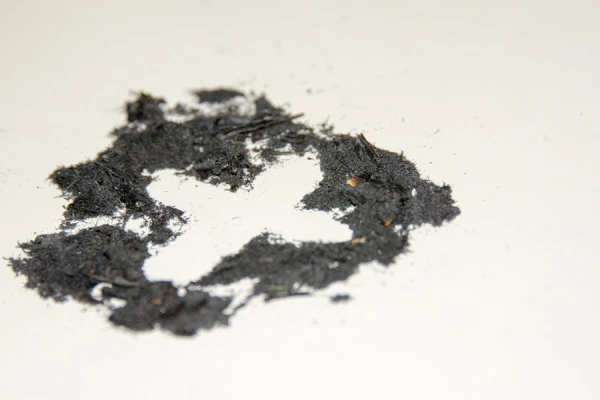
But where exactly do the black or grey powdery ashes come from?
Per the instructions of the Roman Missal, ashes are typically supposed to be made from last year’s Palm Sunday palm branches.
These branches are then burned down into a fine powder and, in the United States, are mixed with holy water or chrism oil to create a light paste. In other parts of the world, sometimes dry ashes are sprinkled on the head rather than made into a paste.
BYOA – Burn Your Own Ashes
Fr. Dan Folwaczny is a priest with the Archdiocese of Chicago and serves as associate pastor at St. Norbert and Our Lady of the Brook parish.
He told CNA that the parish burns their own palms from previous Palm Sundays.
“We have an order of palms that comes in, and some of them are handed out on Palm Sunday but some are leftover, and those we usually store away in the garage until the following year,” he told CNA.
“And then also we have some that people bring back, so people have had them in their houses in the lead-up to Lent, and we’ll tell people to bring them in to the church,” he said.
Then on the day before Ash Wednesday, all of the old palms are placed in a fire pit on the church steps.
“And then the school kids come out and we have a little prayer service and light it on fire,” Folwaczny said.
While some priests order palms from religious goods suppliers, Folwaczny said he has always had plenty of palms and ashes to spare.
“We actually still have plenty in reserve from previous years,” he said. “We could actually not [burn additional palms] for a couple of years and still be fine.”
A similar procedure for the burning of ashes is followed in many parishes and dioceses.
Fr. Harrison Ayre, with the Diocese of Victoria, British Columbia, told CNA on Twitter that he burns his own ashes for Ash Wednesday in a metal garbage bin “and they reduce to ashes quite nicely.”
Ash buyers
While many parishes use Ash Wednesday as an opportunity to use up last year’s palms, the Church also allows for the buying of ashes from religious goods suppliers.
Fr. Joseph Faulkner, a priest of the Diocese of Lincoln, Neb., told CNA on Twitter that he buys his ashes from religious goods suppliers to avoid sub-par or “stabby” ashes.
For Catholic parishes in Colorado, one of the most-used such suppliers is Gerken’s Religious Supplies.
“There is quite an art to (burning ashes),” Mike Gerken, the co-owner, told the Denver Catholic in 2017.
“To get the good ash, you can’t just burn them. You have to let them smolder with no oxygen, and that’s where it gets the real charcoal black.”
Religious goods suppliers such as Gerken’s typically get their Palm Sunday palms, and sometimes the palm ashes as well, from palm suppliers in the warmer parts of the United States, such as California, Texas, Florida and other parts of the South.
Why Palm Sunday palms?
There is liturgical significance in the use of the palms from Palm Sunday, as opposed to other materials, to make the ashes for Ash Wednesday.
Father Randy Stice, associate director for the Secretariat of Divine Worship for the U.S. Bishops’ Conference, told CNA that the ashes made from palms remind us of what Lent is all about.
“Those branches herald Holy Week, the suffering death and resurrection of Christ,” Stice said. The feast of Palm Sunday occurs the beginning of Holy Week, which leads up to Easter. “Then that helps us identity with (Jesus) in Lent…it connects us with events in Christ’s own life,” he said.
Ashes have also long been a symbol of repentance and conversion, even in the Old Testament, Stice added.
“It’s an Old Testament and a New Testament symbol of repentance and conversion, sorrow for our sins, awareness of our frailty and mortality – [symbols] that have been taken up by the Church from the earliest stages.”
This article was originally published on CNA Feb. 14, 2018.
If you value the news and views Catholic World Report provides, please consider donating to support our efforts. Your contribution will help us continue to make CWR available to all readers worldwide for free, without a subscription. Thank you for your generosity!
Click here for more information on donating to CWR. Click here to sign up for our newsletter.
Ricky Reyes dribbles the ball up court as now-Father Peter Schirripa follows behind at the national basketball tournament for seminaries in 2022. / Credit: St. John’s Seminary
CNA Staff, Nov 6, 2023 / 14:40 pm (CNA).
Imagine the scene: The alarm clock starts beeping and it’s 4 a.m. Basketball practice starts in an hour. It’s time for a group of bleary-eyed young men to grab their gear, meet their teammates, and begin a one-mile uphill jog in the middle of New England’s freezing weather to the basketball facility.
Once inside the gym, the work begins: stretching, sprints, layups, scrimmaging, shooting, defensive posture, all with one goal in mind — winning.
This type of intense training is all in a day’s work for one team of men in Boston.
No, it’s not the Division I team at Boston College, Boston University, or Northeastern University.
Rather, it’s how a team of seminarians at St. John’s Seminary in Boston trains. And their goal of winning is twofold: victory in the spiritual life and a championship trophy at the national tournament for seminaries, which is held once a year.
But what does playing basketball have to do with priestly formation? Well, according to the seminarians who play for the St. John’s Eagles, quite a lot.
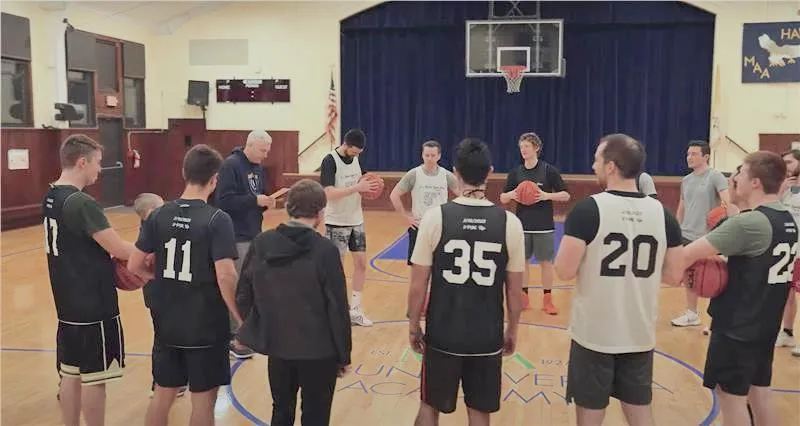
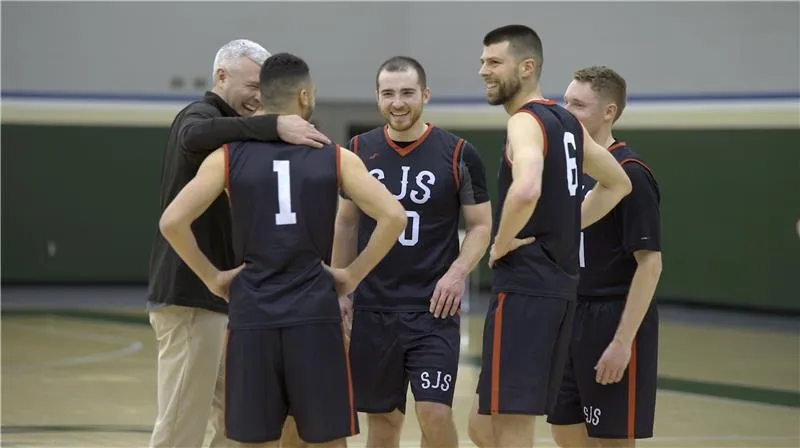
St. John’s Seminary’s basketball team at practice. Credit: St. John’s Seminary/YouTube May 18, 2023
A ‘microcosm of the spiritual life’
When 27-year-old Deacon Marcelo Ferrari, the team’s co-captain, first entered seminary, he saw the game as more of an extracurricular activity, “a good opportunity to spend some time with close friends and maybe build some fraternity.”
“But very quickly it became clear that the basketball team is just a microcosm of the spiritual life,” Ferrari, of Monterrey, Nuevo León, Mexico, said.
Playing the game together imitates the spiritual life in that “you experience a lot of humiliation, especially if you’re not as skilled like me,” said Ferrari, who has more experience in soccer than in basketball.
“But you also just learn a real sense of what sacrifice means,” he said. “Even practice just being at 5 in the morning is enough to demand a lot of the human heart.”
The experience of being on the team aided in Ferrari’s priestly formation in “so many ways,” he said, adding that “it became a critical space for me to recognize especially more of those subtle movements of the heart.”
“There’s nothing like team sports to bring out every part of you,” he said.
An uphill climb
Ferrari had never played organized basketball until he entered St. John’s Seminary. It wasn’t until another seminarian who established the team, now-recently ordained Father Peter Schirripa, asked him to join that he considered it.
“He saw me playing soccer and was like, ‘Oh, this guy’s mildly athletic. Let’s see if we can get him a basketball and see what he can do,’” Ferrari said.
This type of recruiting was par for the course for Schirripa, 30, who grew up in Lexington, Massachusetts, and had the idea for the team when he first entered seminary more than six years ago.
But Schirripa, who had experience in basketball, track and field, and soccer, credits the founder of the media apostle Word on Fire, Bishop Robert Barron, with the conception of the idea.
Schirripa was visiting his alma mater St. Anselm College during its 2017 graduation ceremony, the spring before his entrance to seminary, when he met Barron, who was giving the commencement address. Barron mentioned to him that there was a national basketball tournament for seminaries and encouraged Schirripa to put together a team from St. John’s.
So, Schirripa brought the idea to his superiors at the seminary and got a green light to start building a team for the national tournament.
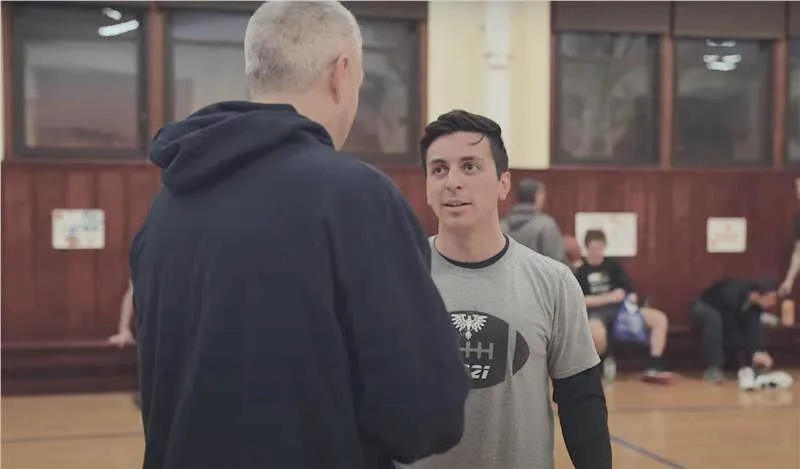
Deacon Marcelo Ferrari at one of St. John’s Seminary’s basketball practices. Credit: St. John’s Seminary/YouTube May 18, 2023
“The leadership was like, ‘Sure, you can do it if you can pull it off.’ But I was a first pre-theologian. I’d been there for, like, three weeks,” Schirripa said.
“And let’s just say there was not a robust athletic or even really communal culture at St. John’s at the time. And so trying to inspire guys to do this and play on the team, it was like I was just taking whatever warm body I could get,” he said.
Eventually, enough seminarians wanted in, and Schirripa’s idea came to fruition, which culminated in St. John’s taking a squad of 15 guys to the national tournament at Mundelein Seminary in Mundelein, Illinois, and winning two games in 2018.
“We went out to it and we won two games, which is crazy because we were so bad,” he said.
He noted that the games were livestreamed and their brother seminarians were watching.
“The whole common room was watching it and I think people couldn’t believe that we did it,” he said.
“And the rest,” Schirripa said, “is history.”
St. John’s has been sending a team to the national tournament ever since. The best they’ve done is third place in a tournament that typically consists of between 12 and 16 teams.
The future of the church
Part of St. John’s success can be attributed to their volunteer coach, Patrick Nee, 44, a practicing Catholic in the greater Boston area who was a Division I basketball player at Brown University in the 1990s.
Nee had coached on the high school level, on travel teams, and even on his young children’s teams, but what made this coaching experience different was the “shock” of being immersed in seminary culture.
“It’s not an experience like I’d ever had before, just being in a gym with 15 seminarians, being on a bus or being on a plane with them and just realizing how good it was,” he said. “And these guys are really holy guys that are just terrific. Getting to know them all, it has just been really inspiring for me.”
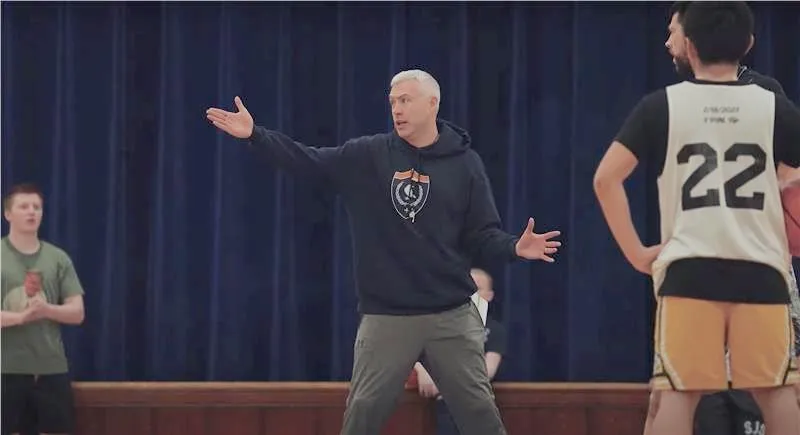
Patrick Nee coaches St. John’s Seminary’s basketball team. Credit: St. John’s Seminary/YouTube May 18, 2023
Nee, a high school state champion from St. Raphael Academy in Pawtucket, Rhode Island, said that he stopped practicing his Catholic faith during his college years and didn’t come back to it until his late 20s.
He said that when he returned to the Church it took him on “a journey.” And over the last five years, that journey has “intensified” even more, he said, adding that “this experience has played a role in that.”
Nee said that it’s overwhelming “in the best way” when he is at the tournaments and “every guy you meet is this on-fire guy who’s studying to be a priest.”
One of those men on fire for the faith is Brian Daley, a member of the St. John’s team, Ferrari said. He recalled an incident at practice one day when a newer seminarian began to indulge in “light mockery” of the other teams they would be playing in the tournament.
Ferrari said that Daley reminded his teammate: “No, these men that we’ll be competing against are all giving their lives for Christ and they’re great examples for us.”
Ferrari called it a moment of “deep fraternity” for the team, who were all inspired by the wisdom Daley shared.
The deacon also said that as a team that fire is seen at every practice through prayer.
At every practice, each player is handed a sheet of prayer intentions to offer up their labor on the court so that all of their work is “done with an eye that sacrifice is fruitful.”
Seeing all of the hard work the teams put in for one weekend showed Nee that they care a lot about winning, “but they never lose track of the bigger picture.”
St. John’s Seminary basketball coach Patrick Nee guides his players during the 2022 tournament. Credit: St. John’s Seminary/YouTube May 18, 2023
He said that being a part of the team has strengthened his faith and added that the whole experience inspired him to tell Schirripa that “we need to share this with people.”
“I wish other people could see this. I mean, if you know anyone who is negative about the future of the Church, it’s like, well, walk into this gym for five minutes and you’ll change your mind immediately,” he said.
Nee’s vision for sharing the experience with others became a reality five months ago when St. John’s Seminary released “Souls in the Game,” a documentary that “highlights priestly formation beyond the study of philosophy and theology.”
The 28-minute documentary follows the team’s journey from the early morning practices to the recruiting and training of the seminarians to the final tournament.
“There is no pressure at all. Go out and play. We have brought life to St. John’s Seminary. God has used this team and let’s go out there and show everyone that we love each other, we love our vocations, and we’re going to represent St. John’s,” Schirripa says to his team during a pregame speech in the documentary.
Viewers might be surprised by how competitive the games are, especially in the scene where 6-foot-4 Schirripa is shown slamming it down during the tournament, which resulted in a technical foul for the team.
Despite the penalty, the team was roaring with excitement at Schirripa’s slam dunk, a feat that not many players ever get to experience on a 10-foot hoop.
“We were ready to storm the court,” Ferrari said in excitement in the documentary.
That documentary can be seen below.
Physical exercise such as can be had playing on a basketball team is something that every seminary should “absolutely” have, Schirripa said.
“I think it’s absolutely essential because you need a physical outlet and you need to obviously have a healthy body, mind, and soul. But it also teaches you to work towards something that’s bigger than yourself, which ultimately is the apostolate,” he said.
“And so it’s such a great venue for formation,” he said.




Dust we are and unto dust we shall return.