Pope encourages young people to ask tough questions at pre-synod launch
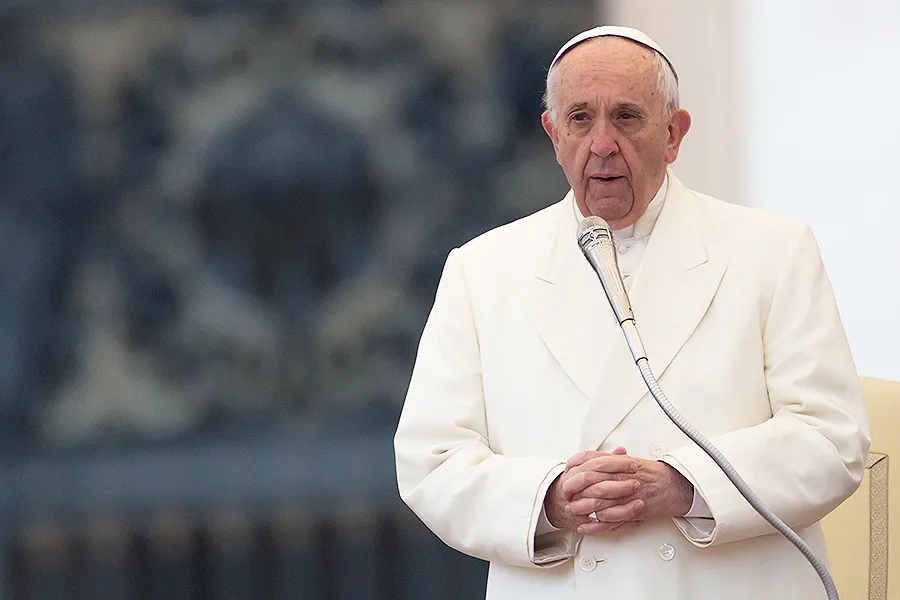
Vatican City, Mar 19, 2018 / 10:43 am (CNA/EWTN News).- Pope Francis opened this week’s pre-synod meeting telling youth to hold nothing back and to have the courage to ask the “raw” and direct questions about life, love, and vocation.
In the March 19 opening session for the event, Francis told youth to let their questions come “without anesthetizing” them.
“The strong questions of ours can have a process of being played down in tone,” or asked in a “polite way,” he said, but urged the young attendees to “be courageous” and to “say the raw truth, to ask the raw questions.”
He spoke to French youth Maxime Rassion, who is not baptized. Rassion said he was facing doubts about his career and struggles to find a deeper meaning in life, asked what he can do to figure out where to start.
In his answer, Pope Francis noted how many youth have fears about similar questions, and said there is a need for discernment. However, “at this point, many ecclesial communities don’t know how to do it or they lack the ability to discern.”
“It’s one of the problems we have,” Francis said, and urged those in positions of pastoral authority not to be afraid to let youth “take everything out” that they are thinking or feeling, and to listen to the blunt questions that young people may pose.
“Accompany them so they don’t err,” he said; and on the other hand, he encouraged youth to find someone they can talk to about their experiences.
Talking is important, but “you can’t talk to everyone about everything,” he said, and told them to find someone “who is wise, who isn’t scared and who knows how to listen” to help them sort through the questions they have.
“It’s important to open everything, to open everything, not to put make up on your feelings,” he said, and cautioned against closing in on oneself, which “weighs you down and takes your freedom.”
“Let your feelings come up, don’t anesthetize them, don’t downplay them; look for someone wise [to talk to] and discern.”
Pope Francis spoke at the opening session of the March 19-24 pre-synod meeting, which has drawn some 300 youth from around the world to talk about major themes for the upcoming Synod of Bishops on “Young People, Faith and the Discernment of Vocation.”
Youth in different states in life are in Rome to participate in the event. Priests, seminarians, and consecrated persons will also participate. Special attention will also be given to youth from both global and existential “peripheries,” including people with disabilities, and some who have struggled with drug use or who have been in prison.
At the end of the gathering, notes of the various discussions throughout the week will be gathered into a comprehensive concluding document, which will be presented to Pope Francis and used as part of the “Instrumentum Laboris,” or “working document,” of the October synod.
In his opening speech for the March 19 session, Pope Francis told youth that “your contribution is indispensable” for the preparation of the October synod gathering.
Too often young people are talked about without being spoken to, he said, stressing the importance of having a “face to face” meeting where they can share their thoughts and desires.
“It’s not enough to exchange some messages or share some nice photos,” he said, adding that “youth must be taken seriously!” Too often youth are left alone, he said, and cautioned that in the Church, “it must never be like this.”
“We need to regain the enthusiasm of the faith and of the flavor of the search. We need to find again in the Lord the strength to recover from failures, to go forward, to strengthen confidence in the future.”
“We need to dare [to take] new paths, even if it involves risks,” he said, adding that risk is necessary because “love knows how to risk; without risk a young person grows old, and it also makes the Church grow old.”
Because of this, “we need you young people, living stones of a Church with a young face, but not using makeup: not artificially rejuvenated, but revived from within,” he said, explaining that the purpose of the synod is to accompany youth.
“Be assured: God trusts you, he loves you and he calls you,” Francis said, saying the Church, in the synod, must learn to have “new ways of presence and closeness.”
After his opening address, Francis heard testimonies from five young people: Tendai Karombo from Zimbabwe, Nicholas Lopez from the US, Cao Huu Minh Tri from Vietnam, Annelien Boon from Belgium, and Angela Markas from Australia.
The Pope was then asked questions from five youth, one of whom was a young Nigerian woman named Blessing Okoedion who was brought to Italy four years ago as a victim of human trafficking.
After suffering the “hell” of forced prostitution, she was finally able to escape and find healing with an order of religious sisters. In her question to the Pope, Okoedion said many of her clients were Catholics, and asked how youth can be made aware of the problem of trafficking, and how to fight the “sick” mentality that reduces women to being the property of men.
In his response, the pope said human trafficking is “a crime against humanity” which is ultimately “born from a sick mentality.”
“The woman is exploited,” he said, noting that “today there is no feminism that has been able to take this out of the unconsciousness” in societal thought. “It’s a sickness of mentality, it’s a sickness of social action, it’s a crime against humanity.”
Pope Francis then asked forgiveness “for all the Catholics who commit this criminal act.”
“I think of the disgust these young women must feel when these men make them do anything,” he said. What women endure is “unbelievable,” he said, and called the practice a form of “slavery.”
In response to a question posed by Argentine youth Maria de la Macarena Segui, who asked about education initiatives and what youth can do to make their encounter with the Lord last over time, the pope stressed the need for an integral education.
Francis said there is need for educational initiatives that follow a “head, heart, hands” model, and which “harmonize” these three aspects into a solid foundation for the person that takes intellectual and charitable formation and turns them into action.
He also responded to a question posed by Ukrainian seminarian Ylian Vendzilovych, who asked how young priests should act amid the “complex realities” of modern society, and questioned how someone preparing for ordination can differentiate between what is good and what is wrong in society.
Francis stressed the importance of community in the life of a priest, and pointed to the many priests who serve their parishes alone or in remote areas. In these cases, it’s important for both the priest and the parishioners to make an effort to build a communal relationship, he said.
“A priest is a testimony of Christ to the extent that he is a member of that community,” he said, adding that if there is not community in a parish, “the bishop needs to intervene.”
He also spoke out against the “terrorism” of gossip and clericalism, which he called a “sick mentality” that confuses the people and drives them away. “Attitudes that are not paternal, not fraternal, also worry me,” he said, explaining that when a priest becomes too rigid or worldly, “there is no witness of the mercy of Christ.”
“I prefer that a young person loses their vocation rather than being a bad religious,” he said.
Sr. Teresina Chaohing Cheng, a religious sister from China, asked how young consecrated people can balance their cultural formation and spiritual lives while fighting against a materialistic society.
In his answer, Pope Francis said good formation for a consecrated person is built on four pillars: the spiritual, intellectual, communal, and apostolic.
This means making sure religious are aware of cultural habits and trends, even those that are bad, while also having a solid foundation to help distinguish and discern what is harmful, he said.
Francis cautioned against keeping religious too sheltered and in the dark about what’s happening in culture and society, saying to “overprotect” them is not formation, but “annuls” their understanding and does them a disservice.
He said to do this “castrates” a person and takes away their freedom, and told Cheng to fight against this in her community. “Don’t overprotect,” he said, because doing so prevents people “from maturing psychologically” and from responding to people in need.