No Picture
News Briefs

Pope Francis sends condolences for death of Cardinal O’Brien

March 20, 2018 CNA Daily News 0

Vatican City, Mar 20, 2018 / 07:38 am (CNA/EWTN News).- On Tuesday Pope Francis offered his condolences for the death of Cardinal Keith Patrick O’Brien, the disgraced former archbishop of Edinburgh, who died Monday at the age of 80 in a hospital in northern England.

The Pope’s March 20 message was addressed to Archbishop Leo Cushley, who was appointed to head the archdiocese of St. Andrews and Edinburgh in 2013 after O’Brien stepped down following his acknowledgment that he participated in inappropriate sexual conduct during his ministry.

In the brief message, Francis said he was saddened to hear of O’Brien’s death and offered his heartfelt condolences to his family and those who mourn him.

“Commending his soul to the merciful love of God our Father, and with the assurance of my prayers for the Archdiocese of St. Andrews and Edinburgh, I cordially impart my Apostolic Blessing as a pledge of peace and consolation in our Lord Jesus Christ,” he wrote.

The funeral and burial arrangements for the cardinal are still being determined. Scottish newspaper The Herald reported March 20 that the Holy See will be a participant in the decision, as well as Cardinal Vincent Nichols, who the Pope appointed to manage the O’Brien scandal in 2013.

According to The Herald, an archdiocesan spokesperson said O’Brien’s funeral arrangements “will be decided in the days to come.”

“There will be consultation between the Holy See – the Holy Father will have an input – and Keith O’Brien’s family as to where his requiem Mass takes place and when and where he is buried.”
 
Born in Ballycastle, County Antrim, Northern Ireland in 1938, O’Brien was named archbishop of St. Andrews & Edinburgh by St. John Paul II in 1985.

From 2002-2012, O’Brien served as President of the Bishops’ Conference of Scotland. He was made a cardinal by John Paul II in 2003 and participated in the 2005 conclave that elected Benedict XVI.

He stepped down as Archbishop of St. Andrews & Edinburgh in 2013 at the age of 74 after allegations went public that he had participated in inappropriate sexual behavior with other men in the 1980s.

After the claims surfaced that February, the cardinal’s request for retirement – originally submitted to Benedict XVI in November 2012 for reasons due to age and health – was accepted immediately by Benedict, going into effect Feb. 25, 2013.

O’Brien did not participate in the March 2013 conclave that elected Pope Francis, and in May 2013, after speaking with the newly-elected Pope, he left Scotland for a time of prayer, penance and reflection.

Two years later, Francis accepted his resignation of the rights and privileges of cardinal – a rare circumstance which can only be approved by the pope.

[…]

No Picture
News Briefs

How the Big Easy celebrates St. Joseph

March 19, 2018 CNA Daily News 0

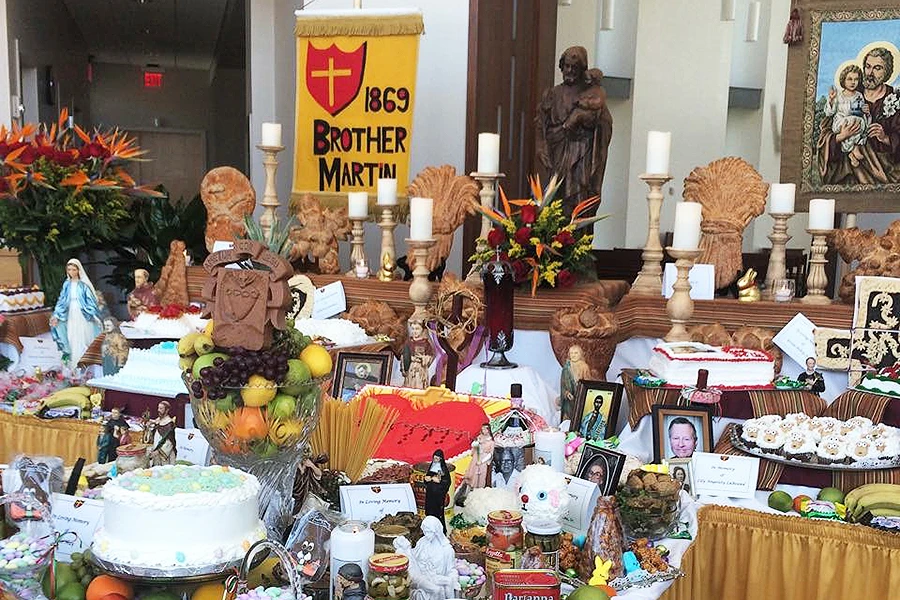
New Orleans, La., Mar 19, 2018 / 03:31 pm (CNA/EWTN News).- Catholic culture is everywhere in New Orleans. Mardi Gras is the city’s defining celebration. The city’s cathedral is one of its most well-known landmarks. And in the days leading to March 19, the people of New Orleans take up a Catholic tradition that began in the Middle Ages – they build “St. Joseph altars.”

This year, nearly 60 New Orleans Catholic schools and parishes have constructed devotional altars, as an expression of gratitude to St. Joseph, and as a labor of love for parishioners, friends, and neighbors.

“The original [St. Joseph’s] altar was built by the people of Sicily in thanks for his prayers to bring an end to their famine,” said Sarah McDonald, communications director of Archdiocese of New Orleans.

“Today, they are considered a labor of love. As you are supposed to be working on the altar you are praying to St. Joseph to bless your family and to hear your intentions and pass them on,” she told CNA.

The tradition began in Sicily, where St. Joseph’s intercession is said to have helped the island through a severe famine almost 1,000 years ago. According to legend, people thanked St. Joseph for his prayers by building prayer altars, on which they placed food, pastries, flowers, wine, and, especially, fava beans.

The beans, which are said to pair well with Chianti, were the first crop Sicilians are said to have grown once their drought ended.

The altars became a custom in Sicily. They came to New Orleans during a wave a Sicilian migration in 19th century.

“In New Orleans we have a very large Sicilian immigrant population coming over in the late 18th century/early 19th century, and with the Sicilian immigrants came the tradition … of St. Joseph’s altars,” McDonald said.

McDonald said the altars were first built in people’s homes, for celebration with neighbors and families. They have now moved to parishes and are even found in some businesses, including grocery stores and concert venues.

Constructed over several days, the altars typically are made in the shape of a cross, with three tiers to represent the Trinity. A picture of St. Joseph is placed on the top tier. Altars are typically blessed by a priest.

The altars are covered with baked goods, flowers, candles, fruits, vegetables, and meatless meals. Many of the pastries and cookies have a symbolic meaning: some cookies are shaped as carpenter’s tools or the Sacred Heart of Jesus.

The food is an expression of gratitude for the local harvest, McDonald said, noting that after the festival canned goods and money are donated to those in need.

To complete the day, many parishes stage a reenactment of the Holy Family’s search for shelter in Bethlehem, after which a feast is served.

Called “Tupa Tupa” or “Knock Knock,” the custom has children representing the Holy Family knocking on the parish door looking for shelter. Two times the procession is denied shelter, and on the third knock everyone is let in for the feast.

[…]

No Picture
News Briefs

If a bishop doesn’t pray, he’s not doing his job, Pope Francis says

March 19, 2018 CNA Daily News 1

Vatican City, Mar 19, 2018 / 01:17 pm (CNA/EWTN News).- Pope Francis marked Monday’s Solemnity of St. Joseph by ordaining three new bishops, telling them prayer is a primary ecclesial duty, and if they do not maintain a strong spiritual life, they are not fulfilling their vocation.

“Announce the Word in every occasion: opportune and inopportune. Admonish, rebuke, exhort with all magnanimity and doctrine. And through the prayer and sacrificial offering of your people, draw from the fullness of the holiness of Christ the manifold richness of divine grace,” the Pope said March 19.

Prayer, he said, “is the first task of a bishop. A bishop who doesn’t pray does not fulfill his duty, he does not fulfill his vocation.”

Francis celebrated Mass in St. Peter’s Basilica on the March 19 feast of St. Joseph, which also marks the fifth anniversary of the inauguration of his papacy.

During the ceremony, he ordained as archbishops three recently appointed nuncios, including Archbishop Waldermar Sommertag, apostolic nuncio to Nicaragua; Archbishop Alfred Xuereb, papal envoy to Korea and Mongolia; and Archbishop Josè Avelino Bettencourt, the Pope’s new ambassador to Georgia and Armenia.

The pope’s brief homily for the day was taken from the section for the ordination of bishops of the Roman Pontifical.

In the homily, he said that while the three men were ordained bishops, “it is Christ who in the ministry of the bishop continues to preach the Gospel of salvation and sanctify believers through the sacraments of faith.”

“It is Christ who in the paternity of the bishop increases his body, which is the Church. It is Christ who in the wisdom and prudence of the bishop guides the people of God in the earthly pilgrimage until eternal happiness,” he said.

Francis reminded the bishops in off-the-cuff comments that they were “chosen among men and for men. You are not called for business, worldliness, or politics: the episcopate is the name of a service, not an honor, as the bishop is more competent for serving than for dominating.”

He told them to love their flock with the love of both a father and a brother, especially priests and deacons.

“Closeness to the priests, please!” he said, and encouraged them to also be close to the poor and defenseless.

“Keep vigil with love on the whole flock in which the Holy Spirit places you to govern the Church of God,” he said, and told them to do this “in the name of the Father, whose image you make present; in the name of Jesus Christ, his Son, by whom you are made masters, priests and pastors. In the name of the Holy Spirit, who gives life to the Church and with its power sustains our weakness.”


[…]