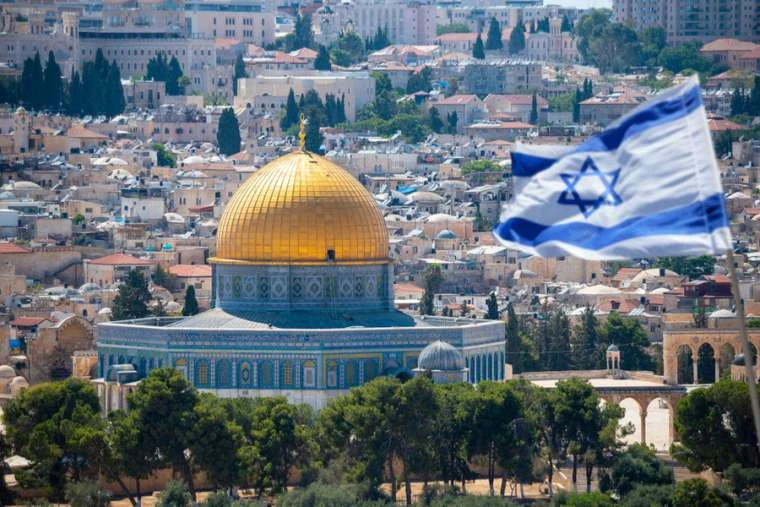
Jerusalem, Nov 6, 2018 / 01:58 pm (CNA/EWTN News).- Top Catholic prelates in Israel are asking the government to repeal the recent Nation State Law, which they say paves a path for discrimination against non-Jewish citizens.
“Although the law changes very little in practice, it does provide a constitutional and legal basis for discrimination among Israel’s citizens, clearly laying out the principles according to which Jewish citizens are to be privileged over and above other citizens,” the Catholic leaders said in their statement, dated Oct. 31.
“We, as the religious leaders of the Catholic Churches, call on the authorities to rescind this basic law and assure one and all that the state of Israel seeks to promote and protect the welfare and the safety of all its citizens.”
The Nation State Law’s provisions, which have the weight of a constitutional amendment, define Israel as the “historic homeland of the Jewish people” who have “a singular right to national self-determination within it.”
The passage of the law by a 62-55 vote July 19 with the support of Prime Minister Benjamin Netanyahu’s right-wing coalition drew widespread international criticism, including from influential groups like the American Jewish Committee.
Following the passage of the law, the Latin Patriarchate of Jerusalem voiced concern that it had downgraded Arabic from an official language to a language with a “special status.” It also objected to the law’s “commitment to work on the development of Jewish settlement in the land, with no mention of the development of the country for the rest of its inhabitants.”
The Oct. 31 joint statement was signed by more than two dozen Catholic ordinaries of the Holy Land, representing Roman, Syrian, and Armenian Catholic, as well as Greek Melkite churches. Signatories included Archbishop Georges Bacouni of the Melkite Greek Catholic Church in Israel, Maronite Archbishop Moussa El-Hage of Haifa, and Apostolic Administrator of the Latin Patriarchate Pierbattista Pizzaballa.
The bishops warned of the focus on Jewish identity at the expense of equality and democracy.
They particularly criticized a clause in the law that promotes “the development of Jewish settlement as a national value,” saying that by doing so, “the law promotes an inherent discriminatory vision.”
The law ignores the Palestinian Arabs living in the region, as well as the Christian, Muslim, Druze and Baha’i communities – all of whom should be treated as equal citizens, the bishops said. They added that the law violates international law standards.
“As Israelis and as Palestinian Arabs, we seek to be part of a state that promotes justice and peace, security and prosperity for all its citizens,” they emphasized.
If you value the news and views Catholic World Report provides, please consider donating to support our efforts. Your contribution will help us continue to make CWR available to all readers worldwide for free, without a subscription. Thank you for your generosity!
Click here for more information on donating to CWR. Click here to sign up for our newsletter.

A view of the separation wall between Israel and the Palestinian Territories from behind a window in the Comboni Sisters’ house in East Jerusalem. / Credit: Marinella Bandini
Jerusalem, Feb 17, 2024 / 06:00 am (CNA).
The Comboni Sisters have been living on the border of East Jerusalem since 1967. Running along the border of their property is a wall, constructed by the Israelis in 2009, dividing the village of Bethany/al-Eizariya — renowned as the site of the resurrection of Lazarus. The sisters’ residence remains on the Israeli side, while the church and the tomb of Lazarus are on the Palestinian side, on the other side of the wall.
“For us, the passage from Scripture that says ‘in Christ the wall of separation between peoples has been broken down’ is very powerful [Eph 2:14], especially when there is a physical wall in front of us that clearly indicates this separation,” Sister Anna Maria Sgaramella, provincial councilor and coordinator of the Middle East Zone for the Comboni Sisters, told CNA.
Sister Anna Maria Sgaramella, provincial council and coordinator of the Middle East Zone for the Comboni Sisters. Credit: Marinella Bandini
Sgaramella arrived in Jerusalem for the first time on Sept. 26, 2000. The very next day, the second intifada — a major uprising by Palestinians against Israeli occupation — erupted. She witnessed the siege of the Basilica of the Nativity in Bethlehem, where she taught theology.
Later, she was transferred to Egypt, where in 2011, she witnessed the uprising known as the “Arab Spring.”
Since 2013, Sgaramella has permanently returned to Jerusalem and now faces another long and bloody conflict. “I have always been struck by the deep sense of hope and determination to move forward among the Palestinian people. With this war, I see it weaker; people are more exhausted,” she said.
A view of the separation wall between Israel and the Palestinian Territories from the terrace of the Comboni Sisters’ house in East Jerusalem. The wall, constructed by the Israelis in 2009, runs along the border of their property, dividing the village of Bethany/al-Eizariya in two, believed to be the site of the miracle of the raising of Lazarus. The sisters’ residence remains on the Israeli side, while the church and the tomb of Lazarus are on the other side of the wall. Credit: Marinella Bandini
There are currently six Comboni Sisters in Jerusalem and each is involved in a specific ministry. They usually come together for morning Mass and evening vespers as well as for meetings and reflection. Their community house is open to religious individuals seeking periods of study or discernment and serves as a center of spirituality for both the congregation and the local Church. The sisters host educational workshops and spiritual exercises as well as welcome pilgrims.
The Comboni Sisters in Jerusalem in a recent photo at the Jordan River. The Comboni Sisters’ community in Jerusalem currently consists of six sisters and each is involved in a specific ministry. Credit: Photo courtesy of Sister Anna Maria Sgaramella
Sgaramella shared with CNA what it’s like to live on the border.
“With the construction of the wall, we found ourselves in the middle, between Palestinians and Israelis,” she explained. “The Palestinians attempt to bypass the wall — especially to pray at the Dome of the Rock — while the Israelis try to repel them in an endless game.”
“Being in the middle is a physical position that has also become a spiritual one,” Sgaramella continued. “We had to reflect and decided to ‘stay in the middle,’ between these two peoples, to serve as a bridge between them. By placing ourselves in the middle, we listen to the injustice faced by the Palestinians and also to the fears of Israeli families.”
For this reason, the religious community has chosen to maintain a small presence in the Palestinian area. Two sisters reside in an apartment beyond the wall, about 100 feet from the Comboni Sisters’ residence.
The exterior of the Comboni Sisters’ house in East Jerusalem where the Comboni Sisters have been living since 1967. Credit: Marinella Bandini
“We desired to stay and share the lives of those people and accompany the small remaining Christian community there. Every time they need to reach the community, they have to travel 18 kilometers [about 11 miles] passing through the Israeli checkpoint,” Sgaramella explained.
The sisters do not do this simply in the spirit of altruism, explained Sgaramella, who is also involved in ecumenical and interreligious dialogue. “We understood from the beginning that being in the middle comes at a cost. It often means getting hit from both sides. On one hand, there are stones and Molotov cocktails from the Palestinians that land on our property; on the other hand, we are under the smoke of tear gas launched in response by the Israelis,” she said.
One incident happened the night of Oct. 6, just hours before the Hamas attack on Israel. Some Molotov cocktails landed on the synthetic grass in the part of the property that houses the kindergarten, causing a fire — the signs of which are still visible today. The fire destroyed the grass, playground equipment, and blackened the recently painted wall.
The exterior of the kindergarten, housed on the Comboni Sisters’ property. In the background is the separation wall that was erected on the edge of the Comboni Sisters’ property in 2009.
The kindergarten is a work that the Comboni Sisters have been carrying out since their arrival and today it serves as an important point of connection with the surrounding community. This significance has grown, especially after the construction of the wall.
“The presence of the kindergarten has never been questioned, neither with the wall nor with the war,” said Sgaramella, who is the director. The kindergarten is attended by approximately 40 children, all of whom are Muslims, divided into two classes. Formally, it is under the jurisdiction of the Palestinian Ministry of Education. “It is a project that meets the needs of the people; furthermore, episodes of violence never occur during the day when the children are present,” she added.
Sister Anna Maria Sgaramella of the Comboni Sisters talks with the children in one of the kindergarten classes hosted at their home in East Jerusalem. The presence of the kindergarten has never been questioned, said Sgaramella, the director. Credit: Marinella Bandini
Every morning, the children begin with a prayer. “We tell the parents right from the start,” Sgaramella explained. “It’s a prayer of thanksgiving for what God has created, for the day, for life, a blessing for parents, neighbors, friends, and also for children who suffer. We pray for peace in the world and in this country.”
Regarding the families, she shared: “There is great trust and respect. They usually choose to send their children here, especially for moral education and English-language instruction.”
Most of the children come from East Jerusalem, but some also come from al-Eizariya. One of the two teachers, Nihal Hashmime, who is also the vice director, has to pass through the checkpoint every day to get to work.
“With the war,” the sister told CNA, “we faced some educational challenges because initially, some children were absent. The work we do with them is to impart certain values, such as peace, friendship, love, and respect for differences.”
Play is also an important aspect. “Children here do not find toy weapons, and they are not allowed to bring them from home,” Sgaramella said.
“Our attempt in education and all other activities is to break down this wall that leads to seeing the other as an enemy,” Sgaramella said. “Sometimes it is difficult to recognize the universality of salvation. We know that Jesus died for everyone, but in certain conflict-ridden contexts, it is challenging to acknowledge the other as a brother. Personally, the field of teaching theology provides me with the space to build bridges among believers. Because in every religion, there are sincere believers seeking truth.”
The sisters Madeleine and Marie-Liesse together with Louis Antona at the entrance of Greece. The three young people covered the distance from Paris to Jerusalem on foot, arriving in mid-May 2024. “I needed to walk 4,500 kilometers to understand that Jesus is not just in Jerusalem, but was by my side every step of the way,” Antona told CNA. / Credit: Photo courtesy of French pilgrims Madeleine and Marie-Liesse
Jerusalem, Jun 18, 2024 / 06:00 am (CNA).
On Sept. 17, 2023, two sisters left Paris and walked for approximately eight months to Jerusalem. Madeleine and Marie-Liesse, 19 and 22, who grew up in a Catholic family, decided to become pilgrims to grow in their faith.
“We needed to make the faith our own,” they told CNA. “This pilgrimage was to discover God, to truly search for him and deepen our faith. We learned that we can trust God; he takes care of us in everything. The Gospel is not a joke.”
Two months later, in mid-November 2023, Louis Antona, 24, also left Paris on foot, bound for Jerusalem. The three young people met providentially in Albania, walked together through Turkey, then parted ways and reunited in Jerusalem. They shared the story of their pilgrimage with CNA.
“I needed to walk 4,500 kilometers to understand that Jesus is not just in Jerusalem but was by my side every step of the way,” Antona told CNA. He walked a total of 189 days and arrived in Jerusalem on May 18.
Madeleine and Marie-Liesse — who asked that their last name not be used to protect their privacy — left from the Basilica of the Sacred Heart of Montmartre in the center of Paris with the blessing of their parents and a priest.
“It was a calling from God,” Madeleine said of the decision she and her sister made to leave. “There’s no need for reasons when God calls; you simply need to follow what he tells you.”
Madeleine and Marie-Liesse during a moment of their journey, between Slovenia and Croatia. “The faith of the people struck us: during Advent, tradition dictates that Mass be attended every morning at 6, and every time we went, the church was packed with people,” they told CNA. The two sisters left Paris on September 17, 2023, and walked for about eight months to Jerusalem. Credit: Courtesy of French pilgrims Madeleine and Marie-Liesse
The sisters created a simple blog to keep friends and family updated on their pilgrimage. The photos and brief stories reveal all the freshness of two young people on a journey while not hiding moments of doubt and difficulty.
“We chose to embark on this journey as beggars,” Marie-Liesse told CNA. “We left with just a few clothes and nothing else — no food, no money. We wanted to surrender ourselves into the hands of providence. Every evening, we knocked on people’s doors asking for shelter, a bed, and food. The Lord always provided.”
Their days were marked by walking and prayer.
“We didn’t have a strict rule because we had to adapt every day to the people who hosted us, the place, and the situation,” Marie-Liesse explained. “But we had a framework: We knew we had to pray in the morning, at midday, at night… It was important for us to be faithful to God. Every day, we also recited a rosary, praying for the intentions entrusted to us.”
The most challenging moment was making the decision to continue the journey after hearing that war had broken out in the Holy Land. “We were in Germany and full of doubts about whether to go on.”
Their journey led them to cross Switzerland, Germany, Austria, Slovenia, and Croatia. In Croatia, “the faith of the people struck us: during Advent, tradition dictates that Mass be attended every morning at 6, and every time we went, the church was packed with people,” the sisters wrote on their blog.
They stopped for a month in Medjugorje (Bosnia and Herzegovina), where their family joined them for Christmas.
“It was a difficult time. Again, we didn’t know what to do. But after a period of discernment, we realized that Christ was calling us back on the road again,” Madeleine said.
Madeleine and Marie-Liesse crossed Montenegro and arrived in Albania, where they encountered Antona.
“I had just finished my studies and wanted to offer something to God,” Antona told CNA. “I wasn’t sure what, but I thought that the best thing I had at that time was time itself. So, I decided to offer God a year of my life by embarking on a journey. It was a challenge; I wasn’t sure if I would enjoy walking and being alone.”
Louis Antona, 24, during a moment of his journey. “I had just finished my studies and wanted to offer something to God,” he told CNA. “I thought that the best thing I had at that time was time itself. So, I decided to offer God a year of my life by embarking on a journey.” Credit: Photo courtesy of Louis Antona
Antona decided to leave, despite the war. “I believe the hardest part of a pilgrimage like this is deciding to start. I knew that if I gave up because of the war, I would never do it again. Anyway, I thought that by the time I arrived, the war would already be over.”
Madeleine and Marie-Liesse are filled with wonder at the manifestation of providence in every detail of their pilgrimage, in the beautiful weather and in the rain, in every small encounter — those who hosted them after seeing them at the bus stop, those who taught them how to make bread, the gentleman who opened his door just before a downpour. “If we had arrived a minute later, we wouldn’t have met him,” they said.
The encounter with Antona wasn’t coincidental either. The two sisters had prayed to God to give them a travel companion.
“We planned to not go through Turkey because we were two women alone, but we would have liked to go that way. So we asked God to meet one pilgrim, and we met him,” the sisters explained.
The three crossed Macedonia and Greece, arriving in Turkey on Palm Sunday. In this predominantly Muslim country, they celebrated Easter, warmly welcomed by the small French-speaking community there.
The sisters Madeleine and Marie-Liesse together with Louis Antona received a blessing from a priest during a Mass in Turkey. They arrived in Turkey on Palm Sunday 2024. In this predominantly Muslim country, they celebrated Easter, warmly welcomed by the small French-speaking community there. Credit: Photo courtesy of Louis Antona
“Every day of this pilgrimage was a miracle,” Antona said. “Every day we have met people who smiled or were nice to us. I have to say that in Turkey we found the most welcoming people.”
“It is not uncommon for the Turks to spontaneously lend us a hand,” Madeleine and Marie-Liesse wrote on their blog. “In Turkey, we encountered an infinite respect for passing strangers and for Christianity, even though Christians here are forced to protect themselves from regular attacks.”
The arrival of Madeleine and Marie-Liesse in Albania. In the photo, Marie-Liesse is in front of a statue of Mother Teresa, who was originally from this country. “Every evening, we knocked on people’s doors asking for shelter, a bed, and food. The Lord always provided,” they told CNA. Credit: Photo courtesy of French pilgrims Madeleine and Marie-Liesse
Upon leaving Turkey, the paths of the three pilgrims split again. The sisters’ route went through Cyprus but they could not find a way from there to Jerusalem by sea due to suspension of transportation because of the war. Providentially, they met someone in Cyprus who offered to pay for airfare, and the sisters arrived in Tel Aviv on May 6. Three days later, on the feast of the Ascension, they were in Jerusalem.
“Many times, we thought we couldn’t reach Jerusalem,” Madeleine said. “We learned that the journey is even more important than reaching the goal. Being here is a great gift, just to be here.”
“We unpacked our bags once and for all, knelt before this Holy Land, and prayed. What peace, what a moment of grace! As we admired the sunrise and the golden light that brought color to the roofs of the old city, we could reread the wonders of God and meditate on the Gospels. His infinite love overwhelmed us,” the two sisters wrote on their blog.
The sisters Madeleine and Marie-Liesse received a blessing from a Franciscan friar at the Basilica of the Holy Sepulcher after their arrival in Jerusalem. “The greatest gift is to be here and understand what happened here, to see with our own eyes, to witness the actual places,” Madeleine said. “We were able to pause in every place, to pray and meditate in silence.” Credit: Photo courtesy of French pilgrims Madeleine and Marie-Liesse
Madeleine has no doubts: “Prayer is what carried us. When you’re weak, that’s when you’re strongest because that’s when God can act in you; you don’t take up all the space. Trusting in God can be challenging, but when you understand that God only wants you to be happy and will give you everything you need, then you realize you have everything to be happy in this moment; you can trust him.”
Ten days later, on the eve of Pentecost, Antona also arrived in Jerusalem. “Even if I had to stop somewhere else, at least I would have aimed to reach Jerusalem. This is a very important city for Christians, but the journey you take to reach it is also very important.”
French pilgrim Louis Antona arrived in Jerusalem on May 18, at the vigil of Pentecost. “Every day of this pilgrimage was a miracle,” he said. Credit: Photo courtesy of Louis Antona
The three pilgrims are still in the Holy Land. They have had the opportunity to participate in various celebrations and to visit the holy places in addition to many other sites in the area.
“The greatest gift is to be here and understand what happened here, to see with our own eyes, to witness the actual places,” Madeleine said. “We were able to pause in every place, to pray and meditate in silence.”
A journey like this isn’t for everyone, but all three of the pilgrims agree that “if God calls you, go in peace. If God helps you, everything becomes possible.”
The French pilgrims rest under the portico of the Church of the Beatitudes on a hill overlooking the Sea of Galilee. In the photo is Louis Antona. A journey like this isn’t for everyone, but, the three young people said, “if God calls you, go in peace. If God helps you, everything becomes possible.” Credit: Photo courtesy of French pilgrims Madeleine and Marie-Liesse
Rome Newsroom, Dec 4, 2020 / 01:00 pm (CNA).- Patriarch Pierbattista Pizzaballa made a solemn entry into the Church of the Holy Sepulchre Friday as the new Latin Patriarch of Jerusalem.
“I cannot but experience feelings of fear in the face of a … […]
Leave a Reply