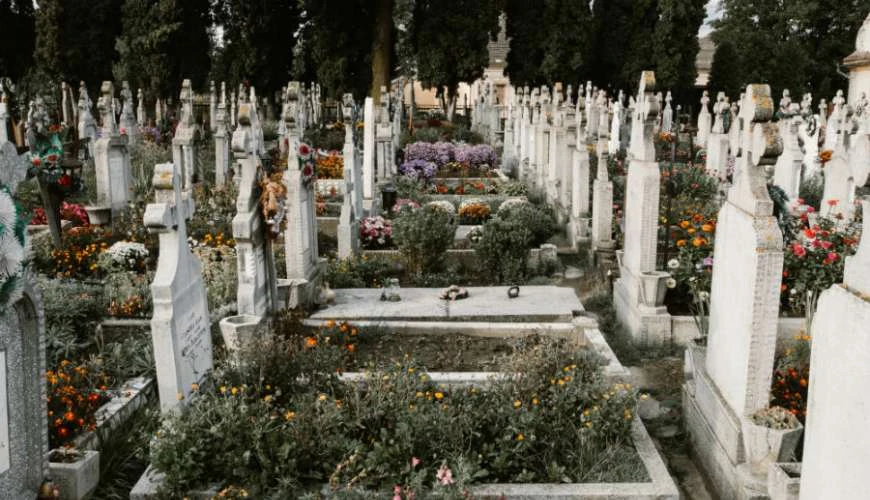
Denver, Colo., Oct 24, 2018 / 12:00 am (CNA).- An after-dark walk through a cemetery in late October seems like a night pulled straight from a Halloween movie or a scary novel.
But when Colorado teens make nighttime visits to Mount Olivet Cemetery this week, it won’t be for ghost stories or a haunted house. Instead, they’ll learn about saints, pray together for the dead, and celebrate Mass.
Mount Olivet’s “Night at the Cemetery” is an annual event for middle and high schoolers, designed to teach them about the intercession of the saints, and the importance of praying for the repose of souls.
John Miller, Outreach Coordinator for Catholic Funeral and Cemetery Services, told CNA that the “Night at the Cemetery” will have a “catechesis on cemeteries and why we pray for the dead.”
He said the students will be able to meet reenactors portraying saints and well-remembered Denver Catholics, who will give the youth “a little bit of their life story [and] weave in some points to remember to pray for the dead, and to pray to the saints in heaven.”
“Night at the Cemetery” will be held at Mount Olivet Cemetery in Wheat Ridge, CO. The first night will take place Oct. 25, followed by Mass at the Gallagher Chapel, and the second night will be Oct. 27, followed by evening prayer.
Students will also be able to meet a mortician and a gravedigger, to learn more about the workings of a Catholic cemetery.
The students will “meet” three people: Therese of Lisieux, a French nun who became a Doctor of the Church; Servant of God Julia Greeley, a freed slave who gave generously to Denver’s poor; and Bishop Joseph Machebeuf, a French Catholic missionary who was the first bishop of Denver.
Miller said the reenactors will emphasize the importance of praying for the souls of the deceased, especially in preparation of All Souls Day.
“It’s probably one of the things people don’t think about a lot when they commit their loved one to the grave,” he said.
“As Catholics, it doesn’t stop at the funeral. You have to constantly pray for our beloved dead, by either having Mass said for them or praying prayers for the souls in purgatory.”
Miller said the reenacted saints will also emphasize the importance of intercessory prayer. He said the saints are able to help people in need grow closer to Christ.
“It’s very important to have a good relation with the saints, to pray to them to help us to grow in love with the Lord each and every day, to grow in holiness, to ask them to especially intercede for us before almighty God.”
Miller said the event also serves to stress the importance of cemeteries, noting these areas are sacred and beautiful. He said they are places of prayer and community.
“Graveyards next to churches are blessed and a majority are consecrated as a sacred place,” he said. “It’s also a place of solace and peace. It has beautiful scenery. It’s a places where some cultures still come on Sunday and have picnics, have barbeques, hang out with their loved ones, pray for them, but also reminisce – share memories, stories.”
“It’s really a place of encounter within community, not only with each other, but also that encounter with God in such a beautiful sacred place.”
If you value the news and views Catholic World Report provides, please consider donating to support our efforts. Your contribution will help us continue to make CWR available to all readers worldwide for free, without a subscription. Thank you for your generosity!
Click here for more information on donating to CWR. Click here to sign up for our newsletter.
CNA Staff, Mar 1, 2024 / 06:00 am (CNA).
The U.S. bishops announced a new initiative last week designed to “bring clarity and compassion” to issues surrounding love, marriage, and sexuality by addr… […]
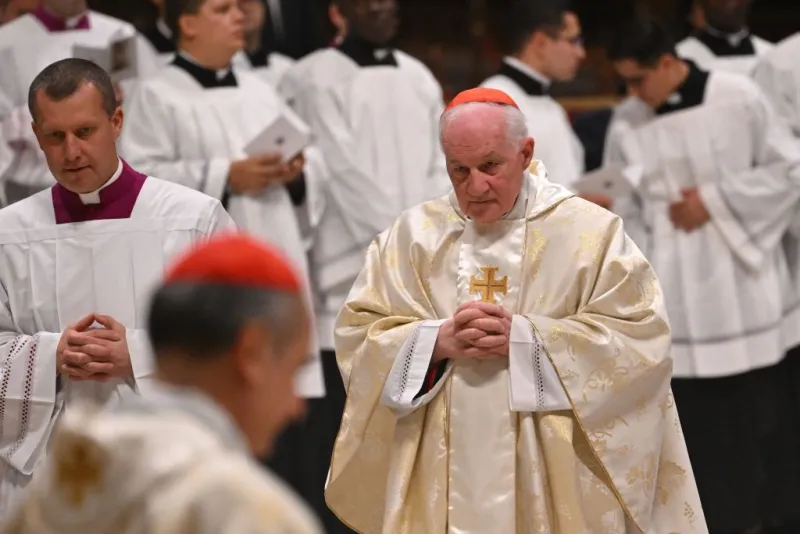
Canadian Cardinal Marc Ouellet atends the pope’s Mass for Our Lady of Guadalupe on Dec. 12, 2022, at St. Peter’s Basilica in the Vatican. / Photo by ANDREAS SOLARO/AFP via Getty Images
Denver, Colo., Dec 13, 2022 / 16:50 pm (CNA).
Cardinal Marc Ouellet has filed a defamation lawsuit in Quebec courts contending that a woman wrongly accused him of sexual assault in a class-action sex abuse lawsuit against the Archdiocese of Quebec.
“I have never been guilty of these reprehensible behaviors, much less of those alleged against other members of the clergy cited in the class action,” the cardinal said in a Dec. 13 statement accompanying the lawsuit. “This inappropriate association, intentionally constructed and widely spread for improper purposes, must be denounced.”
“Having preliminarily made sure to protect the plaintiff’s anonymity by obtaining an order to that effect, today I am taking legal action for defamation before the courts of Québec in order to prove the falsity of the allegations made against me and to restore my reputation and honor,” Ouellet said.
The 78-year-old cardinal served as archbishop of Quebec from 2002 to 2010. He is currently prefect of the Dicastery for Bishops, a key Vatican body that helps the pope evaluate prospective candidates to be named Catholic bishop.
Ouellet was accused of sexual assault by a woman identified pseudonymously as “F.” in an August class-action civil suit filed by multiple plaintiffs against the Archdiocese of Quebec.
The lawsuit against the archdiocese includes the testimony of 101 people who say they were sexually assaulted by clerics or Church staff from 1940 to the present. Eighty-eight clerics are accused in the suit.
Justin Wee, one of the lawyers who is representing the plaintiffs in the lawsuit, told CBC News his client “F.” had heard about the defamation lawsuit online. He had not seen the motion to initiate the lawsuit.
The Vatican, for its part, conducted a preliminary investigation in August. Pope Francis determined that there was not sufficient evidence to begin a canonical investigation against Ouellet for sexual assault.
The woman “F.” says that the cardinal, then archbishop of Quebec, inappropriately kissed or touched her on multiple occasions while she worked as a pastoral intern for the Quebec Archdiocese between 2008 and 2010. She alleged that the misconduct included kissing her and sliding his hand down her back to her buttock.
Ouellet’s defamation lawsuit was filed in the civil division of the superior court in the District of Montreal. It alleges that the “false allegations” against him “have caused and continue to cause serious damage” to the cardinal’s personal and professional reputation. He has also suffered “significant psychological anguish.”
His lawsuit seeks 100,000 Canadian dollars in compensatory damages, about $74,000.
“Any financial compensation that I may receive as a part of these proceedings will be donated in its entirety in support of the fight against the sexual abuse of the Indigenous peoples of Canada,” Ouellet said Tuesday.
According to the cardinal’s defamation lawsuit, the alleged incidents occurred at four different public events: a Sisters of Charity event in Beauport in the fall of 2008; a pastoral appointment ceremony in November 2008; a meeting at an event in a church basement; and during a diaconal ordination at a church in February 2010.
The defamation lawsuit says the cardinal “has no recollection of ever having met Mrs. F. He does not know her.” It says her accounts are inconsistent with the nature of the cardinal’s interactions in public settings. At these events, his lawsuit says, he would make a customary greeting “either by shaking hands or by a kiss on the cheek and would attempt to personalize each interaction in a manner consistent with the behavior of any person in a public representation role.”
His lawsuit further contends that even if the alleged acts took place, which the cardinal denies, they did not constitute “touching of a sexual nature” or sexual assault. It claims the accuser’s comments are contradictory.
The defamation lawsuit alleges another legal fault in that the allegations came in the context of “other allegations involving serious acts against minors.” The allegations against the cardinal are not of a similar nature to the sexual assault of minors by other clergymen alleged in the suit against the archdiocese.
“Ms. F. could not allege her story in such a procedural context,” the lawsuit says. “One may wonder why Ms. F.’s story is included among reprehensible acts of pedophilia, except to include a member of the high clergy in the case.”
“To have associated Mr. Ouellet with individuals who would have committed acts of such a nature constitutes negligence,” the defamation lawsuit continues. “This is so, because the ordinary citizen will perceive that all the reproaches made against the ecclesiastics named in the application are of the same nature, as they are grouped under the same procedure.”
“I firmly denied these slanderous and defamatory accusations unfairly made against me,” he added, citing his previous statement of Aug. 19.
“In truth, I want to emphasize that I never committed the acts of which the plaintiff accuses me,” he said Tuesday.
Ouellet said that sexual abuse victims need justice.
“It is clear that the victims of sexual abuse are entitled to just compensation for the harm they have suffered. I am sensitive to their suffering and reiterate my sincere closeness to them,” he said. “Their right to justice is not questioned by my taking this stand, which is nevertheless painfully necessary to defend the truth, my reputation, and my honor.”
The class-action lawsuit against the Quebec Archdiocese, filed Aug. 16, says that F. wrote to Pope Francis about Ouellet in January 2021. She received an email Feb. 23, 2021, stating that the Vatican had appointed Jesuit Father Jacques Servais to investigate the cardinal. Her last communication with Servais was the following month, March 2021.
Less than a week after the lawsuit was filed, the Vatican said it would not hold a trial against Cardinal Ouellet over the sexual assault allegations.
Servais, the Vatican investigator, said in August that “there are no grounds” to open an investigation into sexual assault. “Neither in his written report sent to the Holy Father nor in the testimony via Zoom that I subsequently took in the presence of a member of the Diocesan Ad Hoc Committee, did this person make an accusation that would provide grounds for such an investigation.”
Vatican spokesman Matteo Bruni added that after relevant consultations, Pope Francis “declares that there are insufficient elements to open a canonical investigation for sexual assault.”
Ouellet was ordained a priest of Quebec’s Diocese of Amos in 1968, at age 23. He joined the Sulpicians in 1972. In 2001 he was appointed secretary of the Pontifical Council for Promoting Christian Unity and consecrated a bishop.
He served as archbishop of Quebec from 2002 to 2010, when he was appointed prefect of the Congregation for Bishops and president of the Pontifical Commission for Latin America.
Ouellet has been outspoken about the need to prevent sex abuse by clergy and the need for sound formation of priests. He has advocated for the increased inclusion of women in the formation of priests and has said that priests need to know how to relate to women well to have a balanced personality.
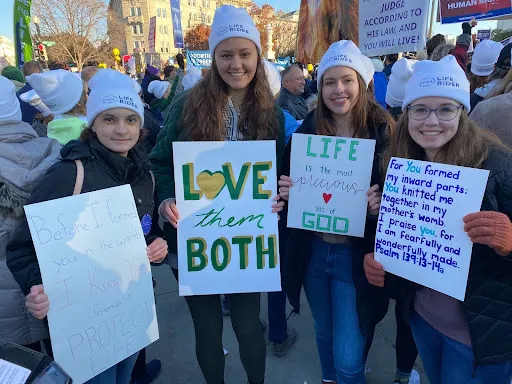
Thousands of pro-life advocates gathered outside the U.S. Supreme Court in Washington, D.C., on Dec. 1, 2021, in conjunction with oral arguments in the Dobbs v. Jackson Women’s Health Organization abortion case. / Katie Yoder/CNA
Washington D.C., Dec 2, 2021 / 08:04 am (CNA).
Anna Del Duca and daughter, Frances, woke up at 5 a.m. Wednesday morning to brave the 30-degree weather outside the U.S. Supreme Court in Washington, D.C. They arrived hours before oral arguments began in the highly-anticipated abortion case, Dobbs v. Jackson Women’s Health Organization.
The case, which involves a Mississippi law restricting most abortions after 15 weeks, challenges two landmark decisions: Roe v. Wade, the 1973 ruling that legalized abortion nationwide, and Planned Parenthood v. Casey, which upheld Roe in 1992.
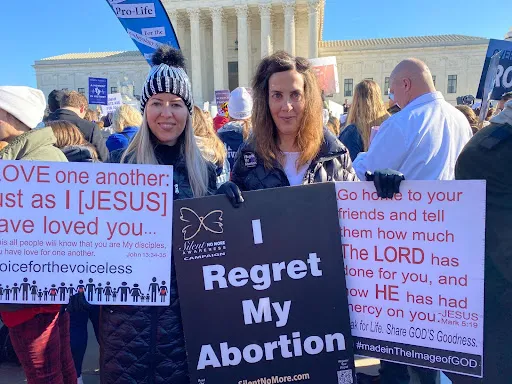
“We’re looking forward to the end of Roe versus Wade in our country,” Anna, who drove from Pittsburgh Tuesday night, told CNA. In her hands, she held a sign reading, “I regret my abortion.”
Anna Del Duca (right) and her daughter, Frances, traveled from Pittsburgh to attend a pro-life rally outside the U.S. Supreme Court on Dec. 1, 2021, in conjunction with oral arguments for the Dobbs v. Jackson Women’s Health Organization abortion case. Katie Yoder/CNA
“I would like to use my testimony to be a blessing to others,” she said, so that “others will choose life or those who have regretted abortion or had an abortion would turn to Jesus.”
Anna remembered having an abortion when she was just 19. Today, she and her daughter run a group called Restorers of Streets to Dwell In Pittsburgh that offers help to women seeking healing after abortion.
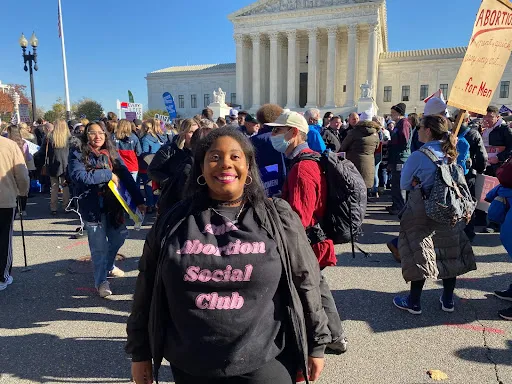
Anna and Frances were among thousands of Americans who rallied outside the Supreme Court before, during, and after the oral arguments. To accommodate them, law enforcement closed the street in front of the court. Capitol police also placed fencing in the space in front of the building in an attempt to physically separate rallies held by abortion supporters and pro-lifers.
At 21-weeks pregnant, pro-life speaker Alison Centofante emceed the pro-life rally, called, “Empower Women Promote Life.” The event featured a slew of pro-life women of diverse backgrounds and numerous politicians.
“It’s funny, there were so many diverse speakers today that the only unifying thread was that we want to protect preborn children,” Centofante told CNA. They included Democrats, Republicans, Christians, Catholics, agnostics, atheists, women who chose life, and women who regretted their abortions, she said.
She recognized women there, including Aimee Murphy, as people who are not the typical “cookie cutter pro-lifer.”
Aimee Murphy, 32, founder of pro-life group Rehumanize International, arrived at the Supreme Court around 6:30 a.m. She drove from Pittsburgh the night before. Her sign read, “Queer Latina feminist rape survivor against abortion.”“At Rehumanize International, we oppose all forms of aggressive violence,” she told CNA. “Even as a secular and non-partisan organization, we understand that abortion is the most urgent cause that we must stand against in our modern day and age because it takes on average over 800,000 lives a year.”
She also had a personal reason for attending.
“When I was 16 years old, I was raped and my rapist then threatened to kill me if I didn’t have an abortion,” she revealed.
“It was when he threatened me that I felt finally a solidarity with unborn children and I understood then that, yeah, the science told me that a life begins at conception, but that I couldn’t be like my abusive ex and pass on the violence and oppression of abortion to another human being — that all that I would be doing in having an abortion would be telling my child, ‘You are an inconvenience to me and to my future, therefore I’m going to kill you,’ which is exactly the same thing that my rapist was telling me when he threatened to kill me.”
On the other side of the police fence, the Center for Reproductive Rights and the National Abortion Access Coalition and NARAL Pro-Choice America participated in another rally. Yellow balloons printed with the words “BANS OFF OUR BODIES” escaped into the sky. Several pro-choice demonstrators declined to speak with CNA.
Voices clashed in the air as people, the majority of whom were women, spoke into their respective microphones at both rallies. Abortion supporters stressed bodily autonomy, while pro-lifers recognized the humanity of the unborn child. Chants arose from both sides at different points, from “Whose choice? My choice!” to “Hey hey, ho ho, Roe v. Wade has got to go!”
At 10 a.m., the pro-life crowd sudddenly went silent as the oral arguments began and the rally paused temporarily as live audio played through speakers.
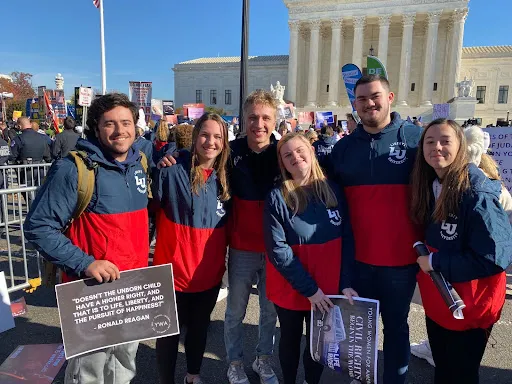
Hundreds of students from Liberty University in Lynchburg, Virginia, traveled to Washington, D.C. for a pro-life rally outside the U.S. Supreme Court on Dec. 1, 2021, in conjunction with oral arguments in the Dobbs v. Jackson Women’s Health Organization abortion case. Katie Yoder/CNA
During the oral arguments, students from Liberty University knelt in prayer. One student estimated that more than a thousand students from the school made the more than 3-hour trip from Lynchburg, Virginia.
“Talking about our faith is one thing, but actually acting upon it is another,” he said. “We have to be the hands and feet of Jesus Christ. So to me this is part of doing that.”
Sister Mary Karen, who has been with the Sisters of Life for 21 years, also stressed the importance of prayer. She drove from New York earlier that morning because, she said, she felt drawn to attend. She came, she said, to pray for the country and promote the dignity of a human person.
“Our culture is post-abortive,” she explained. “So many people have suffered and the loss of human life is so detrimental, just not knowing that we have value and are precious and sacred.”
Theresa Bonopartis, of Harrison, New York, was among the pro-life demonstrators outside the U.S. Supreme Court on Dec. 1, 2021. She runs a nonprofit group called Entering Canaan that ministers to women and others wounded by abortion. Katie Yoder/CNA
She stood next to Theresa Bonopartis, who traveled from Harrison, New York, and ministers to women and others wounded by abortion.
“I’ve been fighting abortion for 30 years at least,” she told CNA.
Her ministry, called Entering Canaan, began with the Sisters of Life and is observing its 25th anniversary this year. It provides retreats for women, men, and even siblings of aborted babies.
Abortion is personal for Bonopartis, who said she had a coerced abortion when she was just 17.
“I was kicked out of the house by my father and then coerced into getting an abortion,” she said. “Pretty much cut me off from everything, and that’s something people don’t really talk about … they make it try to seem like it’s a woman’s right, it’s a free choice. It’s all this other stuff, but many women are coerced in one way or another.”
She guessed that she was 14 or 15 weeks pregnant at the time.
“I saw my son. I had a saline abortion, so I saw him, which I always considered a blessing because it never allowed me to deny what abortion was,” she said. Afterward, she said she struggled with self-esteem issues, hating herself, guilt, shame, and more. Then, she found healing.
“I know what that pain is like, I know what that experience is like, and you know that you can get past it,” she said. “You just want to be able to give that message to other people, that they’re able to heal.”
Residents of Mississippi, where the Dobbs v. Jackson case originated, also attended.
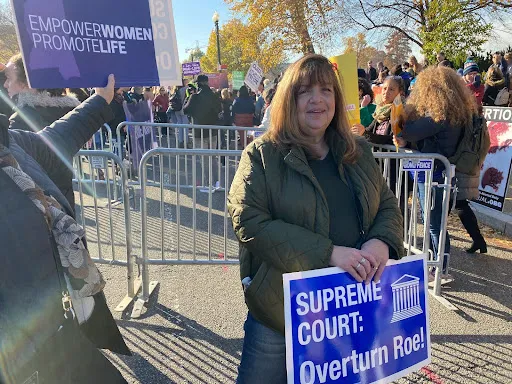
Marion, who declined to provide her last name, drove from Mississippi to stand outside the Supreme Court. She said she was in her early 20s when Roe v. Wade was decided in 1973.
“At the time, of course, I could care less,” she said. Since then, she had a change of heart.
“We were the generation that allowed it,” she said, “and so we are the generation who will help close that door and reverse it.”
Marion, who declined to provide her last name, was among those who attended a pro-life rally outside the U.S. Supreme Court on Dec. 1, 2021, from Mississippi, where the Dobbs v. Jackson Women’s Health Organization abortion case originated. Katie Yoder/CNA
The crowd at the pro-life rally included all ages, from those who had witnessed Roe to bundled-up babies, children running around, and college students holding up homemade signs.
One group of young friends traveled across the country to stand outside the Supreme Court. They cited their faith and family as reasons for attending.
Mathilde Steenepoorte, 19, from Green Bay, Wisconsin, identified herself as “very pro-life” in large part because of her younger brother with Down syndrome. She said she was saddened by the abortion rates of unborn babies dianosed with Down syndrome.
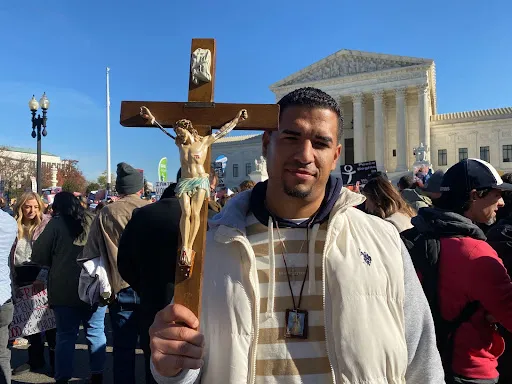
Juanito Estevez, from Freeport, a village on Long Island, New York, at a pro-life rally outside the U.S. Supreme Court on Dec. 1, 2021. Katie Yoder/CNA
Juanito Estevez, from Freeport, a village on Long Island, New York, arrived Tuesday. He woke up at 6 a.m. to arrive at the Supreme Court with a crucifix in hand.
“I believe that God is the giver of life and we don’t have the right [to decide] whether a baby should live or die,” he said.
He also said that he believed women have been lied to about abortion.
“We say it’s their right, and there’s a choice,” he said. When girls tell him “I have the right,” his response, he said, is to ask back, “You have the right for what?”
Mallory Finch, from Charlotte, North Carolina, was among the pro-life demonstrators outside the U.S. Supreme Court on Dec. 1, 2021.
Mallory Finch, from Charlotte, North Carolina, also woke up early but emphasized “it was worth it.” A pro-life podcast host, she called abortion a “human-rights issue.”
“I hope that it overturns Roe,” she said of the case, “but that doesn’t mean that our job as pro-lifers is done. It makes this, really, just the beginning.”



Leave a Reply