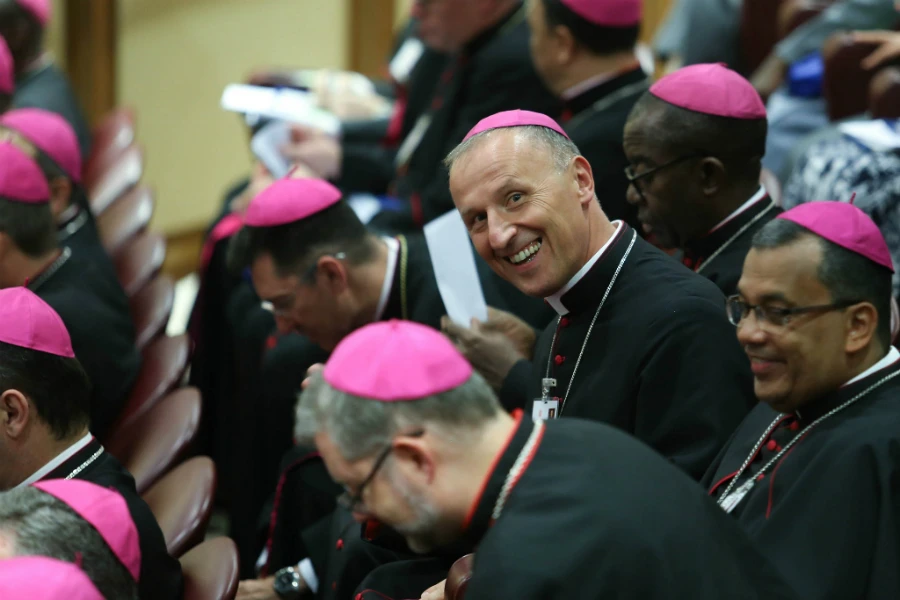
Vatican City, Oct 5, 2018 / 11:01 am (CNA).- The synod of bishops on young people, the faith, and vocational discernment is being held at the Vatican Oct. 3-28.
CNA plans to provide a brief daily summary of the sessions, provided by the synodal fathers from Poland.
Please find below the Polish fathers’ summary of the Oct. 5 session:
Preparation for life in marriage, the father’s role in the family, young immigrants, and the testimony of the life of young people are the topics on the synod’s second day, during which representatives of different countries and continents spoke, exchanging their experiences.
Some of the young people evoked life in broken families. “Therefore, attention was paid to preparing for marriage, for example, pre-marital catecheses that exist in Poland. These catecheses should take into consideration the cultural context because the number of marriages of people from different cultures and religions is increasing,” said Auxiliary Bishop Marian Florczyk of Kielce.
“During the discussion, the opinion was also expressed that the man’s role has been lost. In the past, a man grew to be a father, to fulfill his tasks. The father’s example most strongly draws children to the faith, observed one of the speakers,” Bishop Florczyk emphasized.
Another topic was the issue of immigrants, in a broad sense. “If the Church herself in Europe is struggling with problems, what help should be given to the newcomers?” Attention was paid to the condition of immigrants and of those who receive them. “The religious condition of the latter is unfortunately poor,” said Bishop Florczyk.
Attention was also paid to young people evangelizing their peers through the example of their lives. “The point is for young believers to lead other young people to Jesus Christ because He is the one who shapes their life. The Church is, indeed, a community that characterizes itself by faith in Jesus Christ, that lives by this faith,” highlighted Bishop Florczyk.
“The issues raised show, on the one hand, all the wealth and opportunities, such as good liturgy, but also threats, such as sects that exist in some countries,” said Auxiliary Bishop Marek Solarczyk of Warszawa-Praga.
The discussions also focused on the impact of social media on the lives of young people.
If you value the news and views Catholic World Report provides, please consider donating to support our efforts. Your contribution will help us continue to make CWR available to all readers worldwide for free, without a subscription. Thank you for your generosity!
Click here for more information on donating to CWR. Click here to sign up for our newsletter.
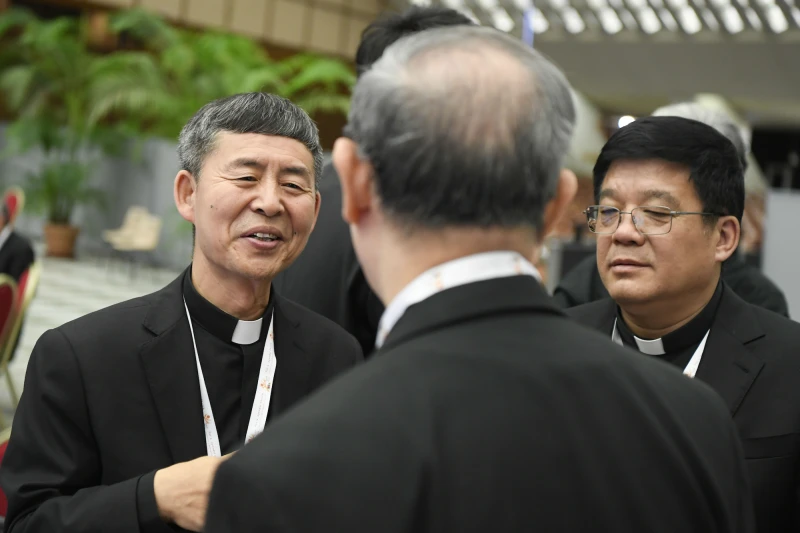
Bishop Yao Shun of Jining and Bishop Yang Yongqiang of Zhouchun (right) of the People’s Republic of China at the Synod on Synodality at the Vatican in October 2023. / Vatican Media
Vatican City, Oct 8, 2024 / 13:30 pm (CNA).
The Synod on Synodality, meant to be a moment of encounter and dialogue for the global Church, has provided a venue for Catholic bishops from mainland China and Taiwan to meet together.
Bishop Norbert Pu is the Catholic Church’s first bishop born in Taiwan. The 66-year-old bishop of Chiayi is a delegate in the nearly monthlong synod assembly as a representative of the Chinese Regional Bishops’ Conference of Taiwan.
In an interview with CNA, Pu said he is most looking forward to getting to know the different bishops, cardinals, and synod delegates from other parts of the world gathered at the Vatican for the second session of the 16th Ordinary General Assembly of Bishops.
Bishop Norbert Pu speaks to CNA at the Vatican, Tuesday, Oct. 8, 2024. Credit: EWTN News
Pu noted that he had already met with the two bishops from mainland China taking part in the synod and plans to meet with them again.
“It’s very important to dialogue with them, to respect each other. I think it’s good … not only for the Chinese, for the whole Church,” the Taiwanese bishop said.
Bishop Antonio Yao Shun of Jining, the first bishop consecrated in China under the terms of the Sino-Vatican agreement, represented the Church in China at the synod assembly in October 2023 along with Chinese Archbishop Joseph Yang Yongqiang before the two suddenly departed early without explanation.
Yao has said that many of the participants in last year’s synod assembly “showed interest in the development of the Church in China, eager to know more and to pray for us.”
The synod also provided an opportunity for the bishops from the People’s Republic of China to spend time with the bishop of Hong Kong, Cardinal Stephen Chow.
During last year’s synod assembly, the cardinal and the two bishops even took a brief trip together to Naples where they offered Mass at the Chiesa della Sacra Famiglia dei Cinesi (Church of the Holy Family of the Chinese), a church built in 1732 as part of an institute founded by Pope Clement XII to train Chinese seminarians and teach missionaries the Chinese language to help with the evangelization of China.
A new synod delegate from China
For this year’s assembly, Yao has been replaced by Chinese Bishop Vincent Zhan Silu of Mindong diocese in China’s southern Fujian province.
Zhan Silu, 63, was formerly excommunicated for having been ordained a bishop without a papal mandate in Beijing in 2000. His excommunication was lifted in 2018 when the Vatican signed a historic provisional agreement with the Chinese government on the appointment of bishops.
When Cardinal Jean-Claude Hollerich was asked why Yao had been replaced by Zhan Silu, the relator general of the synod replied: “The Secretariat of State communicated the names to us, but we have no other information on the matter,” according to Asia News.
Without Yao, Archbishop Yang, 54, is the synod veteran among the two Chinese bishops. Since participating in last year’s synod assembly, Yang has been transferred to the Archdiocese of Hangzhou, a move that took place “within the framework of dialogue” of the provisional agreement with China, according to the Vatican. The change elevated him to the rank of archbishop.
Yang was ordained a bishop with Vatican approval in 2010 and served as the bishop of Zhoucun in mainland China’s Shandong Province from 2013 to June 2024.
He participated in the 2023 National Committee of the Chinese People’s Political Consultative Conference, a political advisory body that is part of the Chinese Communist Party’s united front system, where it was decided that the Catholic Church should integrate its thought with the party and unite more closely to Xi Jinping, according to the official website of the Catholic Patriotic Association.
Zhan Silu and Yang are among the 368 voting delegates taking part in the second synod assembly at the Vatican Oct. 2–27.
The synod is taking place amid the ongoing dialogue between Beijing and Rome on the appointment of bishops. The Vatican has yet to announce if it renewed its provisional agreement with China, which is expected to have been renewed this fall for the third time since it was first signed in 2018.
Vatican-Taiwan relations
During the first week of the assembly, some synod delegates took a break from the day’s meetings to join in the celebration of Taiwan’s 113th National Day at a reception organized by the Embassy of the Republic of China to the Holy See just down the street from St. Peter’s Basilica.
Cardinals and others enjoy a celebration of Taiwan’s 113th National Day at a reception organized by the Embassy of the Republic of China to the Holy See in Vatican City, Wednesday, Oct. 2, 2024. Credit: Embassy of the Republic of China to the Holy See
Vatican City State is the only remaining country in Europe that recognizes Taiwan as a country.
The Holy See has had formal diplomatic relations with Taiwan, formally called the Republic of China (ROC), since 1922, while the Church has not had an official diplomatic presence on the mainland People’s Republic of China (PRC) since it was officially expelled by Beijing in 1951.
The island of Taiwan, fewer than 110 miles off the coast of China and home to a population of more than 23 million people, has maintained a vibrant democracy with robust civil liberties despite increased pressure from Beijing regarding the island’s status.
Unlike mainland China — where images of Christ and the Virgin Mary have been replaced with images of President Xi Jinping, according to a report released last week — Catholics in Taiwan enjoy religious freedom, which is enshrined in its constitution.
More than 10,000 people attended the National Eucharistic Congress in Taiwan last weekend, according to Taiwan’s Ministry of Foreign Affairs.
Pope Francis sent a message to the congress, writing that he hoped it would “arouse in the hearts of the Christian faithful a true worship and love of the Eucharist.” The congress in the Diocese of Kaohsiung was the fifth Eucharistic congress held in Taiwan since 2011.
Bishop Pu told CNA that the congress presented an opportunity to let more people in Taiwan know about the Eucharist and its central importance to the Catholic faith.
“We hope we can always maintain this formal and good relationship with the Vatican. Because for Taiwan, this is very important. We hope that the world will see this because Taiwan is a democratic and free country, respected by other nations,” Pu said.
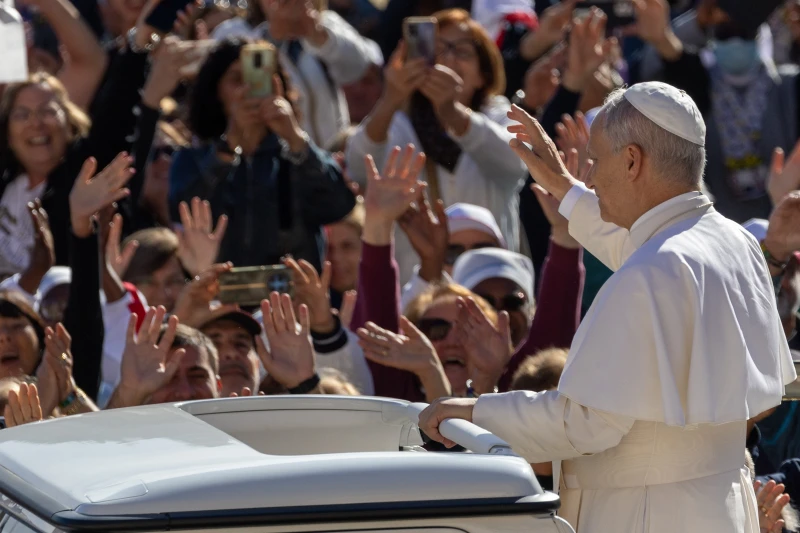
Pope Leo XIV greets pilgrims gathered in St. Peter’s Square at the Vatican on September 27, 2025. / Daniel Ibáñez
Vatican City, Sep 27, 2025 / 07:30 am (CNA).
Pope Leo XIV marked the Jubilee of Catechists on Saturday, urging practitioners of the Church’s lay teaching ministry to hand on the faith in a way that helps others encounter Christ personally, rooted in humility and hope.
In his general catechesis, the pope spoke to all the faithful: “God reveals himself to those who are simple and humble of heart because they are open to receiving him,” he said.
Leo recalled the election of Saint Ambrose as bishop of Milan, chosen by popular acclaim while still preparing for baptism. “It was also docility that led Ambrose to respond to that call, trusting in the grace of God,” he said. Christians today, he added, are likewise invited “to become childlike. Whether we are parents, students or catechists; businesspeople, priests or religious, we are all called to live our Christian faith authentically by humbly following the Lord’s inspirations.”
The Jubilee of Catechists is one of a series of themed celebrations during the Holy Year 2025, which centers on the theme of hope. Each gathering highlights how different vocations and ministries can bear witness to the renewal of the Church and the world. This weekend, more than 20,000 pilgrims from 115 countries have come to Rome for the celebration dedicated to catechists.
The jubilee opened Friday evening with a prayer vigil in St. Peter’s Basilica following a day of pilgrimages to the Holy Door. It will conclude Sunday morning with a Mass in St. Peter’s Square at 10:00 a.m., during which the pope will confer the lay ministry of catechist on 39 men and women. Among them is Catherine Miles-Flynn, an American mother of eight serving in the Arabian Peninsula, profiled here.
At the end of the Saturday audience, the pope offered a special word to catechists: “As you instruct others in the faith, keep in mind the importance of teaching them to cultivate a relationship with Jesus. May his love revive in all of us the hope that does not disappoint.”





Leave a Reply