

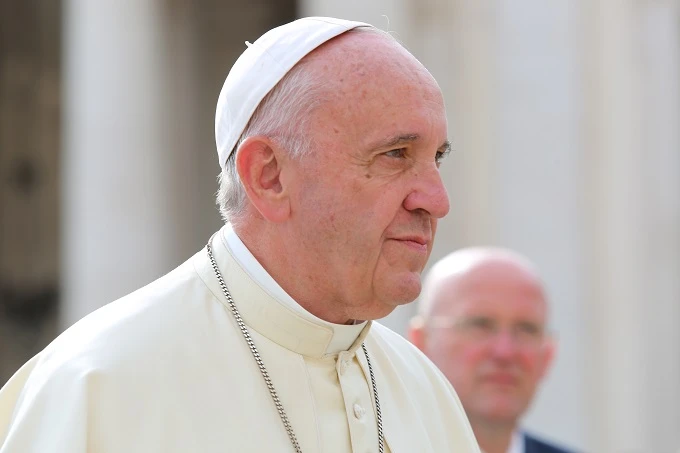
Vatican City, Mar 29, 2018 / 08:21 am (CNA/EWTN News).- On Thursday the Holy See stated that a reported interview between Pope Francis and an Italian journalist, which claims the Pope denied the existence of hell, should not be considered an accurate depiction of Francis’ words, but the author’s own “reconstruction.”
A recent meeting between Pope Francis and Italian journalist Eugenio Scalfari, 93, was a “private meeting for the occasion of Easter, however without giving him any interview,” the March 29 communique stated.
“What is reported by the author in today’s article is the result of his reconstruction, in which the literal words pronounced by the Pope are not quoted. No quotation of the aforementioned article must therefore be considered as a faithful transcription of the words of the Holy Father.”
Scalfari, a self-proclaimed atheist, is the founder and former editor of Italian leftist newspaper La Repubblica. In an article published on the site March 29, Scalfari claims that Pope Francis told him, “hell doesn’t exist, the disappearance of the souls of sinners exists.”
Scalfari’s fifth meeting with Pope Francis, it is not the first time he has misrepresented the Pope’s words following a private audience.
In November 2013, following intense controversy over quotes the journalist had attributed to Francis, Scalfari admitted that at least some of the words he had published a month prior “were not shared by the Pope himself.”
In a meeting with the journalists of the Foreign Press Association of Rome in 2013, Scalfari maintained that all his interviews have been conducted without a recording device, nor taking notes while the person is speaking.
“I try to understand the person I am interviewing, and after that I write his answers with my own words,” Scalfari explained. He conceded that it is therefore possible that “some of the Pope’s words I reported, were not shared by Pope Francis.”
Scalfari also falsely reported that Pope Francis had made comments denying the existence of hell in 2015.
Vatican spokespersons have dismissed the texts of Scalfari as unofficial. In 2014, Fr. Federico Lombardi, past papal spokesperson, told CNA that “if there are no words published by the Holy See press office and not officially confirmed, the writer takes full responsibility for what he has written.”
Pope Francis has previously spoken about the existence of hell in public speeches, including at a prayer vigil in March 2014.
There he gave an address in which he said that members of the mafia should change their lives, “while there is still time, so that you do not end up in hell. That is what awaits you if you continue on this path.”
If you value the news and views Catholic World Report provides, please consider donating to support our efforts. Your contribution will help us continue to make CWR available to all readers worldwide for free, without a subscription. Thank you for your generosity!
Click here for more information on donating to CWR. Click here to sign up for our newsletter.


Well, here we go again. The pope is the victim again… (yawn how many times will this work?)
Why give interview with someone who keeps misquoting you? or does he?
I expect there will be those who defend him today with that “big bad anti-Francis conspiracy” line… who tomorrow will be saying … ‘you know what… there is no hell, Francis is right’
Prayer For The Silence of A Pope.
Dear loving and merciful Father,
We pray for your Son’s earthly guardian
of the deposit of faith.
Grant to your humble servant N. __________
that he may reserve and decline both speech and writing so as to safeguard your tradition that you so lovingly have bestowed on us for thousands years.
May you grant our Vicar the peace and courage needed for earthly solitude and contemplation.
Eternal and loving giver of all that is good, we beseech thee, to guide Him in his duties in living the gospel without words.
We ask this thru Christ Our Lord.
Amen
The fact that the Pontiff continues to put himself in this position proves, yet again, that not all members of the Society of Jesus are intellectuals.
But does he believe hell is empty since he loves a statue in Europe that has a half smiling Christ carrying Judas on his shoulder. Christ on the other hand said to His Father in prayer, ” Those whom you gave me I guarded and not one of them perished but the son of perdition that the scriptures might be fulfilled.” Christ said this PRIOR to Judas completing the betrayal sin yet Christ used the past tense…”perished”. Justin Martyr said past tense prophecy is unchangeable as in Isaiah 53:5…” But he WAS wounded for our inequities, bruised for our sins..”….said in the past tense hundreds of years prior to Christ suffering. Thus on the Judas issue, Christ always had gravitas whereas Francis has a falsely hopeful levity. Hell is not real if no one is there. Hundreds of thousands of criminals have died trying to kill law enforcement throughout history. It is bizarre to think they all had sanctifying grace and thus reached purgatory…as they died trying to murder law enforcement. Many have been killed in the act of adultery. Again…purgatory is a reward not a default setting for all idiots. I Peter says…” if the just man will scarcely be saved, where will the impious and the sinner appear?”. I think Francis thinks hell is empty most of the time and in a week that forces him into gravitas, he becomes orthodox. It varies. He’s mercurial. Christ was constant….He had the constantia which the Stoics admired.
“He had the constancy…”
Constantia is a woman’s first name. Auto spell check has a way of frustrating even the most conscientious typists.
That sounds like what they used to call a “non-denial denail”
they didn’t say that he didn’t say it, they just said we didn’t say that he said it. OK, so…. What does the pope believe… Who knows? with Francis anything is possible. Don’t hold your breath for the pope to say that there is a hell and sinners are punished there though, because it is soooooooooo beneath him to respond to petty little things like this.