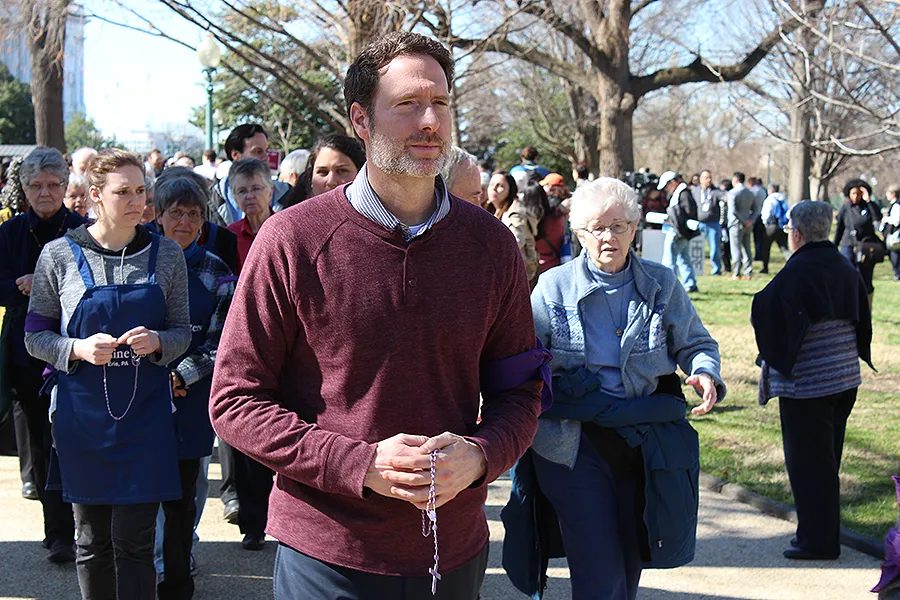
Washington D.C., Feb 27, 2018 / 04:20 pm (CNA).- A group of about 100 people–including Franciscan friars, religious sisters, and laity–gathered in the rotunda of the Russell Senate Building in Washington on Tuesday, and were led away in flex cuffs in a planned act of civil disobedience.
The protest was intended to pressure Congress to take action on “Dreamers,” or people who were brought to the United States illegally as children. It was organized as part of the Catholic Day of Action with Dreamers, an event planned by Catholic social advocacy groups.
One of those arrested was Sr. Tracy Kemme, a Sister of Charity of Cincinnati. Prior to her arrest, Kemme told CNA that she considered her actions to be worthwhile to help protect the immigrant community.
“Myself, two of my sisters, and one of our associates will be doing civil disobedience,” said Kemme. She continued, “It’s a moral moment of truth and it’s worth it to us to try to raise the consciousness of our legislators.”
Registered “Dreamers” are afforded renewable protection from deportation under an Obama-era policy called the “Deferred Action on Childhood Arrivals” (DACA). President Donald Trump sought to end DACA in September of 2017 and gave Congress a six-month period to come up with a solution before the protections would expire on March 5.
Two federal courts have issued injunctions preventing the President from ending DACA.
On Monday, the Supreme Court declined to consider the Administration’s expedited appeal of those injunctions, ensuring that the program will remain as-is until a final court decision is made later this year.
Congressional legislators have been unable to pass compromise bills that would have codified parts of DACA into law. On Monday, the USCCB urged Catholics to call their Congressmen as part of the “National Call-in Day for the Protection of Dreamers.”
The PICO National Network, along with Faith in Public Life and the DC Catholic Coalition, organized Tuesday’s “day of action.” The day featured a prayer rally and peaceful civil disobedience, culminating with the arrests.
Kemme told CNA that she hopes Congress is able to pass a DREAM Act unconnected to other proposed immigration reforms, and that her faith inspires her passion of working with the immigrant community.
“As a Catholic, my end goal would be comprehensive immigration reform with a path to citizenship that keeps families together,” she said.
Kemme’s desires were echoed by Sr. Elise Garcia, O.P., from the Dominican sisters in Adrian, Michigan. Garcia said she was in D.C. on Tuesday to pray for the Dreamers as well as for elected leaders, and she too would like to see comprehensive immigration reform.
“Ideally, I would like to see an entire comprehensive package of immigration reform. That’s the ideal. Short of that, I’d like to see justice for Dreamers,” who have only known the United States as their home.
Before the Capitol Police attempted to disperse the protest, Bishop John Stowe, OFM Conv., Bishop of Lexington, addressed the crowd. Once the crowd began loudly praying a decade of the rosary, the police started to make arrests.
A total of 40 people were arrested and charged with “Crowding, Obstructing, or Incommoding.”
If you value the news and views Catholic World Report provides, please consider donating to support our efforts. Your contribution will help us continue to make CWR available to all readers worldwide for free, without a subscription. Thank you for your generosity!
Click here for more information on donating to CWR. Click here to sign up for our newsletter.

This photo of Father Allan Travers was featured in the local newspaper after his pitching “performance” for the Detroit Tigers against the Philadelphia A’s on May 18, 1912. The photo featured the caption “strikebreaker,” which worried Travers’ mother, since there was a street trolley strike in Philadelphia earlier in the month, and she didn’t want her son caught in the confusion. / Photo credit: Public domain
Detroit, Mich., Jul 23, 2023 / 08:00 am (CNA).
The worst pitcher ever to take the mound for the Detroit Tigers became a Catholic priest.
Granted, Allan Travers was already on the path to the priesthood before suiting up for Detroit on May 18, 1912. But his story — and place in baseball history — is the prime example of being in the right place at the right time (or the wrong place at the wrong time).
Travers played in only one game, but one was enough to show that God had plans for him that didn’t involve the big leagues.
The story begins, as most stories of Tigers lore do, with Ty Cobb.
The Tigers were in New York on May 15 to play the Highlanders (the precursor to the Yankees). Cobb was playing in the outfield when he was verbally abused by a New York fan who was using profanity and racial slurs to describe Cobb’s play.
Cobb — never known for keeping his cool — stormed into the stands and unleashed a volley of punches on the fan. Tigers players rushed to the scene of the chaos, yelling at Cobb to lay off the man, who was missing one hand and three fingers on his other hand after suffering an industrial accident.
Cobb didn’t care and continued the barrage.
Ban Johnson, president of the American League, happened to be at the game, checking on the family-friendly excitement of what was turning into America’s pastime.
Having one of the league’s star players beat up a disabled spectator didn’t jibe well with Johnson’s vision for baseball, so Cobb was suspended indefinitely.
The Tigers felt Cobb’s punishment was unfair, so the players voted to strike until Cobb was reinstated for the club’s next game in three days against the two-time defending World Series champion Philadelphia Athletics.
Detroit Tigers legend Ty Cobb is pictured in 1911. Not one to keep his cool, Cobb launched himself into the stands to attack a fan who insulted him in 1912, resulting in a league suspension and sparking his teammates to strike in protest. Credit: Public domain
Johnson called the Tigers’ bluff, informing then Tigers owner Frank Navin the team would face a $5,000 fine for every game Detroit forfeited.
Navin needed to field a team, and quick, so he and Tigers manager Hughie Jennings collaborated with Athletics owner/manager Connie Mack to field a team of players to take the field.
This was well before the age of expansive minor league rosters — or commercial airlines, for that matter — so it wasn’t as though the Tigers could call up the farm team in Toledo and get them to Philadelphia in time to play the A’s. Instead, scouting was done the old-fashioned way, spreading word throughout town, asking who wanted to play baseball.
And this is where Aloysius Joseph “Allan” Travers, the student manager on the St. Joseph’s College baseball team, comes into the story.
Jennings worked with a friend of his, Joe Nolan, a sportswriter for The Philadelphia Bulletin,to field a team. Nolan knew Travers, a junior at St. Joseph’s who lived in Philadelphia, from the time the A’s fielded a second-stringer team to play St. Joseph’s College.
Nolan asked Travers to find 10-12 amateur players in the area who could suit up for the Tigers in case the Tiger players followed through on their strike threats. The idea was that the amateurs would never actually take the field; rather, it was just a tactic to get Jennings’ “real” players on the field.
Father Allan Travers, SJ, was a priest who taught at St. Joseph’s College (now St. Joseph’s University) in Philadelphia. But in 1913, while a student at St. Joseph, he was the improbable pitcher for the Detroit Tigers, where he secured a bizarre spot in baseball history. Credit: Public domain
Travers rounded up eight players who were free that day and enticed by the $25 Navin offered to each player.
Jennings had his team of strike-breakers, as requested by Navin.
When the umpire called “play ball,” the Tiger regulars took the field, but when the umpire spotted Cobb and told him to take a seat, the rest of the team walked out and took off their uniforms.
The strike-breakers would have to play after all. They were ushered into the locker room and donned the Tigers’ gray uniforms (this was in the days before names were on the back of uniforms). Two bench coaches joined the group to offer the squad some big league experience.
The question was, who would pitch?
There were no takers at first, so Navin offered an extra $25. Travers volunteered; $50 was good money for a college kid in 1912. There was one small problem — Travers had never played organized ball.
He was the assistant manager on the college baseball team, tasked with keeping stats and writing game summaries.
But there he was, the college student with plans to join the seminary after graduation, pitching before 20,000 fans at Shibe Park against the two-time defending World Series champions. A modern David versus Goliath, a plucky underdog story.
This time Goliath won.
Travers did as well as one would expect the assistant manager of a college baseball team to do against professionals. He pitched a complete game, surrendering 24 runs on 26 hits (both American League records), walking seven and striking out one. He got an MLB strikeout — they can’t take that away from him.
But the 15.75 ERA leaves a mark. He also batted 0-for-3 at the plate.
Travers’ time in the major leagues was abrupt. After the 24-2 shellacking the A’s put on the strikebreaking Tigers, Cobb persuaded his teammates to end the strike before the team’s upcoming series against the Washington Senators.
Travers’ calling was the priesthood, not pitching.
After graduating from St. Joseph’s College in 1913, he joined the Society of Jesus, studying at St. Andrew on the Hudson in New York and Woodstock College in Maryland. He was ordained a priest in 1926, making him the only priest ever to play in a Major League game.
His ministry took him to teaching positions at St. Francis Xavier High School in Manhattan and St. Joseph’s Prep and St. Joseph’s College in Philadelphia.
Father Travers didn’t speak about his baseball exploits, but he did give an interview about his bizarre start for the Tigers.
“About noon when Nolan told me about the strike of Detroit, he told me the club would be fined and might lose its franchise if 12 players didn’t show up,” Travers told sportswriter Red Smith. “He told me to round up as many fellows as I could. We never thought we’d play a game.”
The replacement Detroit Tigers are pictured in the dugout against the Philadelphia A’s on May 18, 1912. Photo credit: Public domain
The priest said Jennings told him to avoid throwing fastballs to “avoid getting killed out there,” but the A’s didn’t hold back, even resorting to bunting when they found out the third baseman had never played baseball before.
“I fed ‘em nothing but slow stuff after Frank Baker almost hit one out of the park on me, which fortunately went foul,” Travers said. “I was doing fine until they started bunting. The guy playing third base had never played baseball before. I just didn’t get any support. I threw a beautiful slow ball and the A’s were just hitting easy flies. Trouble was, no one could catch them.”
Curious enough, the only “fame” Travers got from his start was his picture in the newspaper with the word “Strikebreaker” printed above. There was a trolley strike in Philadelphia that month, and Travers’ mother was worried for her son’s safety because people might suspect he was a scab.
Travers didn’t like talking about his baseball “career” with his students, and his story is not well known, save for a few baseball history blogs.
He did sign a ball from that fateful day that wound up in the collection of Ada, Michigan, resident Steve Nagengast, who claims to have the largest collection of Tigers autographs. Nagengast was featured in the Detroit News, and the anecdote about Travers piqued Detroit Catholic’s interest.
Travers didn’t have the greatest impact on Tigers history. But the $5,000-per-game fine the Tigers faced for each game the club forfeited would have been devastating, especially in an era when professional teams folded and changed towns all the time.
So who knows.
Father Travers’ one-game career might have just saved the Tigers.
Denver Newsroom, Apr 29, 2020 / 05:13 pm (CNA).- While the coronavirus has shut down universities and artistic events, the drama department of a Catholic university performed a play nevertheless, through a video conference.
A production of Shakespeare’s “Measure for Measure” was meant to be staged last week. Because of the pandemic, the Catholic University of America’s Rome School of Music, Drama, and Art instead performed the play on Youtube.
Eleanor Holdridge, chair of the drama department and the play director, told CNA that the play was a blessing, allowing the students a break from isolation and bringing art into homes amid the coronavirus pandemic.
“It was great because it was something to be working as a group towards. It was something we didn’t have to give up and that we can have hope towards in the midst of this crisis,” she said.
“We sort of had a virtual cast party. We all watched it. It went live on the 23rd, Shakespeare’s birthday. So the cast families all watched it together and then we kind of met up afterward to have a real cast party.”
The performance was not streamed live. Instead, each scene was recorded separately and then the actor’s scenes were placed side-by-side as if in a video conference. If the scene was a monologue, then the actor would appear solo on the screen. In between acts, pictures of the sets would appear along with music pieces composed by Roc Lee, a sound designer and composer.
The actors were encouraged to situate themselves in areas of the house with blank walls and good lighting. In one instance, Holdridge said, a student recorded himself huddled in a corner of the house to evoke his character’s imprisonment. Prior to the play, the costume designer video chatted with each cast member and then helped them pick out the best costumes from what they have at home.
She said the online play was also very challenging. While rehearsals usually go for about four hours, it was much more difficult to keep everyone on track while online, and the session had to be shortened. She also said the gestures of acting were too large for the screen and the actors had to focus heavily on speaking with only a little body movement.
As students were feeling distraught and isolated, she said, the play was a unique opportunity for the actors to get back into university life.
“[College is] about what you’re learning, obviously, but you’re also learning how to be your own person away from your parents and you’re learning how to be a member of society. You’re learning how to work with your friends and peers towards something,” she said.
“I feel like they very much needed to feel like they were working, not just with faculty but with each other towards a goal.”
Holdridge also said the event was an opportunity to promote art within the household during the pandemic. She highlighted the importance of acting as a promotion of empathy.
“The art of acting and theater … is a really wonderful way in which to teach or learn empathy. You can’t do what we do without feeling empathy … You have to imagine yourself to be many different characters or find the motivations of many different characters,” she said.
“So in terms of having empathy towards other people and not having a rigid scorn or scoff at other ways of being is, I think, one of the great things that theater is and what it can do.”
Marie Kottenstette, a senior English and drama major who played Isabella, said it was a valuable learning experience, and, although it was not ideal, it was an important opportunity.
“Being able to work and act, even if it isn’t exactly what we’re used to, was important,” she said. “I feel like we’re still learning and growing. We’re in college so we’re constantly learning and this was definitely a learning experience.”
Leave a Reply