Acapulco, Mexico, Feb 6, 2018 / 07:00 pm (CNA).- The Archdiocese of Acapulco, Mexico, reported that two priests were murdered early Monday morning, Feb 5.
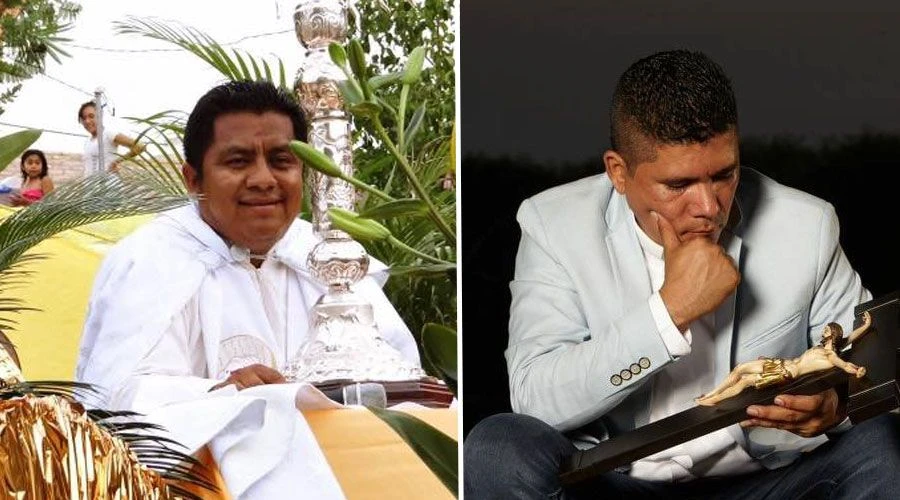
Fr. Iván Añorve Jaimes, pastor of Holy Family Parish in the town of Las Vigas, and Fr. Germain Muñiz Garcia, the pastor of Mezcala; were killed in an attack by unidentified individuals in Taxco township.
According to a press release from the Guerrero State Attorney General's Office, the victims were traveling on the Iguala-Taxco highway when they were suddenly cut off by another vehicle, from which shots were fired. The assailants fled the scene.
“As a Church we are greatly troubled by this tragic event which is mourned by the entire archdiocesan community and that of the Diocese of Chilpancingo-Chilapa. We call on the authorities, that once the truth is known, that justice be served,” a statement from the Archdiocese of Acapulco reads.
After lifting up their prayers for the souls of the priests, the Archdiocese of Acapulco also asked prayers for “the conversion of those who, forgetting that we are brothers, commit this kind of crime, which injures the dignity of the human person so much, snatches away the sacred gift of life and sows pain and suffering in the family and in society.”
“Let us not relent in our efforts to build peace in our family, in our community, in our state, in our homeland. Let us ask the Lord for this peace every day,” the statement concludes.
This article was originally published by our sister agency, ACI Prensa. It has been translated and adapted by CNA.
If you value the news and views Catholic World Report provides, please consider donating to support our efforts. Your contribution will help us continue to make CWR available to all readers worldwide for free, without a subscription. Thank you for your generosity!
Click here for more information on donating to CWR. Click here to sign up for our newsletter.
La Paz, Bolivia, Nov 11, 2019 / 04:47 pm (CNA).- The Bolivian bishops have urged an end to the vandalism that has taken place following the resignation of president Evo Morales on Sunday.
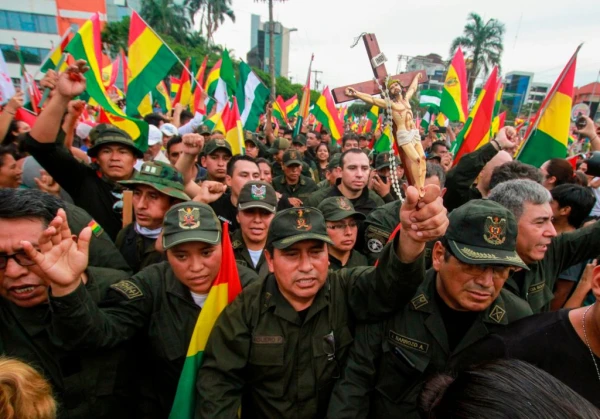
Supporters of Morales have clashed with police in several cities.
In a Nov. 10 message, the bishops’ conference, along with several civic groups, encouraged “Bolivians to peace and to not commit acts of vandalism or revenge or anything we could regret. We all have a grave obligation to defend the lives of all Bolivians.”
They also pointed out that “what’s happening in Bolivia is not a coup d’état, we say it before all Bolivian citizens and the entire international community.”
“In the name of God we tell you: stop the violent acts and let us preserve life and the peace. Let us maintain the peaceful spirit that has reigned in the people in this time,” they said.
Morales resigned Nov. 10 after weeks of protest regarding a disputed Oct. 20 election. The socialist leader had been in power since 2006.
According to the electoral commision Morales won on the election’s first round, but the opposition claimed fraud. The Organization of American States said Nov. 10 that there was “clear manipulation” in the election, and that it was statistically improbable that Morales had won by the margin needed to avoid a runoff.
Within hours of the OAS report, Morales resigned, after being encouraged to do so by the head of the Bolivian armed forces.
In both La Paz and El Alto, Morales’ supporters have clashed with police, and more than 20 people have reportedly been injured.
The deputy head of the Senate, Jeanine Anez, has said she will serve as a caretaker president until elections are held.
Morales has been offered asylum by Mexico.
The Bolivian bishops and civil leaders said, “We call on the National Police and the Armed Forces of the nation to urgently fulfill their constitutional role in defense of property and people, preserving the lives and freedom of everyone.”
“We are all in agreement in proposing to the National Assembly of Bolivia a constitutional and peaceful solution in order to shortly have constitutional president with the task of forming a new electoral tribunal and bringing us to new elections so that the entire people may express their opinion in freedom and peace,” they continued.
Luis Fernando Camacho, an opposition leader, reportedly placed a Bible on the Bolivian flag in the presidential residence after Morales resigned, saying, “Pachamama will never return to the Palace. Bolivia is Christ’s.”
Bishop Krzysztof Bialasik Wawrowska of Oruro spoke with ACI Prensa, CNA’s Spanish language sister agency, saying that when the news of Morales’ resignation came, “at that moment all the people gathered together to celebrate this fact, practically as a victory, because we were already living in a dictatorship and the people knew that they didn’t want to become like Venezuela.”
“At this moment there’s a big celebration in Oruro’s main square and they just called me to go there and pray and thank God for this grace of freedom that he has given us,” Bishop Bialasik said.
The bishop said Bolivia must “form an electoral tribunal as soon as possible for the new elections. This could take about three months to find the people, the leaders that can lead the country over the next few years.”
With these leaders, the Bishop of Oruro concluded, Bolivia may have “more hope, and also the life and dignity of people … may also be respected.”
Rodrigo Iván Cortés, president of the National Front for the Family, described Claudia Sheinbaum’s victory as “very bad news for life, family, and freedoms.” / Credit: EWTN Noticias/Screenshot
ACI Prensa Staff, Jun 5, 2024 / 18:50 pm (CNA).
Various pro-life, pro-family, and lay leaders of the Catholic Church in Mexico have reacted with concern to the election of Claudia Sheinbaum as president of the country.
Rodrigo Iván Cortés, president of the National Front for the Family, described Sheinbaum’s victory as “very bad news for life, family, and freedoms.”
For the pro-family leader, Sheinbaum represents continuity with the same progressive agenda of the outgoing administration of President Andrés Manuel López Obrador. Citing the growing legalization of abortion and use of gender ideology throughout the country, Cortés explained that “the López Obrador regime culminated in a culture of death, of ideology, not only of gender confusion but also of socialist populist indoctrination.”
However, in an interview with “EWTN Noticias,” EWTN’s Spanish-language news program, Cortés emphasized that just as people didn’t vote for López Obrador because of his position on abortion, gender ideology, or for freedoms to be canceled, people didn’t vote for Sheinbaum for those same reasons. What happens, he indicated, is that “when they come to power, they implement [that agenda].”
For Juan Dabdoub, president of the Mexican Family Council (ConFamilia), there are “two important factors” that would explain Sheinbaum’s victory in the presidential elections.
The first, he told ACI Prensa, CNA’s Spanish-language news partner, is that in Mexico there is “a poor political culture, which makes a large majority of the people manipulable.”
A second factor, Dabdoub noted, is that “Mexican Catholicism has failed in something extremely important that Pope St. John Paul II already pointed out: ‘A faith that does not create culture is a useless faith.’”
In a Jan. 16, 1982, speech, John Paul II said: “A faith that does not become culture is a faith that is not fully accepted, not entirely thought out, not faithfully lived.”
For the president of ConFamilia, “Mexico has stopped being a country of practicing Catholics and has become one of simply baptized people; and when a Catholic doesn’t live his faith in the outside world, that is, outside his home and his parish, those who dominate the world take control.”
Dabdoub considered Sheinbaum’s victory to be “a brutal threat” to the defense of life, family, and freedoms, since she has “a radical progressive agenda.”
‘Formation and serious work are needed’
For Father Hugo Valdemar, who for 15 years headed the communications office of the Primatial Archdiocese of Mexico when Cardinal Norberto Rivera led the archdiocese, “Catholics must learn that social media are not enough to really influence; serious formation and work are needed, otherwise everything remains up in the air.”
“The big problem is that we haven’t been seriously forming the laity, and nothing is being done to do so,” he told ACI Prensa. However, he noted that with a Sheinbaum administration, “the Church is not in danger. I don’t see an adverse climate, much less persecutory, and Christian values have been violated for a long time.”
What’s next in the battle for life and family?
Pilar Rebollo, director of the Steps for Life platform, pointed out that Sheinbaum’s election “means much more work” for pro-lifers: “It requires us to be united, it requires us to be coordinated,” anticipating possible “frontal attacks on what we know as our values that are foundational.”
Rebollo also emphasized the importance of serving underserved and vulnerable populations, which, she considered, were key to Sheinbaum’s victory. This, she said, must be done “not out of a desire for numbers but zeal for souls, a desire to [heal] wounds, zeal for humanity, to see Christ in others.”
It should be noted that all three candidates for president — Sheinbaum, Xóchitl Gálvez, and Jorge Álvarez Máynez — backed the legalization of abortion and the LGBTQ policy agenda, so Mexican voters had no real alternative to vote for a pro-life and pro-family candidate.
Sheinbaum is the first person of Jewish ancestry to be elected to Mexico’s presidency. In February of this year, she visited Pope Francis at the Vatican, where she asked him to bless a rose wrought in silver by a Mexican artisan. She later presented it to the rector of the Basilica Shrine of Our Lady of Guadalupe in Mexico City.
Jason Poblete of the Global Liberty Alliance anticipates that Claudia Sheinbaum will govern under the shadow of the current president and his leftist party. Credit: EWTN News Nightly/Screenshot
During her campaign, Sheinbaum was seen wearing a skirt bearing the image of the revered Virgin of Guadalupe. According to Jason Poblete of the Global Liberty Alliance, Sheinbaum also wore a rosary around her neck at a public event. He and others suggested that this was an act of demagoguery intended to appeal to Catholics, who comprise approximately 78% of the country’s population.
Sheinbaum, 61, holds a doctorate in physics specializing in energy and taught at Mexico’s National Autonomous University. Her political militancy began during her student years, joining a group that became the founding youth movement of the socialist Party of Democratic Revolution. She later joined the ruling Morena party. She has been described as a climate activist, having been part of a Nobel Prize-winning commission advising the United Nations on climate change.
Sheinbaum’s tenure as Mexico City mayor was marked by progressive initiatives. For example, the World Economic Forum, led by Klaus Schwab, noted that as mayor she ended public school policy requiring gender-appropriate uniforms for children. Sheinbaum said: “The era when girls had to wear a skirt and boys had to wear trousers has been left behind; I think that’s passed into history,” and added: “Boys can wear skirts if they want and girls can wear pants if they want.”
While she did not raise the issue during her campaign, Sheinbaum’s Morena party is a firm supporter of abortion. The newly-elected congress will be seated in September, one month before Sheinbaum’s inauguration, thus allowing incumbent president López Obrador an opportunity to push through his legislative initiatives.
Poblete told “EWTN News Nightly” that the 2024 election may have led to a Morena majority in Mexico’s Congress, which has vowed to amend the constitution in order for Mexican Supreme Court justices to be elected by popular ballot, thereby confirming partisan control of the heretofore independent judiciary, which would rule on issues such as abortion and matters of gender ideology. He fears that Sheinbaum will govern under the shadow of the current president and his leftist party.
This story was first published by ACI Prensa, CNA’s Spanish-language news partner. It has been translated and adapted by CNA.
Ottawa, Canada, Feb 25, 2020 / 03:00 pm (CNA).- A bill has been introduced by the Canadian government that would further liberalize the country’s “Medical Assistance in Dying” (MAiD) laws and allow those without terminal illnesses to … […]





Leave a Reply