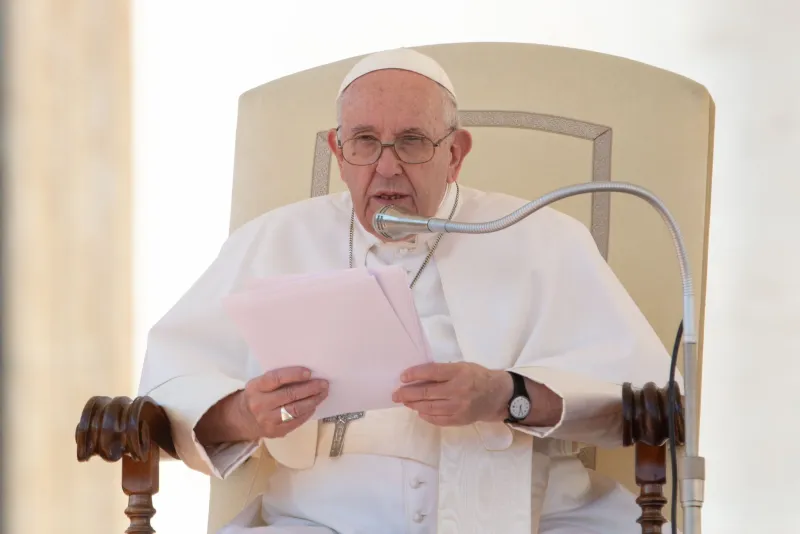
 Pope Francis speaks in St. Peter’s Square Oct. 15, 2022. / Daniel Ibanez/CNA
Rome Newsroom, Nov 22, 2022 / 12:30 pm (CNA).
Why did Pope Francis dismiss the entire leadership of the Church’s worldwide charity arm Tuesday?
What role will Pier Francesco Pinelli play as temporary administrator of Caritas Internationalis, appointed by papal decree on Nov. 22?
A key date to understanding the move and how it aligns with the pope’s broader reforms is Oct. 15, 2022.
On that day, Pope Francis received in audience at the Vatican Father Giacomo Canobbio and delegates of Bain Capital. The financial investment firm is where Pinelli previously worked. And Canobbio is the priest who, without announcement, was appointed by Pope Francis to the role of commissioner of the Pontifical Lateran University.
Both appointments are typical for the pontiff and his preferred modus operandi: Pope Francis sends an inspection or appoints a commissioner whenever he wants to reform something.
The papacy of commissioners
There were no apparent reasons for appointing a commissioner to Caritas Internationalis — just as there were no apparent reasons for appointing a commissioner at the Pontifical Lateran University.
However, Pope Francis has previously ordered a number of inspections.
Bishop Claudio Maniago was made the inspector of the Congregation for Divine Worship and the Discipline of the Sacraments, after which the pope appointed Archbishop Arthur Roche as prefect of the dicastery. Next, Bishop Egidio Miragoli inspected the Congregation of the Clergy, which was still in progress when the pope appointed the Korean bishop Lazzaro You Heung-sik — later created cardinal— as prefect of the dicastery.
At the beginning of his pontificate, Pope Francis appointed several commissions.
One such body was the commission of reference on the administrative-economic structures of the Holy See, known by its Italian acronym COSEA. Another was CRIOR, the commission for studying the Institute of Works of Religion reform, commonly known as the Vatican Bank.
Their work, once completed, resulted in the extensive overhaul of the Vatican’s financial departments and the new Institute of Works of Religion statutes, promulgated in 2019.
However, the appointment of a commissioner in Caritas Internationalis has another clear precedent: the inspection of the Dicastery for the Promotion of Integral Human Development.
The inspection took place in July 2021 and was led by Cardinal Blase Cupich, the archbishop of Chicago. The team also included Sister Helen Alford, vice-rector of the Pontifical Angelicum University, an ordinary member of the Pontifical Academy of Social Sciences; and Pinelli, the new administrator of Caritas Internationalis.
Pinelli’s profile
A trained engineer and experienced manager, Pinelli has worked with several institutions as well as a consultant for management and investment firms.
According to Vatican rumors not officially confirmed but provided to CNA from multiple sources, Pinelli was also involved in restructuring what is now the Dicastery for Integral Human Development.
A press release from the dicastery said Pinelli was an engineer “with a more humanist than technical way of proceeding” and that he was “formed in Ignatian spirituality,” a man who “from an early age was active as a volunteer working with recovering drugs addicts, in development cooperation, support for missionary works, and catechesis.” The statement also noted that he is married with three children and three grandchildren.
The release also emphasized that “in 33 years of work,” Pinelli had gained managerial experience in different sectors, including a large energy company.
Having worked both as a project manager for energy companies and as a management consultant for Bain, Pinelli also has experience working with religious and secular works and institutions, according to the release.
Obviously, his formation and positions in some Jesuit institutions may have played a role. It seems likely that Cardinal Michael Czerny, SJ, the current prefect of the dicastery, had a word in involving him and others.
However, it is still hard to assess which issues are at stake. It seems clear that the pope wants to reform Caritas Internationalis, including its statutes and bylaws.
Founded in 1951, the Catholic confederation is made up of 162 charitable organizations based in 200 countries around the world. Its headquarters are located on Vatican territory in Rome, and the Vatican oversees its activity.
According to Czerny’s dicastery, “no evidence emerged of financial mismanagement or sexual impropriety”; however, “deficiencies were noted in management and procedures, seriously prejudicing team spirit and staff morale.”
Pinelli’s task
The reform of the statutes will be the first task of the new commissioner.
Pinelli will be assisted by Maria Amparo Alonso Escobar, Caritas Internationalis’ head of advocacy, and by Jesuit Father Manuel Morujão, who will provide personal and spiritual accompaniment to Caritas employees, according to Pope Francis’ decree.
In May 2023, the next Caritas Internationalis general assembly is expected to be held in Rome, with the appointment of the new president, general secretary, and treasurer. By then, the reform process will likely be completed.
Caritas Internationalis will undergo a review “in order to improve its management norms and procedures — even while financial matters have been well-handled and fundraising goals regularly achieved — and so better to serve its member charitable organizations around the world.”
However, a reform of the statutes already took place in 2019 and was approved by the pope with a rescript of Jan. 13, 2020.
As for the change of the statutes of Caritas Internationalis, it was simply a matter of passing the competencies from the Pontifical Council Cor Unum, which no longer exists, to the Dicastery for the Promotion of Integral Human Development, which has absorbed its functions.
As for the rules of procedure, these changes were not communicated. But they generally accepted some of the requests approved by the Caritas General Assembly, which envisaged encouraging the presence of women within the highest representative bodies and including two young people in the same representative bodies.
In particular, there was talk of the Representative Council of the federation, abbreviated with the name RE.CO., the acronym for Representative Council. These indications have now been implemented and will become operational.
The structure of Caritas Internationalis was thus “adjusted” and adapted to the reform of the Curia.
However, the statutes of Caritas Internationalis remained confirmed in the structure as Pope Benedict XVI reformed them in 2012. Those statutes strengthened the collaboration between Caritas Internationalis and the Holy See and clearly outlined the competencies of the Vatican Secretariat of State.
Not only that: the new structure of Caritas Internationalis gave greater coordination to departments and bodies connected to the Holy See, which also concerned doctrinal aspects.
The rationale behind Benedict XVI’s reform
It is noteworthy that the 2012 reform was part of a more extensive project by Benedict XVI to accomplish Pastor Bonus’s provisions fully.
Pastor Bonus was the apostolic constitution that regulated the functions and tasks of the Curia offices, and Praedicate Evangelium now replaces that.
However, the reform came after a governance crisis. In 2011, the Secretariat of State did not approve the renomination of the former secretary general, Lesley-Anne Knight. (However, her work was praised by the president of Caritas Internationalis at the time, Cardinal Oscar Andrés Rodriguez Maradiaga.) As a result, she was replaced by Michel Roy, a Frenchman who worked with Secours Catholique — the Caritas in France.
Knight’s non-confirmation also stemmed from the new approach given with the subsequent reform of Caritas Internationalis.
It was an approach that derived from the formulation of Benedict XVI’s encyclical Caritas in Veritate. In the encyclical, Benedict XVI stressed that human development and foreign aid could not be separated from the demand for truth. The encyclical also pointed to the fact that many international organizations were promoting abortion, contraception, sterilization, and euthanasia.
This was an approach that Knight did not fully share, as she publicly explained to the media at the time.
While some approved of Knight’s departure, others were disappointed. Despite a robust generational change in Caritas Internationalis in recent years, these divisive feelings may have lingered in the background and fueled some complaints about “management and procedures.”
What will the new reform look like?
The tone of the dicastery’s press release suggests that the reform will be more managerial. But, above all, it is a substantial change in philosophy from the reform of Benedict XVI.
In short, it could be another paradigm shift by Pope Francis, comparable to some degree to his restrictions of the Traditional Latin Mass.
From this point of view, Pope Francis has identified several people to help complete his changes to the Church’s structure.
In carrying out the reform, the pope does not hesitate to demote someone like Cardinal Luis Antonio Tagle, current president of Caritas, who now finds himself mandated to “liaise” with Pinelli and his staff for the upcoming general assembly.
Tagle was rumored to be appointed the next prefect of the Dicastery of Bishops. Even if these rumors were to be confirmed, Tagle’s public image has now been compromised by the Caritas decision. This will also weigh in a future conclave.
Pope Francis, however, is completing his goals. As he said in one of his homilies in the days of the COVID-19 lockdown of 2020 — and also in a meeting with the Candia Foundation in April — he remains critical of humanitarian organizations that do good work but spend 60% of their budget on wages. The pope called on them to keep costs to a minimum, “so that most of the money goes to the people.”
[…]





Well, my goodness me! I think that I shall take up bank robbery for a living, and will go to Cardinal Marx to have my endeavors blessed before I head out for a heist. And while I’m at it, I’ll go out and commit perjury, but I’ll ask him for a blessing ceremony beforehand. And, y’know, there are some people who really annoy me, so I think I’ll poison or knife or shoot them – but I’ll be sure to get Cardinal Marx to “accompany me as an individual” as I do it.
It is a terrible thing to have evil on the loose in the Church, with corrupt leaders cooperating with it.
It must be exhausting to have to juggle so many “concrete situations” at once.
Perhaps I can hide some of those stabbed, poisoned, and shot annoyances in the concrete.
An internal contradiction of immense proportions. It is not possible to square this circle.
To be led away from Christ in the name of “mercy”.
Why doesn’t Cardinal Marx just convert to Anglicanism?
Dr Maike Hickson German born wife of Dr R Hickson and member of the John Paul II Academy for Human Life and the Family recently interviewed Dr Josef Seifert for 1Peter5 on his firing in Spain. Seifert cited Prof Gerhard Hover’s repudiation of intrinsic evil [Time is greater than space], the phi theological basis of Pope Francis’ New Paradigm, and basis for Cardinal Reinhard Marx’ position on homosexual union. From my Thomistic perspective “concrete circumstances” frequently cited by Pope Francis as moral determinants however mitigating or thought favorable cannot make an evil act good since the object of the act must be ordered to God. The moral law referencing human acts that are inherently evil reflect the divine law, and God who is neither subject to time or change. Evil is in the will of man, due to a willful privation of direction to a due end. If as Gerhard Hover argues time is reduced to the continuous motion of the Aristotelian tradition [form and absence of form which affects human acts] it must be taken as an excessive limitation [coarctata temporis acceptio]. Time Hover says is actually greater than the space by which it is measured. Human acts are of themselves transient in nature inclusive of their intrinsic moral nature. Time in this sense transcends the limitations of space and consequent restrictions like intrinsic evil. This theorem [Hover’s] effectively denies that evil is in contradiction to God. Evil must then exist as commensurate to the divine nature as good or evil, but dependent on human measurable time. Then nothing is intrinsically and forever evil to God. Since it is man that determines what is good or evil. That is apotheosis. Instead God unchanging undivided Pure Act and First Principle cannot be subject to moral divisibility that mirrors a Zoroastrian good and evil composite of justice, namely what is evil today is good tomorrow. In God there is no Darkness.
Hi ,
I’ve been a Catholic all my life, that’s almost 59 years.
This Cardinal Marx seems to have stopped being a Catholic AND DEFINATLY A CHRISTIAN, with his heinous attack on our Faith. How can you bless someone who quite clearly is facing an eternal punishment for their sin, and then inviting this perversion into any Christian church.
He should be guiding lost souls to the right path.
He is an insult to everything he is supposed to be, but more importantly what the Catholic faith is supposed to be.
I fear this could be a case of ” birds of a feather. He should get out of our Religion instead of soiling the already bad image Catholism already has with crimes against children.
This person or wanna be do gooder is a complete imbecile, if he finds his job too hard to do he should get out ,and stop damaging 2000 years of Christianity.
Hi Father Peter,
I find your comments very very deep and learned, complicated and difficult to understand.
But to simplify.
God does, many many times through the bible point out what is good and what is evil. This to me is where mankind finds the answers to life’s conundrums, so in ” the rule book” or bible every conceivable sin for mankind is addressed.
Now, if an individual commits certain sins throughout their lives and never seeks forgivenesses and most importantly, never ceases these sins – then their soul is lost for eternity. This may sound very harsh BUT this is Gods law and no matter how hurtful any individual may find this, this is the truth.
Now anyone who tries to alter the word and teachings of God is foolish because the Bible is foolproof, but NOT for the foolish.
To be truly fair to anyone who seeks advice and who genuinely does not know the answers it is best to make them fully aware of the dire eternal consequences of leading a sinful life.
God Bless
Brian.
I’m not sure about these German Marxes whether they be Reinhard or Karl. I’d rather take Groucho and Harpo.
Groucho Marx…. ” Love goes out the door and innuendo”.
Hi ,
I’ve been a Catholic all my life, that’s almost 59 years.
This Cardinal Marx seems to have stopped being a Catholic AND DEFINATLY A CHRISTIAN, with his heinous attack on our Faith. How can you bless someone who quite clearly is facing an eternal punishment for their sin, and then inviting this perversion into any Christian church.
He should be guiding lost souls to the right path.
He is an insult to everything he is supposed to be, but more importantly what the Catholic faith is supposed to be.
I fear this could be a case of ” birds of a feather. He should get out of our Religion instead of soiling the already bad image Catholism already has with crimes against children.
This person or wanna be do gooder is a complete imbecile, if he finds his job too hard to do he should get out ,and stop damaging 2000 years of Christianity.