
Vatican City, Sep 9, 2017 / 08:00 am (CNA/EWTN News).- The Holy See has release a new “motu proprio” from Pope Francis outlining a shift in the responsibility of local bishops and the Apostolic See for the revision and approval of liturgical texts.
Dated Sept. 3, the document is titled “Magnum Principium,” meaning “The great principle,” and deals explicitly with two specific changes to Canon 838 of the Code of Canon Law, which addresses the authority of the Apostolic See and national episcopal conferences in preparing liturgical texts in vernacular languages.
The document was published Sept. 9, in the middle of Pope Francis’ six-day trip to Colombia.
Specifically, changes were introduced were to paragraphs 2 and 3 of Canon 838.
Canon 838, 2 has until now stated that: “It is for the Apostolic See to order the sacred liturgy of the universal Church, publish liturgical books and review their translations in vernacular languages, and exercise vigilance that liturgical regulations are observed faithfully everywhere.”
However, with Francis’ motu proprio, the text has been changed to read: “It is for the Apostolic See to order the sacred liturgy of the universal Church, publish liturgical books, recognize adaptations approved by the Episcopal Conference according to the norm of law, and exercise vigilance that liturgical regulations are observed faithfully everywhere.”
Similarly, 838, 3 previously read: “It pertains to the conferences of bishops to prepare and publish, after the prior review of the Holy See, translations of liturgical books in vernacular languages, adapted appropriately within the limits defined in the liturgical books themselves.”
The text will now read: “It pertains to the episcopal conferences to faithfully prepare versions of the liturgical books in vernacular languages, suitably accommodated within defined limits, and to approve and publish the liturgical books for the regions for which they are responsible after the confirmation of the Apostolic See.”
The changes apportion a greater portion of responsibility for the preparation and approval of liturgical translations to episcopal conferences, rather than the Vatican’s Congregation for Divine Worship and the Sacraments.
Additionally, Pope Francis noted that after the Second Vatican Council, the Church was acutely aware of “the attendant sacrifice involved in the partial loss of liturgical Latin, which had been in use throughout the world over the course of centuries.”
However, “it willingly opened the door” so that vernacular liturgical translations, “as part of the rites themselves, might become the voice of the Church celebrating the divine mysteries along with the Latin language.”
In light of the various views expressed by Council Fathers at the time, the Church, he said, was also aware of the challenges the task would present.
“On the one hand it was necessary to unite the good of the faithful of a given time and culture and their right to a conscious and active participation in liturgical celebrations with the substantial unity of the Roman Rite,” he said.
Yet on the other hand, “the vernacular languages themselves, often only in a progressive manner, would be able to become liturgical languages, standing out in a not dissimilar way to liturgical Latin for their elegance of style and the profundity of their concepts with the aim of nourishing the faith.”
Pope Francis expressed that “general guidelines” regarding the use of the vernacular “must be followed by Liturgical Commissions as the most suitable instruments so that, across the great variety of languages, the liturgical community can arrive at an expressive style suitable and appropriate to the individual parts, maintaining integrity and accurate faithfulness especially in translating some texts of major importance in each liturgical book.”
The primary goal of translating liturgical texts and biblical texts for the liturgy, he said, is to “announce the word of salvation to the faithful in obedience to the faith and to express the prayer of the Church to the Lord.”
Because of this, “it is necessary to communicate to a given people using its own language all that the Church intended to communicate to other people through the Latin language.”
Francis stressed that while fidelity “cannot always be judged by individual words but must be sought in the context of the whole communicative act and according to its literary genre,” there are particular terms which “must also be considered in the context of the entire Catholic faith because each translation of texts must be congruent with sound doctrine.”
Given the weight of the task, the Pope said it’s no surprise that certain problems have arisen between episcopal conferences and the Apostolic See along the way.
In order for decisions about the use of the vernacular language to be of use and value in the future, then, “a vigilant and creative collaboration full of reciprocal trust” between the Apostolic See and bishops conferences is “absolutely necessary.”
Because of this, “in order that the renewal of the whole liturgical life might continue,” Francis said ‘it seemed opportune that some principles handed on since the time of the Council should be more clearly reaffirmed and put into practice.”
Apt attention ought to be paid to the “benefit and good of the faithful,” while at the same time ensuring that the “right and duty” of episcopal conferences is not forgotten, since it is their task to “ensure and establish that, while the character of each language is safeguarded, the sense of the original text is fully and faithfully rendered and that even after adaptations the translated liturgical books always illuminate the unity of the Roman Rite.”
In order to make collaboration between the Apostolic See and bishops conferences “easier and more fruitful,” and after having listened to advice from a commission of bishops and experts he established to study the issue, the Pope said he wished to make the “canonical discipline” already in force in canon 838 more clear.
Namely, Francis said he wanted the changes to be more directly in line with paragraphs 36, 40 and 63 of the Second Vatican Council Constitution on Sacred Liturgy “Sacrosanctum Concilium” and the provisions of point nine of Paul VI’s 1964 Motu Proprio “Sacram Liturgiam.” so that “the competency of the Apostolic See surrounding the translation of liturgical books and the more radical adaptations established and approved by Episcopal Conferences be made clearer, among which can also be numbered eventual new texts to be inserted into these books.”
All changes will go into effect on Oct. 1 of this year.
 […]
[…]


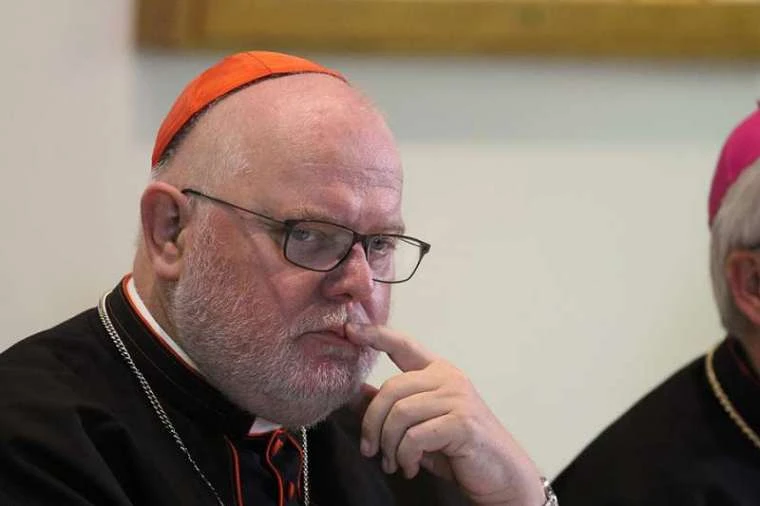

Well, my goodness me! I think that I shall take up bank robbery for a living, and will go to Cardinal Marx to have my endeavors blessed before I head out for a heist. And while I’m at it, I’ll go out and commit perjury, but I’ll ask him for a blessing ceremony beforehand. And, y’know, there are some people who really annoy me, so I think I’ll poison or knife or shoot them – but I’ll be sure to get Cardinal Marx to “accompany me as an individual” as I do it.
It is a terrible thing to have evil on the loose in the Church, with corrupt leaders cooperating with it.
It must be exhausting to have to juggle so many “concrete situations” at once.
Perhaps I can hide some of those stabbed, poisoned, and shot annoyances in the concrete.
An internal contradiction of immense proportions. It is not possible to square this circle.
To be led away from Christ in the name of “mercy”.
Why doesn’t Cardinal Marx just convert to Anglicanism?
Dr Maike Hickson German born wife of Dr R Hickson and member of the John Paul II Academy for Human Life and the Family recently interviewed Dr Josef Seifert for 1Peter5 on his firing in Spain. Seifert cited Prof Gerhard Hover’s repudiation of intrinsic evil [Time is greater than space], the phi theological basis of Pope Francis’ New Paradigm, and basis for Cardinal Reinhard Marx’ position on homosexual union. From my Thomistic perspective “concrete circumstances” frequently cited by Pope Francis as moral determinants however mitigating or thought favorable cannot make an evil act good since the object of the act must be ordered to God. The moral law referencing human acts that are inherently evil reflect the divine law, and God who is neither subject to time or change. Evil is in the will of man, due to a willful privation of direction to a due end. If as Gerhard Hover argues time is reduced to the continuous motion of the Aristotelian tradition [form and absence of form which affects human acts] it must be taken as an excessive limitation [coarctata temporis acceptio]. Time Hover says is actually greater than the space by which it is measured. Human acts are of themselves transient in nature inclusive of their intrinsic moral nature. Time in this sense transcends the limitations of space and consequent restrictions like intrinsic evil. This theorem [Hover’s] effectively denies that evil is in contradiction to God. Evil must then exist as commensurate to the divine nature as good or evil, but dependent on human measurable time. Then nothing is intrinsically and forever evil to God. Since it is man that determines what is good or evil. That is apotheosis. Instead God unchanging undivided Pure Act and First Principle cannot be subject to moral divisibility that mirrors a Zoroastrian good and evil composite of justice, namely what is evil today is good tomorrow. In God there is no Darkness.
Hi ,
I’ve been a Catholic all my life, that’s almost 59 years.
This Cardinal Marx seems to have stopped being a Catholic AND DEFINATLY A CHRISTIAN, with his heinous attack on our Faith. How can you bless someone who quite clearly is facing an eternal punishment for their sin, and then inviting this perversion into any Christian church.
He should be guiding lost souls to the right path.
He is an insult to everything he is supposed to be, but more importantly what the Catholic faith is supposed to be.
I fear this could be a case of ” birds of a feather. He should get out of our Religion instead of soiling the already bad image Catholism already has with crimes against children.
This person or wanna be do gooder is a complete imbecile, if he finds his job too hard to do he should get out ,and stop damaging 2000 years of Christianity.
Hi Father Peter,
I find your comments very very deep and learned, complicated and difficult to understand.
But to simplify.
God does, many many times through the bible point out what is good and what is evil. This to me is where mankind finds the answers to life’s conundrums, so in ” the rule book” or bible every conceivable sin for mankind is addressed.
Now, if an individual commits certain sins throughout their lives and never seeks forgivenesses and most importantly, never ceases these sins – then their soul is lost for eternity. This may sound very harsh BUT this is Gods law and no matter how hurtful any individual may find this, this is the truth.
Now anyone who tries to alter the word and teachings of God is foolish because the Bible is foolproof, but NOT for the foolish.
To be truly fair to anyone who seeks advice and who genuinely does not know the answers it is best to make them fully aware of the dire eternal consequences of leading a sinful life.
God Bless
Brian.
I’m not sure about these German Marxes whether they be Reinhard or Karl. I’d rather take Groucho and Harpo.
Groucho Marx…. ” Love goes out the door and innuendo”.
Hi ,
I’ve been a Catholic all my life, that’s almost 59 years.
This Cardinal Marx seems to have stopped being a Catholic AND DEFINATLY A CHRISTIAN, with his heinous attack on our Faith. How can you bless someone who quite clearly is facing an eternal punishment for their sin, and then inviting this perversion into any Christian church.
He should be guiding lost souls to the right path.
He is an insult to everything he is supposed to be, but more importantly what the Catholic faith is supposed to be.
I fear this could be a case of ” birds of a feather. He should get out of our Religion instead of soiling the already bad image Catholism already has with crimes against children.
This person or wanna be do gooder is a complete imbecile, if he finds his job too hard to do he should get out ,and stop damaging 2000 years of Christianity.