

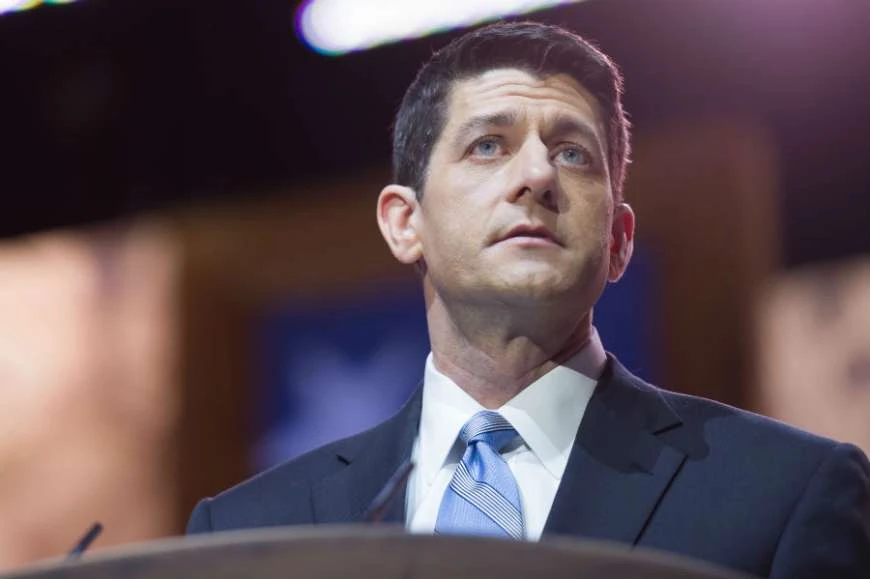
Washington D.C., Jan 10, 2018 / 12:52 pm (CNA/EWTN News).- Speaker of the House Paul Ryan (R-Wisc.) will address the upcoming March for Life, organizers announced on Wednesday. This is the first time Ryan has spoken at the March for Life in person since he was elected speaker in 2015.
The 45th annual March for Life will take place on January 19th in Washington, D.C., and is the country’s largest pro-life protest. The event is held each year near the anniversary of the Roe v. Wade Supreme Court decision that legalized abortion in the United States.
Last year, Ryan appeared at the march via a video message, encouraging marchers and thanking them for their passion and courage in fighting for the unborn.
On Twitter, Ryan said that he looked forward to attending the March for Life, and said that he will “march to defend the rights of those who cannot defend themselves.”
We march to defend the rights of those who cannot defend themselves. I look forward to attending the 45th annual #MarchForLife next week. https://t.co/GVz2oVRtsQ
— Paul Ryan (@SpeakerRyan) January 10, 2018
March for Life President Jeanne Mancini said in a press release that she was honored that Ryan would be speaking at the March for Life. Ryan, said Mancini, is an “unwavering champion” for the cause.
“It is an honor to have Speaker of the House Paul Ryan address the 45th annual March for Life. Speaker Ryan has been an unwavering champion for the pro-life cause since taking office, and continues to utilize his post to promote the inherent dignity of the human person at all stages of life,” she said.
Ryan will be joined at the March for Life by his congressional colleagues Reps. Dan Lipinski (D-Ill.) and Chris Smith (R-New Jersey), along with Tim Tebow’s mother, Pam Tebow, and Sister Bethany Madonna of the Sisters of Life. More speakers will be announced in the future.
The theme of this year’s march is “Love Saves Lives.” Over 100,000 people are expected to attend.
If you value the news and views Catholic World Report provides, please consider donating to support our efforts. Your contribution will help us continue to make CWR available to all readers worldwide for free, without a subscription. Thank you for your generosity!
Click here for more information on donating to CWR. Click here to sign up for our newsletter.

How DARE Paul Ryan call himself a Catholic. This is the Catholic Church that I remember.
I remember my outrage when the Catholic Church transferred Cardinal Bernard Laws to the Vatican after he was exposed for transferring pedophile priests in his diocese. I was even more infuriated when the Cardinal could participate in Pope John Paul’s funeral. For the first time in fifty years I questioned my devotion to the Church.
AND THEN I REMEMBERED:
A young black child attending and receiving communion without any fear or hesitation in all-white Catholic Churches in North Carolina and Virginia in the 40’s and 50’s.
Four Catholic nuns who traveled ten miles every Sunday on dirt roads to transport three young black children to Mass who had no other way to get to church.
I remember an elderly Catholic priest who brought communion EVERY Sunday for ten years to my disabled paternal grandmother even though she had nothing to contribute to the Church as she lived on $85.00 a month after my grandfather died.
I remember a big Irish Catholic priest who chose to work with the African-American community in the south in the 1950’s and organized a youth group among a handful of young black Catholics. That priest led this group of “rag tag” students down the main streets of a small southern city to protest segregation. One of those students, Joseph McNeil, went on to A&T State University where he organized and began the sit-down demonstrations at lunch counters in the Woolworth Stores. His actions initiated the integration of public facilities in this country. That lunch counter is enshrined in a museum in Greensboro, North Carolina.
I remember that same priest procured full scholarships for several young African-American women to attend the prestigious St. Mary College in South Bend, Indiana in 1959.
I remember requesting from the Josephites (priest’s community) a photo of Father Richard Swift to include in a book that I am writing and being astounded at a short bio included with the photo that chronicled his remarkable life of service.
I remember a wonderful Catholic priest who counseled and consoled me during my years of life with an alcoholic husband and severely asthmatic son.
I remember a jovial, happy priest who provided a full scholarship for my son to attend the local Catholic school when I couldn’t afford the tuition
I remember contacting a quiet Catholic priest, whom I had never met, and asking him to visit my son away in college in the hospital with a broken jaw that he sustained playing college football. Father Thomas Hadden went to visit my son without any hesitation and reported back to me. We became lifelong friends.
I remember a kind and gentle priest who helped me get the diocese to accept my divorces from two unhealthy marriages without any criticism or judgment.
During my second marriage, I had a daughter and I remember a very elderly Monsignor who held my hand, prayed with me, and counseled me when my husband walked out and left me with an eighteen-month-old daughter.
I remember two priests and two nuns who traveled with me to Wake Forest University to see that young lady graduate from college.
I remember a kindly Catholic priest, the son of a Methodist minister, who encouraged and supported a community clinic, food bank, dental clinic, and an unbelievable social outreach that turned no one away: all run by the Sisters of St Ursula and volunteers.
I remember all the Catholic clinics, food banks, and outreach programs sponsored by the Catholic Church throughout this country and the world that are supported by local priests and staffed by dedicated Catholic nuns and lay people.
I remember my years of involvement in all Catholic ministries, from training and assigning lectors to starting the first ever youth program at the St. Mary Cathedral in Wilmington, NC.
I remember a jolly, happy-go-lucky Irish priest obsessed with Notre Dame Football and a quiet, stern, holy priest with a wicked sense of humor; they changed my life forever. Their presence makes heaven a better place!
Pedophile priests should be excommunicated and so should those who continue to protect them. The behavior is unconscionable as young lives are destroyed. I weep when I learn of priests who continue to commit these horrendous acts and, I again, ask myself if I can continue to support the Roman Catholic Church ? THEN I REMEMBER:
“How DARE Paul Ryan call himself a Catholic.”
Huh. Is Paul Ryan a pedophile or a disgraced prelate? Did I miss something? Good grief.