No Picture
News Briefs

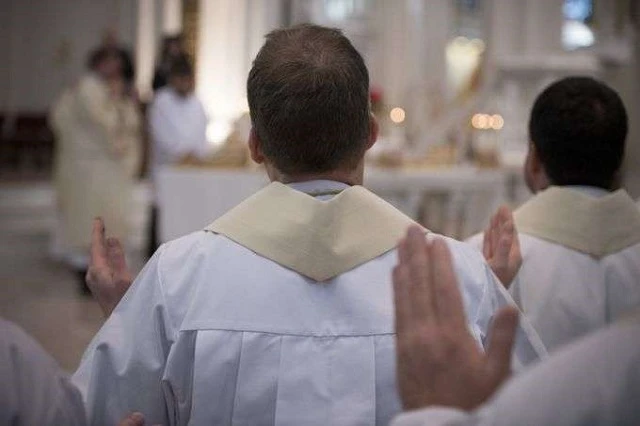
Pope appoints new under-secretaries to CDF and Congregation for Clergy

September 14, 2017 CNA Daily News 0

Vatican City, Sep 14, 2017 / 09:00 am (CNA/EWTN News).- Thursday the Vatican announced Pope Francis’ appointment of Fr. Matteo Visioli as the new under-secretary of the Congregation for the Doctrine of the Faith, following the appointment on Tuesday of Fr. Andrea Ripa as under-secretary of the Congregation for Clergy.

Fr. Visioli, 51, replaces Fr. Giacomo Morandi, who had been under-secretary of the Congregation for the Doctrine of the Faith since 2015 and was promoted to secretary of the dicastery on July 18. Fr. Ripa, 45, was appointed Sept. 12 and replaces Mons. Antonio Neri, who died on June 5.

Both canonists, Fr. Visioli is the author of more than 30 articles and books in the area of church law, including the topics of ecumenical dialogue, the mystery of communion, and the right to receive the sacraments.

He also has several forthcoming publications, including one on confessionalism and the doctrinal principles of the Second Vatican Council, which will be published in the Journal of Law and Religion from Cambridge University Press.

Fr. Visioli was born in Parma, Italy on July 20, 1966, and ordained a priest in May 1992.

He studied at the Pontifical Gregorian University, receiving licenses in theology in 1994 and canon law in 1996. The following year he received a specialization in jurisprudence. He received a doctorate in canon law in 1999.

Fr. Visioli held the position of Episcopal Vicar of the Church-World sector from 1999-2008 and was a member of the Committee for the Entities and the Ecclesiastical Property of the Italian Bishops’ Conference from 2001-2008.

He also ministered to parishes in the province of Parma and since 1999 has been head of the Legal Office for the Diocese of Parma.

He is presently the President of Caritas Children Onlus and Episcopal Vicar for Pastoral Care for the diocese.

He is the director and professor of the Inter-diocesan Institute of Religious Sciences, “S. ‘Ilario di Poitiers,” as well as a professor of canon law at the Pontifical Gregorian University and the Studium Generale Marcianum of Venice.

Fr. Ripa was born in Rimini, Italy on January 5, 1972 and ordained a priest for the Diocese of Rimini in 2004. He received his license in canon law from the Pontifical Lateran University in 2006 and his doctorate in canon law in 2010.

His doctoral thesis was titled, “The missed innovation: the probative value of the parties’ declarations from the 1983 Code to Dignitatis Connubii, the contribution of case law of the Sacred Roman Rota.”

He received a diploma of a Roman Rota lawyer in 2013 and has published multiple scientific articles.

Fr. Ripa was a professor of matrimonial and canon law for the Higher Institute of Religious Sciences in Rimini and of the “General Norms” at the Lugano Faculty of Theology and the Pontifical Lateran University.

He was also a judge and vicar of the Ecclesiastical Tribunal of Flaminio in Bologna.

He has been a part of the Congregation for Clergy since 2013 and in addition to Italian, knows English, French, Spanish and Latin.

[…]

No Picture
News Briefs

We need more politicians who are brave, Catholics in UK say

September 13, 2017 CNA Daily News 4

London, England, Sep 14, 2017 / 12:01 am (CNA/EWTN News).- It’s a tough time for Catholics in public life, and not just in the United States.

Last week, Sen. Dianne Feinstein (D-Calif.) grilled Catholic lawyer Amy Coney Barrett on her religious views during a hearing for her nomination as a federal circuit court judge, in a line of questioning that “smacks of the worst sort of anti-Catholic bigotry,” theologian Dr. Chad Pecknold told CNA Sept. 6.

Across the pond, a Catholic member of Parliament in the U.K. faced his own round of hostile questions, during an interview on the morning show Good Morning Britain.

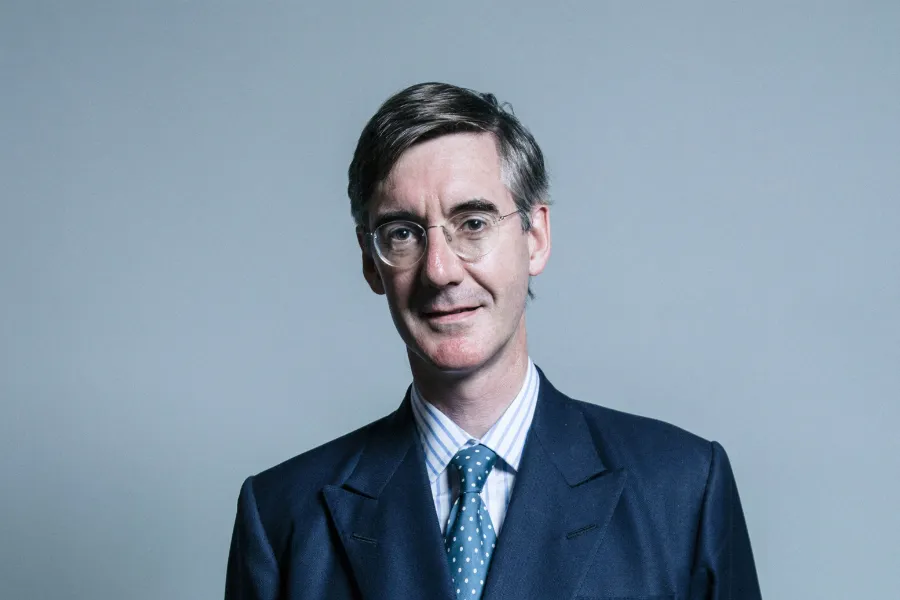
After a brief question about immigration and Brexit, hosts Piers Morgan and Susanna Reid vigorously interrogated Conservative MP Jacob Rees-Mogg on his views on same-sex marriage and abortion, both of which are legal in the U.K. The MP is seen by some as a potential Conservative Party leader and even a possible future prime minister.

When repeatedly asked about his views on same-sex marriage, Rees-Mogg responded that he supports the teaching of the Catholic Church, and that the teaching is “completely clear.”

Continually grilled about both this issue and then about abortion, Rees-Mogg noted that while he opposes same-sex marriage and abortion on moral grounds, he equally follows the teaching of the Church not to judge others. He also noted that the laws of the land will not change due to his religious beliefs, because liberal Democrats comprise Parliament’s majority.

“None of these issues are party-political, they are issues that are decided by Parliament on free votes,” Rees-Mogg said. “They are not determined by the Prime Minister, there’s no question of these laws being changed. There would not be a majority in the House of Commons for that.”

Morgan then asks Rees-Mogg if the people could accept a leader with Catholic religious views.

“I think the Conservatives are much more tolerant of religious faith, and so they should be,” Rees-Mogg said.

“It’s all very well to say we live in a multicultural country, until you’re a Christian, until you hold the traditional views of the Catholic Church,” he added. “And that seems to be fundamentally wrong. People are entitled to hold these views, but also the Democratic majority is entitled to have the laws of the land as they are, which do not go with the teaching of the Catholic Church and will not go with the teaching of the Catholic Church.”

Numerous Catholic leaders applauded the British MP’s public witness to his faith.

“Well done Jacob Rees-Mogg! Thank you so much for standing up for Catholics and clearly yet gently proclaiming the teaching of Christ,” tweeted Bishop Philip Egan of Portsmouth.

Luke Coppen, editor of the Catholic Herald, told CNA in e-mail comments that this is not the first time Catholic politicians in the UK have experience such antagonism.

“Hostility towards Catholicism is nothing new in Britain. Indeed, it is nothing now compared to what it was in the Elizabethan era,” during which it was illegal – and often fatal – to be Catholic, Coppen noted.

Rather than being frightened by the friction that faith and politics sometimes bring, faithful Catholics should continue to serve in the public sphere, Coppen said.

“They are an example to us: we should always seek to serve the wider society because our faith obliges us to,” he said.

Some have even compared Rees-Mogg’s witness to that of St. Thomas More, who opposed King Henry VIII’s remarriage after failing to secure a decree of nullity, and his ploy to break from Rome and become the leader of the Church of England. His faithfulness to the Church cost him his life, and St. Thomas More is often invoked as a patron saint of religious freedom.

“In this week’s magazine we have a headline describing Rees-Mogg as ‘the Thomas More of breakfast television,’” Coppen said.

“That’s tongue in cheek, of course, because he was very brave. But he’s unlikely to be executed,” he noted, though Catholics in public life “may no longer receive invitations to certain dinner parties.”

Bishop Mark Davies of Shrewsbury also praised Rees-Mogg’s remarks, and also encouraged Catholics to continue to be active, faithful participants in the public sphere.

“…beyond the immediate furore I am sure public figures like Jacob Rees-Mogg will ultimately be respected for their courage and integrity,” he told CNA.

“I am sure we need to see greater Christian witness in political life rather than a withdrawal of faithful Catholics from the public square and from the public debates of our time. The challenge faced by Christians today allows us to see more clearly why Saint Thomas More was made a patron saint for statesmen.”

[…]

No Picture
News Briefs

What the bishops say about politics matters – and here’s why

September 13, 2017 CNA Daily News 6

Washington D.C., Sep 13, 2017 / 03:14 pm (CNA).- Catholic moral theologians have responded to Steve Bannon’s accusation that the U.S. bishops are economically motivated in their stance on immigration, calling the former White House chief strategist “rash” in his take on the issue.

But what’s more, they say Catholics should not treat the guidance of the bishops as just another “guy with an opinion,” as Bannon said – even when dealing with situations that are applications of the Church’s doctrinal teaching.

“I absolutely reject Bannon’s way of formulating it in general,” Dr. Kevin Miller, a professor of theology at the Franciscan University of Steubenville, told CNA.

“In teaching about matters dealing with faith and morals: even when the bishops are speaking in a prudential way, in a non-magisterial way, they’re not just some other guy in the conversation,” he said. “There’s a certain kind of appropriate deference that is due there, even if one is to end up disagreeing with what they say or do there.”

“But I also disagree with Bannon because I think he’s making an artificial distinction between, on the one hand, the realm of faith and morals, and on the other hand, the realm of politics,” Miller added.

“Politics has to be engaged in morally and the Church has something to say – and has said a great deal over the centuries – over what that means.”

Miller’s comments came in response to remarks by former White House chief strategist Steve Bannon, during an interview with CBS News’ “60 Minutes” host Charlie Rose, posted online Sept. 7. The full interview aired September 10. In the clip, Bannon criticized the U.S. Bishops’ immigration policy stances and said that the bishops support undocumented immigration because of a cynical “economic interest.”

Rose asked Bannon about the Trump administration’s recent announcement to phase out the Deferred Action for Childhood Arrivals Program (DACA). After Bannon defended the decision, Rose pressed further, noting that Bannon is a Catholic and that New York Archbishop Cardinal Timothy Dolan – along with other leaders – have opposed the move.

DACA was established in 2012 by former President Barrack Obama to create a pathway to legal residency for undocumented immigrants who came to the United States as children so that qualifying individuals can work or continue their education. After challenges on the executive order’s constitutionality – which was partially upheld– the Trump administration responded to pressures from numerous state attorney generals to repeal the program. Currently, around 800,000 persons are part of the DACA program.

“The bishops have been terrible on this,” Bannon responded.

“By the way, you know why? Because [they have been] unable to really, to come to grips with the problems in the church, they need illegal aliens,” Bannon said. “They need illegal aliens to fill the churches. It’s obvious on the face of it.”

He continued, saying that while he respected the bishops on elements of doctrine, “this is not about doctrine. This is about the sovereignty of a nation.”

“And in that regard,” Bannon said, “they’re just another guy with an opinion.”

In response, the U.S. Conference of Catholic Bishops issued a statement saying that the bishops’ stance on issues including life, healthcare and immigration reform “is rooted in the Gospel of Jesus Christ rather than the convenient political trends of the day.”

“It is both possible and morally necessary to secure the border in a manner which provides security and a humane immigration policy,” the statement said. “For anyone to suggest that it is out of sordid motives of statistics or financial gain is outrageous and insulting.”

Cardinal Dolan also responded to the interview, calling Bannon’s insinuation that the bishops’ teaching is based on an economic incentive “preposterous.”

“That’s insulting and that’s just so ridiculous that it doesn’t merit a comment,” the cardinal said. Both Dolan’s comment and the statement from the bishops’ conference referenced long-standing Church teachings highlighting the Christian duty to care for one’s neighbors, as well as to protect the vulnerable within a society.

Miller explained that while there is an element of truth in Bannon’s statement, in that the statements of bishops’ conferences “don’t share in the magisterium,” or the official authoritative teaching of the Church, that does not mean the bishops’ statements or positions on policy should be disregarded. The lack of official magisterial weight of a statement like the bishops’ Sept. 5 comments in defense of DACA “doesn’t mean it doesn’t require significant, significant deference.”

Miller said it would be “rash” to disregard the guidance of the bishops, and that often, when a bishop comments or signs a statement, it’s generally “a fairly clear application” of teachings the Church does hold.

The professor also discussed the issue of prudential judgement, and that Catholics are able to disagree on matters of prudence in how a situation is handled or implemented. Dr. Miller acknowledged that in situations like immigration, there is a prudential component in determining how best the Church’s teachings should be applied. Yet, he continued, the bishops’ statements and judgement still require deference. The prudential character of subjects the bishops might talk about, Miller stressed, “doesn’t mean that you can feel free to ignore them and they’re like some guy next door.”

Miller also pushed back against the distinction Bannon made between matters of prudence and matters of “dogma.” He said that while Catholics can, in good faith, disagree on matters of practicality and approach, the bishops’ moral voice still has relevance to politics.

“Although there’s this difference between basic moral principle and prudential judgement about how to apply it in sometimes complex cases, I don’t think that that distinction is as neat as people sometimes think it is in at least some cases.” Miller explained that the Church has long spoken on the moral duties of nations, and their obligation to serve the common good. While states can do some things in the name of “sovereignty,” he continued, they must act in the interest of the common good – particularly with an eye towards the most vulnerable.

Joseph Capizzi, professor of theology at the Catholic University of America and executive director of the school’s Institute for Human Ecology, told CNA that while there may not be a definitive, set doctrine on immigration itself, there is aconsistent teaching within the Church “on principles that pertain to immigration.” He pointed to scriptures and to traditions reaching back to the earliest centuries of the Church that highlight the Church’s concern for “the poor, the outcast, refugees, orphans – the physically vulnerable.”

“Those are the first people who get our attention. We’re supposed to care for them.” Capizzi also pointed to the Church’s tradition of care for one’s neighbor and those within one’s community. The care for individuals of that community must be promoted in concert with the common good of the community and its people, he explained.    

The issue of immigration is not one that is new for the Church in the United States, Capizzi said. “When many of our parents and grandparents came into this country, they faced very similar antagonisms,” and many of the same arguments used against immigration today were used in previous decades and centuries, he noted.

“The Catholic bishops are only articulating the same defense of good Catholic people that was articulated on behalf of their parents and their grandparents, and in some cases, themselves, over the course of the history of this country.”

The positive contribution of Catholic immigrants and immigrants in general to the Church and to the United States should outweigh the concerns raised by Bannon’s “crass” and “unprovable” statements, as well as those of a decline of Christianity in the United States and the West.

“There’s no question the Catholic Church benefits from the presence of hard-working, faithful young Catholic men and women who are coming into this country seeking better lives for themselves and their children,” Capizzi said.


[…]

No Picture
News Briefs

Count on it: Mother Angelica will always be with EWTN, says CEO

September 13, 2017 CNA Daily News 2

Worcester, Mass., Sep 13, 2017 / 12:19 pm (CNA/EWTN News).- Fans of Mother Angelica should know that her influence will not wane at EWTN, where she will always have a place, said the network’s CEO during the Family Talk at the 2017 EWTN Family Celebration in Worcester, Mass, Sept. 9-10.

“Her message really resonates with everyone universally… that’s an incredible, incredible thing,” said Michael P. Warsaw, Chairman of the Board and Chief Executive Officer at EWTN Global Catholic Network.

“One of the remarkable things we’ve commented about this: how fresh and how evergreen Mother Angelica’s shows are,” he said. “Many of these shows are 30 years old, and yet they seem as if they were just recorded today. Her message is really timeless in that respect.”

Mother Mary Angelica of the Annunciation, a Poor Clare nun, founded EWTN in 1981. She passed away on Easter Sunday 2016, after a long period out of the public eye following a severe stroke in 2001. In addition to running a network that became the largest religious media network in the world, she hosted a popular call-in show, “Mother Angelica Live,” in which she catechized, conducted interviews, and answered viewer questions.

Warsaw said that these shows still have global influence.

“One of the things that has really impacted me as I have traveled and we have expanded internationally is that Mother Angelica really does translate across any language group,” Warsaw said Sept. 9 at the EWTN Family Celebration in Worcester, Mass.

Warsaw, together with several other EWTN leaders, spoke to a crowd of hundreds at Worcester’s DCU Center on Saturday afternoon in a Family Talk. The talk is a way for EWTN viewers to engage with the network, asking questions and making suggestions.

One viewer, Maria from Somerset, Mass., wanted to be certain that EWTN would continue to broadcast Mother Angelica’s shows.

“I think you can count on the fact that Mother Angelica will always be a part of the on-air programming,” Warsaw replied.

Among stories recounted at the Family Talk was an Australian archbishop’s encounter with a woman who was in a rehabilitation center.

“He walked in and said ‘Hi, I’m the archbishop, I’m here to see you’,” Warsaw said.

“And she said: ‘Shh! I’m praying the rosary with EWTN. You should sit down and wait’.”

“And so, he dutifully pulled his rosary out of his pocket and prayed his rosary along with her, and made his visit afterward,” Warsaw said.

A recurring concern among attendees was the situation of family members and friends who were no longer practicing Catholics.

Zachary, a 14-year-old high school freshman, mentioned a friend who had drifted away from the faith and asked how to help her return to the practice of the faith.

Father Mark Mary Cristina, MFVA, responded: “Certainly encourage her to pray. If she’s not going to Mass, invite her to go to Mass with you.”

“Sometimes I think when we are in grief or struggling, practicing our faith can help increase our faith,” the priest said. “Certainly be a good listener, pray for her, try to encourage her to pray.”

“And we’ll pray for you,” Warsaw added.

Father Joseph Mary Wolfe, MFVA, chaplain for EWTN, reflected on the network’s coverage of pro-life issues.

“I believe that there are people walking this earth that are alive today because of EWTN’s pro-life programming,” he said.

For his part, Warsaw cited letters from women who had considered abortions at one point in their lives. Some had written in saying: “My baby was born because at that moment when I needed EWTN, you were there.”

He cited the launch of the news show EWTN Pro-Life Weekly and its focus on key issues in the pro-life cause at all stages of life.

“We’re really trying to motivate people to get involved in the pro-life movement, whatever state they are in,” said Warsaw. “There’s really no other outlet that has done as much in terms of the pro-life message, the pro-life cause, as the network has done over these years.”

“I think it comes back to the importance of prayer. The centrality of that is certainly Mother Angelica’s mission,” he said.

EWTN Global Catholic Network, in its 37th year, is the largest religious media network in the world. EWTN’s 11 TV channels are broadcast in multiple languages 24 hours a day, seven days a week to over 268 million television households in more than 145 countries and territories. EWTN services also include radio channels transmitted through SIRIUS/XM, iHeart Radio, and over 500 domestic and international AM & FM radio affiliates; a worldwide shortwave radio service; the largest Catholic website in the U.S.; electronic and print news services, including “The National Catholic Register” newspaper, and several global wire services; as well as a publishing arm. CNA is part of the EWTN family.


[…]