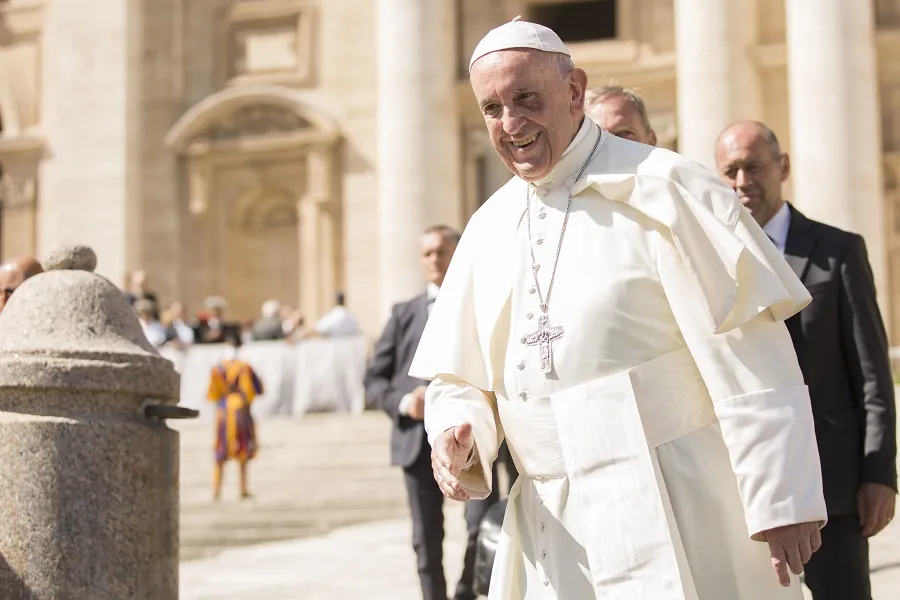
Vatican City, Sep 25, 2017 / 09:12 am (CNA/EWTN News).- Monday Pope Francis spoke to benefactors of the Vatican Swiss Guard about love of neighbor, which he said must first be steeped in love of Christ and drawn from prayer and frequent reception of the sacraments.
“Love to one’s neighbor corresponds to the mandate and the example of Christ if it is based on a true love of God. It is thus possible for the Christian, through his dedication, to make others feel the tenderness of the heavenly Father,” the Pope said Sept. 25.
“To give love to brothers, it is necessary to draw it from the furnace of divine charity, through prayer, listening to the Word of God, and nurturing the Holy Eucharist. With these spiritual references, it is possible to operate in the logic of gratuity and service.”
Pope Francis met Monday morning with 50 members of the Foundation of the Pontifical Swiss Guard, an organization which offers financial, material and technical support to the Vatican’s small military force.
He thanked them for their work in support of the young Swiss men who devote some years of their lives to “serving the Church and the Holy See.”
“This is an opportune occasion for me to reiterate that their discreet, professional and generous presence is so appreciated and useful for the good performance of Vatican activities.”
The business of the foundation expresses community spirit and solidarity, the Pope said, a typical feature of the Catholic presence in society and an attitude which is rooted in the appeal of the Gospel to love one’s neighbor.
“Therefore, through your work, you are concrete witnesses of evangelical ideals and, in the Swiss social fabric, you are an example of fraternity and sharing,” he said.
Concluding, Francis wished them joy as they continue their “fruitful commitment,” and bestowed the apostolic blessing.
He also prayed for protection for them and their families through the intercession of the Blessed Virgin Mary and St. Nicholas of Flüe, the patron of Switzerland, whose feast the Swiss celebrate on Sept. 25.
St. Nicholas of Flüe was born in 1417 near the Lake of Lucerne in Switzerland. He married at the age of 30 and had 10 children. In addition to his duties as a husband and a father, Nicholas donated his talents and time selflessly to the community and always strove to give an excellent moral example to all.
The saint was also able to devote much of his private life to developing a strong relationship with the Lord. He had a strict regime of fasting and he spent a great deal of time in contemplative prayer.
Around the year 1467, when he was 50 years old, Nicholas felt called to retire from the world and become a hermit. His wife and children gave their approval, and he left home to live in a hermitage a few miles away.
While living as a hermit, Nicholas quickly gained a wide reputation for his personal sanctity, and many people sought him out to request his prayers and spiritual advice.
Nicholas lived the quiet life of a hermit for 13 years. However in 1481, a dispute arose between the delegates of the Swiss confederates at Stans and a civil war seemed imminent. The people called on Nicholas to settle the dispute, so he drafted several proposals which everyone eventually agreed upon.
Nicholas’ work prevented civil war and solidified the country of Switzerland. But, as a true hermit, he then returned to his hermitage after settling the dispute.
He died six years later on March 21, 1487 surrounded by his wife and children. The Church celebrates his feast day on March 21, though in Switzerland and Germany it is celebrated on Sept. 25.
If you value the news and views Catholic World Report provides, please consider donating to support our efforts. Your contribution will help us continue to make CWR available to all readers worldwide for free, without a subscription. Thank you for your generosity!
Click here for more information on donating to CWR. Click here to sign up for our newsletter.
Pope Francis announced in March that the next Synod of Bishops, to be held in October of 2022, will discuss the topic of “synodality” – that is, the Synod will be talking about synods, synods, […]
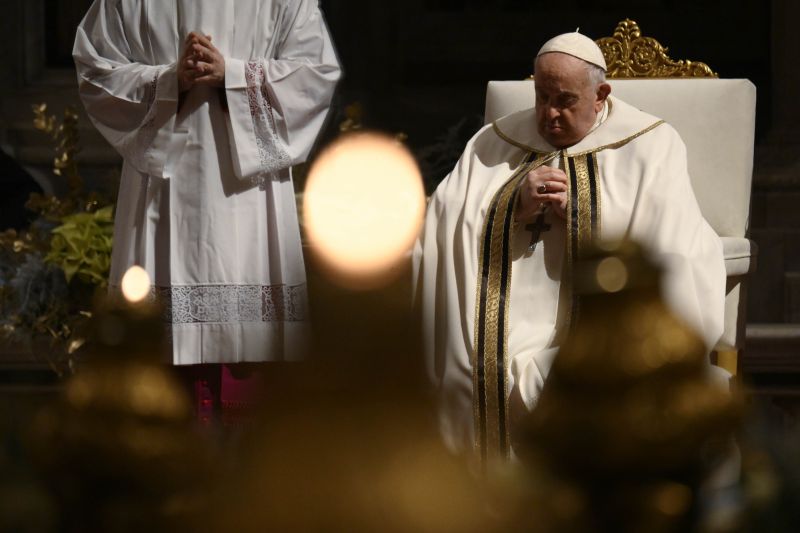
Pope Francis prays during Christmas Mass in St. Peter’s Basilica on Dec. 24, 2023. / Vatican Media
Vatican City, Dec 24, 2023 / 18:00 pm (CNA).
Below is the full text of Pope Francis’ homily for the Solemnity of the Nativity of the Lord, delivered on Dec. 24, 2023, in St. Peter’s Basilica.
“A census of the whole earth” (cf. Lk 2:1). This was the context in which Jesus was born, and the Gospel makes a point of it. The census might have been mentioned in passing, but instead is carefully noted. And in this way, a great contrast emerges. While the emperor numbers the world’s inhabitants, God enters it almost surreptitiously. While those who exercise power seek to take their place with the great ones of history, the King of history chooses the way of littleness. None of the powerful take notice of him: only a few shepherds, relegated to the margins of social life.
The census speaks of something else. In the Scriptures, the taking of a census has negative associations. King David, tempted by large numbers and an unhealthy sense of self-sufficiency, sinned gravely by ordering a census of the people. He wanted to know how powerful he was. After some nine months, he knew how many men could wield a sword (cf. 2 Sam 24:1-9). The Lord was angered and the people suffered. On this night, however, Jesus, the “Son of David”, after nine months in Mary’s womb, is born in Bethlehem, the city of David. He does not impose punishment for the census, but humbly allows himself to be registered as one among many. Here we see, not a god of wrath and chastisement, but the God of mercy, who takes flesh and enters the world in weakness, heralded by the announcement: “on earth peace among those whom he favors” (Lk 2:14). Tonight, our hearts are in Bethlehem, where the Prince of Peace is once more rejected by the futile logic of war, by the clash of arms that even today prevents him from finding room in the world (cf. Lk 2:7).
The census of the whole earth, in a word, manifests the all-too-human thread that runs through history: the quest for worldly power and might, fame and glory, which measures everything in terms of success, results, numbers and figures, a world obsessed with achievement. Yet the census also manifests the way of Jesus, who comes to seek us through enfleshment. He is not the god of accomplishment, but the God of Incarnation. He does not eliminate injustice from above by a show of power, but from below, by a show of love. He does not burst on the scene with limitless power, but descends to the narrow confines of our lives. He does not shun our frailties, but makes them his own.
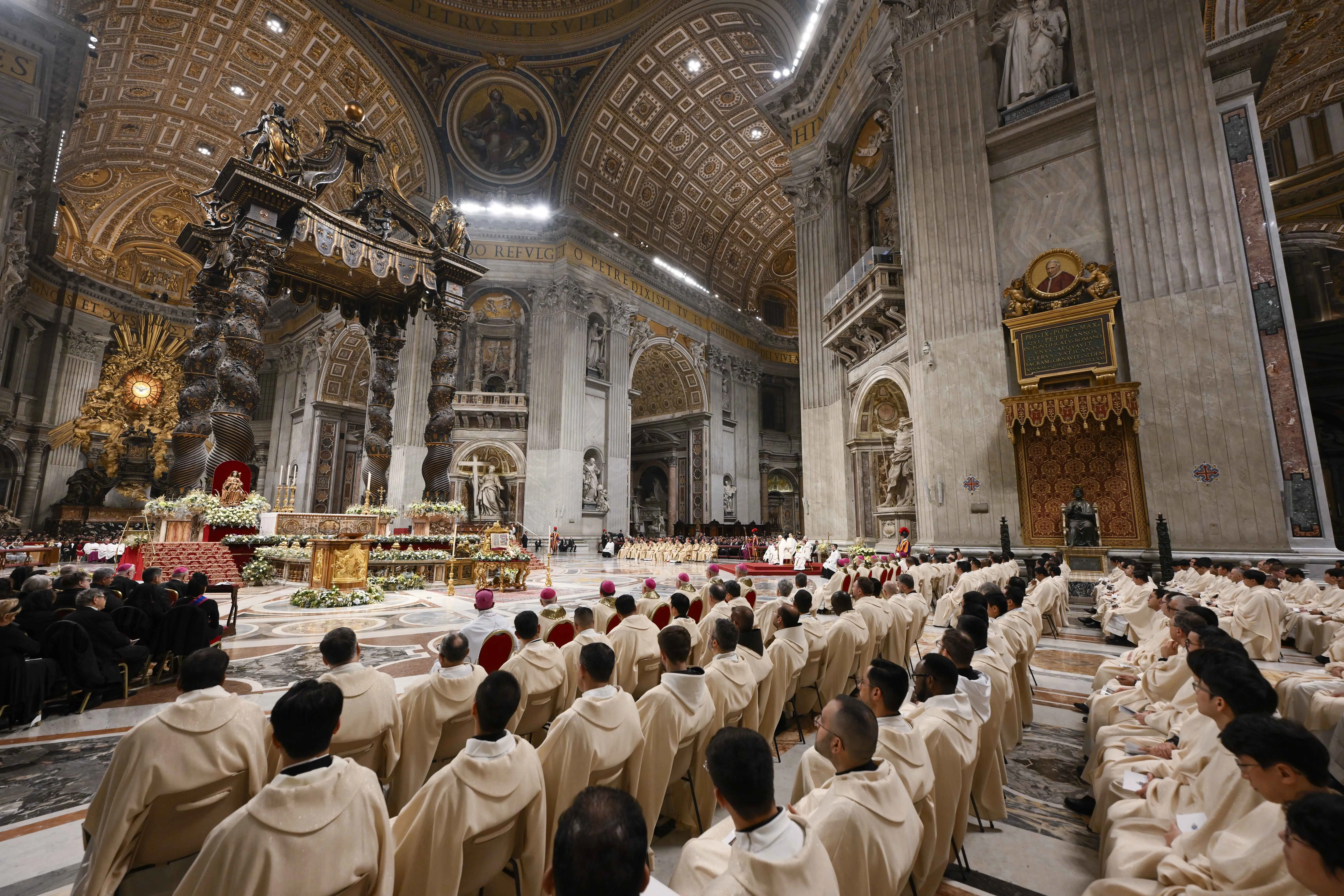
Christmas Mass in St. Peter’s Basilica on the night of Dec. 24, 2023. Vatican Media
Brothers and sisters, tonight we might ask ourselves: Which God do we believe in? In the God of incarnation or the god of achievement? Because there is always a risk that we can celebrate Christmas while thinking of God in pagan terms, as a powerful potentate in the sky; a god linked to power, worldly success, and the idolatry of consumerism. With the false image of a distant and petulant deity who treats the good well and the bad poorly; a deity made in our own image and likeness, handy for resolving our problems and removing our ills. God, on the other hand, waves no magic wand; he is no god of commerce who promises “everything all at once”. He does not save us by pushing a button, but draws near us, in order to change our world from within. Yet how deeply ingrained is the worldly notion of a distant, domineering, unbending, and powerful deity who helps his own to prevail against others! So many times this image is ingrained in us. But that is not the case: our God was born for all, during a census of the whole earth.
Let us look, then, to the “living and true God” (1 Thess 1:9). The God who is beyond all human reckoning and yet allows himself to be numbered by our accounting. The God, who revolutionizes history by becoming a part of history. The God who so respects us as to allow us to reject him; who takes away sin by taking it upon himself; who does not eliminate pain but transforms it; who does not remove problems from our lives but grants us a hope that is greater than all our problems. God so greatly desires to embrace our lives that, infinite though he is, he becomes finite for our sake. In his greatness, he chooses to become small; in his righteousness, he submits to our injustice. Brothers and sisters, this is the wonder of Christmas: not a mixture of sappy emotions and worldly contentment, but the unprecedented tenderness of a God who saves the world by becoming incarnate. Let us contemplate the Child, let us contemplate the manger, his crib, which the angels call “a sign” for us (cf. Lk 2:12). For it truly is the sign that reveals God’s face, a face of compassion and mercy, whose might is shown always and only in love. He makes himself close, tender, and compassionate. This is God’s way: closeness, compassion, tenderness.
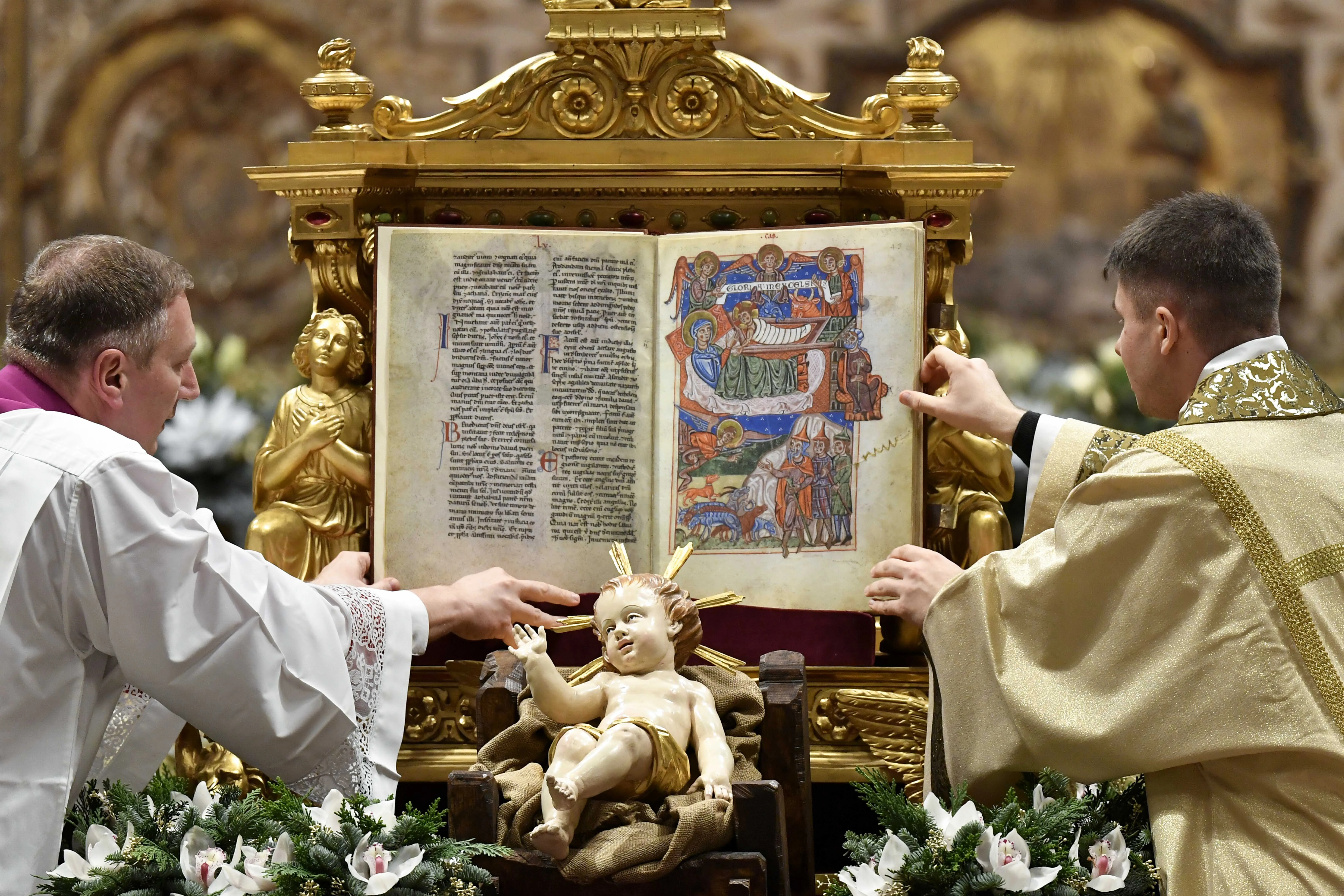
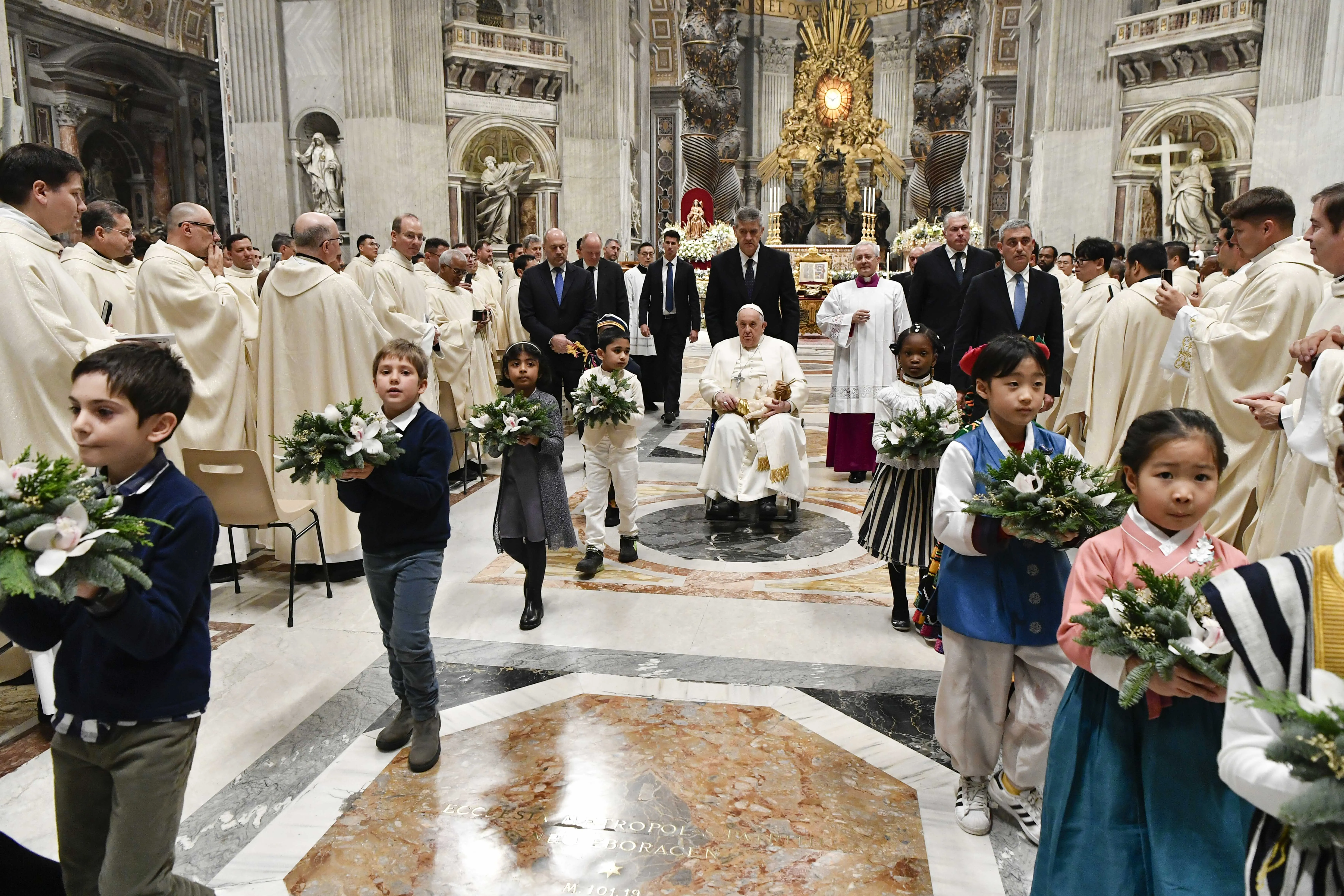
Pope Francis brings a figure of the Christ child over to the nativity scene inside of St. Peter’s Basilica at the end of Mass. Vatican Media
Sisters and brothers, let us marvel at the fact that he “became flesh” (Jn 1:14). Flesh: the very word evokes our human frailty. The Gospel uses this word to show us that God completely assumed our human condition. Why did he go to such lengths? Because he cares for us, because he loves us to the point that he considers us more precious than all else. Dear brother, dear sister, to God, who changed history in the course of a census, you are not a number, but a face. Your name is written on his heart. But if you look to your own heart, and think of your own inadequacies and this world that is so judgmental and unforgiving, you may feel it difficult to celebrate this Christmas. You may think things are going badly, or feel dissatisfied with your limitations, your failings, your problems, and your sins. Today, though, please, let Jesus take the initiative. He says to you, “For your sake, I became flesh; for your sake, I became just like you”. So why remain caught up in your troubles? Like the shepherds, who left their flocks, leave behind the prison of your sorrows and embrace the tender love of the God who became a child. Put aside your masks and your armor; cast your cares on him and he will care for you (cf. Ps 55:22). He became flesh; he is looking not for your achievements but for your open and trusting heart. In him, you will rediscover who you truly are: a beloved son or daughter of God. Now you can believe it, for tonight the Lord was born to light up your life; his eyes are alight with love for you. We have difficulty believing in this, that God’s eyes shine with love for us.
Christmas Mass in St. Peter’s Basilica on the night of Dec. 24, 2023. Vatican Media
Christ does not look at numbers, but at faces. However, who looks at him amid the many distractions and mad rush of a bustling and indifferent world? Who is watching? In Bethlehem, as crowds of people were caught up in the excitement of the census, coming and going, filling the inns, and engaged in petty conversation, a few were close to Jesus: Mary and Joseph, the shepherds, and then the Magi.
Let us learn from them. They stood gazing upon Jesus, with their hearts set on him. They did not speak, they worshiped. Tonight, brothers and sisters, is a time of adoration, of worship.
Worship is the way to embrace the Incarnation. For it is in silence that Jesus, the Word of the Father, becomes flesh in our lives. Let us do as they did, in Bethlehem, a town whose name means “House of Bread”. Let us stand before him who is the Bread of Life. Let us rediscover worship, for to worship is not to waste time, but to make our time a dwelling place for God. It is to let the seed of the Incarnation bloom within us; it is to cooperate in the work of the Lord, who, like leaven, changes the world. To worship is to intercede, to make reparation, to allow God to realign history. As a great teller of epic tales once wrote to his son, “I put before you the one great thing to love on earth: the Blessed Sacrament… There you will find romance, glory, honor, fidelity, and the true way of all your loves on earth” (J.R.R. TOLKIEN, Letter 43, March 1941).
Brothers and sisters, tonight love changes history. Make us believe, Lord, in the power of your love, so different from the power of the world. Lord, make us, like Mary, Joseph, the shepherds, and the Magi, gather around you and worship you. As you conform us ever more to yourself, we shall bear witness before the world to the beauty of your countenance.
Pope Leo XIV waves at the crowds of people who braved a rainy morning for the general audience in St. Peter’s Square on Sept. 10, 2025. / Credit: Vatican Media
National Catholic Register, Sep 14, 2025 / 07:09 am (CNA).
Sept. 14 marks Pope Leo X… […]



Leave a Reply