No Picture
News Briefs

Why YouTube needs Catholics

August 10, 2017 CNA Daily News 2

Denver, Colo., Aug 10, 2017 / 03:02 am (CNA/EWTN News).- Catholic YouTube junkies of the world, unite – you are needed for the New Evangelization.

That was essentially the message of the recent Catholic YouTubers Hangout, the first-of-its-kind online meeting of dozens of Catholics from around the world who last month about bringing the Gospel to their YouTube channels.

About 50 channels logged on to take part, hailing mostly from the United States, but also with channels joining from places like Italy, Brazil and Spain.

The hangout started as the brainchild of Daniel Glaze, who is one-half of the channel “That Catholic Couple” – the other half is Daniel’s wife, Ana. On their channel, they show their followers (dubbed “The Donut Squad,” a play on Glaze) all about their life as a young Catholic couple and first-time parents.

Daniel said the idea for the hangout came when he was watching a Catholic YouTube video one day and wondered whether Catholics on YouTube knew each other or ever collaborated together.  

Steve the Missionary (aka Steven Lewis) of the “Steve the Missionary” channel, and Maria Mitchell, the producer of the “Ascension Presents” channel, had similar questions. Why weren’t there more Catholics on YouTube, the way there were on other social media platforms like Twitter? Why wasn’t there a Catholic community on the platform?

“(We all) noticed that there really wasn’t a cohesive community of people who create together, react to each other, or collaborate with each other,” Lewis told CNA.

“Daniel was the one who was smart enough to start calling his friends and asking what we wanted to do about it.”

And that’s how the Catholic YouTubers Hangout was born. The free online conference was open to any channel that was in some way, shape or form, Catholic – meaning either the content explicitly talked about Catholicism and the Catholic church, or the creator of a channel is a Catholic who is letting their faith influence their work.

The goals for the hangout were twofold: to create a community of Catholic YouTubers, and to encourage further collaboration within that community.

Each host of the hangout also gave a keynote address, the main ideas of which can also mostly be found in this collaborative by Daniel, Ana and Lewis: https://www.YouTube.com/watch?v=inXOliuYdQk&t=21s  

This community of Catholic YouTubers is necessary, Lewis said, because “Catholics need to get their voice in the hyper-progressive, strictly materialistic, and atheist and agnostic conversation happening on YouTube.”

He said he wants there to be a “Catholic YouTube” of sorts – a corner within the platform dominated by explicitly Catholic conversations and creators, like there is on Twitter or Instagram.

“But I know that that’s not enough,” he said.

“The second thing I want is for Catholics to be a part of every other corner of YouTube. We should be earning our rights to be heard in the conversations happening on ‘Gamer YouTube,’ ‘Politics YouTube,’ or ‘Movie-Nerd YouTube,’” he said.
 
“Having both of these is important to spreading the Gospel. The first is important for answering the explicit questions of people interested in the faith, the second is important for putting the Gospel in new places among the people of the world.”

Lewis, who has been creating videos for his channel since 2013, said he was inspired to start making videos because he was already a major YouTube junkie, as well as a missionary with the Fellowship of Catholic University Students (FOCUS) at the time. He realized there was a need for the Gospel to reach one of his favorite online platforms.

“I love trying to say old truths in new ways. I love seeing and explaining the new ways that deep truths percolate into our lives,” Lewis said.

While many of his videos could fit in a category of apologetics and faith conversations geared towards millennials, they also include things like Lewis’ thoughts on the World Cup, eulogies for closing coffee shops, or his ability to eat bacon on certain Fridays in Lent when some dioceses were granted dispensations and others were not.

Daniel noted that even within his own Catholic-themed channel, the conversations are not necessarily explicitly Catholic, but are about life as a young family, informed by a Catholic view.

“We need more variety of Catholic content on YouTube, which means we need Catholic content creators living out their faith and showcasing it through video. For example, my channel ‘That Catholic Couple’ is a vlogging (video blogging) channel where we regularly share what it means to be a young family. Yes, we speak about our faith, but our content isn’t always explicitly Catholic. Plus, we need different perspectives on the platform to put the Gospel in the niche corners of YouTube,” he said.

During the hangout, Lewis said he challenged Catholic YouTubers to do two things: first, to watch and subscribe to each other’s channels, because it helps build community. Secondly, he encouraged them to keep watching their favorite secular videos on YouTube, because it can help creators to hone a more professional style.  

“Don’t be afraid of the secular influences on your style,” Lewis said.

“We think of Audrey Assad (a Catholic singer/songwriter) as writing in the tradition of modern praise and worship writers. While that’s true, if you ask her what her musical and lyrical interests are, she’ll tell you about artists like Paul Simon: a secular artist of such quality, that anyone can learn from him,” Lewis said.

Daniel added that the community is important, because it will allow Catholics to push each other to be better. Creating great art is something that the Church used to lead the world in, but has fallen behind in recent years, especially when it comes to creating good video.

“To be frank, the time of bad Catholic video content needs to end,” he said.

And the need for good Catholic video has never been more urgent, as video streaming has exploded in recent years with the boom of smartphones, Lewis added.

“The explosion of streaming video, especially through our phones, means that people are open to the possibilities of what a video can show them. Like any media, streaming videos can be baptized and used to glorify God. Let’s not waste our time!” Lewis said.

“It’s tough because we are currently outnumbered on YouTube, but so were the Apostles, so we’re in good company,” he added. “Also, I really like this new bromance I’ve got with Daniel.”

Daniel said that the hangout was only the beginning, and the he plans on continuing to look for opportunities to provide resources to foster community and collaboration among Catholic YouTubers, ultimately to help further the message of the Gospel.  

“A good friend of mine once said, ‘conversion of the heart isn’t fostered by one video, but it can start one.’”

Lewis urged all Catholics to share videos and blogs that further the Gospel message. And, if they find a gap somewhere, to fill it.

“Online evangelization is not about getting famous, it’s about seeing a need and addressing it,” he said.

“If you find a video/post/blog that says what you need to say right now, like and share it! If you can’t find that video/post/blog, I guess it’s time for you to make it yourself!”

[…]

No Picture
News Briefs

Texas bishop: Don’t deport mother of young cancer patient

August 9, 2017 CNA Daily News 2

El Paso, Texas, Aug 9, 2017 / 04:50 pm (CNA/EWTN News).- Deportation to Mexico of the mother of a cancer-stricken girl would be cruelty, the Bishop of El Paso has said.

“It certainly touched my heart to hear about this little girl in the hospital, facing the possibility that her mother would be deported,” the Bishop Mark Seitz told the El Paso Times Aug.7, adding “Clearly it would be a cruel thing for our country to deport her mother.”

He has met with Alia Escobedo, 8, and her mother Maria Elena de Loera, who sought asylum in the U.S. in 2014 after her husband was killed in Mexico. She has said she feared for the safety of her children.

Bishop Seitz joined other religious leaders and the woman’s lawyer at the El Paso Processing Center in asking ICE officials to halt her deportation.

Since her mother arrived in the U.S., Alia has since been diagnosed with bone cancer. She has gone through eight surgeries on her leg, lungs and mouth. While the cancer appeared to be removed and went into remission in February, it has returned with tumors in her lungs.

“Her medical condition is very complicated. Two different kinds of cancer,” the bishop said of the girl. “Her ongoing treatment is something that is extremely important in a situation like this.”

The woman facing possible deportation reflected on her daughter’s endurance. “She is very strong,” de Loera said. “She has tremendous strength. She does not give up. She wants to keep living.”

“If we go back to Juarez, she is not going to survive. She has a better chance to live if she stays here,” the mother told the El Paso Times.

The case was the first time Bishop Seitz had intervened directly to prevent an individual’s deportation.

“The Church’s responsibility is, I think, to speak the gospel and to speak to the conscience of people in our country to call us to something better, to call us to be a place of compassion, even as we deal with these complex issues of immigration,” he said.

In 2015 immigration officials denied de Loera’s request to remain in the U.S., but granted her a reprieve while her daughter was undergoing cancer treatments. They have argued that her sister is caretaker of her daughter, but de Loera said that there are no documents guaranteeing her sister is the guardian.

De Loera wears an ankle monitor and immigration officials can access her location any time.

Her attorney, Linda Rivas, has asked immigration officials to reconsider renewal of her permit and to reverse orders to deport her.

Rivas said ICE officials have agreed to consider the evidence to decide whether de Loera can remain in the U.S.

“We find this to be good news and we do appreciate the cooperation from ICE at this time given that Maria is at her daughter’s side,” she said.

[…]

No Picture
News Briefs

After years of exile, Dominican sisters return to Iraq’s Nineveh Plain

August 9, 2017 CNA Daily News 0

Erbil, Iraq, Aug 9, 2017 / 04:32 pm (CNA/EWTN News).- After three years in exile from Iraq’s Nineveh Plain while it was occupied by the Islamic State, the Dominican Sisters of St. Catherine of Siena are returning to their homeland to face the daunting challenge of rebuilding their destroyed communities.

“Three years ago, we left our homes at night to the unknown. We started a journey of displacement, exile and questioning,” stated an Aug. 6 open letter from the Dominican Sisters in Erbil.

“Despite everything, we always dreamed of going back and finding our houses safe and sound, just as we left them. We strongly wished that we would return and kindle our candles for prayers, harvest our grapes, and read our books,” the letter continued.

In 2014, the Nineveh Plain was overtaken by the Islamic State, forcing tens of thousands into exile and displacement. The Nineveh Plain territory lies between the city of Mosul, the country’s second-largest city, and Iraqi Kurdistan.

In the fall of 2016, two years after the Islamic State claimed the Nineveh territory, Iraqi forces made significant military gains and liberated the Nineveh Plain. Many scattered families were able to return to their towns with hope for the future.

“God showered us with His graces as our towns were liberated, one after the other; ISIS was defeated and the Plain of Nineveh seems to have been liberated,” the Dominican Sisters wrote.

While the territory is now seemingly safe from Islamic State forces, the Sisters said that it “does not mean that the Plain of Nineveh is entirely cleansed from that mentality.”

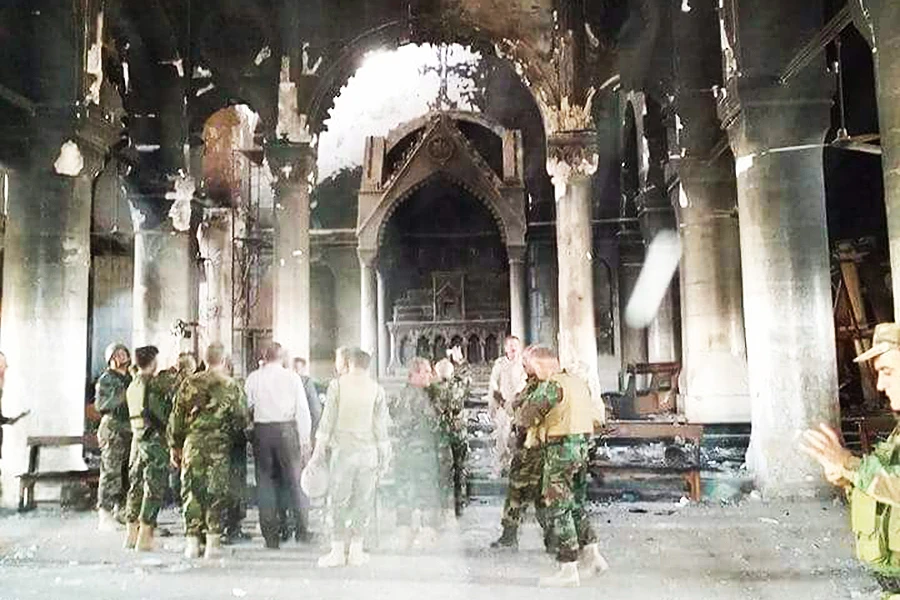
Upon returning to their homes, many found graffiti on the walls in their towns that read “we’re going to break your crosses,” and “you have no place with us.” Some churches were found to have battle instructions etched on the walls, with piles of deadly chemicals in the corners.

In addition, the physical damage left behind is overwhelming. Upwards of 6,000 homes are in need of repair or complete rebuilding just in the city of Bakhdida, also known as Qaraqosh. The families who still have standing houses are few and far between.

“We were so much stunned by the damage we saw. It was badly painful to see all that overwhelming destruction,” the sisters said.

“We immediately realized that it was not military forces or smart weapons that caused all the damage, but hate,” the sisters wrote, saying “hate leaves both oppressed and oppressor deeply winded.”

Some towns, such as Batnaya, were left 90 percent destroyed and the process of cleaning up has only begun. Another town, Bakhdida, was only 30 percent destroyed, but the NGOs who are helping with its repairs “are not enough compared to the destruction.”

Volunteers and locals hope to rebuild or repair as many homes as they can by September, which would be the beginning of the school year. However, the sisters noted that only the Church and some NGOs are actively involved in the long and expensive rebuilding process.

Many families have decided not to return to their communities due to the overwhelming loss of their homes. Others don’t return because they can no longer trust their neighbors. The sisters said that “we knew that it was our neighbors who betrayed us and did us harm, even before ISIS did.”

“It is not easy to decide whether to go back,” the Sisters continued, saying that their own convent in Bakhdida was also partially destroyed.

However, the sisters have decided to return to the Nineveh Plain, and they will be living in a family home in Telskuf until their convent has been repaired. The sisters also need to rebuild the orphanage which had been burnt down, and hope to start a kindergarten by the fall.

Although the aftermath of Islamic State’s occupation of the Nineveh Plain is significant, the sisters are hopeful for the future. Some families have been able to return to their homes, and the sisters are grateful that some of the rebuilding process that has already begun.

“Today, we see the marvelous work of God,” the sisters reflected.

“God is with us and will not leave us. We thank you for all the support you have shown us. Please pray for us as we start this new phase of our lives.”

[…]

No Picture
News Briefs

Cardinal Parolin says urgency of peace a key reason for Russia trip

August 9, 2017 CNA Daily News 0

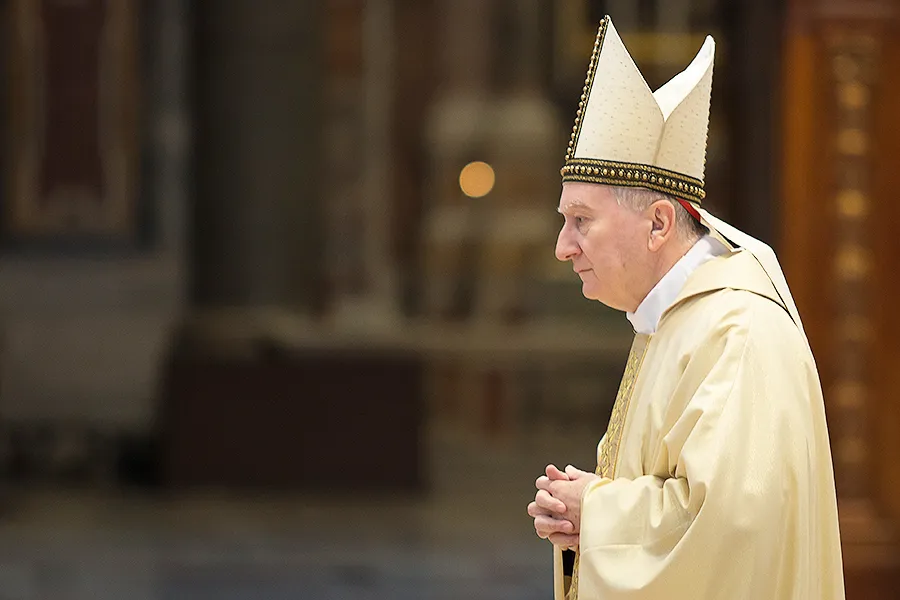
Vatican City, Aug 9, 2017 / 11:01 am (CNA/EWTN News).- Vatican Secretary of State Cardinal Pietro Parolin has said he will be going to Russia Aug. 20-24 largely out of a desire to promote peace both there and with the West, and to solidify relations with the Eastern Orthodox.

Conflicts throughout the world, particularly in areas such as the Middle East, Syria and Ukraine, “are constant objects of attention and concern for the Holy See,” Cardinal Parolin said in the interview published Aug. 9 in Corriere della Sera.

“Because of this, the need and urgency of searching for peace and the way to do it will certainly be one of the principle themes” of his meeting with Russian President Vladimir Putin, he indicated.

In addition to meeting with with Putin, the cardinal is also expected to hold meetings with Russian Orthodox Patriarch Kirill, as well as several other high-level authorities in the Russian Orthodox Church.

In his interview, Cardinal Parolin stressed that the Holy See has always held “a special interest for the vast eastern portion of Europe,” which he said “has a role to play in the search for greater stability on the continent and greater unity, including relations between East and West.”

“After the period of ideological opposition, which obviously can’t entirely fade from today to tomorrow, and in the new scenarios that have opened up since the end of the Cold War, it’s important to take advantage of every occasion to encourage respect, dialogue, and mutual collaboration in a view to promoting peace.”

The visit, he said, is also understood as a completion of the tour he has made of the region over the past few years, which, through official papal trips or visits he has made alone, has brought him to Belarus, the Caucasus nations, the Baltic countries, and Ukraine.

Now “I will have the opportunity to complete the picture with the visit to Russia.”

When asked whether or not he is concerned about rising tensions between the United States and Russia, Cardinal Parolin said he trusts that both parties involved “will know how to act with due responsibility to avoid the escalation of tensions.”

He also voiced confidence that the two nations will be able to recognize “the eventual errors that could have been at the origin of that situation.”

U.S. President Donald Trump recently turned up the heat in the ongoing conflict with Russia, due largely to tensions over their involvement in Syria and Ukraine, and possible meddling in the 2016 U.S. presidential election.

Recently Trump hit Russia with more economic sanctions due to the country’s involvement in the election, prompting Putin to expel 755 people from its U.S. embassy and consulates.

“It would be dramatic if nothing were done in this respect and, as a consequence, relations would deteriorate further,” Cardinal Parolin said, and stressed the crucial role of both Churches and civil society “in encouraging every initiative that leads to creating a more positive general atmosphere.”

The cardinal was also questioned on a comment made by Pope Francis to German Chancellor Angela Merkel during a recent audience, when he said it is a “tragic contradiction” to promote unity and persist in war.

Asked if this would be a topic raised in his meeting with Putin, the Vatican Secretary of State stressed that the Church consistently calls on all political leaders “not promote national interests, or in any case, particular interests,” but rather to work for “the common good, to respect for international law.”

“Not the law of force, but the force of the law,” he said, noting that the Church also urges global leaders to make decisions which promote the integral development of man throughout the world, as well as “concord and collaboration among nations.”

“And the method is always dialogue,” he said, and pointed to a quote from a letter written by St. Augustine in which the saint says that for a true leader, “the greatest title of glory is that of killing war with the word.”

In the Latin verb, Cardinal Parolin said, this means “with negotiation, with discussions instead of killing men with the sword, and ensuring that peace is maintained with peace and not with war.”

On his meeting with Patriarch Kirill, the cardinal said relations between the Catholic and Russian Orthodox Church would obviously be a big priority, as well as how their respective Churches interact with society in facing the “great spiritual, cultural and political themes of today.”

“From this point of view, it’s important to seek a positive and open means to continue to weave inter-ecclesial relations and to contribute constructively, on the part of the Churches, to the resolution of the complex problems which afflict and challenge humanity,” he said.

“It is my living hope, then, that the encounter may serve for an ever greater awareness, mutual esteem and collaboration between Catholics and Orthodox.”

Cardinal Parolin said that while his trip is not intended as a preparation for an eventual visit from Pope Francis, he hopes that “with the help of God,” his visit “can offer some contribution in this regard.”

[…]