

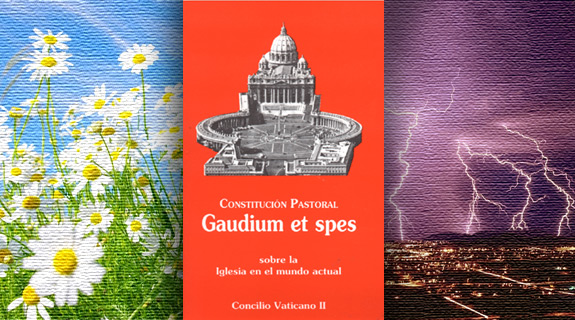
It is easy to be critical of Gaudium et Spes as a document pushed through at the end of the Second Vatican Council when the Holy Spirit was out to lunch or the Conciliar fathers had eaten rather too much lunch and were not fully awake. As one of my students once remarked, “Were they all on Prozac?”
In the early and mid-1960s, however, people didn’t need to take Prozac. There was a general optimism about the world. Medical advances were made every day, material standards of living were the highest they had ever been, and unemployment was very low. A dog had been sent into space and successfully returned to earth, and there was John F. Kennedy’s project to land human beings on the moon by the end of the decade. The Vietnam War had only just begun and, apart from some members of the Catholic Worker Movement who had organized a couple of demonstrations and some students at UC Berkeley who had started burning draft cards, the world was not too concerned about the events in Indochina. Lyndon B. Johnson had given his “Great Society” speech in which he promised an elimination of poverty and racial injustice, the Prime Minister of Northern Ireland was at last speaking to the President of the Republic of Ireland, and The Sound of Music was the movie of the year.
Communism was still a problem, but the Council fathers were precluded from spending too much time on this. A deal had been done between the Vatican’s Secretariat of State and the Soviet leaders, to the effect that the Conciliar documents would not make any specific condemnations of Communism. In return, the Communist leaders would graciously allow members of the Russian Orthodox Church to attend the Council as observers.
In general it was felt that the Church and “the Free World” were at last “on the same page” and that the Communist leaders on the other side of the Iron Curtain would soon figure out that, however nice it is in theory, Marxism doesn’t actually work well in practice.
As a consequence of this generally optimistic mood, there are sections of the document which do sound as though they have been written by people who have forgotten about evil, sin, and atheistic ideologies. The young Joseph Ratzinger, writing in 1969, described some of the document’s sections as “downright Pelagian” in tone.
However, there are other sections that are highly sober.
It is no surprise, therefore, that there ended up being two dominant interpretations of this document. In shorthand terms, one can call them the Wojtyła interpretation and the Schillebeeckx interpretation. The Wojtyła interpretation zeroed in on paragraph 22, according to which human persons only understand themselves to the extent that they know Christ. According to Blessed John Paul II—the former Bishop Karol Wojtyła—Christ is the answer to all the legitimate hopes and desires of persons of good will throughout the world. He read Gaudium et Spes with a Christocentric accent. However, as Ratzinger noted, the “daring new” Christocentric anthropology embedded within the document was not well expressed. There is a tension between the first section, where the human person is merely “theistically hued” or, in some general way, made in God’s image, and the second section, which is specifically Trinitarian.
The Schillebeeckx interpretation zeroed in on paragraph 36, which recognized a “legitimate autonomy of the world”:
If by the autonomy of earthly affairs we mean that created things and societies themselves enjoy their own laws and values, which must gradually be deciphered, put to use, and regulated by men, then it is entirely right to demand that autonomy. Such is not merely required by modern men, but harmonizes also with the will of the Creator. For by the very circumstances of their having been created, all things are endowed with their own stability, truth, goodness, proper laws, and order.
On its face this sounded like the ecclesial leaders were “bowing out” from any involvement in world affairs. According to a superficial reading of this paragraph, taken out of its context with other qualifying paragraphs, the world did not need Christian revelation.
Paragraph 36 uses language borrowed from St. Thomas Aquinas, which appears, in turn, to have been borrowed from St. Augustine. It does allow for a non-secularizing interpretation. However, getting the interpretation “right” requires reading rather a lot of background theology into it—and the background theology relates to the most difficult areas of the relationship between nature and grace and soteriological issues about the place of the world in the economy of salvation. One can read this paragraph in a number of different ways depending on one’s theological foundations, and the so-called “plain person” who reads it without any theological formation is likely to struggle.
With reference to some of the interpretations this paragraph has been given, Cardinal Angelo Scola has suggested that it might be right to ask if the Catholic world, called to address the great contemporary anthropological and ethical challenges, has not been co-responsible—whether by naïveté, delay, or lack of attention—for the current (that is, secularist) state of things. According to Scola, there is a “latent ambiguity” around the interpretation of the principle of the autonomy of earthly affairs. He reads paragraph 36 as an acknowledgement that there is a realm of life that is the responsibility of the laity. He doesn’t read it as authority for the proposition that there might be aspects of life that have no intrinsic relationship to the Creator.
A concrete illustration of the ambiguity fostered by the use of the word “autonomy” may be found in the following paragraph of Robert A. Krieg’s Catholic Theologians in Nazi Germany. Speaking of two different species of Catholics, Krieg concluded:
On the one hand, insofar as they stand in the theological orientation of Pope Pius XI and Catholic Action, they are intent on transforming secular society into a Christian one, dedicated to Christ the King. On the other hand, to the degree that they are inspired by the Second Vatican Council, they are guided by a respect for the “rightful autonomy” of human affairs and a commitment to what Pope Paul VI identified as “the progress of peoples,” anchored in a pledge to defend human rights. (1)
Krieg is certainly right to identify these two mentalities as popular alternatives among Catholic laity. The idea, however, that this is an either-or option is based on a false dichotomy. The choice offered is between a Christian society or one “committed to the progress of peoples anchored in a pledge to defend human rights.” The whole point of John Paul II’s interpretation of the Council is that the progress of peoples runs on a Christocentric trajectory. The human dignity that human rights are supposed to defend is based on the notion of the Imago Dei. Removing that, and in particular, removing Christ, is a recipe for secularism. We can’t marginalize Christ for reasons of social acceptability without putting Christianity out of business.
On this theme, and with a high degree of prescience, the great French Jesuit Yves de Montcheuil (who was murdered by the Gestapo in 1944) wrote:
Jesus does not speak of the evils in the social order as springing from a social disorder that could be overcome by means proper to that social order. He refers them to the idea of sin, that is, to an interior evil, an offence against God. The prophet Amos, when he roared out against the abuses of his time, was not protesting in the name of human dignity, which was being violated, but in the name of the sanctity of God which sin outraged. Human dignity and human justice, separated from God, end by being corrupt. (2)
As Benedict XVI was to write some six decades later, “a humanism that excludes Christ is an inhuman humanism.”
At its worst, Gaudium et Spes became an excuse for correlating, and even accommodating, the faith to the culture of modernity. It became, in other words, the license for what we now call the “spirit of the Council”—the practice of identifying fashionable trends in the secular culture and tying the faith to them in a pathetic marketing ploy. This is what Ratzinger called the practice of presenting the Church as a poorly managed haberdashery shop constantly changing its windows to lure more customers. As he was later to write:
…a Christianity and a theology that reduce the core of Jesus[’s] message, the “kingdom of God” to the “values of the kingdom” while identifying these values with the main watchwords of political moralism, and proclaiming them, at the same time, to be the synthesis of all religions—all the while forgetting about God, despite the fact that it is precisely he who is the subject and the cause of the kingdom of God, does not open the way to regeneration, it actually blocks it. (3)
At its best, on the other hand, Gaudium et Spes served as a foundation for the theological anthropology advanced in John Paul II’s Trinitarian encyclicals—Redemptor Hominis, Dives in Misericordia, and Dominum et Vivificantem—and his more famous catechesis on human love. After Gaudium et Spes, we no longer have marriage manuals that speak of marital dues and rights and address the sacrament of marriage in the idioms of contract law. It is well known that it was the young Archbishop Karol Wojtyła from Kraków who was largely responsible for this development. It laid the foundations for what was to become John Paul II’s theology of the body—an overtly scriptural presentation of the meaning of human sexuality with reference to a fundamentally personalist anthropology, not narrowly focused on any particular faculty of the soul but on the entire person. As a consequence of this shift in Gaudium et Spes, Paul VI’s Humanae Vitae (1968) spoke of contraception with reference to “the person of the woman” and “mutual personal perfection.”
Some five decades after the Council began, the world is much less receptive to Christian revelation. Christians in the Middle East are being martyred almost daily, Christians in the western liberal democracies are under pressure to privatize their faith, and Christians in the Communist parts of Asia have been oppressed for decades. It is difficult to imagine how hard life must be for Chinese Catholics, when couples are forced to comply with the one child policy or suffer persecution, including forced abortions.
If one examines the social changes in the western world over the past half-century one can conclude that we have been living through a period in time when the “mythos” of Christianity has been systematically undermined and replaced with an alternative, explicitly anti-Christian mythos. The substance of this new foundational myth is that religion is the source of evil in the world. It therefore needs to be tamed and managed by the modern post-Christian state. This state pretends to offer its citizens nothing other than efficiently run public utilities like airports, telephone and Internet services, gas and electricity, and protection from the aggression (including all manner of negative “value” judgments) of other citizens. However it also controls taxation and, to a large degree, it regulates the education sector. Its taxation policies are rarely ever “family friendly” and its educational institutions serve as a vehicle for the promotion of the post-Christian mythos.
Standing in the front lines against this evil there is, however, a new generation of Catholics weaned on the encyclicals of John Paul II and brought up to think of Joseph Ratzinger/Benedict XVI as a theological superhero. They are much better prepared than the generation of the 1960s to fight “the wars of love,” because they at least recognize that they have been born during a war. The New Jerusalem is still a long way off, but at least it is becoming increasingly visible which people are in favor of it and which ones are opposed. People are either members of the City of God or the City of Man, or even perhaps what Plato called “the city of pigs”—that is, a city whose inhabitants have no higher goal that staying alive and being confident and competitive.
As the Australian poet James McAuley concluded: “There is no promise that we shall not suffer, no promise that we shall not need to fight, only the Word that Love is our Redemption, and Freedom comes by turning to the Light.”
(Editor’s note: This essay was published originally on February 6, 2013.)
Endnotes:
(1) Krieg, R, P, Catholic Theologians in Nazi Germany (London: Continuum, 2004), 175.
(2) Yves de Montcheuil, La Royaume et ses exigencies (Editions de l’Epi, 1957): 47-49. As quoted in English translation in Henri de Lubac, A Brief Catechesis on Nature and Grace (San Francisco: Ignatius, 1984): 164.
(3) Ratzinger, J, ‘Europe in the Crisis of Cultures’, Communio: International Catholic Review, 32 (2005), 345-56 at 346-7.
If you value the news and views Catholic World Report provides, please consider donating to support our efforts. Your contribution will help us continue to make CWR available to all readers worldwide for free, without a subscription. Thank you for your generosity!
Click here for more information on donating to CWR. Click here to sign up for our newsletter.


