No Picture
News Briefs

Solanus Casey, Cardinal Van Thuan among those advanced toward sainthood

May 4, 2017 CNA Daily News 0

Vatican City, May 4, 2017 / 10:47 am (CNA/EWTN News).- Pope Francis on Thursday approved decrees of the Congregation for the Causes of Saints advancing the causes for canonization of 12 individuals, including the American-born Capuchin Solanus Casey and the Vietnamese cardinal Francis Xavier Nguyen Van Thuan.

In his May 4 meeting with Cardinal Angelo Amato, prefect of the congregation, Pope Francis recognized a miracle attributed to the intercession of Venerable Solanus Casey, which allows for his beatification.

Venerable Casey was known for his great faith, attention to the sick, and ability as a spiritual counselor.  

Born Bernard Casey on Nov. 25, 1870, he was the sixth child of 16 born to Irish immigrants in Wisconsin. At age 17 he left home to work at various jobs, including as a lumberjack, a hospital orderly, and a prison guard.  

Reevaluating his life after witnessing a drunken sailor brutally stab a woman to death, he decided to act on a call he felt to enter the priesthood. Because of his lack of formal education, however, he struggled in the minor seminary, and was eventually encouraged to become a priest through a religious order rather than through the diocese.

So in 1898 he joined the Capuchin Franciscans in Detroit and after struggling through his studies, in 1904 was ordained a “sacerdos simplex” – a priest who can say Mass, but not publicly preach or hear confessions.

He was very close to the sick and was highly sought-after throughout his life, in part because of the many physical healings attributed to his blessings and intercession. He is also known for his fondness for playing the violin and singing, although he had a bad singing voice because of a childhood illness which damaged his vocal chords.   
 
Even in his 70s, Fr. Solanus Casey remained very active, and would even join the younger religious men in a game of tennis or volleyball. He died from erysipelas, a skin disease, on July 31, 1957, at the age of 87.

Fr. Michael Sullivan, provincial minister of the Capuchin Franciscan Province of St. Joseph, said May 4 that “Long before we knew and loved Pope Francis, we had the example of Fr. Solanus who lived the Gospel of Mercy. Known for his compassion and simplicity, he drew many thousands to God.”

Archbishop Allen H. Vigneron of Detroit commented that “The beatification of Father Solanus Casey is an incomparable grace for the Church in the Archdiocese of Detroit and for the whole community of Southeast Michigan. He is an inspiration to all us Catholics – and to all – of the power of grace to transform one’s life.”

The Pope also recognized the heroic virtue of Cardinal Nguyen Van Thuan. Imprisoned for his faith in Vietnam for 13 years, nine of them in solitary confinement, he is now declared venerable, a significant step forward in his cause.

Cardinal Van Thuan was born in Vietnam in 1928. He was ordained a priest of the Vicariate Apostolic of Hue in 1953 and appointed Bishop of Nha Trang in 1967.

He was appointed Coadjutor Archbishop of Saigon in April 1975, six days before the city fell to the North Vietnamese army. Cardinal Van Thuan was imprisoned in a re-education camp by the communist government of Vietnam for 13 years, nine of them in solitary confinement.

While imprisoned he smuggled out messages written on scraps of paper that were copied by hand and circulated among the Vietnamese community, eventually being printed in The Road of Hope.

He also wrote prayers in prison, which were later published in Prayers of Hope. He was allowed no religious items, but after sympathetic guards smuggled in a piece of wood and some wire for him, he was able to craft a small crucifix.

After being released from prison, he spent three years under house arrest before being permitted to visit Rome in 1991. He was exiled from Vietnam from that point until early 2001, and he resigned as Saigon’s coadjutor archbishop in 1994 when he was appointed vice president of the Pontifical Council for Justice and Peace. He became the council’s president in 1998.

In 2000 he preached the spiritual exercises for the Roman Curia, which were subsequently published as Testimony of Hope.

He was made a cardinal by St. John Paul II in 2001, and he died in Rome on Sept. 16, 2002, at the age of 74.

Three other causes were also approved for beatification Thursday: Venerable Maria of the Immaculate Conception, founder of the Daughters of Mary Immaculate (1789-1828); Venerable Clara Fey, founder of the Institute of the Sisters of the Poor Baby Jesus (1815-1894); and Venerable Catalina de Maria, founder of the Congregation of the Servant Sisters of the Most Sacred Heart of Jesus (1823-1896).

Pope Francis has also approved the declaration of the martyrdom of Servant of God Luciano Botovasoa, layman and father, of the Third Order of St. Francis, killed in hatred of the faith in Vohipeno, Madagascar on April 17, 1947.

Also recognized were the heroic virtues of the servants of God Cardinal Elia Dalla Costa of Florence (1872-1961); Giovanna Meneghini, founder of the congregation of the Ursuline Sisters of the Sacred Heart of Mary (1868-1918); Vincenza Cusmano, first superior general of the Congregation of the Poor Servants (1826-1894); Alessandro Nottegar, layman and father, founder of the Community of Regina Pacis (1943-1986); Edvige Carboni, laywoman (1880-1952); Maria Guadalupe Ortiz de Landázuri y Fernández de Heredia, laywoman of the Personal Prelature of Santa Croce and of Opus Dei (1916-1975).

[…]

No Picture
News Briefs

Trump to meet Pope Francis at the Vatican on May 24

May 4, 2017 CNA Daily News 0

Vatican City, May 4, 2017 / 09:47 am (CNA/EWTN News).- President Donald Trump will meet Pope Francis during a visit to the Vatican later this month.

“His Holiness Pope Francis will receive the Hon. Donald Trump, President of the United States of America, on Wednesday, 24 May 2017, at 8:30 a.m. in the Apostolic Palace,” the Vatican announced Thursday.

“President Trump will then meet with His Eminence Cardinal Pietro Parolin, Secretary of State, and Archbishop Paul Gallagher, Secretary for Relations with States.”

The president’s trip will also include visits to Israel and Saudi Arabia, according to officials. Trump will also attend a NATO meeting in Brussels on May 25 and a G7 summit in Sicily on May 26.

The president and the pope have sometimes been put at odds.

During a Feb. 18, 2016 in-flight press conference, Reuters reporter Philip Pullella asked the Pope to respond to Donald Trump’s immigration stand.

Pope Francis answered: “A person who thinks only about building walls, wherever they may be, and not building bridges, is not Christian. This is not in the Gospel.”

The pontiff added he would “give the benefit of the doubt” to the political candidate.

One week prior, Trump had bashed Pope Francis as a “pawn” for the Mexican government and “a very political person” who does not understand the problems of the United States.

Holy See spokesman Father Federico Lombardi on Feb. 19 told Vatican Radio that the Pope’s comment “was never intended to be, in any way, a personal attack or an indication of how to vote” and had repeated a longstanding theme of his papacy, bridge-building.

The U.S. bishops have had a mixed response to the early days of the Trump administration, criticizing his refugee and immigration plan, while praising his pro-life measures.

[…]

No Picture
News Briefs

Pope urges Vatican communications to go digital amid ongoing reform

May 4, 2017 CNA Daily News 0

Vatican City, May 4, 2017 / 06:14 am (CNA/EWTN News).- Pope Francis told the Vatican’s Secretariat for Communications, which is holding their first plenary assembly this week, that given a growing digital culture throughout the world, new media must become a primary platform for spreading the Gospel.

“Studying new ways and means to communicate the Gospel of mercy to all people, in the heart of different cultures, through the media that the new digital cultural context makes available to our contemporaries” is something that is “very much in my heart,” Pope Francis said May 4.

He spoke to members of his Secretariat for Communications, which was formed in June 2015 as part of his ongoing reform of the Roman Curia, during their first plenary assembly.

The assembly is taking place May 3-5 at the Vatican and gathers members of the secretariat, which is headed by Msgr. Dario Edoardo Vigano.

In his audience with the plenary participants, Francis said the word “reform” is something we shouldn’t be afraid of. To reform, he said, isn’t just “repainting” things, but is rather “giving another form to things, organizing them in a different way.”

“And it must be done with intelligence, meekness, but also…also, allow me the word, with a bit of ‘violence,’” he said, but stressed that its a “good violence to reform things.”

More than just merging the Vatican’s various communications entities, the secretariat has the task of building “a truly new institution” that has arisen from the need for a “so-called ‘digital convergence,’” he said.

Whereas in the past each form of expression had its own medium in either newspapers, books, photographs, television, radio and CDs, now all of these forms of communications, are transmitted “with a single code that exploits the binary system.”

In this context, he pointed to the Vatican newspaper L’Osservatore Romano, which will officially join the secretariat next year, saying it “will have to find a new and different way to reach a number of readers greater to what it can achieve in paper format.”

As of now the paper operates primarily in daily and weekly print format, with a limited online presence in its various languages.

Pope Francis also turned to Vatican Radio, which broadcasts papal and Vatican news several languages throughout the world, saying the entity will need to be revisited “according to new models and adapted to the modern technologies and needs of our contemporaries.”

He made a point to emphasize the attention Vatican Radio has given to broadcasting in countries will little access to technology, such as certain countries in Africa, noting that services to these places “have never been abandoned.”

In addition to L’Osservatore Romano, the Vatican Publishing House and the Vatican Typography office will also be merged into the greater working community of the secretariat, which is something the Pope said will require “availability to harmonize” with their “new productive and distributive design.”

“The work is great, the challenge is great, but it can be done. It must be done,” he said, stressing the need to for a willingness to work together as all of the changes and merges take place.

As the study commissions within the secretariat move forward in identifying new paths and proposals, the Pope told them to be “courageous” in the criteria they choose, asking that the guiding criteria be an “apostolic and missionary one, with special attention to situations of discomfort, poverty, difficulty.”

“In this way, it becomes possible to bring the Gospel to everyone, to optimize human resources, without replacing the communication of the local Churches and, at the same time, supporting the ecclesial communities most in need.”

He concluded his speech stressing the need to “not let ourselves be overcome by the temptation of attachment to a glorious past,” and encouraged members instead to make “a great effort of teamwork to better respond to the new communicative challenges that the culture of today asks of us, without fear and without imagining apocalyptic scenarios.”

Pope Francis established the Secretariat for Communications on June 27, 2015, with the promulgation of the motu proprio, “The current communication context.”

One of its primary responsibilities is the restructuring and consolidation of the Holy See’s various communications outlets, which were previously ran as individual offices.

The dicastery will eventually oversee Vatican Radio, L’Osservatore Romano, the Vatican Television Center, the Holy See Press Office, the Pontifical Council for Social Communications, Vatican Internet Service, the Vatican Typography, the Photograph Service, and the Vatican publishing house.

Msgr. Dario Edoardo Viganò, previously head of Vatican Television, is prefect of the department. On April 12, 2017, the Pope named a group of 13 new consultors, including EWTN’s Chairman and Chief Executive Officer Michael P. Warsaw

[…]

No Picture
News Briefs

The Green Pope isn’t who you think it is.

May 4, 2017 CNA Daily News 0

Vatican City, May 4, 2017 / 12:02 am (CNA/EWTN News).- There once was a Pope called “The Green Pope.”

He earned the title from both the religious and the secular alike, because he wrote frequently about the environment and asked all Catholics to be better stewards of God’s creation.  

Under this pope’s pontificate, the Vatican became the world’s first sovereign state to become carbon-neutral, meaning that all of the small country’s greenhouse gas emissions are offset by renewable energies and carbon credits, thanks to extra trees and solar panels. He also made use of a more energy efficient, partially electric popemobile.

No, “The Green Pope” is not Pope Francis.

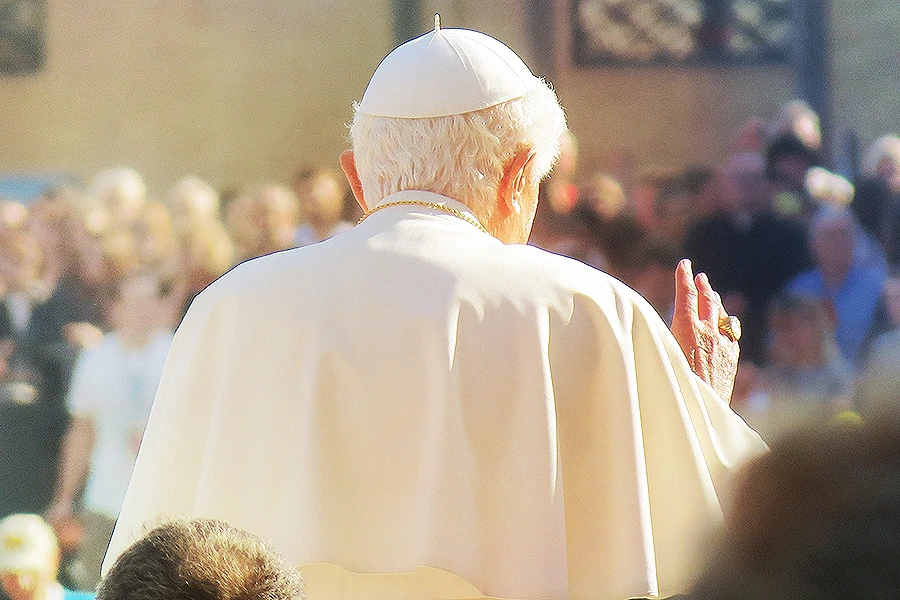
It’s his predecessor, Pope Benedict XVI, which may come as a surprise to those who believe Benedict’s legacy was his staunch conservatism.  

During the World Day of Peace celebration in 2010, Pope Benedict XVI chose the theme “If You Want to Cultivate Peace, Protect Creation.”

“We are all responsible for the protection and care of the environment,” he said.

Drawing on the wisdom from his own predecessors, including Pope John Paul II, Pope Leo XIII and Pope Paul VI, Benedict in his message implored his flock to view climate change and care for creation as an extension of the Church’s care for humanity. He also addressed the phenomenon of “environmental refugees” several years before Francis noted the environment’s contribution to the current refugee crisis.

“Can we remain indifferent before the problems associated with such realities as climate change, desertification, the deterioration and loss of productivity in vast agricultural areas, the pollution of rivers and aquifers, the loss of biodiversity, the increase of natural catastrophes and the deforestation of equatorial and tropical regions? Can we disregard the growing phenomenon of ‘environmental refugees’, people who are forced by the degradation of their natural habitat to forsake it – and often their possessions as well – in order to face the dangers and uncertainties of forced displacement? Can we remain impassive in the face of actual and potential conflicts involving access to natural resources?” Benedict asked in his message.

“All these are issues with a profound impact on the exercise of human rights, such as the right to life, food, health and development,” he added.

This was not the only time Pope Benedict addressed the environment and climate change. In Sydney in 2008, he told the young people of World Youth Day in his opening remarks that care for creation and care for humanity are interconnected.

“The concerns for non-violence, sustainable development, justice and peace, and care for our environment are of vital importance for humanity. They cannot, however, be understood apart from a profound reflection on the innate dignity of every human life from conception to natural death: a dignity conferred by God himself and thus inviolable,” he said.

He even managed to work the topic into his 2007 apostolic exhortation “Sacramentum Caritatis”, on the topic of Eucharist as the source and summit of the life and mission of the Church.

In the letter, in a section entitled “The sanctification of the world and the protection of creation”, Pope Benedict XVI noted that even the liturgy reminds the faithful of the importance of God’s creation when “the priest raises to God a prayer of blessing and petition over the bread and wine, ‘fruit of the earth,’ ‘fruit of the vine’ and ‘work of human hands,’” he wrote.

“With these words, the rite not only includes in our offering to God all human efforts and activity, but also leads us to see the world as God’s creation, which brings forth everything we need for our sustenance. The world is not something indifferent, raw material to be utilized simply as we see fit. Rather, it is part of God’s good plan, in which all of us are called to be sons and daughters in the one Son of God, Jesus Christ,” he added.  

His writings on the topic were so prolific and profound that he is quoted numerous times in Pope Francis’ environmental encyclical, “Laudato Si”.

Like Benedict and his other papal predecessors, Pope Francis noted that an ecology of the environment was directly related to a proper human ecology.

“There can be no renewal of our relationship with nature without a renewal of humanity itself. There can be no ecology without an adequate anthropology. When the human person is considered as simply one being among others, the product of chance or physical determinism, then ‘our overall sense of responsibility wanes,’” Pope Francis wrote in “Laudato Si”, quoting Benedict XVI.

Care for creation, or for “our common home”, as Francis often calls it, will most likely continue to be one of the primary concerns of his pontificate. Besides his encyclical, Pope Francis frequently speaks about climate change and the environment in various audiences, including when he became the first pope to address the United States Congress last fall.

But the important intellectual and practical groundwork laid by his predecessors, and particularly by Pope Emeritus Benedict XVI, cannot be overlooked.


This article was originally published Oct. 11, 2016.

[…]

No Picture
News Briefs

After visit, Pope Francis says Egypt is a ‘sign of hope’

May 3, 2017 CNA Daily News 0

Vatican City, May 3, 2017 / 04:30 am (CNA/EWTN News).- On Wednesday Pope Francis recalled his recent visit to Egypt, saying that given its rich biblical and cultural history, the country is a sign of hope, and has a special role to play in brokering peace in the Middle East.

“Egypt for us was a sign of hope, of refuge and of help,” the Pope said during his May 3 general audience.

He noted how in scripture Jacob and his sons traveled to the region when it was in famine, and later Jesus himself also found refuge there from Herod.

“So recounting this trip enters on the path of recounting hope,” he said, adding that for Christians, “Egypt has the sense of speaking about hope, whether in history or today, and of this brotherhood that I am telling you about.”

Pope Francis spoke just days after returning from his April 28-29 visit to Egypt, which was made largely as the result of a recent thawing in relations between the Vatican and the prestigious al-Azhar University, one of the highest institutional authorities in Sunni Islam, which had been strained since 2011.

The visit also took place in wake of increasing attacks on Egypt’s Coptic community, and as such was meant to offer support for local Christians as well as cement Catholic-Muslim relations.

During his visit, Pope Francis met with the Great Imam of al-Azhar, Ahmed Mohamed al-Tayyeb, at the al-Azhar University, where he also spoke to the International Conference for Peace. He then met with Egypt’s president, Abdel Fattah el-Sisi, and civil authorities before sharing a moment of prayer with Coptic Orthodox Patriarch Tawadros II.

He also spent time with Egypt’s Christian community, celebrating Mass for Catholics on the second and final day of his trip, and meeting with the country’s priests, religious and seminarians.

In his general audience address, the Pope thanked Egypt for “the truly warm welcome” he was given, saying President el-Sisi and the Egyptian authorities made “an extraordinary commitment so this event could take place in the best of ways.”

The goal, he said, was for the visit to be “a sign of peace for Egypt and for that entire region, which unfortunately suffers from conflicts and terrorism.”

Francis told pilgrims that his visit to the al-Azhar University had the “double horizon” of promoting dialogue between Christians and Muslims, and of promoting peace on a global level.

“In this context, I offered a reflection that valued the history of Egypt as a land of civilization and alliance,” he said, explaining that Egypt is widely considered to be “synonymous with ancient civilization and with treasures of art and knowledge.”

This serves as a reminder “that peace is built through education, the formation of wisdom, of a humanism which includes as the religious dimension, the relationship with God, as an integral part,” he said, pointing to the speech given by al-Tayyeb.

“Peace is also built starting from the alliance between God and man, founded on the alliance between men,” he said, explaining that this is a law which can be summed up in the two commandments of love of God and neighbor.

Francis then said this same foundation is also the basis of building “the social and civic order, in which all citizens of every culture, origin and religion are called to participate.”

Because of “the great historic and religious patrimony” of Egypt and its role in the Middle East, the country has “a peculiar task on the path toward a stable and lasting peace, which does not rely on the law of force, but the force of the law.”

Turning to his encounter with Egypt’s Christian community, the Pope said that Christians in Egypt, as in every other nation, “are called to be the leaven of brotherhood,” which is only possible if they are in communion with Christ.

Recalling how he signed a joint-declaration with Patriarch Tawadros, Francis said the two renewed their commitment to finding a shared baptism, and prayed together for the “the martyrs” who have died in recent attacks on the Coptic community.

“Their blood fertilized that ecumenical encounter,” he said, noting that in addition to himself and Tawadros, Patriarch Bartholomew I of Constantinople was also present.  

Francis then pointed to the Mass he celebrated with Egyptian Catholics, calling it a celebration of “faith and fraternity,” in which the presence of the Risen Lord was truly felt.

He also recalled his meeting with the priests, religious and seminarians of Egypt, saying he saw in them “the beauty of the Church in Egypt,” and could pray with them for all Christians in the Middle East, that “they be salt and light in that land, in the midst of that people.”

Speaking off-the-cuff, he noted that Egypt has “a lot of seminarians,” which he said is “a consolation.”

He closed by offering his thanks and praying that the Holy Family of Nazareth, who “emigrated on the banks of the Nile to avoid the violence of Herod,” would always bless and protect the Egyptian people, “and guide them on the path of prosperity, fraternity and peace.”

[…]

No Picture
News Briefs

Pope Francis: Closed hearts cause suffering in the Church

May 2, 2017 CNA Daily News 0

Vatican City, May 2, 2017 / 04:29 pm (CNA/EWTN News).- Moralists without empathy are unable to see how God transforms “hearts of stone” into real hearts of flesh – and it’s a problem that harms the Christian community, Pope Francis said.

“This causes suffering in the Church. The closed hearts, the hearts of stone, the hearts which do not want to be open, do not want to hear, the hearts which only know the language of condemnation,” the Pope said during his Tuesday morning homily at Casa Santa Maria.

He reflected on the hardness of heart which lead to the death of Saint Stephen, as depicted in the day’s reading from the Acts of the Apostles at Mass.

The temple authorities who stoned St. Stephen are what Pope Francis called “those who condemn all who are outside the law.” He said Stephen had called them “uncircumcised of heart” because they lacked an ability to understand the word of God.

Although the apostles were called foolish by Christ on the walk from Jerusalem to Emmaus, the Pope clarified that they were blinded by misunderstanding and fear but capable of hearing the truth and being corrected.

“When Jesus rebuked them, they let his words enter them and their hearts burned within them, while those who stoned Stephen were furious and did not want to listen!”

Pope Francis referred to the Lord’s “beautiful promise” to the Prophet Ezekiel: “I will give you a new heart, and I will put a new spirit in you. I will take out your stony, stubborn heart and give you a tender, responsive heart.”

A tender and responsive heart understands correction and how to hear. Closed hearts, however, don’t know how to listen, they only “know how to condemn, they do not know how to say ‘Explain it to me, why do you say this? Why this? Explain it to me.”

He said these stony hearts are not able to handle Christ’s words of rebuke and are the same hearts which led to the deaths of Saint Stephen and the prophets in the Old Testament.

“There was no place in their hearts for the Holy Spirit,” Pope Francis said, comparing them to Stephen who “was filled with the Holy Spirit, he had understood everything, he was a witness to the obedience of the word made flesh, and this was done by the Holy Spirit.”

Reflecting on the Gospel when the Pharisees propose to stone the adulteress, he told those present to “look inside yourself” to see the sins which Christ makes clearer.

“We look at the tenderness of Jesus, the witness of obedience, that great witness, Jesus, who has given life, which makes us look for the tenderness of God, confronting us, our sins, our weaknesses.”

The fear, misunderstanding, and foolishness of the apostles on the way to Emmaus represent us with our “many doubts, many sins” the Pope said. However, during the temptation to pull away from the cross, he said we should “make space to hear Jesus, who makes our hearts burn.”

Pope Francis urged the faithful to “enter this dialogue and let us call for the grace of the Lord which softens the rigid hearts of those people who are always closed in the law and condemn all who are outside the law.”

[…]

No Picture
News Briefs

Vatican group talks new ways to help poor, marginalized

May 2, 2017 CNA Daily News 0

Vatican City, May 2, 2017 / 11:33 am (CNA/EWTN News).- Traditional solutions to the problem of poverty typically take a top-down welfare approach, focused on fulfilling a person’s most basic needs, such as food and shelter – but which don’t address the issue of societal participation and inclusion.

The plenary session of the Pontifical Academy of Social Sciences, held at the Vatican April 28-May 2, aimed to find solutions which promote inclusion for the otherwise marginalized, especially the poorest in society.

“All of the 20th century, and the end of the 19th century, the response to the poorest of the poor was to provide them with absolute basic necessities, such as the workhouse, food, clothes,” said Margaret Archer, president of the Academy of Social Sciences.

“This is not enabling them to participate in society; at best, only to survive. Life is about more than just simple survival. Welfare is a top-down solution. So this was the motive for the conference on participation,” she said.

Archer, who spoke to journalists at a press conference May 2, said the question of how to go about helping “the poorest of the poor” is a “major challenge” for social theory.

“When you have a population of extreme poverty, what do you do? You give them welfare. The Pope doesn’t want the simplistic solution of just giving them money, because it doesn’t last forever anyway,” she said.

The academy’s plenary session, titled “Towards a participatory society: new ways for social and cultural integration,” discussed the wide-ranging topic of societal exclusion, which can manifest in different ways in different parts of the world.

In addition to the poor and economically disadvantaged, it also can include migrants and refugees, religious minorities, and those with disabilities.

In some parts of the world, an initial exclusion can end up leading to more and worsening issues, said Paulus Zulu, a professor at the University of Natal. In Africa, for example, he said there is “a crisis of representative democracy.”

This is one of the major causes of a lack of social participation, he explained. And when this happens to too great an extent, it frequently leads to excluded populations seeking inclusion or existence elsewhere, one of the reasons behind migration, especially economic migration.

In their meetings, the group discussed alternative ways to bring about “global social change in the direction of inclusivity and fraternity,” Archer said, one solution being through Church support of non-governmental organizations.

Pope Francis sent a message to the academy on April 28 encouraging them in their plenary session and urging them, according to the Church’s social doctrine, to find “ways to apply in practice fraternity as the governing principle of the economic order.”

“Fraternity allows people who are equal in their essence, dignity, freedom, and their fundamental rights to participate differently in the common good according to their capacity, their plan of life, their vocation, their work, or their charism of service,” he said.

“From the beginning of my pontificate, I wanted to point out that ‘in our brother lies the permanent extension of the Incarnation for each of us’ (Evangelii Gaudium, 179). In fact, the protocol we are judged by is based on brotherhood: ‘All you did to one of these least brothers of mine, you did to me’ (Mt. 25:40).”

“Even though we live in a world where wealth abounds, many people are still victims of poverty and social exclusion,” Francis continued.

“The Gospel Proposal: ‘Seek first the Kingdom of God and its justice, and all these things will be added to you’ (Mt 6:33) has been and is still a new energy in history that tends to arouse fraternity, freedom, justice, peace and dignity for all.”

Concluding, he quoted from Benedict XVI’s encyclical, Caritas in Veritate, saying: “To the extent that the Lord will succeed in reigning in us and among us, we will be able to participate in divine life and we will be one to the other ‘instruments of his grace, to pour out the mercy of God and to weave nets of charity and fraternity.’”

[…]

No Picture
News Briefs

Full text of Pope Francis’ in-flight presser from Egypt

April 29, 2017 CNA Daily News 0

Vatican City, Apr 29, 2017 / 03:41 pm (CNA/EWTN News).- In his conversation with journalists on the way back from Egypt, Pope Francis touched on an array of topics, including North Korea, populism and a possible visit from President Donald Trump.

While nothing has been confirmed as far as a meeting with the U.S. president, much of what Francis said in the 32-minute press conference, which took place during his April 29 flight from Cairo to Rome, focused on themes that came up during his two-day visit to Egypt, but which can be applied to some of the major issues up for global discussion today.

Please read below for CNA’s full transcript of the Pope’s inflight press conference:

Greg Burke (Vatican press director): Here among the journalists are those who are making a trip for the first time and those who have made almost 100.. No, more than 100, I think… And you, I don’t know if you know how many international trips you’ve made…

Pope Francis: 18!

Greg Burke: Ah, 18, alright great. I didn’t know. Nineteen is around the corner, so also you have a good number of Papal trips now. Thanks for this moment which is always a strong moment for us and let’s start with the Italian group, Paolo Rodari. I don’t know if you want to say something first.

Pope Francis: Yes, good evening and thanks for your work because these were 27 hours, I think, of much work. Thanks so much for what you did, thank you. And I’m at your disposal.

Greg Burke: Thank you, Holy Father.

Paolo Rodari (Repubblica): Hello. Holy Father, thank you. I wanted to ask you about your meeting yesterday with al Sisi. What did you speak about? Topics of human rights were mentioned and, in particular, that you were able to speak about the case of Giulio Regeni, and do you think the truth will be reached in that regard?

Pope Francis: On this I will give a general response, to then reach the particular. Generally when I am with a head of state in private dialogue, that remains private, unless, by agreement, we say ‘let’s say on this point, we’ll make it public.’ I had four private dialogues here with the Grand Imam of al-Azhar, with al Sisi, with Patriarch Tawadros and with Patriarch Ibrahim and I believe that if it is private, for respect one must maintain privacy… it is confidential… but later there is the question on Regeni. I am concerned, from the Holy See I have moved on that topic because the parents also asked me to. The Holy See has moved. I will not say how or where, but we have moved.

Greg Burke: Dario Menor Torres, from El Correo Espanol.
 
Dario Menor (El Correo Espanol): Thank you, Holiness! You said yesterday that peace, prosperity and development deserve every sacrifice and later you underscored the importance of the inalienable rights of man. Does this mean a support for the Egyptian government, a recognition of its role in the Middle East, and how it tries to defend Christians despite insufficient democratic guarantees from this government?

Pope Francis: Could you repeat… what does what mean? I didn’t hear…

Dario Menor: If these words that you said on the importance of peace, of prosperity and development, saying that they deserve every sacrifice, if we should interpret them as a support of the Egyptian government and how it tries to defend Christians despite insufficient democratic guarantees.

Pope Francis: No, No… one must interpret (it) literally as values in themselves… I said that defending peace, defending the harmony of peoples, defending the equality of citizens, whichever the religion they profess may be, are values. I spoke of values! If a person who governs defends one value or defends another, it is another issue. I have made 18 [international] visits. In many of those nations, I’ve heard, ‘But the Pope, going there, gives support to that government,’ because a government always has its weaknesses or it has its political adversaries, and some say one thing or another… I don’t get mixed up (in that)… I speak about values, and every person sees, is a judge if this government, this state, that from here, that from there, carries those values forward…
 
Dario Menor: Were you left with the urge to visit the Pyramids?

Pope Francis: But, do you know that today at 6:00 in the morning, two of my assistants went to visit the pyramids?

Dario Menor: Would you have liked to go with them?

Pope Francis: Truly, yes.

Dario Menor: Thanks a million.

Virginie Riva (Europe 1): Holy Father, a question possibly starting from the trip and extending it to France, if you accept. You spoke at al-Azhar, at the university, about demagogic populism. French Catholics in this moment are tempted by the populist or extreme vote, they are divided and disoriented. What elements of discernment could you give these Catholic electors?

Pope Francis: Great… there is a dimension of “populisms” – in quotes, because you know that this word for me, I’ve had to relearn it in Europe, because in Latin America it has another meaning – there is an issue in Europe and there is an issue of the European Union behind it… that which I said about Europe I will not repeat it here… I’ve spoken about it four times, I believe, twice in Strasbourg, once at the Charlemagne Prize and at the beginning of the commemoration of the 60th. There is everything I’ve said about Europe. Every nation is free to make choices that it believes convenient before this. I cannot judge if this choice is made for this reason, or for another, because I don’t know the internal politics. It is true that Europe is in danger of dissolving. This is true! I said it softly in Strasbourg. I said it more strongly at the Charlemagne [Prize ceremony] and lately without nuance. We must meditate on only that – the Europe that goes from the Atlantic to the Urals – there is an issue that scares Europe and perhaps feeds … the issue is emigration. This is true. But let’s not forget that Europe was made by migrants, centuries and centuries of migrants. We are them! But it is an issue that must be studied well, also respecting opinions, but the honest opinions of a political discussion – with the capital letter, big, with the big ‘Politics’ and not with the little ‘politics’ of the nation that in the end winds up falling. About France, I’ll tell the truth. I don’t understand the internal French politics. I don’t understand it. I’ve sought to have good relations, also with the current president, with which there was a conflict once, but after I was able to speak clearly about things, respecting his opinion. On the two political candidates, I don’t know the history. I don’t know where they come from, nor – yes, I know that one represents the strong right, but the other I truly don’t know where they come from – for this (reason) I cannot give a clear opinion on France. But, speaking with Catholics, here in one of the gatherings, while I was greeting people, one said to me, ‘But why don’t you think big about politics ?’ What does that mean? Well, he said it to me as if asking for help… eh, to make a party for Catholics. This is a good man but he’s living in the last century. For this, the populisms have relationships with migrants, but this is not from the trip. If I still have time later I can return to this. If I have time, I will return.

Vera Shcherbakova (ITAR-TASS): Holy Father, thank you first of all for the blessings… you blessed me. I knelt down some minutes ago. I am Orthodox and I don’t see any contradiction with my baptism, anyway, I see it as a great pleasure. I wanted to ask: what are the prospects for the relations between the Orthodox, obviously Russian, but also yesterday in the common declaration with the Coptic Patriarch, the common date of Easter (came up) and that they speak of a recognition of baptism… where are we on this point? How do you evaluate the relations between the Vatican and Russia as a State, also in light of the defense of the values of Christians in the Middle East and especially in Syria? Thanks.

Greg Burke: This is Vera Shcherbakova, of the TASS Agency.

Pope Francis: Christos Anesti! I, with the Orthodox, have always had a great friendship, since Buenos Aires, no? For example, every January 6th I would go to vespers, to the complete readings, at your Cathedral of Patriarch Plato, who is in an archbishop in the area of Ukraine, no? And he… two hours and forty (minutes) of prayer in a language that I didn’t understand, but you could pray well, and then the dinner with the community. Three hundred people, a Christmas Eve dinner, not a Christmas dinner. They still couldn’t eat dairy or meat, but it was a beautiful dinner and then bingo, the lottery… friendship… also with the other Orthodox, also sometimes they needed legal help. They would come to the Catholic Curia because they are small communities and they would go to the lawyers. They’d come in and out. But, I’ve always had a filial, fraternal relationship. We are sister Churches! With Tawadros, there is a special friendship. For me, he’s a great man of God! And Tawadros is a patriarch, a pope that carries the Church forward, the name of Jesus before (him). He has a great apostolic zeal… He is one of the most – permit me the word, but in quotes – ‘fanatics’ of finding a fixed date for Easter. I am too. We are seeking the way. But he says, ‘Let’s fight!’ He is a man of God. He is a man who, when he was bishop, far from Egypt, went out to feed the disabled, a man who was sent to a diocese with five churches and he left behind 25, I don’t know how many Christian families with the apostolic zeal. The you know how they make the election among them. They look for three, then they put the names in a bag, they call a child, they close their eyes and the child chooses the name. The Lord is there. He is clearly a great patriarch. The unity of baptism is moving ahead. The guilt of baptism is an historical thing (Editor’s note: Pope Francis seems to be referring to the historical ‘breach’ between the recognition of baptism between the Coptic Orthodox and Catholic traditions. Neither currently recognizes baptism carried out in the other Church), because in the first Councils it was the same, then as the Coptic Christians baptized children in the shrines, when they wanted to get married, they came to us, they were married with a Catholic, they asked for the faith… but they didn’t have it and they asked for baptism under a condition. It started with us, not with them… but now the door has been opened and we are on a good path of overcoming this issue, the door…. In the common declaration, the penultimate paragraph speaks of this. The Russian Orthodox recognize our baptism and we recognize their baptism.  I was a very close friend as the bishop of Buenos Aires with the Russians, also with the Georgians, for example… but the patriarch of the Georgians is a man of God, Ilia II. He is a mystic! We Catholics must learn also from this mystical tradition of the Orthodox Churches. During this trip, we had this ecumenical encounter. Patriarch Bartholomew was there too. The Greek Orthodox Archbishop was there and then there were other Christians – Anglicans, also the secretary of the Union of Churches of Geneva (Editor’s note: Pope Francis is referring to the Conference of European Churches) but all that makes ecumenism is on the path. Ecumenism is made on the path, with the works of charity, with the works of helping, doing things together when they can be done together. Static ecumenism doesn’t exist! It is true that theologians must study and come to an agreement, but it will not be possible for this to finish well if we’re not walking. What can we do together? Pray together, work together, do works of charity together… but, together, eh! And move ahead. The relations with Patriarch Kirill are good. They are good. Also, Metropolitan Archbishop Hilarion has come many times to speak with me and we have a good relationship.

Greg Burke: She’s asking about with the State…

Pope Francis: Ah, with the State! I know that the State speaks of this, of the defense of Christians in the Middle East. This I know and believe that it is a good thing to fight against persecution… today there are more martyrs than in the first centuries, most of all in the Middle East.

Greg Burke: Phil Pulella…this question will address the trip, but then let’s see where it ends…
 
Phil Pulella (Reuters): If I can I would like to speak about another topic, but I’ll start with the trip. You spoke yesterday in your first speech about the danger of unilateral action, and that everyone must be builders of peace. Now you have spoken very clearly about the “third world war in pieces,” but it seems that today this fear and anxiety is concentrated on what is happening in North Korea…
 
Pope Francis:
Yes, it’s the focal point!
 
Pulella: Exactly, it’s the point of concentration. President Trump sent a team of military ships to the coast of North Korea, the leader of North Korea threatened to bomb South Korea, Japan and even the United States if they succeed in building long-range missiles. People are afraid and speak of the possibility of a nuclear war as if it were nothing. You, if you see President Trump, but also other people, what will you say to these leaders who are responsible for the future of humanity? Because we are in a very critical moment…

Pope Francis: I would call them, I call them and I will call them like I called on leaders in different positions to work on resolving problems along the path of diplomacy, and there are facilitators, many of them, in the world. There are mediators who offer…there are countries like Norway, for example, no one can accuse Norway of being a dictatorial country, and it’s always ready to help, to name an example, but there are many. The path is the path of negotiation, the path of diplomatic solutions. This world war in pieces of which I’ve been talking about for two years more or less, it’s in pieces, but the pieces have gotten bigger, they are concentrated, they are focused on points that are already hot. Things are already hot, as the issue of missiles in North Korea has been there for more than a year, now it seems that the thing has gotten too hot. I always say to resolve problems on the path of diplomacy, negotiation, because the future of humanity…today a widespread war destroys I don’t say half of humanity, but a good part of humanity, and it’s the culture, everything. It’s terrible. I think that today humanity is not able to support it. Let’s look to these countries that are suffering an internal war, inside, where there are the fires of war, in the Middle East for example, but also in Africa, in Yemen. Let’s stop! Let’s look for a diplomatic solution! And there I believe that the United Nations has the duty to resume their leadership, because it’s been watered down a bit.

Pulella: Do you want to meet President Trump when he comes to Europe? Has there been a request for a meeting?
 
Pope Francis: I still have not been informed by the Secretariat of State if there has been a request, but I receive every head of state who asks for an audience.  

Greg Burke: I think the questions on the trip have finished. We can take one more still, then we have to go to dinner at six-thirty. There is Antonio Pelayo from Antena 3, who you know…

Antonio Pelayo (Antena 3): Thank you. Holy Father, the situation in Venezuela has deteriorated recently in a very serious way, and there have been many deaths. I want to ask you if the Holy See intends to carry out this action, this peacemaking intervention, and what forms could this action take?

Pope Francis: There was an intervention from the Holy See at the strong request of the four presidents that were working as facilitators. And the thing didn’t turn out. And it remained there. It didn’t turn out because the proposals weren’t accepted or they were diluted. It was a ‘yes-yes,’ but ‘no-no.’ We all know the difficult situation of Venezuela. It is a nation that I really love. And I know that now they are insisting, I don’t know well from where, I believe that it’s from the four presidents, on relaunching this facilitation and they are looking for the place. I think that this has to be with conditions already, very clear conditions. Part of the opposition doesn’t want this. Because it’s curious, the very opposition is divided and on the other hand it appears that the conflicts are always worse.  But, there is something in movement. I was informed of that, but it is very up in the air still. But all that can be done for Venezuela has to be done, with the necessary guarantees, if not we’re playing ‘tin tin pirulero’ (Editor’s note: this is a Spanish term for trying one thing, then another and another without knowing what one is doing). It’s not working…

Greg Burke: Thank you Holy Father. And now we go to…

Jörg Heinz Norbert Bremer (Frankfurter Allgemeine Zeitung): Some days ago you spoke about the theme of refugees in Greece, in Lesbos, and you used this word “concentration camp” because there were too many people. For us Germans this was obviously a very, very serious word, and very close to “extermination camp.” There are people who say that this was a linguistic lapse. What did you intend to say?

Pope Francis: First, you must read well everything that I said. I said that the most generous in Europe were Italy and Greece. It’s true, they are closer to Libya, to Syria. From Germany, I have always admired the ability of integration. When I studied there, there were many integrated Turks in Frankfurt. They integrated and had a normal life. There was no linguistic lapse: there are concentration camps, sorry: refugee camps that are true camps of concentration. Perhaps there are some in Italy, or in another area…in Germany, I’m not sure, but you think of what people do who are closed in a camp and can’t leave. Think about what happened in Northern Europe when they wanted to cross the sea and go to England. They are closed inside. But it made me laugh a bit, and this is a bit of Italian culture, but it made me laugh that in a refugee camp in Sicily, a delegate of Catholic Action told me, one of the delegates from the dioceses in Argentina – there is one or two in the area there, I don’t know which diocese – the heads of that city where the camp was spoke to the people in the refugee camp, and they said: you, here inside, it will hurt you and your mental health too…you have to go out, but please don’t do anything bad. We can’t open the door, but we can make a little hole behind. Go out, have a nice walk, and this is how relationships were made with the people who lived in that city, good relationships, and these (refugees) aren’t delinquents, they don’t commit crimes. The sole fact of being closed without anything (to do), this is a lager! (Editor’s note: he is referring to the German name for concentration camp. For example, Auschwitz was a “lager”). But it doesn’t have anything to do with Germany, no.

Greg Burke: Thank you Holy Father.
 
Pope Francis:
Thanks to you for this work you do which helps a lot of people. You don’t know the good that you can do with your news pieces, with your articles, with your thoughts. We must help people and also help communication, because communication…may the press lead us to good things, may it not lead us to disorientations that don’t help us. Thank you very much! Have a good dinner, and pray for me!

Ed Pentin, Elise Harris, Alan Holdren and Andrea Gagliarducci contributed to this report.

[…]