No Picture
News Briefs

Pope Francis: I am suspicious of ongoing Medjugorje apparitions

May 13, 2017 CNA Daily News 0

Vatican City, May 13, 2017 / 01:06 pm (CNA/EWTN News).- Asked by journalists about the alleged appearance of the Virgin Mary at Medjugorje, Pope Francis said the original apparitions more than three decades ago deserve further study, but voiced doubt in the supposed ongoing visions.

He stressed the need to distinguish between the two sets of apparitions, referencing a report submitted to the Vatican’s Congregation for the Doctrine of the Faith by a commission set to study the apparitions by Benedict XVI in 2010.

“The first apparitions, which were to children, the report more or less says that these need to continue being studied,” he said, but as for “presumed current apparitions, the report has its doubts.”

“I personally am more suspicious, I prefer the Madonna as Mother, our Mother, and not a woman who’s the head of an office, who every day sends a message at a certain hour. This is not the Mother of Jesus. And these presumed apparitions don’t have a lot of value.”

He clarified that this is his “personal opinion,” but added that the Madonna does not function by saying, “Come tomorrow at this time, and I will give a message to those people.”

However, Francis emphasized the need to differentiate between the initial

Pope Francis spoke to the 70 journalists on board with him during his May 13 flight from Fatima back to Rome. The presser followed a two-day trip to mark the centenary of the Marian apparitions that occurred in Fatima in 1917. During the visit, he also canonized two of the young visionaries, Francisco and Jacinta Marto.

While the Fatima apparitions have long been approved by the Vatican and local bishops, debate continues to cloud discussion over the authenticity of the alleged appearances in Medjugorje.

The apparitions allegedly started June 24, 1981, when six children in Medjugorje, a town in what is now Bosnia and Herzegovina, claimed to have witnessed apparitions of the Blessed Virgin Mary.

According to the alleged visionaries, the apparitions conveyed a message of peace for the world, a call to conversion, prayer and fasting, as well as certain secrets surrounding events to be fulfilled in the future.  

These apparitions are said to have continued almost daily since their first occurrence, with three of the original six visionaries claiming to have received apparitions every afternoon because not all of the “secrets” intended for them have been revealed.

In April 1991, the bishops of the former Yugoslavia determined that “on the basis of the research that has been done, it is not possible to state that there were apparitions or supernatural revelations.”

On the basis of those findings, the Congregation for the Doctrine of the Faith directed in October 2013 that clerics and the faithful “are not permitted to participate in meetings, conferences or public celebrations during which the credibility of such ‘apparitions’ would be taken for granted.”

However, Benedict XVI established a commission, headed by Cardinal Camillo Ruini, to study the topic in further detail.

In January 2014, the commission completed their study on supposed apparitions’ doctrinal and disciplinary aspects, and was to have submitted its findings to the Congregation for the Doctrine of the Faith. The congregation has yet to submit its final document to the Pope for a final decision.

Pope Francis told journalists that Ruini’s report was “very well done,” and that there are three main takeaways that must be kept in mind when thinking of the report.

First, he stressed the importance of studying the first apparitions of 1981 as their own entity, and attached to this was the second point on the need to be wary of the alleged ongoing appearances, always distinguishing between the two.

Third, he emphasized the need to also look at the pastoral and spiritual dimensions of Medjugorje, because “people go there and convert. People encounter God, change their lives.”

This isn’t a result of “magic,” he said, but is a valid spiritual and pastoral fact that “can’t be ignored.”
[…]

No Picture
News Briefs

Join me at the feet of Mary, Francis asks ahead of Fatima trip

May 11, 2017 CNA Daily News 0

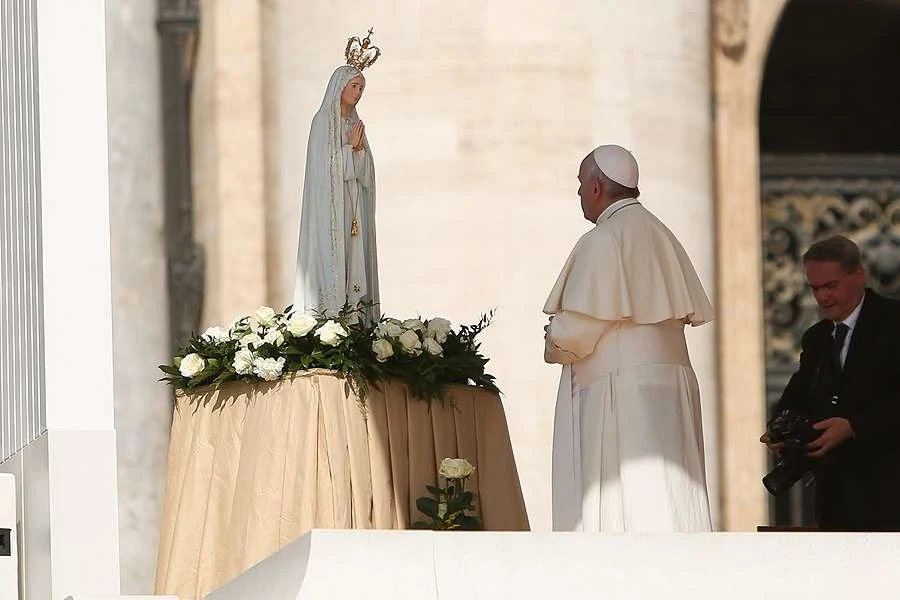
Vatican City, May 11, 2017 / 03:56 am (CNA/EWTN News).- Wednesday evening, just two days ahead of his trip to Fatima, Pope Francis sent a video message to the people of Portugal asking them to be with him during his pilgrimage, whether physically or spiritually, as he presents flowers to the Blessed Virgin Mary.

“I need to feel your closeness, whether physical or spiritual; the important thing is that it come from the heart. In this way, I can arrange my bouquet of flowers, my ‘golden rose,’” he said in the May 10 video message.

“I want to meet everyone at the feet of the Virgin Mother.”

In the message, Pope Francis said he had received many messages asking him to come to people’s homes, communities and towns during his visit, but that he was not able to accept, as much as he would like to.

He also thanked the various Portuguese authorities for being understanding about his decision to restrict his trip to only the usual events associated with a pilgrimage to Fatima, such as praying the rosary at the prayer vigil and visiting the Chapel of the Apparitions.

“Only a few days remain before our pilgrimage, mine and yours, to the feet of Our Lady of Fatima,” he said. “These are days of joy in expectation of our encounter in the home of Mary our Mother.”

“It is as the universal pastor of the Church that I would like to come before the Madonna and to offer her a bouquet of the most beautiful ‘blossoms’ that Jesus has entrusted to my care (cf. Jn 21:15-17),” he continued.

And this means everyone around the world, “none excluded,” he explained. “That is why I need to have all of you join me there.”

“With all of us forming ‘one heart and soul’ (cf. Acts 4:32), I will then entrust you to Our Lady, asking her to whisper to each one of you: ‘My Immaculate Heart will be your refuge and the path that leads you to God’ (Apparition of June, 1917).”

In the video, Francis called the meeting “our pilgrimage,” the motto for which is ‘With Mary, a pilgrim in hope and in peace.’ The program for the visit contains many opportunities for prayer and conversion of heart, he said.

“I am happy to know that in anticipation of that blessed moment, the culmination of a century of blessed moments, you have been preparing yourselves by intense prayer,” he noted. “Prayer enlarges our hearts and makes them ready to receive God’s gifts. I thank you for all the prayers and sacrifices that you offer daily for me. I need them, because I am a sinner among sinners.”

Through prayer, he said, he receives light to his eyes, which “enables me to see others as God sees them, and to love others as he loves them.”

Pope Francis makes the two-day pilgrimage to Fatima May 12-13 to celebrate the centenary of Mary’s appearance to three shepherd children in 1917.

During the trip, the Pope will also celebrate Mass, presiding over the canonization of two of the child visionaries, Francisco and Jacinta Marta.

“In his name, I will come among you and have the joy of sharing with everyone the Gospel of hope and peace,” he concluded his message. “May the Lord bless you, and the Virgin Mother protect you!”

[…]

No Picture
News Briefs

Let’s continue to grow in unity, Francis urges Coptic Orthodox patriarch

May 10, 2017 CNA Daily News 0

Vatican City, May 10, 2017 / 11:06 am (CNA/EWTN News).- Following his trip to Egypt last month, Pope Francis sent a message Wednesday to the head of the Coptic Orthodox Church, Tawadros II, expressing his hope that their Churches will continue to work toward unity in the sacraments.

“Along this path we are sustained by the powerful intercession and example of the martyrs. May we continue to advance together on our journey towards the same Eucharistic table, and grow in love and reconciliation,” Pope Francis said in his letter to the Coptic Orthodox Patriarch May 10.

“I take this opportunity to offer my prayerful best wishes for your peace and health, as well as my joy and gratitude for the spiritual bonds uniting the See of Peter and the See of Mark.”

Pope Francis’ message marked the fourth anniversary of his meeting with Tawadros II in Rome on May 10, 2013; the day has become an annual celebration of fraternal love between the Catholic and Coptic Orthodox Churches.

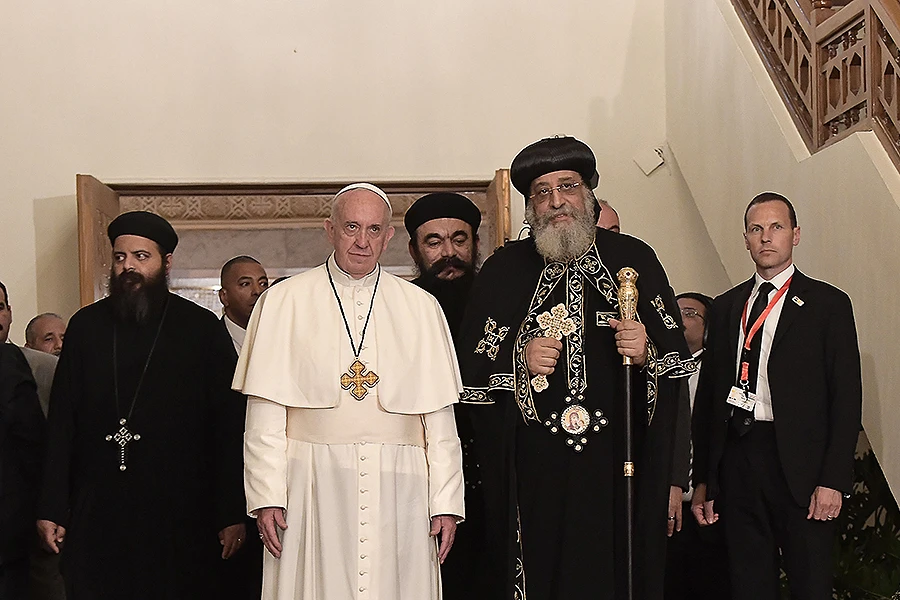
Pope Francis and the Coptic Orthodox Patriarch also met April 28 during Francis’ two-day trip to Cairo. During the encounter, the two signed a joint declaration indicating their gratitude for the chance “to exchange a fraternal embrace and to join again in common prayer.”

In his letter to the patriarch, Francis thanked the leader for his hospitality and for the common prayer they shared during the meeting.

He also noted, in particular, the agreement made that both Churches would acknowledge the validity of baptisms performed in the other Church.

Quoting from the statement, Francis said he is “especially grateful that we have strengthened our baptismal unity in the body of Christ by declaring together ‘that we, with one mind and heart, will seek sincerely not to repeat the baptism that has been administered in either of our Churches for any person who wishes to join the other.’ Our bonds of fraternity ‘challenge us to intensify our common efforts to persevere in the search for visible unity in diversity, under the guidance of the Holy Spirit’.”

The Pope also gave assurance of his continued prayers for Tawadros II and for peace in Egypt and the Middle East. He called on the Holy Spirit, especially during the Easter season, to “fill our hearts with his grace and kindle in them the fire of his love.”

“May the Spirit of peace bestow on us an increase of hope, friendship and harmony,” he continued.

He concluded the letter saying that “with these sentiments, on this special occasion which has rightly become known as the day of friendship between the Coptic Orthodox Church and the Catholic Church, I exchange with Your Holiness a fraternal embrace of peace in Christ our Lord.”

The Coptic Orthdox Church is an Oriental Orthodox Church, meaning it rejected the 451 Council of Chalcedon, and its followers had historically been considered monophysites – those who believe Christ has only one nature – by Catholics and the Eastern Orthodox, though they are not considered so any longer.

The May 2013 meeting between Francis and Tawadros marked the first visit of a Coptic Orthodox patriarch to Rome in 40 years. Shenouda III, Tawadros’ predecessor, visited Bl. Paul VI in 1973, and St. John Paul II returned the visit to Egypt in 2000.

[…]

No Picture
News Briefs

Pope: Mary’s ‘yes’ echoes the joy, suffering of every mother

May 10, 2017 CNA Daily News 0

Vatican City, May 10, 2017 / 05:56 am (CNA/EWTN News).- Days before his trip to Fatima, Pope Francis said Mary’s ‘yes’ at the Annunciation was more than a yes to bearing the Son of God, but was also an acceptance of everything she would endure after – something every mother experiences with a new child.  

“It was not easy to answer with a ‘yes’ to the angel’s invitation; yet she, a woman still in the flower of youth, answers with courage, despite not knowing anything about the fate that awaited her.”

“Mary at that moment looks like one of the many mothers of our world, brave to the extreme when it comes to welcoming in her womb the story of a new human being who is growing,” he said May 10.

Her ‘yes’ to the angel at the Annunciation was just the first step “in a long list of obedience” leading to the moment she stands at the foot of her Son’s cross, the Pope said.

During his general audience, Pope Francis centered his catechesis on the few lines from the Gospel of John that describe Mary “standing by the cross of Jesus.” Though Mary is largely a silent figure in the Gospels, she listens and “ponders every word and every event in her heart.”

“The Gospels are laconic, and extremely subtle. They record with a simple verb the presence of the Mother: She ‘was standing,’ she was standing,” he said, noting that “nothing is said of her reaction: if she weeps, if she does not weep … nothing; not even a brushstroke to describe her grief.”

Throughout history poets and painters have imagined this moment in art and literature, “but the Gospels just say, she was ‘standing.’ She was there, in the worst moment, in the cruelest time, and suffered with her son,” but “she was standing,” Francis said.

Though there had been a “slow eclipse” of her presence in the Gospels, she returns at this crucial moment when many others had fled.

“Mothers do not betray, and at that moment, at the foot of the cross, none of us can say whose was the cruelest passion; whether that of an innocent man who dies on the scaffold of the cross, or the agony of a mother who accompanies the last moments of her son’s life,” he said.

And she doesn’t get angry or protest: she simply stands and listens, Pope Francis said, pointing to the relationship between listening and the virtue of hope.

Despite everything, even the “deepest darkness,” Mary does not leave, but stands faithfully, he said. “That’s why we all love her as a Mother…We are not orphans: we have a Mother in heaven, who is the Holy Mother of God.”

Mary, he said, teaches to us “the virtue of waiting, even when everything seems meaningless: she is always confident in the mystery of God.”

Even though she didn’t know what the outcome of her Son’s Passion would be, she is loyal to the plan of God, just as she promised to the angel “on the first day of her vocation,” Francis said, explaining that it is also part of her motherly instinct to suffer for her child.

“The suffering of mothers: We have all known strong women that braved the many sufferings of their children!” he said.

Even in the first days of the Church, before Christ’s resurrection is known and the disciples are all afraid, the “Mother of Hope” stays, Francis said. “She was simply there, in the most normal of ways, as if it were a natural thing.”

Thus, he concluded, “in moments of difficulty, Mary, the Mother Jesus has given to us all, can always support our steps, can always say to our heart: ‘Get up! Look ahead, look at the horizon,’ because she is a Mother of Hope.”

[…]

No Picture
News Briefs

Vatican astronomer: If you’re afraid of science, you don’t have faith

May 10, 2017 CNA Daily News 3

Vatican City, May 10, 2017 / 03:04 am (CNA/EWTN News).- The Jesuit director of the Vatican Observatory, who has worked as an astronomer and planetary scientist at the Vatican for more than 20 years, told journalists Monday that faith and reason are hardly at odds.

“If you have no faith in your faith, that is when you will fear science,” Brother Guy Consolmagno, S.J., said May 8.

He spoke to journalists at a press conference ahead of a May 9-12 summit on “Black Holes, Gravitational Waves, and Space-Time Singularities” being held in Castel Gandolfo at the Vatican Observatory, just outside Rome.

Presser w/ Br. Guy Consolmagno (@specolations) & col. on Vatican conference on Black Holes, Gravitational Waves & Space-Time Singularities pic.twitter.com/Q8FYJMD2y5

— Hannah Brockhaus (@HannahBrockhaus) May 8, 2017

“The Vatican Observatory was founded in 1891 by Pope Leo XIII to show that the Church supports good science, and to do that we have to have good science,” Br. Consolmagno said, explaining the reasoning behind the conference.

The hope is that the encounter will foster good science, good discussion, and even friendship. Among the speakers will be a Nobel Prize winner in physics and a Wolf Prize winner.

Among the topics of papers being presented at the conference are Strong evidence for an accelerating universe; Black hole perturbations: a review of recent analytical results; and Observing the Signature of Dynamical Space-Time through Gravitational Waves.

“Those of us that are religious, will recognize the presence of God, but you don’t have to make a theological leap to search for the truth,” Br. Consolmagno said. “There are many things we know we do not understand. We cannot be good religious people or scientists if we think that our work is done.”

The summit is also taking place in recognition of Fr. Georges Lemaître, the Belgian physicist and mathematician who is widely credited with developing the “Big Bang” theory to explain the origin of the physical universe.

Addressing common misconceptions surrounding the Big Bang, such as the idea that it did away with the need for a creator, Br. Consolmagno said the solution isn’t just to put God at the beginning of things and call that good, either.

“The creative act of God is not something that happened 13.8 billion years ago,” he said. “God is already there before space and time exist. You can’t even say ‘before’ because he is outside of time and space.”

The creative act is happening continuously: “If you look at God as merely the thing that started the Big Bang, then you get a nature god, like Jupiter throwing around lightning bolts.”

“That’s not the God that we as Christians believe in,” he went on. “We must believe in a God that is supernatural. We then recognize God as the one responsible for the existence of the universe, and our science tells us how he did it.”

The organizer of the conference, Fr. Gabriele Gionti, S.J., said Fr. Lemaître always distinguished between the beginnings of the universe and its origins.

“The beginning of the universe is a scientific question, to be able to date with precision when things started. The origins of the universe, however, is a theologically charged question.”

Answering that question “has nothing at all to do with a scientific epistemology,” he added.

Br. Consolmagno commented that “God is not something we arrive at the end of our science, it’s what we assume at the beginning. I am afraid of a God who can be proved by science, because I know my science well enough to not trust it!”

“An atheist could assume something very different, and have a very different view of the universe, but we can talk and learn from each other. The search for truth unites us.”

He suggested that to demonstrate that the Church and science are not at odds, those who are both church-goers and scientists should make that fact more known to their fellow parishioners.

He threw out some practical ideas, such as setting up a telescope in the church parking lot or leading the parish’s youth group on a nature hike.

The Church, in a sense, developed science through the medieval universities she founded, he explained. For example, Bishop Robert Grosseteste, a 13th century Bishop of Lincoln and chancellor of Oxford University, helped develop the scientific method and was often cited by Roger Bacon.

“If there is a rivalry” between the Church and science, Br. Consolmagno said, “it’s a sibling rivalry.”

“And it’s a crime against science to say that only atheists can do it, because if that were true, it would eliminate so many wonderful scientists.”

[…]

No Picture
News Briefs

Vatican astronomer: If you’re afraid of science, you don’t have faith

May 10, 2017 CNA Daily News 0

Vatican City, May 10, 2017 / 03:04 am (CNA/EWTN News).- The Jesuit director of the Vatican Observatory, who has worked as an astronomer and planetary scientist at the Vatican for more than 20 years, told journalists Monday that faith and reason are hardly at odds.

“If you have no faith in your faith, that is when you will fear science,” Brother Guy Consolmagno, S.J., said May 8.

He spoke to journalists at a press conference ahead of a May 9-12 summit on “Black Holes, Gravitational Waves, and Space-Time Singularities” being held in Castel Gandolfo at the Vatican Observatory, just outside Rome.

Presser w/ Br. Guy Consolmagno (@specolations) & col. on Vatican conference on Black Holes, Gravitational Waves & Space-Time Singularities pic.twitter.com/Q8FYJMD2y5

— Hannah Brockhaus (@HannahBrockhaus) May 8, 2017

“The Vatican Observatory was founded in 1891 by Pope Leo XIII to show that the Church supports good science, and to do that we have to have good science,” Br. Consolmagno said, explaining the reasoning behind the conference.

The hope is that the encounter will foster good science, good discussion, and even friendship. Among the speakers will be a Nobel Prize winner in physics and a Wolf Prize winner.

Among the topics of papers being presented at the conference are Strong evidence for an accelerating universe; Black hole perturbations: a review of recent analytical results; and Observing the Signature of Dynamical Space-Time through Gravitational Waves.

“Those of us that are religious, will recognize the presence of God, but you don’t have to make a theological leap to search for the truth,” Br. Consolmagno said. “There are many things we know we do not understand. We cannot be good religious people or scientists if we think that our work is done.”

The summit is also taking place in recognition of Fr. Georges Lemaître, the Belgian physicist and mathematician who is widely credited with developing the “Big Bang” theory to explain the origin of the physical universe.

Addressing common misconceptions surrounding the Big Bang, such as the idea that it did away with the need for a creator, Br. Consolmagno said the solution isn’t just to put God at the beginning of things and call that good, either.

“The creative act of God is not something that happened 13.8 billion years ago,” he said. “God is already there before space and time exist. You can’t even say ‘before’ because he is outside of time and space.”

The creative act is happening continuously: “If you look at God as merely the thing that started the Big Bang, then you get a nature god, like Jupiter throwing around lightning bolts.”

“That’s not the God that we as Christians believe in,” he went on. “We must believe in a God that is supernatural. We then recognize God as the one responsible for the existence of the universe, and our science tells us how he did it.”

The organizer of the conference, Fr. Gabriele Gionti, S.J., said Fr. Lemaître always distinguished between the beginnings of the universe and its origins.

“The beginning of the universe is a scientific question, to be able to date with precision when things started. The origins of the universe, however, is a theologically charged question.”

Answering that question “has nothing at all to do with a scientific epistemology,” he added.

Br. Consolmagno commented that “God is not something we arrive at the end of our science, it’s what we assume at the beginning. I am afraid of a God who can be proved by science, because I know my science well enough to not trust it!”

“An atheist could assume something very different, and have a very different view of the universe, but we can talk and learn from each other. The search for truth unites us.”

He suggested that to demonstrate that the Church and science are not at odds, those who are both church-goers and scientists should make that fact more known to their fellow parishioners.

He threw out some practical ideas, such as setting up a telescope in the church parking lot or leading the parish’s youth group on a nature hike.

The Church, in a sense, developed science through the medieval universities she founded, he explained. For example, Bishop Robert Grosseteste, a 13th century Bishop of Lincoln and chancellor of Oxford University, helped develop the scientific method and was often cited by Roger Bacon.

“If there is a rivalry” between the Church and science, Br. Consolmagno said, “it’s a sibling rivalry.”

“And it’s a crime against science to say that only atheists can do it, because if that were true, it would eliminate so many wonderful scientists.”

[…]

No Picture
News Briefs

Kidnapped Indian priest pleads for help in new video

May 9, 2017 CNA Daily News 0

Vatican City, May 9, 2017 / 05:04 am (CNA/EWTN News).- Fourteen months after his kidnapping in March 2016, Salesian priest Fr. Tom Uzhunnalil has appeared in another video asking for help in obtaining his release, criticizing the response of a local bishop and the Indian government.

Opening with a word of thanks, Fr. Tom apparently references either a message he’s received, or the general concern surrounding his case.

“I received the message of concern that you sent to me, my dear family people. I’m thankful to you. Thank you very much,” he said in the video, published on YouTube May 8.

The video, which has not yet been authenticated, shows a cardboard sign with the date April 15, 2017, sitting on the lap of a thin-looking Fr. Tom, who appears with overgrown hair and a beard.

Speaking slowly in English, Fr. Tom said the Indian government has been contacted several times concerning his release. The bishop of Abu Dhabi in the United Arab Emirates has also been contacted, he said, claiming that he’s seen their responses, and they were “very, very poor.”

The priest indicated that he is in poor health, saying: “my health condition is deteriorating quickly, and I require hospitalization as early as possible,” he said.

He then made an appeal for his release, asking “my little family people” to do what they can “to help me be released. Please, please do what you can to help me be released. May God bless you for that.”

Fr. Tom was kidnapped in Yemen in March of last year during an attack on a Missionaries of Charity house that left 4 sisters dead. He garnered international attention last spring when rumors spread that he was to be crucified on Good Friday. Those rumors were later discredited.

A video was posted to YouTube Dec. 26, 2016, showing Fr. Tom personally appealing to Pope Francis, and bishops all over the world, for help.

“Dear Pope Francis…as a father, please take care of my life,” Fr. Tom said. The five-minute video was the first communication from Fr. Tom since his abduction. The priest had overgrown hair and spoke slowly from a prepared script.

Pope Francis did appeal for the priest’s release April 10, 2016, after his Sunday Regina Coeli address in St. Peter’s Square.

“I renew my appeal for the freeing of all kidnapped persons in armed conflict zones,” the Pope said. “In particular, I wish to remember Salesian priest Tom Uzhunnalil, who was abducted in Aden, Yemen last March 4.”

Since his kidnapping, Salesians in the Bangalore province of India have made continued efforts for his safety and release, including holding a prayer vigil Jan. 4 and a worldwide novena Jan. 15-23.

No one has claimed responsibility for the priest’s kidnapping, making it difficult for the Indian government to broker the priest’s release. In addition, the situation has been exacerbated by the political instability in Yemen.

Yemen has been embroiled in civil war since March 2015, when Shia rebels attempted to oust Yemen’s Sunni-led government. Saudi Arabia has led a pro-government coalition. Both al-Qaeda and the Islamic State have set up strongholds in the country amid the power vacuum. More than 6,000 people have been killed in the conflict, according to the United Nations.


Below is the video released of Fr. Tom, which has not been authenticated:

<iframe width=”560″ height=”315″ src=”https://www.youtube.com/embed/AGpa-tBUvuk” frameborder=”0″ allowfullscreen></iframe>

[…]

No Picture
News Briefs

Don’t let Venezuelans fall into despair, Pope tells bishops

May 8, 2017 CNA Daily News 0

Vatican City, May 8, 2017 / 04:22 pm (CNA/EWTN News).- In response to Venezuela’s violent riots, inflated prices, and political mistrust, Pope Francis urged the country’s bishops to continue promoting a culture of encounter.

“Dear brothers, I wish to encourage you to not allow the beloved children of Venezuela to allow themselves to be overcome by distrust or despair since these are evils that sink into the hearts of people when they do not see future prospects,” Pope Francis said in a May 5 letter to the bishops.

“I am persuaded that Venezuela’s serious problems can be solved if there is the desire to establish bridges, to dialogue seriously and to comply with the agreements that were reached.”

Riots have spiked in Venezuela in recent years, resulting from unemployment, food and medicine shortages, and President Nicolás Maduro’s authoritarian policies.

Price controls in 2003 caused inflation rates to sky rocket on basic necessities, baring the access of food and medicines to the people. Poor socialist policies have effected an estimated 160 products, and while they remain affordable on the shelf, they are soon swept off and sold on the black market at a triple digit inflation rate.

Violent riots have fluctuated since the death of the previous president Hugo Chavez in 2013, but gained even more traction after opposition leaders were arrested last year and Maduro’s attempt for more power by dissolving the legislature in March of this year.

Archbishop Ubaldo Santana of Maracaibo spoke gravely on the situation in an interview with Alpha and Omega news weekly earlier this year, calling it a “bloodbath of considerable proportions” fueled by riots and criminally charged activities.

“We’re talking about 30,000 people murdered a year, and if we don’t manage to find peaceful ways to understand each other, that number can increase.”

In the letter, Pope Francis commended the pastors who have shared in the suffering of their flock.

“I also know that you, dear brothers, share the situation of your people, who along with the priests, consecrated women and men and the lay faithful are suffering for the lack of food and medicines, and that some have even endured personal attacks and acts of violent acts in your Churches.”

But hunger and lack of basic necessities has also fueled violence among the people and looting has notably increased. According to The New York Times, shopping carts full of food and other supplies were stripped from supermarkets and liquor stores during riots among poor and working class communities.

Opposition leaders have also struggled with the violent riots, trying to channel the political unrest into peaceful demonstrations, but even the peaceful protests have been greeted by rubber bullets and tear gas.

Archbishop Diego Padrón Sánchez of Cumaná, President of Venzeuala’s bishop conference, said the government “carried out violence with the various persecutions conducted against different opposition leaders” in response to peaceful protests late last year.

Venezuela is noted to be one of the most politically corrupt countries in Latin America, and anger recently arose after the Supreme Court’s attempted to strip legislative power from the National Assembly. The move was identified by the United States and the United Nations as a power grab by Maduro, whose supporters hold seats in most of the court.

However, despite the political unrest the bishops have continuously called for people to avoid “any form of violence, to respect the rights of citizens and to defend and promote human dignity and fundamental rights,” Pope Francis said.  

“I urge you to continue doing everything necessary so that this difficult path may be possible, convinced that the communion among you and your priests will give you the light to find the right path.”

[…]

No Picture
News Briefs

Pope to seminarians: Let Mary help you fall in love with Jesus

May 8, 2017 CNA Daily News 0

Vatican City, May 8, 2017 / 12:05 pm (CNA/EWTN News).- Pope Francis met with priests and seminarians from the Portuguese College in Rome, asking them to allow Mary to bring them closer to Christ – just like she did for the children at Fatima.

“The meeting with Our Lady was for (the shepherd children) a graceful experience that made them fall in love with Jesus,” he said Monday.

“I must wish the same to all of you, dear friends. Above every other goal that has brought you to Rome and keeps you here, there is always this: knowing and loving Christ – As the Apostle Paul would say – trying to conform more and more to him until a total gift of self.”

Pope Francis met with priests, seminarians and religious of the Pontifical Portuguese College of Rome at the Vatican May 8.

During the audience he referenced his imminent pilgrimage to Fatima, Portugal May 12-13 for the 100th anniversary of Our Lady’s appearance to three shepherd children, or “Pastorelli,” Francisco, Jacinta and Lucia.

In their meeting, Francis encouraged the Portuguese priests and seminarians to look to the example of the child visionaries, of which two, Francisco and Jacinta, will be canonized during his trip.

“Concretely you, dear priests, are called to progress, without tire, in your Christian, priestly, pastoral, and cultural formation,” he said.

“Whatever your academic specialty, your first concern always remains to grow on the path of priestly consecration, through the loving experience of God: a close and faithful God, as Blessed Francisco and Jacinta and the Servant of God Lucia felt him.”

In Mary, the children had a “tender and good teacher,” he continued, who introduces them to the “intimate knowledge of Trinitarian love and brings them to taste God as the most beautiful reality of human existence.”

“Today, contemplating their humble and yet glorious lives, we feel enticed to entrust us, too, to the praises of the same Master,” the Pope said.

Christ invites us to look for shelter under the mantle of Mary as well, who takes us by the hand like a mother, teaching us “to grow in the love of Christ and fraternal communion.”

Pope Francis said he was pleased to hear that since 1929, the chapel of the Portuguese College has had an image of Mary hanging near the altar.

“Look at her and let her look at him,” he said, “because she is your Mother and loves you so much. Let yourself be watched by her, to learn to be humble and even more brace in following the Word of God.”

It is a relationship with Our Lady that “helps us to have a good relationship with the Church,” he explained, because “both are Mothers.”

Through Mary, you can receive the embrace of Jesus, her son, he said, and having a strong friendship with Jesus, you can learn to love each person with the measure of the Heart of Christ.

He warned those present that to lack a relationship with Mary is to be like an orphan of the heart. For a priest to forget his Mother, especially in difficult times, is a very grave absence.

Concluding, Francis offered prayers for the community and their families, and asked Our Lady of Fatima to “teach us to believe, worship, hope and love like Blessed Francisco and Jacinta and Servant of God Lucia.”

[…]