No Picture
News Briefs

At Stations of the Cross, Pope asks for grace to be ashamed of our sins
March 30, 2018 CNA Daily News 1

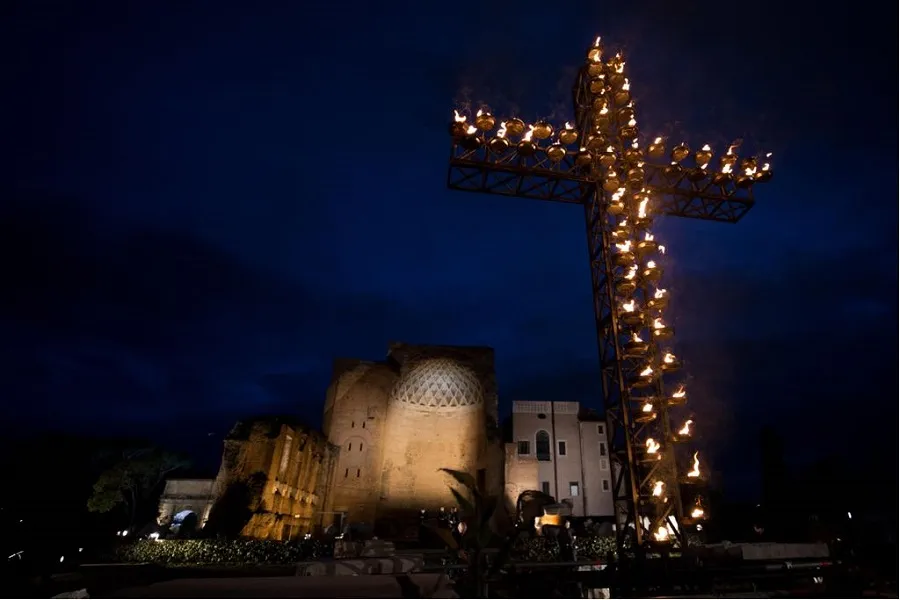
Vatican City, Mar 30, 2018 / 02:38 pm (CNA/EWTN News).- During his annual Good Friday Via Crucis at the Colosseum, Pope Francis made a heartfelt prayer asking God to give Christians the grace to be ashamed of their sins, to repent and beg for mercy, and to have hope that his love is stronger than death.

“Before your supreme love, shame pervades us for having left you alone to suffer for our sins…shame for having chosen Barabbas and not you, power and not you, appearance and not you, the god of money and not you, worldliness and not eternity,” the Pope said in his March 30 prayer.

Christians also feel shame for all the people, including some clergy, who “allowed themselves be deceived by ambition and vainglory, losing sight of their dignity and first love,” and those who have left future generations a world “fractured by divisions and wars” and “consumed by selfishness.”

Above all, Christians are ashamed “for having lost a sense of shame,” he said, and asked the Lord to “always grant us the grace of holy shame!”

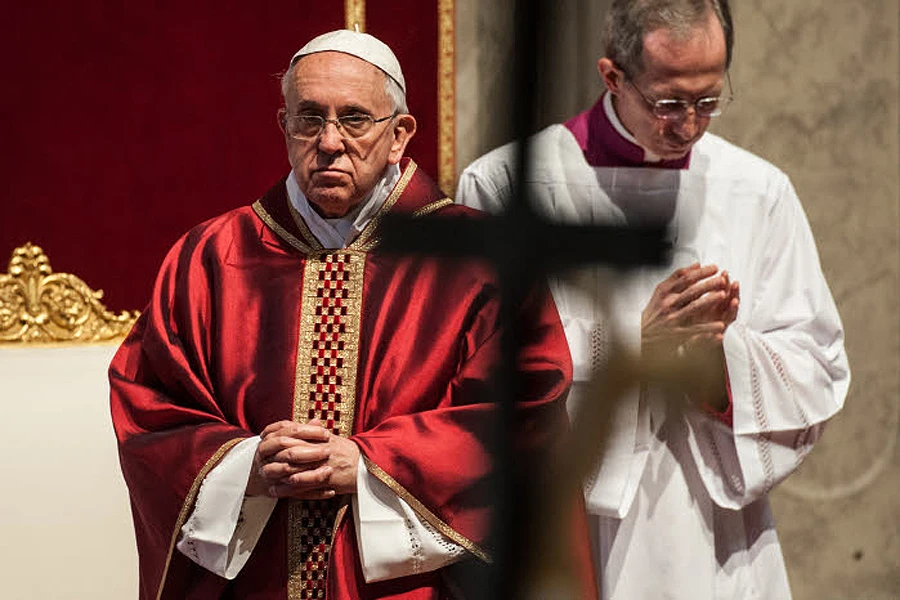
Pope Francis presided over the Stations of the Cross on Good Friday at the Colosseum – an ancient practice which dates back to the pontificate of Benedict XIV, who died in 1758. After a pause, the tradition was revived by Bl. Pope Paul VI in 1964, and under St. John Paul II it became known globally through television.

Each year the pope personally chooses someone to write the meditations for the stations. This year he asked a group of Italian high school students to write the meditations, guided by religion teacher Andrea Monda.

The meditations reflected on different themes, such as compassion, Jesus’ humanity, man’s dignity, fear of suffering, modern sensitivity to anything considered offensive, the surprises God gives and the knowledge that as Christians, we are never alone.

While in the past, the pope himself used to carry the cross from station to station, it is now carried by individuals and families. This year cross-bearers included Archbishop Angelo Donatis, the Vicar of Rome, a family of five from Syria, Dominican religious sisters from Iraq and friars from the Holy Land, among others.

In his prayer at the end of the Via Crucis, Pope Francis said that as Christians contemplate Jesus’ bloody death, they look to him with a gaze full of repentance, “which before your eloquent silence, begs for your mercy.”

This repentance, he said, “springs from the certainty that only you can save us from evil, only you can heal us from our leprosy of hate, selfishness, pride, greed, revenge and idolatry.

“Only you can embrace us by restoring our dignity as your children and rejoicing for our return home, our return to life,” he said, adding that this repentance also comes from being aware of one’s smallness and vanity, and from allowing oneself to be moved by God’s “powerful invitation to convert.”

It is the repentance of David, “who from the abyss of his suffering finds in you his only strength,” and
the repentance of Peter, “who when his eyes met yours, wept bitterly for having denied you.”

“Lord Jesus, always grant us the grace of holy repentance,” he said, but noted that despite man’s sinfulness, in front of God’s majesty “the spark of hope is lit in the darkness of our despair, because we know that your only measure for loving us is to love us without measure.”

This hope, he said, is that God’s message will continue to inspire people today with the knowledge that good and forgiveness overcome evil and the desire for revenge, and that a “brotherly embrace” can dispel “hostility and fear of the other.”

It is also a hope that Christ’s sacrifice would continue to emanate the “fragrance of divine love” that touches the young people who consecrate their lives to God, and that missionaries would continue “to challenge the slumbering consciousness of humanity,” by risking their lives to serve the poor, invisible, exploited and forgotten.

Francis said this is also a hope that the Church, which is holy and yet made up of sinners, “may continue, still today, despite all attempts to discredit it, to be a light that illuminates, encourages, uplifts and bears witness to your unlimited love for humanity.”

He prayed that the Church would be “a model of selflessness, an ark of salvation, and a source of certainty and truth.”

“Lord Jesus, always grant us the grace of holy hope!” he said, and asked Jesus to help Christians “strip ourselves of the arrogance of the unrepentant thief to your left, of the short-sighted and the corrupt” and those who saw in Jesus “another chance to put one’s own fault on others, even God.”

Closing his prayer, Francis asked Jesus to help Christians identify instead “with the good thief who looks to you with eyes full of shame, repentance and hope.”

With these eyes, the good thief “saw divine victory in your apparent defeat and knelt before your mercy, honestly stealing his way into heaven.”

[…]

No Picture
News Briefs

On Good Friday, papal preacher tells youth to run toward love of Christ

March 30, 2018 CNA Daily News 1

Vatican City, Mar 30, 2018 / 10:06 am (CNA/EWTN News).- Papal preacher Fr. Raniero Cantalamessa dedicated his Good Friday homily to young people, comparing them to the apostle John and urging them to have the courage to go in the opposite direction of the selfishness of the world, running instead toward the sacrificial love of Jesus on the cross.

In his March 30 homily, Cantalamessa said modern society has come “under the dominion of Satan and sin,” and has been taken over by what St. Paul in his Letter to the Ephesians called the “spirit of the air.”

Cantalamessa said the phrase takes on a literal meaning today, because this spirit “spreads itself in infinite ways electronically through airwaves,” and plays a major role in shaping public opinion.

“To act, think or speak against this spirit is regarded as non-sensical or even as wrong and criminal,” he said, adding that the best way to ensure that one has not conformed to this world is by going in the opposite direction, walking toward suffering, and toward “the poor and those at the lowest level of society,” rather than away from them.

“Blending in with this world of suffering and marginalization is, paradoxically, the best way of ‘separating’ ourselves from the world because it means going in the direction from which the world flees as much as it can. It means separating ourselves from the very principle that rules the world, self-centeredness,” he said.

To drive his point home, Cantalamessa quoted British poet T.S. Eliot, saying “in a world of fugitives / The person taking the opposite direction / Will appear to run away.”

“Dear young Christians, if you will allow an old man like John to address you directly, I would exhort you: be those who take the opposite direction! Have the courage to go against the stream,” he said, adding that “the opposite direction for us is not a place but a person; it is Jesus, our friend and redeemer.”

Fr. Cantalamessa is the official papal preacher. He offers meditations to the pope and members of the Curia on Fridays during Advent and Lent, and he preaches the homily for the Good Friday veneration liturgy.

After the chanting of the Gospel during the liturgy for the Lord’s Passion in St. Peter’s Basilica, presided over by Pope Francis, Cantalamessa in his homily reflected on why the Church places such a strong emphasis on the cross of Christ.

He said that according to one theory, it could be because God reveals himself “sub contraria specie,” meaning in a form contrary to what he actually is: “he reveals his power in weakness, his wisdom in foolishness, his riches in poverty.”

However, this logic does not apply to the cross, he said, because on the cross God reveals himself “as he really is, in his most intimate and truest reality.” And this reality, he said, is that “God is love…oblative love, a love that consists in self-giving, and only on the cross does God’s infinite capacity for self-gift manifest the length to which it will go.”

With a Synod of Bishops dedicated to youth on the schedule for this October, Cantalamessa said the presence of St. John with Jesus on Calvary holds special significance, since it is believed that the evangelist joined Jesus when he was still a young man.

Noting how John is often referred to in scripture as “the disciple whom Jesus loved,” the papal preacher said this was a real and personal experience of “falling in love” with the Lord that can be seen from the fact that the whole of John’s Gospel focuses on the person of Jesus, rather than his works and teaching.
Cantalamessa said St. John was almost certainly one of the two disciples of John the Baptist who, when Jesus passed them on the beach, followed him and spent the day with him. He noted how when they asked Jesus where he was staying, “it was about the tenth hour.”

“That hour decided the course of John’s life, and he never forgot it,” Cantalamessa said, and stressed the importance of helping young people today understand not only what God and the Church expect of them and what they can offer to the Church and to society, but also to help youth understand what Jesus himself can offer to them.

He pointed to how John described his experience with Jesus as the “fullness of joy” and an “abundant life,” and urged members of the Church to accept Francis’ invitation in Evangelii Gaudium to “a renewed personal encounter with Jesus Christ, or at least an openness to letting him encounter them.”

“I ask all of you to do this unfailingly each day. No one should think that this invitation is not meant for him or her, since no one is excluded from the joy brought by the Lord,” he said, continuing to quote Francis.

Cantalamessa said it is possible to encounter Christ today because He is risen and alive, and that after this personal encounter takes place, “everything is possible.”

Speaking directly to youth, the papal preacher said they have a special mission “to rescue human love from the tragic drift in which it had ended up: love that is no longer a gift of self but only the possession – often violent and tyrannical – of another.”

Pointing to the self-sacrificial “agape” love shown by Jesus on the cross and the desiring, “eros” love that “welcomes, that pursues, that desires, and that finds joy in being loved in return,” Cantalamessa said these two types of love are linked, and cannot be separated from each other.

God both desires man and exercises charity toward him, he said, explaining that learning how to love like God “is not a question of renouncing the joys of love, attraction, and ‘eros,’ but of knowing how to unite ‘eros’ and ‘agape’ in the desire for another, the ability to give oneself to the other.”

Learning how to do this will not happen “in one day,” he said, and told youth to start preparing themselves now to give themselves either to another person in marriage, or to God in a consecrated vocation.

This preparation, he said, can begin now with something as simple as a smile or a gift of one’s time or service in one’s family, parish or volunteer work, which “so many of you are already quietly doing.”


[…]

No Picture
News Briefs

Analysis: Francis, China, and the art of the deal

March 28, 2018 CNA Daily News 1

Vatican City, Mar 28, 2018 / 12:00 pm (CNA).- If Vatican-brokered agreements negotiated under his leadership are any indication, it seems clear that when a deal is on the table, Pope Francis usually tries to take it.

In Colombia, with the U.S. and Cuba, and in China, it seems that Francis generally prefers to take an imperfect patch job that might at least begin to restore broken ties, even if it faces opposition, rather than waiting for perfect diplomatic agreement to arise.

A clear example of this is the Vatican’s pending agreement with China on the appointment of bishops, which many sources, including the Vatican’s own Secretary of State, Cardinal Pietro Parolin, have said is “imminent.”

In negotiations with China, the Vatican is reportedly using an approach similar to the one that led to a 1996 accord Parolin brokered with Vietnam. In China, the Holy See would apparently have the final say in appointing bishops, choosing from a selection of candidates put forward by the government-backed Chinese Catholic Patriotic Association, the legally recognized Catholic body in the nation.

The proposal has been harshly criticized by some, including Bishop Emeritus of Hong Kong Cardinal Joseph Zen. However, many, including Zen’s successor Cardinal John Tong Hon, himself also Emeritus Bishop of Hong Kong, have supported an accord, saying the situation for religion in China has generally improved, and that while there might be problems in some areas, China is a large nation, and incidents of arrest or imprisonment are generally rare and limited to certain regions.

Similar conversations happened when the Vatican helped the Colombian government and leaders of the Revolutionary Armed Forces of Colombia (FARC) reach a peace agreement in September 2016, intended to an end five decades of violent armed conflict that left some 260,000 people dead and millions displaced.  

The Vatican helped to broker the agreement, which allowed the incorporation of some FARC leaders into the government, in exchange for the group’s disarmament and renunciation of kidnapping and drug trafficking.

The deal marked a breakthrough in what had been a long-time stalemate in which neither side was willing to budge.

However, it was met with mixed reactions from Colombian citizens and Church leaders, with some priests, bishops, and cardinals voicing dissatisfaction, arguing that the deal’s stipulations were too lenient on the guerrilla fighters.

Though voters rejected the deal in an October 2016 referendum, the Colombian government and FARC renegotiated its terms, implementing a plan in November 2016. Colombian president Juan Manuel Santos Calderón was awarded the Nobel Peace Prize for his efforts in the peace process.

Despite debate on the ground, Cardinal Parolin traveled to Colombia for the official signing of the accord in a show of support, and in September 2017 Pope Francis visited Colombia himself, making a 6-day trip to the South American nation to recognize steps made in the peace process.

The peace deal remains controversial, and critics note that 250 activists and political leaders have been murdered in Colombia since the agreement was struck. But there remain opportunities to build on the groundwork laid by the accord.

Francis was also an active player in helping broker the 2015 restoration of ties between the United States and Cuba, bringing an end to a freeze in diplomatic relations severed in 1961.

Secret talks between diplomats from each side began in 2013, and were aided by support from the Vatican.

The Vatican’s role was largely unknown until the process had already been mostly formalized, but the Vatican’s role in helping broker the deal was significant.

Francis showed just how invested the Holy See was in restoring relations between the two nations that he added a stop in Cuba ahead of his visit to the United States in September 2015.

For the China deal currently being discussed, the biggest concern is how much religious freedom Catholics will actually have if it’s signed and implemented.

Opponents such as Cardinal Zen have questioned whether it’s possible to have genuine dialogue with the Chinese government, and whether Beijing will in fact allow Catholics to have a longer leash should a deal come to fruition.

However, others, such as Cardinal Tong, have argued that China is a large country where incidents of arrests or imprisonments are largely isolated to certain areas.

Cardinal Zen has often said that “no deal is better than a bad deal,” and in a recent blog-post called the proposal an act of “suicide” and a “shameless surrender” to the communist government.

On the other hand, in an interview with CNA last week, Cardinal Tong said opposing the deal was “unreasonable.” He argued that the Chinese government has generally become more tolerant, and called the deal “far-sighted,” saying that at times, sacrifice is necessary in order for Catholics to become “members of one family.”

Compounding the debate is yesterday’s arrest of Bishop Vincent Guo Xijin of Mindong, who is recognized by the Vatican but not the government, and who was taken into custody by police alongside the diocesan chancellor. He was held overnight but was later released, and was barred from celebrating any Mass as a bishop, including Holy Week liturgies.

According to Asia News, Guo was detained for refusing to concelebrate this week’s Chrism Mass with Bishop Vincent Zhan Silu, one of seven illicit bishops backed by the Chinese government.

Asia News reports that after refusing to concelebrate the Chrism Mass with Zhan, Guo organized a separate, earlier Chrism Mass for the “underground” faithful in Mindong, who form the majority of the local Church, and was seized in order to prevent him from moving forward with the liturgy.

In January, Asia News reported that a Vatican delegation asked Bishop Guo voluntarily to accept a position as auxiliary bishop, serving under Bishop Zhan. The request was made as one of the conditions of an eventual agreement between the Vatican and the Chinese government.

Details or an official timeline for a deal in China have not been made public, and no declaration has been made on the seven illicit bishop, meaning that for the moment, they are still excommunicated. Under the terms of the proposed deal, the Vatican would reportedly regularize each of the seven illicit bishops, bringing them into communion with Rome.

Though it is unknown what impact, if any, Guo’s overnight detainment will have on an agreement between China and the Vatican, many who are close to the situation, including Cardinal Parolin, have in recent weeks said things are moving forward, and it may only be a matter of months before a deal is made.

Cardinal Zen recently met with Pope Francis during a last-minute trip to Rome in January, after Guo and another bishop were asked to step down in favor of bishops backed by the Chinese government.

Francis’ willingness to meet with Cardinal Zen, just as he met with many Colombian prelates ahead of the 2016 peace deal, some of whom shared reservations, indicates that he is willing to hear out other perspectives on these matters, and talk things through, even if he chooses to move forward anyway.

So while a deal with China, if it is made, will certainly be met with mixed reactions, one thing is certain: there is likely not much that will stop Francis from going after it, so long as he sees the potential of real change for the better.

For Francis, something is always better than nothing, and if there’s a shot, even with problems unresolved, he prefers to try. Whether this approach bears good fruit or not, we can probably expect to Francis to have a similar approach moving forward.


[…]

No Picture
News Briefs

Kiss from Pope Francis a wish come true for boy with Down syndrome

March 28, 2018 CNA Daily News 0

Vatican City, Mar 28, 2018 / 10:07 am (CNA/EWTN News).- When Peter Lombardi was diagnosed with leukemia in 2015, his wish was to get a kiss from Pope Francis, but his family’s plans to see him at the World Meeting of Families in Philadelphia fell through when Peter was in the hospital.

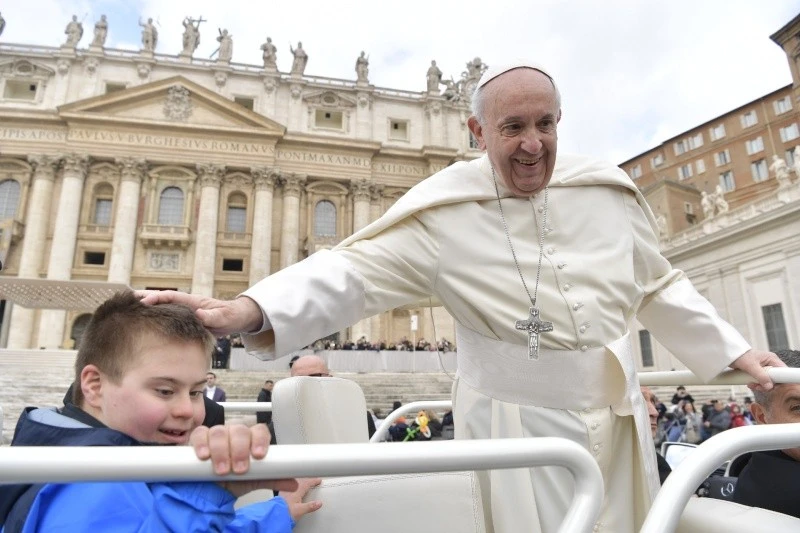
His wish came true March 28 when Francis saw Peter, 12, who has Down syndrome, in the crowd of people and stopped the popemobile to have him lifted in. Peter not only got a kiss from the Pope, but a blessing, and a ride twice around the crowded square during the General Audience in St. Peter’s Square.

“If the Pope could have just waved to him I would have been happy,” Peter’s mother, Brenda, told CNA. Peter said that he likes the Pope and that getting a kiss from him made him feel better.

“I rode with him and he gave me a kiss and blessing,” he said. He was also happy to have received a balloon animal after the experience.

In remission since June, Peter is visiting Rome and Medjugorje for two weeks with his parents, Brenda and Matt, and his three brothers, “to thank our Lord for his healing and to thank the Blessed Mother; for their faithfulness, for their love and mercy upon our family,” Brenda said.

“God protected him throughout his leukemia,” she continued. “God’s mercy is so infinite and his grace through the heavy crosses are even bigger and better in the end when you put your trust in him.”

Peter originally asked for the kiss from Pope Francis when he was sick and watching the Pope on TV from the hospital. Brenda recounted how the people from the Make-A-Wish Foundation came into Peter’s room and asked him what he wanted.

They were really surprised, she noted, when he said, “see that man on TV, kissing all those kids? I want a kiss from him!”

While the Make-A-Wish Foundation could not grant that one, his other wish will be granted soon: a lightsaber fight with Darth Vader at Walt Disney World.

[…]