No Picture
News Briefs

Pope Francis: We should leave every Mass better than when we went in

April 4, 2018 CNA Daily News 1

Vatican City, Apr 4, 2018 / 03:31 am (CNA/EWTN News).- On Wednesday Pope Francis said the Eucharist is key to living an authentic Christian witness, and that those who leave Mass unchanged, continuing to gossip or hold onto unholy habits, have missed the point.

“While the Mass ends, the commitment for Christian witness opens. We leave the church to go in peace to bring the blessing of God to our daily activities, to our homes, to our work, to the affairs of the earthly city, glorifying the Lord with our lives,” the pope said April 4.

The Mass, he said, is not just a weekly commitment that can be forgotten about once people go out the church doors.

“No. Christians go to Mass to participate in the passion, death and resurrection of the Lord, and to live as better Christians,” he said. “If we leave the church gossiping” or talking badly about other people, then “the Mass didn’t enter into my heart, because I am not capable of living Christian testimony.”

“Every time I leave Mass I must leave better than I went in,” he said, adding that the Eucharist should leave a person with a better heart, a better spirit and “a stronger desire to live as a Christian.”

Pope Francis spoke to pilgrims in a rainy St. Peter’s Square for his weekly general audience, which this week fell during the Octave of Easter and was dedicated to his last round of catechesis on the Mass.

Francis opened with an aside wishing pilgrims a happy Easter and saying the flowers adorning the facade of St. Peter’s Basilica are representative of the joy and happiness that blossom after Christ’s resurrection.

He asked pilgrims to join him in wishing retired Pope Benedict XVI — who he said was watching the audience on television — a happy Easter, and told them to give his predecessor a big round of applause.

In his speech, the pope focused on the concluding rite of Mass, in which believers are told to “go in peace to love and serve the Lord.”

The Mass, particularly with this commission, “finds fulfillment in the concrete choices one makes [and] involves us first-hand in the mysteries of Christ,” he said.

“We cannot forget that we celebrate the Eucharist to learn to become Eucharistic men and women,” he said, explaining that this means allowing Christ to act in and through the choices one makes, taking on his thoughts, feelings and actions.

St. Paul expresses this clearly when he speaks of his own assimilation to Jesus, saying he no longer lives, but Christ lives in him, Francis said, explaining that the apostle’s experience “also illuminates us.”

“In the measure in which we mortify our egoism, meaning we allow what opposes the Gospel and the love of Jesus to die, greater space is created in us for the power of his Spirit,” he said.

And while the liturgy is a prime way to gain great unity with Jesus, Francis noted that the presence of Christ in the consecrated bread and wine “does not end with the Mass.” Rather, the Eucharist is kept in the tabernacle in order to give communion to the sick who are unable to attend Mass, and it is also kept for moments of “silent adoration” through the exposition of the Blessed Sacrament.

“Eucharistic worship outside of the Mass, whether in private or in community, helps us to remain in Christ” and imitate his words and actions, Francis said, adding that Christians are men and women “who allow their soul to grow with the strength of God.”

“Not these small, tight, egoistic souls,” he said, but “great souls” who allow themselves to grow with the strength of the Holy Spirit and after being washed by the body and blood of Christ.

The Eucharist also separates us from sin, he said, because “the more we participate in the life of Christ and progress in his friendship, the more difficult it is to separate ourselves from him with mortal sin.”

Community is also an essential element of the Mass, he said, because the Eucharist “makes the Church,” and ought to lead to an increased commitment in service of the poor, who bear the flesh of Christ.

Pope Francis closed his audience asking pilgrims to give thanks to the Lord “for the path of rediscovering the holy Mass which he has given us to walk together,” and prayed that each person would allow themselves “to be attracted with a renewed faith to this real encounter with Jesus, died and risen for us.”

“May our lives always flourish like this, like Easter, with flowers of hope and good works, that we always find the strength for this in the Eucharist, in union with Jesus.”

[…]

The Dispatch

Hell and Pope Francis

April 2, 2018 Mark Brumley 83

Let’s hope the lesson regarding Mr Scalfari has finally been learned so we don’t see further international headlines recounting this or that alleged contradiction by […]

No Picture
News Briefs

Death doesn’t have the final word, Pope Francis says on Easter

April 1, 2018 CNA Daily News 1

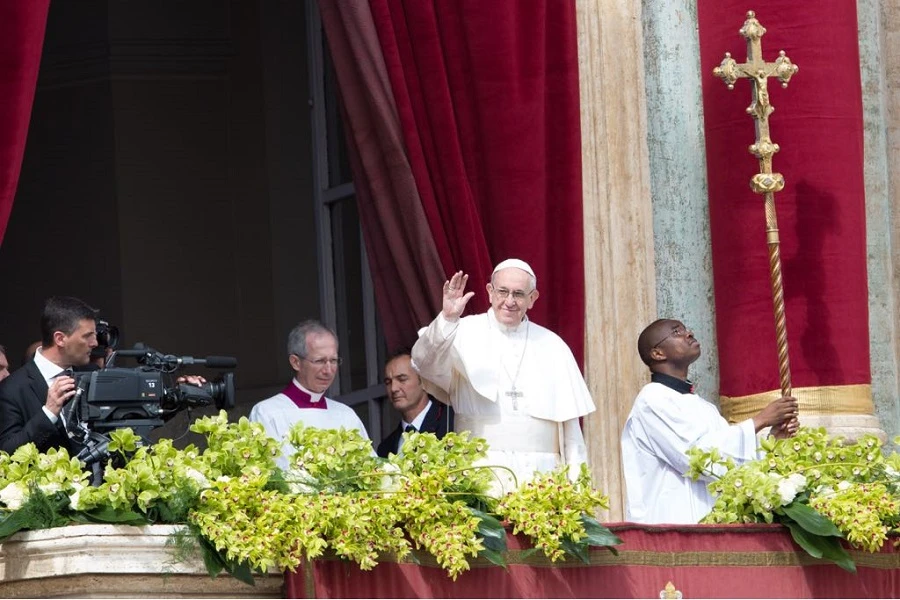
Vatican City, Apr 1, 2018 / 04:25 am (CNA/EWTN News).- During his Urbi et Orbi Easter blessing, Pope Francis said Jesus’ death and resurrection provide hope to a world marred by conflict, proving that modern tragedies such as war and violence won’t have the final say.

“We Christians believe and know that Christ’s resurrection is the true hope of the world, the hope that does not disappoint,” the Pope said April 1, Easter morning.

Like the parable Jesus told of the grain of wheat which has to die before bearing fruit, Francis said that “it is the power of the grain of wheat, the power of that love which humbles itself and gives itself to the very end, and thus truly renews the world.”

“This power continues to bear fruit today in the furrows of our history, marked by so many acts of injustice and violence,” he said, and pointed to the plight of migrants and refugees, and victims of the drug trade, human trafficking and other forms of modern slavery.

He asked for peace throughout the world, especially in the “long-suffering” nation of Syria, “whose people are worn down by an apparently endless war.”

“This Easter, may the light of the risen Christ illumine the consciences of all political and military leaders, so that a swift end may be brought to the carnage in course, that humanitarian law may be respected” in order to facilitate access to aid, and to allow those who have been displaced to return to their homes.

Pope Francis also prayed for the Holy Land, which in recent days has seen an increase in violence, for Yemen and for the entire Middle East, “that dialogue and mutual respect may prevail over division and violence.”

“May our brothers and sisters in Christ, who not infrequently put up with injustices and persecution, be radiant witnesses of the risen Lord and of the victory of good over evil.”

He also prayed for those who yearn for “a more dignified life,” specifically children and those from areas in Africa that suffer from hunger, violence and terrorism, such as the Democratic Republic of the Congo and South Sudan.

Francis also prayed for the process of peace and dialogue on the Korean peninsula, and for Ukraine, that humanitarian aid would be able to reach the people and that recent steps to promote peace and harmony in the nation would be “consolidated.”

Turning to Venezuela, Pope Francis said citizens are living “in a kind of foreign land within their own country,” and prayed that with the grace of the resurrection, the nation would be able to find “a just, peaceful and humane way to surmount quickly the political and humanitarian crises that grip it.”

Prayers were also offered for children who lack education as a result of war, for elderly who have been “cast off by a selfish culture that ostracizes those who are not productive,” and for world leaders, that they “may always respect human dignity, devote themselves actively to the pursuit of the common good, and ensure the development and security of their own citizens.”

Pope Francis closed his address repeating the question the angel posed to the women who came to the tomb and found it empty, asking: “Why do you seek the living among the dead? He is not here, but has risen.”

“Death, solitude and fear are not the last word.” he said. “There is a word that transcends them, a word that only God can speak: it is the word of the resurrection.”And by the power of God’s love, “it dispels wickedness, washes faults away, restores innocence to the fallen, and joy to mourners, drives out hatred, fosters concord and brings down the mighty.”

[…]

No Picture
News Briefs

On Easter, Pope asks: How will you respond to the resurrection?

April 1, 2018 CNA Daily News 0

Vatican City, Apr 1, 2018 / 03:30 am (CNA/EWTN News).- On Easter morning Pope Francis said God’s announcement to his people always comes as a surprise, like the shock of the disciples who found Jesus’ tomb empty after his resurrection, and told Christians not to waste time responding to the good news they’ve been given.

“The announcements of God are always a surprise, because ours is a God of surprises,” the Pope said April 1, on Easter morning. “From the beginning of the history of salvation, from Abraham, who God tells to ‘go, get up and go to the land I send you to,’ there’s always one surprise after another.”

“God doesn’t know how to make an announcement, a proclamation without surprising us,” he said, “and that surprise moves your heart, it touches you. It happens when you don’t expect it.”

Francis also spoke of the haste with which the women and the disciples in John’s Gospel responded when they heard news of the empty tomb and Jesus’ resurrection, and he posed a question to those present for the Mass, asking “what about you?”

“What about me? Is my heart open to God’s surprises?” he said, urging Christians to ask themselves: “Am I able to go with great haste, or do I stay back and say, ‘I’ll go tomorrow’?”

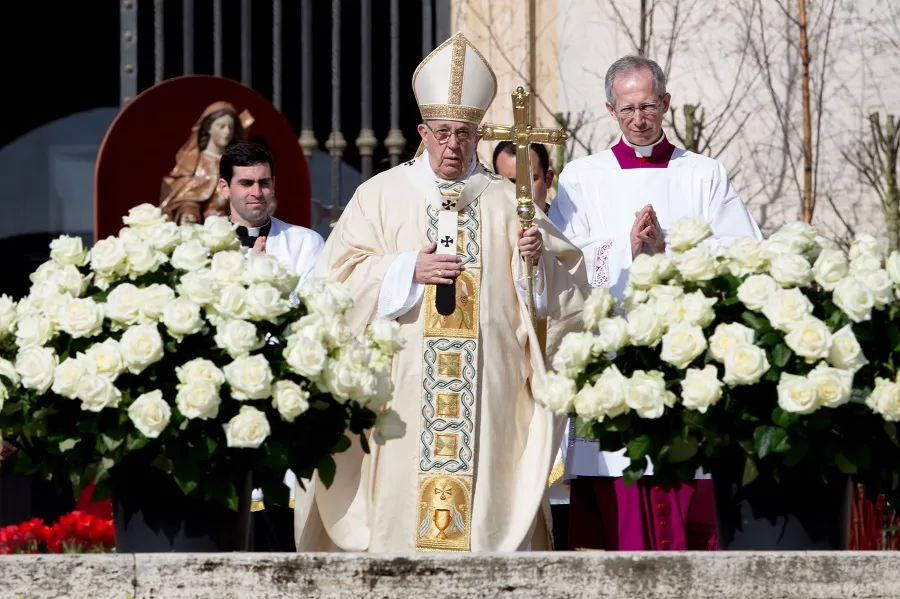
Pope Francis celebrated Easter Mass in St. Peter’s Square after presiding over the Easter Vigil inside the basilica the night before, bringing a close to the Easter Triduum and the events of Holy Week.

The altar during Mass was bedecked with some 50,000 flowers of different varieties, which were a gift from florists in Holland.

Though he usually sticks to his text during formal liturgies, Francis did not prepare a homily for Easter morning, and spoke to pilgrims in brief, off-the-cuff remarks. He did the same thing last year, meaning a spontaneous reflection Easter morning could be a new trend for the Argentine pope.

In his short homily, the pope focused on three aspects of the day’s Gospel passage from John, in which Peter and John run to the tomb after Mary Magdalene tells them she found it empty earlier that morning.

The three aspects Pope Francis focused on are the surprise of the announcement, the haste with which the women and the disciples ran to the tomb, and the personal response of each

Please see below for the full text of Pope Francis’ homily:

After having listened to the word of God, this passage from the Gospel, I want to say three things. First, the announcement: the Lord is Risen. That proclamation, that from the tine of the early Christians they would greet each other this way: the Lord is risen! And the women that were there to anoint the Lord’s body, they found themselves in front of a surprise. The surprise. The announcements of God are always a surprise, because ours is a God of surprises. So from the beginning of the history of salvation, from Abraham, who God tells to ‘go, get up and go to the land I send you to,’ there’s always one surprise after another. God doesn’t know how to make an announcement, a proclamation without surprising us. And that surprise moves you heart, it touches you. It happens when you don’t expect it. It’s a surprise from ‘down low’, it takes you off guard. God’s announcement was a surprise.

The rush, the women ran, they went in a hurry to get to the tomb, to say ‘we found this!’ The surprises of God put us on the path, on the journey right away, without waiting. So they run to see, and Peter and John, they run. The shepherds, the night of Christmas when Jesus was born in Bethlehem, ran…the Samaritan woman runs to tell her people, ‘this is new, I met a man who told me everything I have ever done!’ These people run, they leave what they’re doing. The housewife leaves the potatoes in the pot, and they’ll be burned, but it’s important to run, to see that surprise that announcement. Today this also happens to us in our neighborhoods, when something happens and people go to see it. People go with great haste. Andrew didn’t waste time and he went to Peter to say: ‘we found the Messiah!’ The surprises, the good news, are always given like this, with great haste. But in the Gospel there is a person who takes their time, who doesn’t want to take a risk, but the Lord is good, and he waits for him with great love. This is Thomas, who said ‘I’ll believe when I see his wounds.’ The Lord is patient with those people who do not get up and leave with great haste.

Thirdly, is a question: and me, what? What about me? Is my heart open to God’s surprises? Am I able to go with great haste, or with that chant, do I stay back and say ‘I’ll go tomorrow’? What is the surprise saying to me? John and Peter, they ran to the tomb. John in his Gospel, tells us to believe. Even Peter, believed, but in his own way, with that faith that is a bit mixed with remorse for having denied the Lord. The announcement that has made a surprise, to run and go with great haste, and the question: what about me, today, in this Easter in 2018? What about me? What about you?

[…]