No Picture
News Briefs

Cardinal Levada, former CDF prefect, dies aged 83

September 26, 2019 CNA Daily News 1

Vatican City, Sep 26, 2019 / 08:21 am (CNA).- Cardinal William Levada, the former prefect of the Congregation for the Doctrine of the Faith, died Wednesday, Sept. 25 at the age of 83. He was the first American to lead the Congregation for the Doctrine … […]

No Picture
News Briefs

Pope Francis says slander is a ‘diabolical cancer’

September 25, 2019 CNA Daily News 5

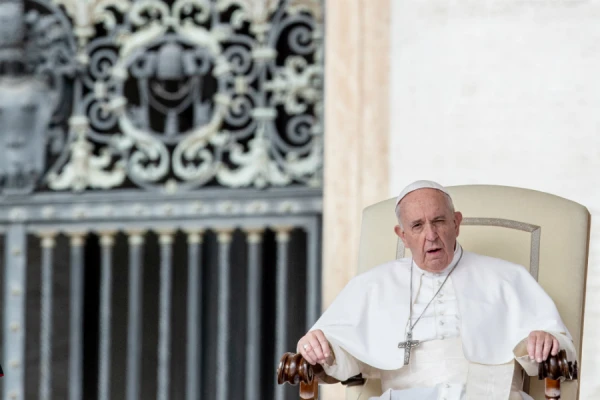
Vatican City, Sep 25, 2019 / 05:30 am (CNA).- Pope Francis said Wednesday that slander is a ‘diabolical cancer’ that seriously damages the Church.

“We know that slander always kills. This ‘diabolical cancer,’ which arises from the desire to destroy a person’s reputation, also attacks the rest of the ecclesial body,” Pope Francis said Sept. 25 in his general audience in St. Peter’s Square.

The pope warned that slander seriously damages the Church when “there is a coalition to smear someone” due to “petty interests or to cover up their own inadequacies.”

The Catholic Church teaches that the sins of slander, or calumny, involve remarks contrary to the truth that harm the reputation of others and give occasion for false judgments concerning them.

“To avoid rash judgement, everyone should be careful to interpret insofar as possible his neighbor’s thoughts, words, and deeds in a favourable way,” paragraph 2478 of the Catechism of the Catholic Church states.

“Honor is the social witness given to human dignity, and everyone enjoys a natural right to the honor of his name and reputation and to respect. Thus, detraction and calumny offend against the virtues of justice and charity,” the catechism states.

Pope Francis pointed to the Sanhedrin’s false witnesses and accusations made against Jesus before his crucifixion, and the slanders against Christian martyrs throughout history.

He focused on the Acts of the Apostles account of St. Stephen’s strong words in response to his slanderers’ before his martyrdom.

“Stephen bravely denounces the hypocrisy with which the prophets and Christ himself have been treated,” Francis said. “He speaks clearly, he tells the truth.”

“This causes the violent reaction of the listeners, and Stephen is sentenced to death, sentenced to stoning,” he added.

Pope Francis noted that Stephen did not “look for loopholes” or “appeal to personalities who could save him” after his death sentence, but instead “put his life back into the Lord’s hands.”

“Stephen’s prayer is beautiful at that moment: ‘Lord Jesus, receive my spirit,’” he said.

“He died as a son of God, forgiving: ‘Lord, do not hold this sin against them.’ These words of Stephen teach us that it is not fine speeches that reveal our identity as children of God, but only the abandonment of one’s life in the hands of the Father and forgiveness for those who offend us, who see the quality of our faith,” Pope Francis said.

The pope said that the Acts of the Apostles also recounts “the emergence of some problems within the Christian community.”

“There have always been problems,” the pope said.

The apostles had to determine how to harmonize the differences that coexisted within the early Christian community “without conflicts or splits happening,” he said.

“The Apostles begin a process of discernment which consists in considering the difficulties well and seeking solutions together,” Pope Francis explained. “They find a way out in dividing up the various tasks for peaceful growth of the entire ecclesial body and  avoiding neglecting both the ‘race’ of the Gospel and the care of the poorest members.”

The pope said that martyrdom also ensured the growth and fruitfulness of the People of God.

“We also ask the Lord that, looking at the martyrs of yesterday and today, we can learn to live a full life, welcoming the martyrdom of daily fidelity to the Gospel and of conformation to Christ,” Pope Francis said.

[…]

No Picture
News Briefs

Vatican office temporarily suspends sanctions against Indiana Jesuit school

September 23, 2019 CNA Daily News 4

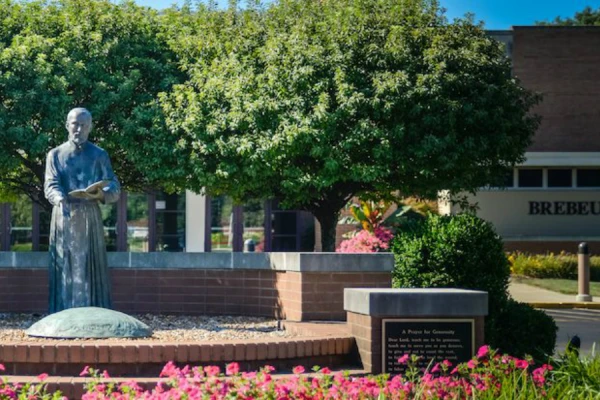
Vatican City, Sep 23, 2019 / 04:07 pm (CNA).- The Vatican’s Congregation for Catholic Education has temporarily suspended a decree from the Archbishop of Indianapolis that revoked the Catholic identity of a Jesuit high school. The suspension will have effect while the congregation considers an appeal of the decree.

The June 21 decree from Archbishop Charles Thompson said the archdiocese would no longer recognize Brebeuf Jesuit Preparatory School as Catholic, after a disagreement about the school’s employment of a teacher who attempted to contract a same-sex marriage.

Fr. Brian Paulson, SJ, head of the Jesuits’ Midwest Province, has led the appeal of the archbishop’s decree. After Thompson declined to rescind the decree, Paulson turned to the Congregation for Catholic Education to consider the matter.

The president of Brebeuf, Fr. Bill Verbryke, SJ, said Sept. 23 that the congregation “has decided to suspend the Archbishop’s decree on an interim basis, pending its final resolution of our appeal.”

Verbryke added that “It is very important to understand, however, what this temporary suspension of the Archbishop’s decree does NOT mean. It does not mean that the matter has been resolved, or that any permanent decision has been made. It also does not mean that anyone should infer that the Congregation for Catholic Education is leaning one way or the other on any of the issues at hand.”

“The Congregation has simply granted a temporary suspension of the Archbishop’s decree until it makes a final decision,” Verbryke explained in a message to the school community.

Verbryke noted that Thompson had “very kindly informed me that, as a result of this temporary suspension of his decree, Brebeuf is free to resume our normal sacramental celebrations of the Eucharist.”

The archbishop had already granted permission for daily Masses to be said at the school’s chapel, but had denied permission for Masses offered on particular occasions, such as an Aug. 15 “Mass of the Holy Spirit as a traditional opening-of-the-school-year- Mass.”

The school’s president said it is unknown how long the appeal process will last, “but please be assured that we are sincere in our desire to resolve our disagreement with the Archbishop and resume the strong relationship we had always enjoyed with the Archdiocese since our founding in 1962.”

He emphasized that the “process is ongoing in an environment of not only deep love for our Church, but also, despite our differences on this matter, deep respect for the Archbishop. Ultimately, our desire is to remain in full communion with the Catholic Church, without restrictions on our celebration of the Eucharist, and that our identity as a Catholic school be fully recognized and supported by the Archdiocese.”

Kris Mackey, advancement and communications director for the Jesuits’ Midwest province, told CNA that Verbryke’s letter “mirrored the letter” received from the Congregation for Catholic Education.

She added that the congregation’s suspension of Thompson’s decree was made at the congregation’s discretion, and that adjacent to its appeal, the province “had asked for the suspension during the time that the decision-making is happening.”

While the congregation “granted yes to the suspension,” Mackey reflected, “of course they’re discerning,” and how long the appeals process will last is unknown.

“The two are kind of unrelated,” she said. The suspension does not indicate the congregation is more likely to rule one way or another.

In a statement, the Archdiocese of Indianapolis said that the temporary suspension was “following standard canon-law procedures,” and that “this is a common, temporary, measure that does not affect a final determination.”

The local Church added that it awaits a final determination from the Congregation for Catholic Education.

The archdiocese had announced June 20 that “every archdiocesan Catholic school and private Catholic school has been instructed to clearly state in its contracts and ministerial job descriptions that all ministers must convey and be supportive of all teachings of the Catholic Church.”

Teachers, the archdiocese said in June, are classified as ministers because “it is their duty and privilege to ensure that students receive instruction in Catholic doctrine and practice. To effectively bear witness to Christ, whether they teach religion or not, all ministers in their professional and private lives must convey and be supportive of Catholic Church teaching.”

“Regrettably, Brebeuf Jesuit Preparatory School has freely chosen not to enter into such agreements that protect the important ministry of communicating the fullness of Catholic teaching to students. Therefore, Brebeuf Jesuit Preparatory School will no longer be recognized as a Catholic institution by the Archdiocese of Indianapolis.”

Layton Payne-Elliot, the Brebuef teacher who attempted a same-sex marriage, is civilly married to Joshua Payne-Elliot, who was dismissed earlier this year from a different Catholic high school in Indianapolis, because contracting a same-sex marriage violates archdiocesan policies and Catholic teaching.

Joshua Payne-Elliot filed a lawsuit against the archdiocese in protest of his dismissal, one day after having reached a settlement with Cathedral High School, where he had been employed.

The archdiocese has said that “religious liberty, which is a hallmark of the U.S. Constitution and has been tested in the U.S. Supreme Court, acknowledges that religious organizations may define what conduct is not acceptable and contrary to the teachings of its religion, for its school leaders, guidance counselors, teachers and other ministers of the faith.”

In a press conference June 27, Archbishop Thompson stressed that Payne-Elliot was removed not because he was homosexual, but because he had contracted a same-sex marriage, in opposition to Church teaching on marriage.

The conflict between Brebeuf and the archdiocese began with an archdiocesan request that the contract of Layton Payne-Elliot not be renewed because he is in a same-sex marriage.

The school leaders wrote in June that “after long and prayerful consideration, we determined that following the Archdiocese’s directive would not only violate our informed conscience on this particular matter, but also set a concerning precedent for future interference in the school’s operations and other governance matters that Brebeuf Jesuit leadership has historically had the sole right and privilege to address and decide.”

[…]

No Picture
News Briefs

Pope Francis: You cannot over-invest in spreading God’s Word through media

September 23, 2019 CNA Daily News 2

Vatican City, Sep 23, 2019 / 10:18 am (CNA).- When it comes to spreading the Word of God through media, no investment is too big, Pope Francis told officials and consultors of the Dicastery for Communication Monday.

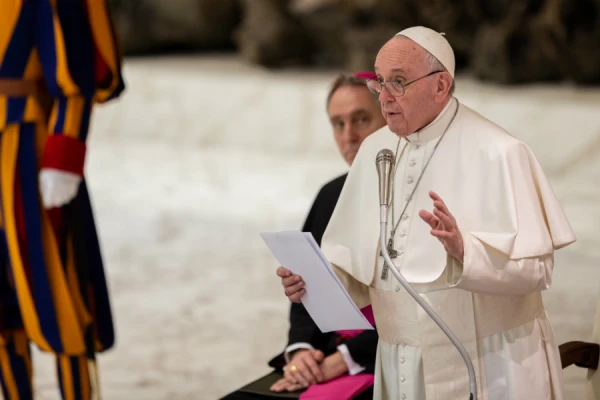
In a prepared text given to participants in the Vatican’s Sala Regia Sept. 23, the pope spoke about communication as a mission of the Church. “No investment is too high for the diffusion of the Word of God,” he said. “At the same time, every ‘talent’ should be well spent, taken advantage of.”

Pope Francis went on to say that “in reality, our strength alone is not enough,” and referenced an address of St. Paul VI in 1964, in which he told the Vatican’s then-social communications department that “a thought of faith must therefore support the smallness of our humble efforts.”

“The more we make ourselves instruments in the hands of God, that is, small and generous, and the more the probability of our efficiency will grow,” Paul VI said.

“We know,” Pope Francis said, “that since then [1964] the challenges in this area have grown exponentially and our forces are never enough. The challenge to which you are called, as Christians and communicators, is really high. And that is why it is beautiful.”

The pope addressed the group of bishops and media professionals at the start of the plenary assembly of the Dicastery for Communications, being held at the Vatican Sept. 23-25.

This is the first plenary assembly of the dicastery since its institution in 2015. In attendance are the officials of the dicastery together with consultors from the international media realm, among whom is EWTN Chairman and Chief Executive Officer Michael P. Warsaw. Catholic News Agency is a service of EWTN.

The pope commented, “I therefore rejoice that the theme chosen for this Assembly is ‘We are members of one another’. Your, our strength lies in unity, in being members of one another. Only so we can better respond to the needs of the Church’s mission.”

In addition to his prepared speech, which was dispersed in written form, Pope Francis gave lengthy impromptu remarks to the assembly, counseling them to have the “signature of testimony” in everything they do.

“If you want to communicate only the truth without goodness and beauty, stop yourselves, do not do it. If you want to communicate a kind of truth, but without involving yourselves, without giving witness to that truth with your very lives, with your very flesh, stop yourselves, do not do it,” the pope said.

He also warned them against falling into an attitude of resignation when confronted by the worldliness of society.

Worldliness is not new to this century, he said, “it was always a danger, it was always a temptation, it was always the enemy”

In this vein, the pope said he has heard people think the Church should close itself off a little, “be a tiny, but authentic Church.”

“That word that gives me an allergy,” he stated. “If something is, it is not necessary to say ‘authentic.’”

The Church should be small “like leaven, small like salt,” he urged. “This is the Christian vocation!”

To think the Church of the future will be a “Church of the elect” is to risk falling into “the heresy of the Essenes,” he said, which is how “Christian authenticity is lost.”

Francis added that “the resignation to cultural defeat… comes from the bad spirit, it does not come from God.”

“Do not be afraid,” he encouraged. “We are few? Yes, but with the desire to ‘missionize,’ to show others who we are. With witness.”

He said he also is a “little allergic” to when people say something is “truly Christian.” “We have fallen into the culture of adjectives and adverbs, and we have forgotten the strength of nouns,” he argued.

“This is the mission of communication: to communicate the reality, without sweetening it with adjectives or adverbs.”

Just say something is “a Christian thing,” he said. It is unnecessary to say something is “authentically Christian.”

The communicator must show the “true, the right, the good, and the beautiful,” he said, and he does this with “the soul and with the body; he communicates with the mind, with the heart, with the hands; you communicate with everything.”

“And it is true that the greatest communication is love: in love there is the fullness of communication: love for God and among us.”

Something those working in Catholic communications should not do is proselytism, the pope said, adding that as “Benedict XVI said with great clarity: ‘The Church does not grow because of proselytism, but because of attraction,’ that is, testimony.”

“And our communication should be testimony.”

Pope Francis concluded by thanking the members of the dicastery for their work, telling them to “communicate the joy of the Gospel: This is what the Lord asks of you today.”

[…]

No Picture
News Briefs

Theologian withdraws from German synodal path

September 21, 2019 CNA Daily News 4

Vatican City, Sep 21, 2019 / 03:08 pm (CNA).- A member of the International Theological Commission has announced that she is no longer available to participate in the “binding synodal path” undertaken by the bishops’ conference of Ger… […]

No Picture
News Briefs

Pope Francis: The Church is a home for the lost

September 21, 2019 CNA Daily News 1

Vatican City, Sep 21, 2019 / 10:59 am (CNA).- No one is lost to Jesus, neither should they be considered lost to the Church and her members, Pope Francis told Catholics in Albano Laziale Saturday.

The pope reflected on the story of Zacchaeus the tax c… […]