No Picture
News Briefs

Married priests are a possible option for the Amazon, says Vatican spokesman

September 20, 2019 CNA Daily News 0

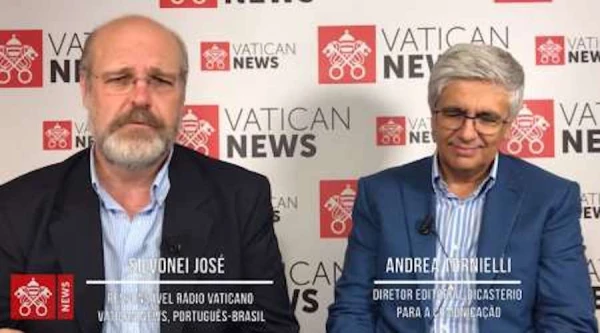
Vatican City, Sep 21, 2019 / 12:00 am (CNA).- Andrea Tornielli, editorial director of the Dicastery for Communications in the Vatican, said that married priests will be a subject of discussion during the upcoming synod of bishops on the Amazon, which will take place October 6-27 in Rome, but noted that the synod does not have the power to make decisions on the matter.

“The synod will discuss the possibility, for territories like the Amazon, to propose the ordination of married men. That is, the ordination of catechists, older persons who already have a role of responsibility in several communities. But it’s not a decision already made, nor is it certain that they synod will arrive at that decision.” Tornielli said in an interview Sept. 19.

“In any case it would not be a decision of the synod but it would be a decision of the pope,” Tornielli said in the interview, which was published on the Facebook page of the Brazilian bishops’ conference.

Tornielli referred to the working document of the synod:

“Affirming that celibacy is a gift for the Church, it is asked, that for the most remote areas of the region, the possibility be studied of priestly ordination for older people, preferably indigenous, respected, and accepted by their community even though they still have a constituted and stable family, for the purpose  of ensuring  the sacraments that accompany and sustain the Christian life,” the working document says.

In the interview, Tornielli explained that “the synod does not approve anything because it is a consultative body, the one who decides is the pope. We know, because we have read it, the synod’s Instrumentum laboris mentions the difficulties that communities in remote areas face in receiving the sacraments, and of having priests who can celebrate Mass.”

He also noted that “for many centuries in the Catholic Church there have been married priests. They are the priests of the Eastern Catholic Churches who have returned to full communion with Rome. But note, it’s not that priests can marry but that persons already married are ordained, this is for the Easterners.”

“The same thing exists, and perhaps this will be a surprise for our listeners, in the Latin Rite Church, as an exception, from the time of Pius XII. Pope Pacelli received former Anglican priests who wanted to enter into communion with Rome and as they were married they were ordained priests and they support their families,” he continued.

Moreover, Tornielli then said, “Pope Benedict himself with the constitution Anglicanorum coetibus has established that this exception can continue in the case of the Anglicans. So there already are exceptions.”

In effect, in 2009 Pope Benedict XVI approved the creation of personal ordinariates, jurisdictions created to receive the Anglicans who request by the thousands to return to full communion with the Catholic Church. In that framework, married Anglican priests can be ordained as Catholic priests.


A version of this story was originally published by ACI Prensa, CNA’s Spanish-language partner. It has been translated and adapted by CNA.


[…]

No Picture
News Briefs

Vatican department heads meet to discuss budget deficit

September 20, 2019 CNA Daily News 1

Vatican City, Sep 20, 2019 / 11:50 am (CNA).- The heads of dicasteries and Vatican City State institutions met Friday to discuss finances and how to reverse a reportedly rapidly growing deficit in the Holy See’s budget.

Matteo Bruni, Holy See press office director, confirmed to CNA that the meeting took place Sept. 20 among heads of dicasteries of the Roman Curia and of institutions connected to the Holy See and Vatican City State.

According to the Wall Street Journal, in May Pope Francis asked Cardinal Reinhard Marx of Munich and Freising, coordinator of the Council for the Economy, which oversees Vatican finances, to convoke the meeting to consider solutions and to “inform the respective heads about the gravity of the situation.”

The Holy See sustained a deficit of roughly 70 million euros ($77 million) in 2018, doubled from the previous year, according to Vatican officials, The Wall Street Journal reports.

The Sept. 20 meeting was intended to increase awareness of the issue among Vatican officials, many of whom are unaware of the gravity of the situation, according to Joseph Zahra, a Maltese economist who is a member of the Council for the Economy.

Zahra also said the Vatican will be releasing a financial report this fall, the first since 2015.

Vatican finances have been one of the major focuses of Pope Francis’ reform efforts, though he has faced serious setbacks.

Efforts began in 2013, with the creation of an investigatory commission to examine the Holy See’s administrative structures. Consisting of seven lay experts, one clerical secretary, and external consultants, the commission met from August 2013 to May 2014.

This work was later overshadowed when, in 2015, two former members of the commission were arrested for stealing and leaking confidential information about Francis’ papacy.

In February 2014, Pope Francis made his first major structural changes to the Roman Curia, establishing the Council for the Economy and the Office of Auditor General, an autonomous office with the power to conduct special investigations.

He also created the Secretariat for the Economy, appointing Cardinal George Pell as prefect, but that office is now vacant, as Pell returend to his home country to defend himself against charges of child sex abuse, of which he was convicted. The cardinal is appealing his conviction.

[…]

No Picture
News Briefs

Pope’s cardinal advisors continue to discuss apostolic constitution

September 19, 2019 CNA Daily News 2

Vatican City, Sep 19, 2019 / 10:14 am (CNA).- Pope Francis’ now six-member Council of Cardinal Advisors met this week to continue work on the forthcoming apostolic constitution, incorporating into the draft suggestions submitted by bishops’ conferences and others during the summer.

According to a brief press release from the Holy See press office Thursday, the council met Sept. 17-19, with a focus on “re-reading and modifying the draft of the new Apostolic Constitution,” which has the provisional title Praedicate evangelium.

“This first rereading, which has come to an end, was a passage of listening and reflection that responds to the indications of the Holy Father in the sense of communion and synodality,” the statement said.

The new constitution has been the advisory group’s key reform project since its establishment in 2013, one month after Pope Francis’ election.

The document is expected to place renewed emphasis on evangelization as the structural priority of the Church’s mission, with some predicting the merger of the Vatican’s Congregation for the Evangelization of Peoples and the Pontifical Council for the Promotion of the New Evangelization into a single larger department.

Praedicate evangelium will replace Pastor bonus, the current apostolic constitution on the Roman Curia promulgated by Pope John Paul II on June 28, 1988, and subsequently modified by both popes Benedict and Francis.

Pope Francis attended the council’s meetings, the advisory group’s 31st, when not in other audiences and appointments. On Wednesday morning the pope held his usual general audience, and Thursday morning he had a full slate of appointments, including with Cardinal Reinhard Marx, Archbishop of Munich and Freising and the coordinator of the Council for the Economy, who is also president of the German bishops’ conference.

The Council of Cardinal Advisors is often referred to informally as the “C9,” although there have been only six members since December 2018, when three of the original members, Cardinals George Pell, Francisco Javier Errazuriz, and Laurent Monsengwo, were removed, ostensibly for reasons of age.

In addition to Marx, the other members of the pope’s advisory council are Cardinals Pietro Parolin, Óscar Andrés Rodríguez Maradiaga, Seán Patrick O’Malley, Giuseppe Bertello and Oswald Gracias.

Bishops Marcello Semeraro and Marco Mellino, the secretary and adjunct secretary of the council, were also present at the meetings this week.

The next round of gatherings will take place Dec. 2-4.

[…]

No Picture
News Briefs

Blood of St. Januarius liquefies on feast day

September 19, 2019 CNA Daily News 0

Naples, Italy, Sep 19, 2019 / 10:06 am (CNA).- The miracle of the liquefiction of the blood of early Church martyr St. Januarius took place Thursday in Naples.

The blood was shown to have liquefied shortly after 10 a.m. during Mass in the Naples’ Cathedral of the Assumption of Mary.

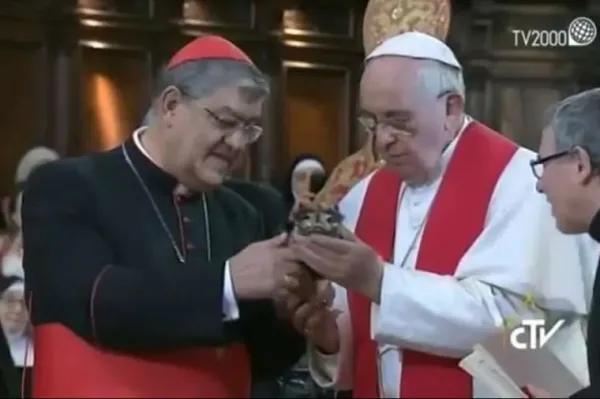
The Mass was celebrated by Cardinal Crescenzio Sepe, Archbishop of Naples, who in his homily, strongly criticized the violent crime of Neapolitan streets.

Despite the city’s recurring miracle, “the evil that the hateful and violent killers commit in Naples is limitless,” he said.” In effect they try to kill at birth just the possibility of making a future…”

This, he noted, generates fear and insecurity, and goes against the common good. 

“We must ask ourselves: does Naples still have a great and sincere heart? Us citizens of today’s Naples have to answer this question with truth, therefore, with realism, with honesty and courageously, without letting ourselves be taken by a false nostalgia of the times we once had,” he stated.

St. Januarius, or San Gennaro in Italian, the patron of Naples, was a bishop of the city in the third century, whose bones and blood are preserved in the cathedral as relics. He is believed to have been martyred during Diocletian persecution.

The reputed miracle is locally known and accepted, though has not been the subject of official Church recognition. The liquefaction reportedly happens at least three times a year: Sept. 19, the saint’s feast day, the Saturday before the first Sunday of May, and Dec. 16, the anniversary of the 1631 eruption of Mount Vesuvius.

During the miracle, the dried, red-colored mass confined to one side of the reliquary becomes blood that covers the entire glass. In local lore, the failure of the blood to liquefy signals war, famine, disease or other disaster.

The blood did not liquefy in December 2016, but Monsignor Vincenzo De Gregorio, abbot of the Chapel of the Treasure of San Gennaro, said it was a sign that Catholics should pray rather than worry about what the lack of miracle could mean.

“We must not think of disasters and calamities. We are men of faith and we must pray,” he said at the time.

The vial has sometimes changed upon the visit of a pope.

On March 21, 2015, Pope Francis met with priests, religious and seminarians at the cathedral and gave a blessing with the relic.

Sepe then received the vial back from the pope and noted that the blood had partially liquefied.

The last time blood liquefied in the presence of a pope was in 1848 when Bl. Pius IX visited. The phenomenon didn’t happen when St. John Paul II visited the city in October 1979, or when Benedict XVI visited in October 2007.


[…]

No Picture
News Briefs

A new book from a Vatican journalist, for Vatican journalists

September 18, 2019 CNA Daily News 1

Vatican City, Sep 19, 2019 / 12:00 am (CNA).- A book on papal communication aims to connect the history of the Vatican’s communications office with the theology of the Second Vatican Council.

“I welcomed this publication with great pleasure,” Alessandro Gisotti, deputy editorial director at Vatican Media, during a September launch event for “Anche i Papi comunicano,” – “The popes also communicate.”

 “I believe it is also a sign of gratitude to all the colleagues who accompanied me during the months in which I held the position of director of the Press Room. I was part of this story and now that it has been dedicated to Navarro Valls the Press Room is even more the home of journalists,” Gisotti added, according to a report from Vatican Media.

The book is authored by Veronica Giacometti, an editor at Italian news agency ACI Stampa and a former intern at Radio Vaticano. ACI Stampa is CNA’s Italian-language partner agency.

Gisotti said the book is important because it connects contemporary Catholic communicators to the Church’s tradition.

“Tradition means transmitting knowledge, it is important that Vatican experts know how popes have communicated in recent decades,” he said.

“Popes communicate first of all with their presence. A president, if he does not act, is thought not exist. But the pope exists and communicates as Peter’s successor, he is the message itself, therefore political categories cannot be applied to his communication,” Gisotti said.

Giacometti told Vatican Media that she wrote the book to be a resource to Vatican journalists.

This book can be a working tool. It contains basic information (for Vatican journalists.) For example, what is a bolletino, how is the press office structured,” among other questions, she said.

Giacometti said she aimed to put the traditions of Vatican journalists on paper.

Alan Holdren, director of EWTN’s Rome office, and long-time Vatican journalist, also spoke at the launch event.

“I think all of us feel this need to know where we have come from. I have been here for 10 years, my first days of journalism at the Vatican were right in the Vatican’s press room. I spent a year and a half there, every day of the week, to report the facts about the pope. The press room for us is a meeting point, a welcome point, a point of information that is essential to carry out our profession,” Holdren said.


[…]